




Fitzroy Minerals Returns 384-Metre Copper Intercept at Buen Retiro


Fitzroy Minerals reports a 384-metre copper intercept at Buen Retiro in Chile, with infill drilling and metallurgical test work underway ahead of a maiden resource and prefeasibility study.
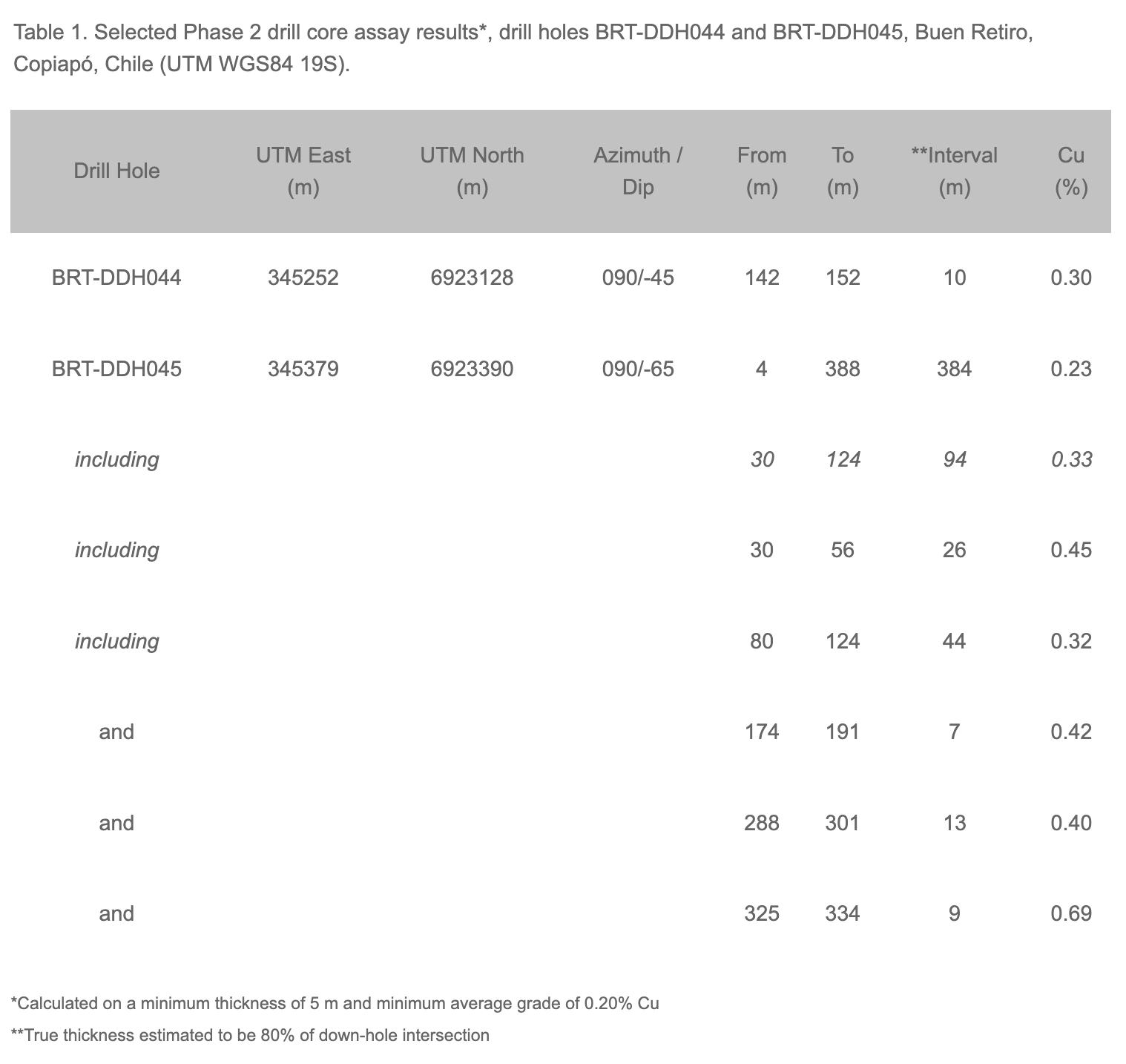
- Fitzroy Minerals has reported a drill hole intersecting 384 metres grading 0.23% copper from 4 metres depth, including 94 metres at 0.33% copper from 30 metres, at the Buen Retiro copper project in northern Chile.
- The intercept comprises two distinct mineralisation styles, a stockwork zone transitioning into a stratiform system, with consistent chalcopyrite mineralisation throughout, extending a sulphide trend identified in the North area of the property.
- The company's presentation draws direct geological comparisons between Buen Retiro and the Candelaria mine, showing analogous mineralisation styles across both properties.
- Infill drilling of approximately 6,000 metres is underway ahead of a maiden mineral resource estimate (MRE), with heap-leach metallurgical testwork at SGS Laboratories.
- Concurrent with the drill results, Fitzroy raised C$21.1 million, bringing its treasury to approximately C$29 million and enabling the company to advance the project independently of any clawback from Pucobre.
Buen Retiro Extends Its Footprint
Fitzroy Minerals released drill results from its Buen Retiro copper project in northern Chile on 20 March 2026, reporting a 384-metre intercept grading 0.23% copper, backed by an independent geological assessment that supports the interpretation of a significant copper system in the region. The result comes during an active infill drilling campaign targeting a maiden mineral resource estimate ahead of a prefeasibility study (PFS) for the heap-leach development pathway. It is a confirmation of a major copper system supported by coincident geophysical anomalies, but the project's most consequential tests, resource definition and metallurgical validation, remain ahead.
What the Headline Intercept Shows
The headline intercept of 384 metres at 0.23% copper from 4 metres is notable primarily for its continuity rather than its grade. Copper mineralisation in the form of chalcopyrite was consistent throughout the hole, with higher-grade intervals including 94 metres at 0.33% copper from 30 metres, which itself includes 26 metres at 0.45% copper, 44 metres at 0.32% copper from 80 metres and 9 metres at 0.69% copper from 325 metres. True thickness is estimated at approximately 80% of the downhole intersection.
The geological significance lies in the transition of the hole records. The first 100 metres intersected a stockwork zone intercalated with minor breccias from the start of fresh rock at 4 metres. The hole then transitioned into a stratiform system for a further 284 metres. The company has described this as Candelaria-style mineralisation, a reference to the Lundin Mining-operated Candelaria mine located nearby in the Copiapó region, which carries an open-pit measured and indicated resource of 591.6 million tonnes grading 0.37% copper and 0.09 grams per tonne gold, largely hosted in the Upper Pucobre Formation.
By contrast, a second hole reported in the same release intersected a series of lower-grade intervals, with the best result being 10 metres at 0.30% copper from 142 metres. The contrast between the two holes illustrates the variability that infill drilling is designed to resolve.
The Candelaria Comparison: Geological Context and Caveats
The Candelaria analogy is the most consequential geological claim in Fitzroy's current narrative, and it carries both weight and qualification.
Weight, because it is not solely a management assertion. The company's presentation draws direct core photograph comparisons between the two deposits, showing similar hematite stockwork, coarse chalcopyrite, hematite breccia, and calcite-specularite-chalcopyrite assemblages across both properties, hosted in the Upper Pucobre Formation.
Qualification, because the project's qualified person under NI 43-101, Dr. Scott Jobin-Bevans, has explicitly stated that the Candelaria-style mineralisation described has not been independently verified and is not necessarily indicative of the mineralisation on the Buen Retiro property. That distinction matters: the geological analogy informs the exploration thesis but does not constitute resource classification or a validated deposit model.
What the comparison does provide is a conceptual framework for depth potential. Most of the underground Candelaria resource sits in the Lower Pucobre Formation. Buen Retiro drilling to date has been focused on the Upper Pucobre Formation. A major induced polarisation (IP) anomaly has been identified at depth at Buen Retiro and remains open.
How the New Result Fits the Broader Drilling Picture
Earlier drilling at Buen Retiro has returned results, including 110 metres at 1.94% copper and 135 metres at 0.73% copper, which anchored the heap-leach PFS case in the Southwest area of the property. Mineralisation has been identified continuously over more than 1,700 metres in the South and Southwest areas, with the North area, where the latest hole was drilled, now extending the system approximately 1 kilometre north of the historical Manto Negro Mine open pit.
The dual character of Buen Retiro, often framed by the company as "two projects in one", is central to understanding the current programme. The company is simultaneously pursuing two distinct objectives: infill drilling to support a maiden resource estimate for the near-term heap leach development pathway, and exploration drilling targeting the deeper sulphide system. The latest result advances the second of those objectives. It is an exploration hole that builds the geological case, not an infill hole that directly supports resource definition. Supported by its expanded treasury, the company is now scaling up its exploration footprint.
President and Chief Executive Officer of Fitzroy Minerals, Merlin Marr-Johnson, outlined the revised scope of the 2026 programme:
"We can expect that we're going to probably end up drilling above 15,000 meters, it could be 20,000 meters this year, it could be 25,000 meters this year, and remember that'll be at the cost of 10% of the total spend."
Whether that translates into resource tonnes at economic grades is what this expanded drill programme will determine.
The Pucobre Partnership and What It Changes
Pucobre is the only primary copper producer listed on the Santiago Stock Exchange, with a market capitalisation of approximately US$2.5 billion. Its Planta Biocobre facility is located near Buen Retiro and has grandfathered permitting. Pucobre previously operated the historical mine at the site.
For Fitzroy, access to Pucobre's existing infrastructure eliminates the need to build a sulfuric acid processing facility from scratch, reducing both upfront capital costs and the permitting burden associated with a new build. The heap leach joint venture, subject to a letter of intent from Pucobre, is being structured on an open-book basis using Pucobre's actual operating costs from the area, which management expects will yield a PFS close to the FS standard.
Pucobre holds a clawback option to acquire 30% of the project, exercisable at the second quarter of 2027 when Fitzroy is expected to gain full title. The cost of that clawback is 90% of all eligible expenditure to date. Following a C$21.1 million capital raise announced concurrently with the drill results, Fitzroy's treasury now stands at approximately C$29 million buffer, even after funding the expanded 12-month work programme.
Marr-Johnson confirmed:
"With the extra capital, we have the ability to trigger the option exercise independent of any clawback that we might get from Pucobre."
While Pucobre's clawback would still bring an experienced Chilean operator into the joint venture, it is no longer a financial prerequisite for Fitzroy to maintain project momentum.
What to Watch Next
Several milestones over the coming months will determine whether Buen Retiro's development trajectory maintains its current pace.
- Metallurgical baseline: Results from the SGS heap leach test work will establish whether the oxide mineralisation processes at commercially viable recovery rates, a prerequisite for the PFS economics.
- Maiden resource estimate: Pending assay results from the approximately 6,000-metre infill drilling programme targeted for completion in April 2026, will feed directly into the maiden mineral resource estimate and determine the resource classification and confidence level underpinning the PFS.
- Sulphide targeting: Phase 1 Ambient Noise Tomography survey findings will either support or complicate the Candelaria analogy and define targets for the deeper drilling programme.
- Financial validation: Delivery of the initial PFS targeted for the first quarter of 2027, and whether Pucobre exercises its clawback option at that point, will represent the first formal economic assessment of the heap leach project.
Analyst's Notes





Subscribe to Our Channel






.png)

Stay Informed


