




Selkirk Copper Has Moved Past Discovery: What Phase 2 Actually Changes About Restart Risk


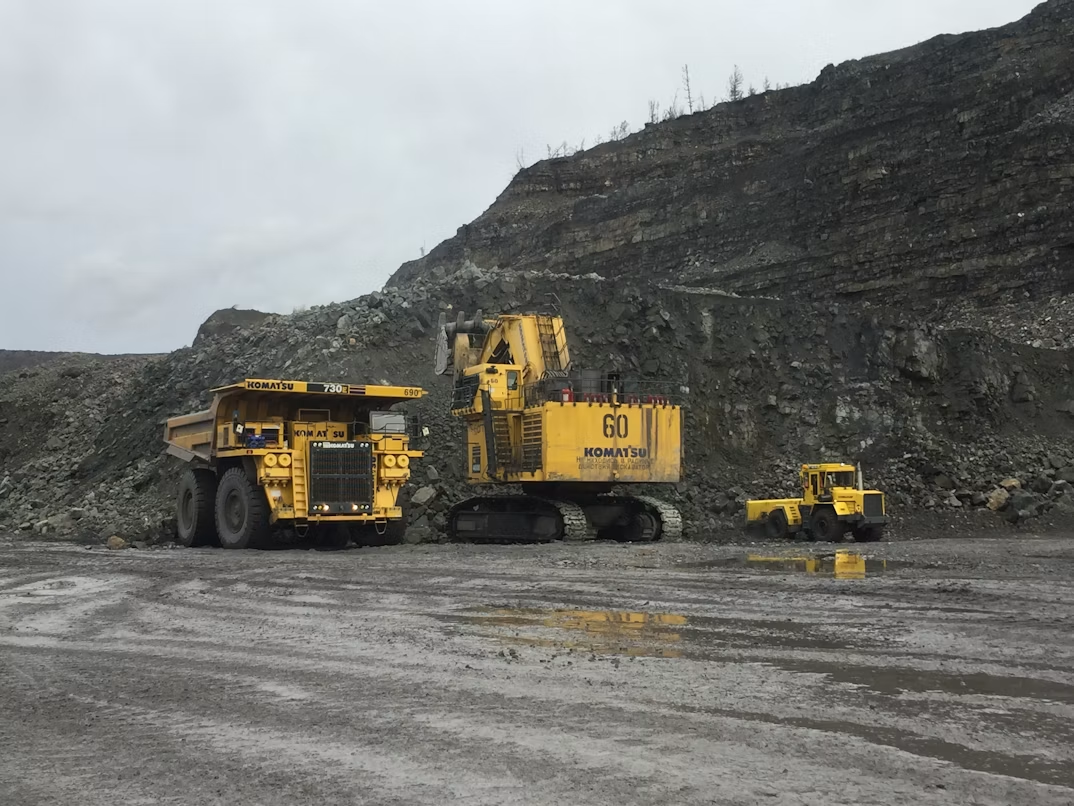
Selkirk Copper’s Phase 2 at Minto shifts from discovery to engineering, advancing feasibility studies, restart planning, and potential 2028 production.
- Selkirk Copper Mines launched Phase 2 of its Minto deposit drill programme in May 2026, targeting a total of 50,000 metres.
- Phase 2 adds geotechnical drilling and geometallurgical data collection to its scope for the first time, objectives designed to generate engineering inputs for the planned Feasibility Study (FS) rather than advance exploration.
- SRK Consulting (Canada) Inc. and Hatch Ltd. have been awarded engineering work packages covering rock mechanics evaluation, water and waste management, mineral processing, infrastructure, and mining.
- The Minto site carries over $330 million in existing infrastructure, and the 2023 bankruptcy of the previous operator, Minto Metals, cleared prior financial encumbrances, including a precious metals stream and a concentrate offtake agreement.
- The study sequence targets a Trade-Off study and Preliminary Economic Assessment (PEA) for mid-2026, an FS for mid-2027, and a Final Investment Decision (FID) in mid-2027, with potential first production by mid-2028.
What Has Happened
Selkirk Copper Mines (TSX-V: SCMI | OTCQB: SKRKF | FRA: IO20) commenced Phase 2 of its drill programme at the Minto deposit in May 2026, targeting 50,000 metres across the programme's full duration. The programme's scope distinguishes it from Phase 1: alongside resource expansion and infill drilling, Phase 2 explicitly includes geotechnical drilling and geometallurgical data collection, objectives absent from the preceding programme. The stated purpose is to collect all required information for a planned Feasibility Study (FS), increase resource confidence, and advance integrated mine planning. In the programme's first month, 14,000 metres were completed across 59 holes, representing 28% of the planned total.
Phase 1 vs. Phase 2: Scope Comparison
Phase 1 ran from August 2025 to April 2026, completing 52,288 metres of diamond drilling across 175 holes. Its objectives were organised around discovery and expansion: expanding known mineralised zones, identifying higher-grade intervals within them, discovering new mineralised lenses, testing high-quality exploration targets, and upgrading existing Inferred and Indicated Resources. The high-grade Minto North West zone expanded by approximately 90% during Phase 1, and two new lenses were confirmed at depth: the 117 Lens beneath the Area 2 Pit and the 301 Lens beneath Area 118. Phase 1 was designed as a geological programme, and that is what it produced.
Phase 2 is built around a different purpose. Where Phase 1 was designed to characterise what the deposit contains, Phase 2 is designed to answer what it takes to mine it. Infill drilling tightens resource confidence and supports updated resource definition, while geotechnical drilling provides engineering data for mine planning, and geometallurgical collection informs processing models. Integrated mine planning and economic studies are explicit programme outputs rather than downstream deliverables. The combined effect is a programme that addresses geology and engineering simultaneously rather than in sequence.
Daily drill productivity has also improved. Four active drills in Phase 2 are averaging 120 metres per day each, compared with 94 metres per day during Phase 1. The higher output per drill translates to faster data acquisition across the programme's 50,000-metre scope.
Geotechnical & Geometallurgical Drilling: From Characterisation to Mine Design
Geotechnical and geometallurgical drilling are engineering activities, not exploratory ones. Both generate the quantified inputs that mine design, processing modelling, and cost estimation require. At Minto, geotechnical work draws on structural models developed from drilling and oriented core measurements, which provide the analytical framework for geotechnical design. SRK Consulting (Canada) Inc. has been awarded engineering work packages covering rock mechanics, geotechnical design, and water and waste management for the Trade-Off and Preliminary Economic Assessment (PEA) studies.
Geometallurgical data collection runs alongside geotechnical work. It serves a specific FS function: linking the ore's physical characteristics directly to the processing and infrastructure design inputs required by the study. Geologists and metallurgists are actively sharing information as a feedback mechanism to inform downstream processing and mine planning decisions. Hatch Ltd. has been awarded engineering work packages covering mineral processing, infrastructure, and mining.
The outputs from SRK Consulting and Hatch feed directly into the Trade-Off study and PEA targeted for mid-2026, which will be informed by the completed Phase 1 drill programme. The current Phase 2 drilling programme will then serve as the primary engineering data source for the subsequent Feasibility Study's mine design and processing assumptions.
Existing Infrastructure & the Restart Thesis
The Minto site has over $330 million in existing infrastructure: a 4,100-tonne-per-day mill, open-pit and underground workings, a tailings management facility, a 400-person camp, a water treatment plant, road access, and grid power. The previous operator, Minto Metals, ceased operations and entered bankruptcy in May 2023. The bankruptcy process cleared prior financial encumbrances attached to the asset, including a precious metals stream and a concentrate offtake agreement. The cleared encumbrances remove obligations that would otherwise apply to the site's future production.
President and Chief Executive Officer of Selkirk Copper Mines, M. Colin Joudrie, views Minto's existing infrastructure as a key advantage in reducing restart capital requirements:
"So, when you're envisioning these sorts of things and thinking about how to make money, the best way to do it is not to spend money on the stuff that doesn't make money. And so, in this particular instance, we don't have to build a power line, we don't have to build a road, we don't have to build the above-ground facility."
Under previous owners, the Minto site historically produced up to 30,000 tonnes of copper per year alongside 35,000 ounces of gold and 350,000 ounces of silver. That production record demonstrates the site's prior operating capacity. The FS pathway applies to an asset with a documented track record of processing ore at production scale, rather than one where the performance of the infrastructure under operating conditions is entirely untested.
Broader Context: Copper Belt Setting & Resource Position
The Minto deposit sits in central Yukon, 250 kilometres north of Whitehorse on the Klondike Highway, within the Minto-Carmacks copper belt. The deposit comprises over 85 structurally disrupted lenses of chalcopyrite-bornite-magnetite-bearing schist hosting copper-gold-silver mineralisation with almost no pyrite. Geologically, it has been characterised as resembling a strongly metamorphosed calc-alkaline porphyry or iron-oxide-copper-gold-like deposit.
Joudrie frames the FS as grounded in proven resource, not speculative exploration outcomes:
"Underpinning that we have a good resource position on which to build. We're not having to go and make heroic assumptions around exploration success, etc."
The current resource, effective 7 April 2025, comprises 12.588 million Indicated tonnes at 1.20% copper, 0.46 grams per tonne gold, and 4.27 grams per tonne silver, containing 333.8 million pounds of copper. The Inferred resource adds 23.658 million tonnes at 1.05% copper, 0.387 grams per tonne gold, and 3.90 grams per tonne silver, containing 546.8 million pounds of copper. The property covers 26,850 hectares in total, and only 3 kilometres of a 7-kilometre mineralised trend within the licensed mine area has been explored to date.
What to Watch Next
The near-term study sequence begins with a Trade-Off study and PEA targeted for completion in mid-2026, followed by an FS planned for mid-2027 and an anticipated Final Investment Decision (FID) in mid-2027. Potential first production is projected for mid-2028. Both the Trade-Off study and the FS will rely on updated, property-wide resource models, mine plans, and permitting strategies to establish the detailed capital and operating cost estimates on which a restart decision would be based. The sequential structure means that each study phase builds on the outputs of the preceding one: Phase 1's data collection feeds the Trade-Off study and PEA, which then informs the scope and assumptions of the Feasibility Study, which will ultimately be underpinned by Phase 2 drilling.
The company's stated approach to that sequence reflects a preference for thoroughness over pace.
"Our approach is measure twice, cut once. We're not in this business to undercut the viability of this thing going forward because we missed a permit, we missed an understanding around technical issues in the underground, etc."
The Trade-Off study and PEA, due in mid-2026, represent the first external checkpoint on the updated economics of the Minto Project. The Feasibility Study and FID that follow will determine whether Phase 2's transition from exploration to engineering data collection has produced sufficient definition to support a mine restart.
FAQs (AI-Generated)
Analyst's Notes





Subscribe to Our Channel








.jpg)
Stay Informed


