




From Discovery to Delivery: Cabral Gold Moves Into a Higher-Stakes Execution Phase


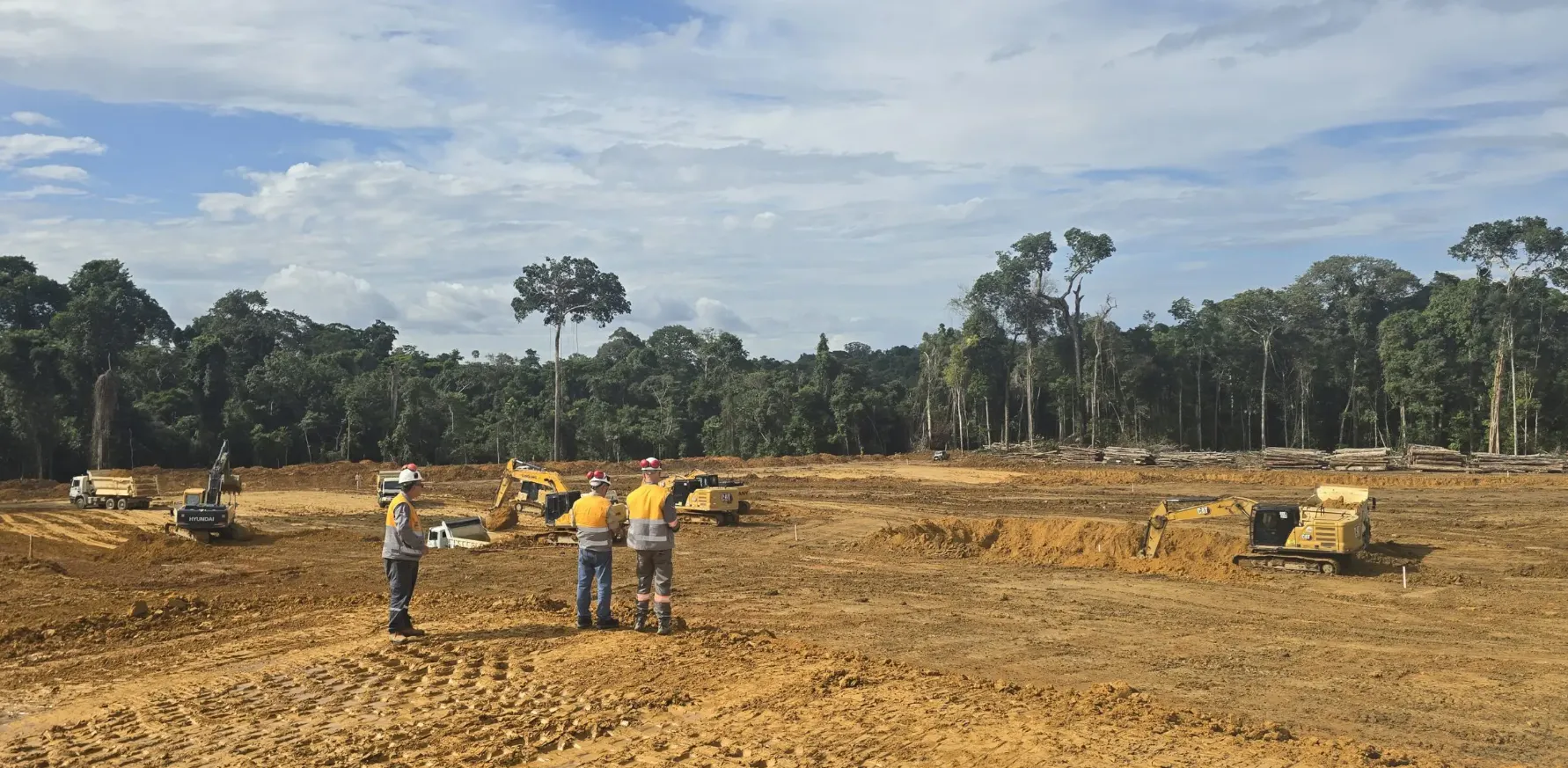
Cabral Gold enters the execution phase as Phase 1 build nears completion, shifting focus from geology to construction, commissioning, and delivery risk.
- Phase 1 heap leach project is 70% complete, on budget and on schedule, with critical equipment in transit ahead of schedule and plant commissioning brought forward to June 2026.
- Wet-season earthworks completed in April 2026, closing the highest-risk construction phase with site productivity meeting or exceeding conservative PFS assumptions.
- Phase 1 models 113,155 ounces over 6.2 years at US$1,210 per ounce all-in sustaining costs (AISC), fully funded by a US$45 million gold loan requiring 39 kilograms of gold quarterly from March 2027.
- The Licença Prévia (LP) granted on March 10, 2026, removes the 500,000 tonne per annum cap and provides a regulatory foundation for Phase 2 development of 1.2 million ounces in existing resources plus four new discoveries, including bonanza grades at Jerimum Cima (9.5 metres at 87.4 grams per tonne gold).
- Cuiú Cuiú's 2 million ounce historical placer gold production is 10 times Tocantinzinho's output, with a 7-kilometre soil anomaly versus 1 kilometre suggesting a larger hard rock mineralising system.
What Has Happened
Cabral Gold (TSXV: CBR | OTCQX: CBGZF | FRA: C3J) has spent the last year transitioning from a gold district explorer to a near-term producer, and the April 29, 2026, construction update marks the inflexion where geological and permitting milestones convert into infrastructure, procurement schedules, and equipment delivery timelines. The Phase 1 gold-in-oxide heap leach project at Cuiú Cuiú is now 70% complete, remains on budget and on schedule for commissioning in the Third Quarter of 2026 and commercial production in the Fourth Quarter of 2026, with 85% of project costs committed under contract and critical equipment, including the Adsorption, Desorption and Recovery (ADR) plant and mineral sizer in maritime transit ahead of schedule.
The update confirms that the earthworks phase, the highest-risk segment of the build during the wet season, is complete with concrete foundations in place and plant erection underway. The construction progress supports the broader staged development strategy: Phase 1 is designed to generate near-term cash flow from low-capital, free-digging oxide material to fund aggressive exploration across a district where historical placer gold production totalled 2 million ounces, 10 times the output from the adjacent Tocantinzinho deposit.
Wet Season Earthworks Complete, Commissioning Brought Forward
The completion of major earthworks and civil foundations in April 2026 closes the ground preparation phase and marks the transition to plant erection and equipment installation. This milestone is significant because earthmoving during the wet season (January to April) was identified as the primary schedule risk.
President and Chief Executive Officer of Cabral Gold, Alan Carter, noted:
“We're on budget, and we're on schedule. I'm pretty proud of the team because we're just coming to the end of the rainy season. We've lost a few days through wet weather. We knew we would. We anticipated that. We built that into the schedule. But still, there were risks around moving millions of tonnes of earth during the wet season."
The successful navigation of wet-season earthworks has two implications. First, it confirms that site productivity during difficult weather conditions met or exceeded the conservative assumptions built into the July 2025 Pre-Feasibility Study (PFS), which management suggested may lead to productivity levels exceeding the conservative metrics of the Updated PFS. Second, it de-risks the commissioning timeline, with plant commissioning now brought forward to June 2026 from the original Third Quarter target, adopting an "as early as possible" approach that provides additional flexibility ahead of planned commercial production in early Fourth Quarter 2026. The company has engaged Strategic Metallurgy Pty Ltd to oversee commissioning of the processing plant, with Como Engineering retaining responsibility for final on-site commissioning of the ADR plant.
Procurement Complete, Critical Equipment in Transit Ahead of Schedule
Procurement of all major plant equipment is now complete, with all items required to commence erection on site and available to the construction team. The ADR plant, fabricated by Como Engineering in Perth, was dry commissioned in stages before being disassembled and packed in shipping containers. The containers are expected to arrive in Brazil ahead of schedule in late May 2026. Components of the mineral sizer sourced from Germany are expected to arrive in Brazil in early May 2026, with the last components due to arrive on May 5. All steel structures and components required for the conveyor systems are now on site, as are the materials required to commence construction of the heap leach pads and water management ponds, including high-density polyethylene (HDPE) pipes and liners.
Long-lead equipment delivery has historically been the constraint that causes delays in junior mine construction schedules. The fact that critical equipment is in transit ahead of schedule reduces commissioning risk and supports the company's decision to advance plant commissioning to June 2026.
Phase 1 Economics: Low-Capital Oxide Mining to Fund District Exploration
The Phase 1 project is designed to process 3,000 tonnes per day of near-surface gold-in-oxide material from the MG, Central, and Machichie deposits, with a life-of-mine (LOM) strip ratio of 0.78 waste-to-ore. The PFS models LOM gold production of 113,155 ounces over 6.2 years, with average annual production of 25,000 ounces during the initial two years and LOM all-in sustaining costs (AISC) of US$1,210 per ounce. The oxide material consists of soils, sediments, and weathered bedrock (saprolite) within 60 metres of surface. This material is free-digging, eliminating the need for drilling, blasting, crushing, or grinding, and heap leach column tests demonstrated gold recoveries between 72.5% and 96%, establishing an 88% recovery assumption for the PFS.
The processing simplicity and low capital intensity are deliberate design choices: the project is intended to generate near-term cash flow to fund exploration and resource expansion across the district, deliberately avoiding dilutive equity financings. The Phase 1 project is fully funded by a US$45 million gold loan closed in November 2025 with Precious Metals Yield Fund, an affiliate of Phoenix Gold Fund, the company's largest institutional shareholder. The loan carries a 10% interest rate and mandates principal payments of 39 kilograms of fine gold per quarter beginning March 31, 2027.
LP for Full Mining License De-Risks Phase 2 Expansion Pathway
The granting of the Licença Prévia (LP) for the Full Mining License on March 10, 2026, is the most significant permitting milestone in the Brazilian mine licensing process and applies to both the Phase 1 gold-in-oxide project and the subsequent Phase 2 hard rock expansion. The LP process, which started in 2018, is the most complex and time-intensive stage of Brazilian permitting, and its completion materially de-risks the project and enhances long-term value potential by providing a pathway for the much larger Phase 2 project.
As Carter stated:
"Getting the LP that we announced a couple of weeks ago is a very significant step. It is the most important step in the whole mine permitting process in Brazil."
The Phase 1 project is being built under trial mining licenses capped at 500,000 tonnes per annum (approximately 1,500 tonnes per day), half the PFS design capacity of 3,000 tonnes per day. The full mining license removes this throughput constraint and allows expansion to design capacity and beyond. More importantly, the LP applies to the hard rock resources at Cuiú Cuiú, which currently contain Indicated resources of 12.29 million tonnes at 1.14 grams per tonne gold (450,200 ounces) and Inferred resources of 13.63 million tonnes at 1.04 grams per tonne gold (455,100 ounces), providing the regulatory foundation for Phase 2 development targeting hard rock mineralisation.
Bonanza Grades at Jerimum Cima Signal High-Grade Structural Controls
Three rigs are currently drilling at Jerimum Cima, between Central and PDM, and at MG. The company announced on March 12, 2026, that drilling at the Jerimum Cima target returned 9.5 metres at 87.4 grams per tonne gold from 173.8 metres depth, including 2.9 metres at 285.5 grams per tonne gold, the highest grade hole drilled at Cuiú Cuiú. This result is probably the same zone intersected by previous holes, which returned 45.6 metres at 4.5 grams per tonne gold and 9.5 metres at 5.74 grams per tonne gold, including 3.6 metres at 13.9 grams per tonne gold, suggesting a high-grade structural intersection at the core of the Jerimum Cima system.
The last global resource estimate was completed in September 2022 and totalled 1.2 million ounces across the Central, MG, and JB deposits. Since then, the company has drilled 35,000 metres and made four hard rock discoveries at PDM, Machichie Main, Jerimum Cima, and Machichie Northeast. At Machichie Northeast, recent drilling returned 12 metres at 27.7 grams per tonne gold, including 5 metres at 65.5 grams per tonne gold, and 11 metres at 33 grams per tonne gold, including 4 metres at 89.3 grams per tonne gold. Updated resource estimates for MG, alongside maiden resources for PDM and Machichie, are expected in the second half of 2026.
District Scale: 10 Times the Placer Gold Output of Tocantinzinho
The Cuiú Cuiú project is located immediately northwest of GMining Ventures' Tocantinzinho gold mine, which entered commercial production in September 2024 and is the third largest gold mine in Brazil, producing just under 180,000 ounces per year. The two properties are contiguous, share the same geological structure and host rock, and are both located on the Tocantinzinho lineament within the Tapajós Gold Province, which was the site of the world's largest ever gold rush in the 1980s when an estimated 30 to 50 million ounces of placer gold were recovered between 1978 and 1995 according to the Agência Nacional de Mineração (ANM), Brazil's National Mining Agency.
The critical difference in district scale is placer gold production: Cuiú Cuiú historically produced 2 million ounces of placer gold, while Tocantinzinho produced 200,000 ounces, a 10:1 ratio.
Carter explained the significance of this:
"I was involved in the discovery of Tocantinzinho 20 years ago. When we initially identified Tocantinzinho, we did a soil survey, and we got a soil anomaly which is about a kilometre across. Well, the equivalent soil anomaly at Cuiú Cuiú is 7 km across and open. So, we have multiple deposits here as well."
The placer gold footprint is a proxy for the scale of hard rock mineralisation feeding the drainage systems, and the 7-kilometre soil anomaly at Cuiú Cuiú compared to the 1-kilometre anomaly at Tocantinzinho suggests a larger and more distributed mineralising system.
What to Watch Next
The construction timeline is now tightly defined: plant commissioning Phase 1 commences in June 2026, Phase 2 commissioning follows later in the Third Quarter, and commercial production is targeted for early Fourth Quarter 2026. Monthly construction updates will reveal any deviation from the on-budget, on-schedule narrative, particularly on equipment delivery timelines and progress on plant erection and heap leach pad construction.
Resource expansion drilling is ongoing with three rigs operating. Pending drill results from Jerimum Cima will clarify the size and continuity of the high-grade zone, and updated resource estimates for MG, PDM, and Machichie expected in the second half of 2026 will quantify tonnage and grade additions from 35,000 metres of drilling completed since September 2022. The Phase 2 development pathway depends on demonstrating hard rock resource viability through a Preliminary Economic Assessment (PEA) targeted for 2027. The execution variables that matter most over the next six months are commissioning success (particularly pregnant solution tenor and carbon column performance), mining productivity relative to PFS assumptions, and the pace of resource expansion drilling results from Jerimum Cima, PDM, and Machichie.
FAQs (AI-generated)
Analyst's Notes





Subscribe to Our Channel




.jpg)
Stay Informed






















