




Group Eleven Extends Ballywire High-Grade Strike 17% as Southwest Trend Takes Shape


Group Eleven (TSXV:ZNG) extends Ballywire high-grade zinc-silver strike 17%, with copper-silver below and 16 holes underway on a funded 70,000m programme.
- Group Eleven has extended Ballywire’s high-grade strike by about 17%, with both step-outs hitting high-grade zinc-lead-silver in untested ground.
- Copper-silver mineralisation beneath the zinc in both step-outs supports the stacked two-horizon model behind the 24x framework.
- The company is funded for a four-rig programme of about 70,000 metres, with C$16.2 million cash at 30 June 2026 and Glencore as a 12.8% shareholder.
- Sixteen holes are in progress, and drilling towards the B anomaly is the next real test of whether the discovery repeats along the trend.
- Catalysts include 12 to 18-month wait for MRE decision, metallurgical testworks, and untested parallel trend which are further open on the southwest trend and the main zones.
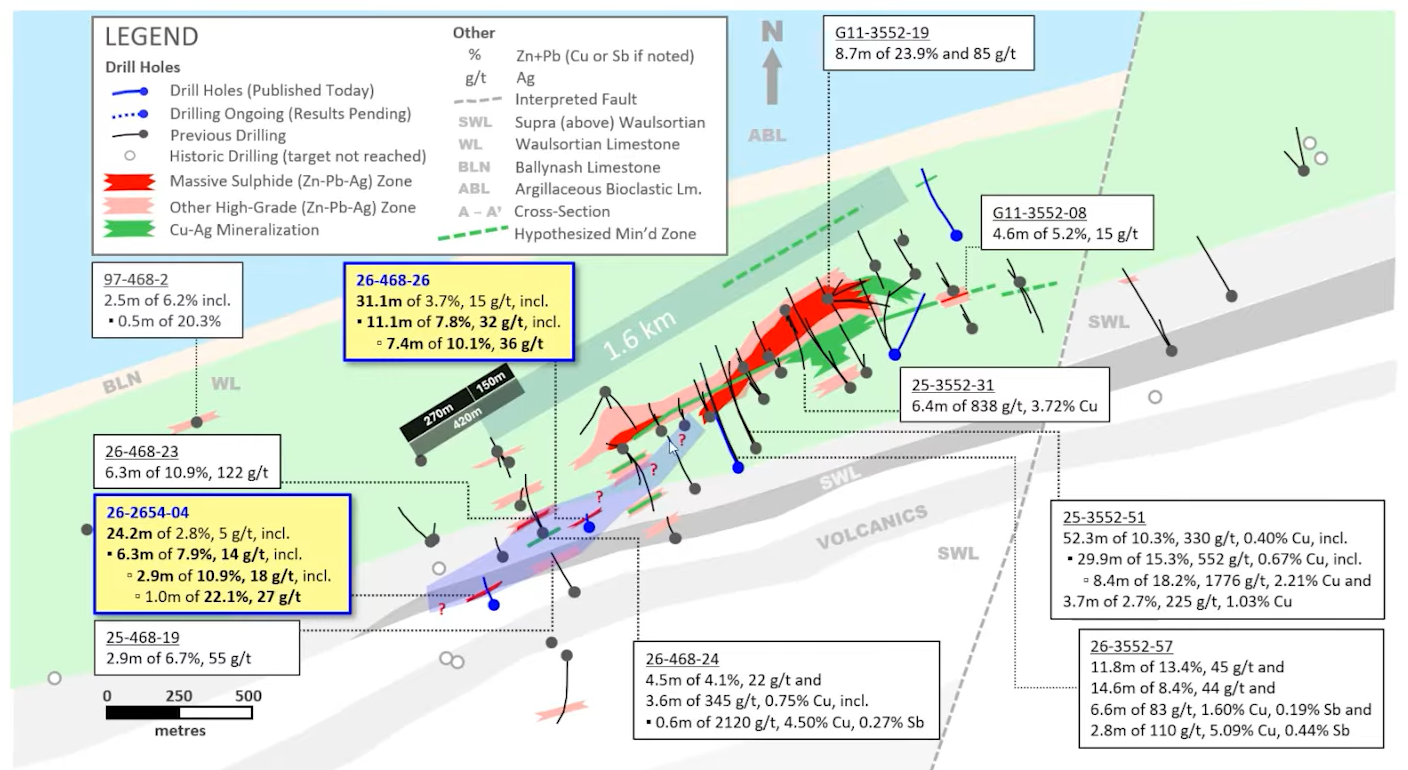
Ireland has a long record as one of the world’s most productive zinc districts, yet significant new discoveries in the country have been rare for more than a decade. Group Eleven Resources Corp. (TSXV:ZNG) is drilling one of them. Its Ballywire discovery lies about 20 kilometres from Glencore’s Pallas Green deposit and the company’s own Stonepark deposit. The latest five holes extend the strike of Ballywire’s high-grade zone by 270 metres, from roughly 1,600 metres to around 1,870 metres, an increase of about 17%. CEO and co-founder Bart Jaworski said the results add two significant pierce points to the company’s thesis that mineralisation continues to the southwest.
Two Step-Outs Into Untested Ground
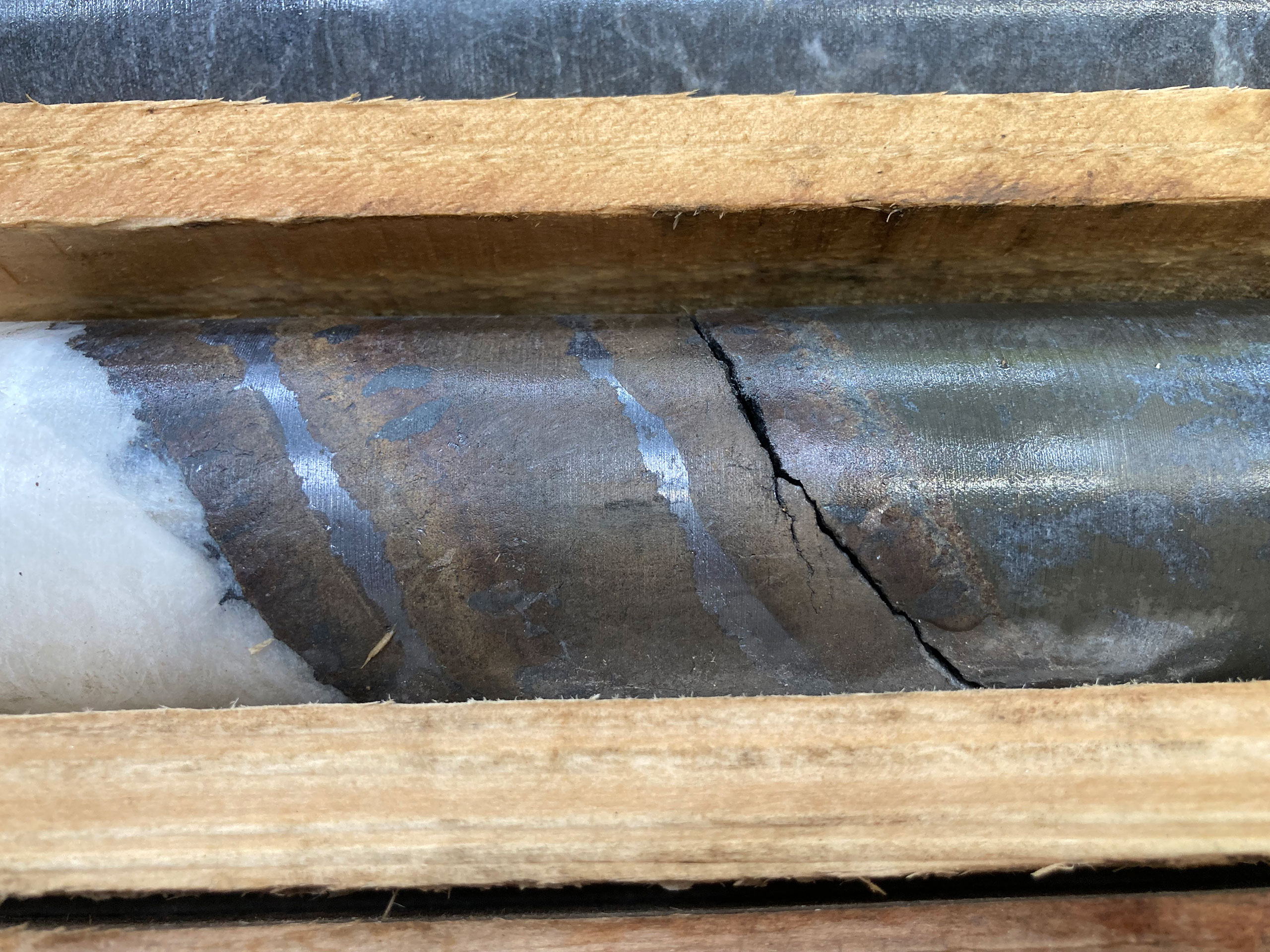
The first step-out was drilled on a fence with no previous holes. It cut a 24-metre mineralised zone in the Waulsortian Limestone, the main target horizon. That zone included about 6.3 metres of 7.9% zinc-lead and 14 g/t silver. The hole continued below the limestone and intersected copper-silver mineralisation. Three follow-up holes are in progress on the section.
The second step-out lies 420 metres from the first, returned 7.4 metres of nearly 10.1% zinc-lead with 36 g/t silver. The rods became stuck at 421 metres in poor ground and the hole was abandoned. Before that point it had entered the top of a copper-silver zone grading up to 92 g/t silver. Two further holes are drilling on this section.
Interview with Bart Jaworski, CEO of Group Eleven Resources
A Southwest Trend Gaining Definition
The southwest corridor came into focus in March, when a hole returned 6.3 metres of 10.9% zinc-lead and 122 g/t silver. The new holes step out from that result in both directions. Jaworski said the southwest zone is now significantly de-risked, although more work is required. How it connects to the main zone has yet to be determined. Sixteen holes are currently in progress, concentrated along the southwest corridor, with further step-outs planned towards the northeast.
A Hybrid Deposit Model
Ireland’s producing zinc mines have been carbonate-hosted deposits. Copper-silver systems have historically been confined to the southwest of the country. Ballywire contains both, stacked one above the other. The closest analogue for the deeper zone is Gortdrum, a copper-silver deposit mined as an open pit in the 1960s.
“We have a bit of a hybrid model and we’re the first ones in the 60 years of exploration history. Mining history in Ireland [to have] found a zinc discovery with a copper discovery underneath it,” Jaworski said.
He argued that the two zones could offer economic synergies if they are developed together.
Testing the Scale of the Trend
Ballywire sits on the C anomaly, one of four gravity highs labelled A to D along a 6-kilometre trend. Jaworski estimates the company is about a quarter of the way through that trend. Current drilling sits just south of the B anomaly. A previous operator intersected around half a metre of massive sulphide on its northern side more than a decade ago.
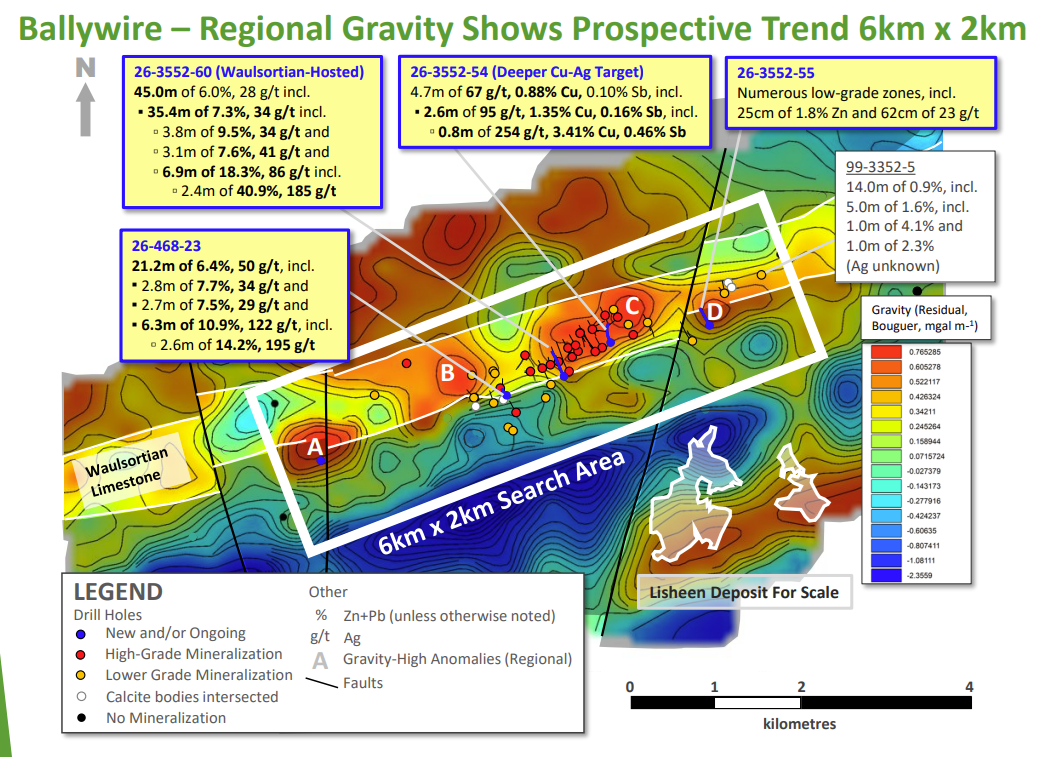
Management’s theoretical 24x upside framework multiplies four anomalies, three potential parallel trends and two stacked horizons. Jaworski said the zinc-over-copper doubling is very likely, because the deeper copper keeps appearing beneath the zinc. He said the evidence to date leans towards success on the four anomalies. The northern and southern parallel trends remain the bigger question, and he stressed he is not forecasting the full 24x.
Funding, Drilling and Resource Timing
Group Eleven completed a C$12 million bought deal led by Cormark and Beacon earlier this year. Its October 2026 presentation reports cash of C$16.2 million as at 30 June 2026. The capital funds a four-rig programme of about 70,000 metres over two years, with roughly 51,000 metres directed at Ballywire. Glencore holds 12.8% of basic shares and Michael Gentile holds 13.6%.
Jaworski said the timeline for a maiden mineral resource estimate (MRE) has not changed. The company plans to spend the next 12 to 18 months drilling across the full 6-kilometre trend before deciding when to publish. He argued that an early estimate risks being made obsolete by the next major step-out.
Metallurgy and Key Risks
Ballywire hosts zinc, lead, silver, copper and germanium, which naturally raises questions about recoveries. Jaworski said the metals occur in separate zones rather than one complex ore. The upper zone is conventional sphalerite, galena and pyrite, typical of Irish zinc deposits. The deeper zone contains chalcopyrite and tennantite-tetrahedrite, with less available data. No oxide mineralisation has been encountered. Metallurgical testwork has not yet begun, and the company expects to start it in the not-too-distant future. The connection between the southwest trend and the main zone, and the untested parallel trends, are further open questions.
The Investment Thesis for Group Eleven Resources
- The high-grade strike at Ballywire has grown by about 17% to roughly 1,870 metres, with both new step-outs drilled into previously untested ground.
- Copper-silver mineralisation continues to appear beneath the zinc, which supports management’s view that a second stacked horizon is likely.
- A funded four-rig programme of about 70,000 metres removes near-term financing pressure, backed by C$16.2 million in cash at 30 June 2026.
- Glencore (12.8%) and Michael Gentile (13.6%) anchor the shareholder register with industry and specialist-investor support.
- Investors should monitor results from the 16 holes in progress, particularly the five follow-up holes on the two new southwest sections.
- Drilling towards the B anomaly is the first real test of whether the discovery repeats along the 6-kilometre trend.
- The metallurgical testwork and a 12-to-18-month wait before an MRE decision are the main gaps in the current case.
Macro Thematic Analysis
Policy attention on critical minerals has broadened in recent years, led by the United States and mirrored by the European Union’s Critical Raw Materials Act. Several metals at Ballywire sit within that conversation. Copper and silver are tied to electrification and solar demand. Zinc remains essential to galvanised steel and infrastructure.
Germanium is the most striking case. It is used in fibre optics, infrared optics and semiconductors, and China dominates global supply. Beijing’s export restrictions since 2023 have pushed Western buyers to look for alternative sources. Jaworski noted that germanium has recently traded at around $200 per ounce outside China. Most germanium is recovered as a by-product of zinc processing, which places Irish zinc deposits in an unusual position. Group Eleven’s re-assay programme lifted average germanium grades by 68% in September. The economic contribution has not yet been quantified, and Jaworski said that work still needs to be done.
Asked whether the surge of interest in critical minerals changes Group Eleven’s business model, Jaworski pointed to the pace of work on the ground.
“It makes us more cognizant that we have to move and we’re moving fast as you can see all the drilling that we’re doing. We’re not sitting on our laurels,” he said.
Ireland adds jurisdictional appeal. It has permitted six mines over the past 60 years and sits close to European smelters. A new European source of zinc, copper, silver and germanium would face a receptive market. The open question for investors is whether Ballywire can grow large enough to matter.
TL;DR
Group Eleven Resources (TSXV:ZNG) has extended the high-grade strike at its Ballywire zinc-lead-silver discovery in Ireland by 270 metres, an increase of about 17%. Both new step-outs hit high-grade zinc-lead in untested ground, and both found copper-silver mineralisation beneath it, which supports the company’s stacked two-horizon model. Ballywire occupies one of four gravity anomalies along a 6-kilometre trend, and drilling is moving towards the B anomaly. A four-rig programme of about 70,000 metres is funded, with C$16.2 million in cash at 30 June 2026. Sixteen holes are in progress. A maiden resource decision is 12 to 18 months away, and metallurgical testwork has not yet begun.
FAQ (AI-generated)
Analyst's Notes





Subscribe to Our Channel



Stay Informed


