




Group Eleven Advances Toward Maiden Resource as Ballywire Expands with Strong Drill Hits


Group Eleven advances Ireland's top zinc-silver-copper discovery: 5 rigs, world-class grades, 24x upside potential, C$18M cash, MRE in 12–18 months. M&A interest rising.
- Group Eleven Resources is drilling five rigs across its Irish portfolio - four at the Ballywire zinc-lead-silver-copper discovery in County Limerick and one at the adjacent Stonepark property - as part of a 70,000-metre campaign
- A steeply dipping copper-silver system has been confirmed beneath the flat-lying zinc horizon across three drill fences spanning 430 metres of strike, with January 2026 producing what management described as the best silver intersection recorded globally at that time.
- A secondary southwest-trending massive sulphide zone has emerged in addition to the primary trend, increasing tonnage potential and demonstrating the structural complexity of the Ballywire system.
- Management articulates a potential 24-times exploration upside relative to the current discovery footprint, based on four gravity anomalies along a 6-kilometre trend, of which the current discovery occupies only one.
- A maiden mineral resource estimate is targeted within 12 to 18 months, with approximately C$18 million in cash on hand following a March 2026 financing, and Ireland's M&A environment is accelerating with activity from Glencore, Sprott-backed operators, and the Irish government's own minerals fund.
Group Eleven Resources is a Canadian-listed mineral exploration company focused entirely on Ireland, one of the world's most established zinc-producing jurisdictions. In a recent interview, CEO Bart Jaworski provided a detailed update on drilling progress at the company's Ballywire discovery in County Limerick, discussed the geological interpretation of an emerging copper-silver system at depth, and offered context on the strategic landscape developing across the Irish mineral belt. For investors tracking the company, the conversation covered grade continuity, scale potential, metallurgical considerations, and the path to a maiden mineral resource estimate.
Five Rigs Drilling Across Two Properties
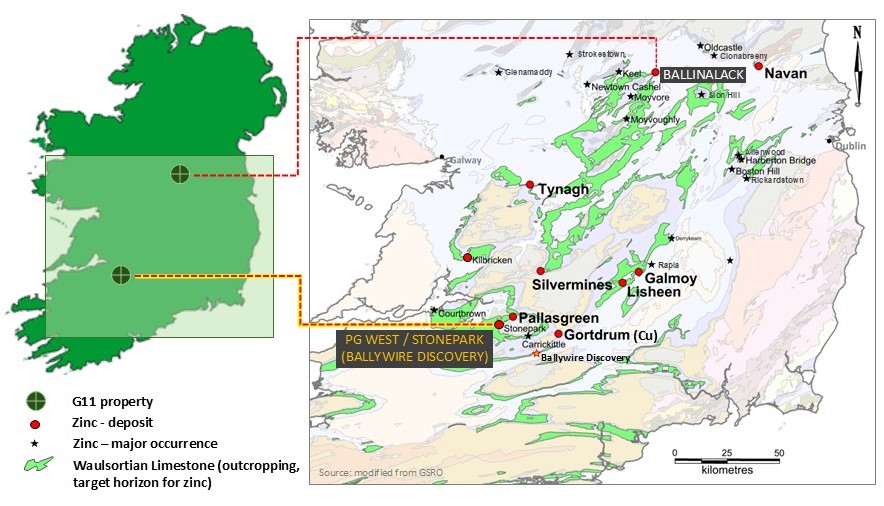
Group Eleven is currently operating five drill rigs: four dedicated to Ballywire and one at Stonepark, the adjacent property forming part of the company's Capital Star project located approximately 20 kilometres to the north. The Ballywire program operates within a larger 70,000-metre drill campaign and is advancing two parallel objectives - extending the known zinc-lead-silver mineralisation along the southwest trend and delineating the copper-silver system identified at depth. The Stonepark rig is targeting a potential new discovery, with an initial 2,700-metre program underway ahead of a planned 15,000-metre campaign.
The company holds approximately C$18 million in cash following a March 2026 financing that raised C$12 million, providing capital to sustain both programs into 2027.
Ballywire: 3.2 Kilometres of Strike and a Secondary Trend
The Ballywire discovery has now returned zinc-lead-silver mineralisation across 3.2 kilometres of strike. Drilling in recent months has also identified a secondary southwest-trending massive sulphide zone that is distinct from the primary east-southeast trend. This secondary trend was identified after a step-out of 80 metres in the southwest direction intersected massive sulphide mineralisation at a location where it was not expected, followed by a further 80-metre step-out that confirmed the continuity. The emergence of a secondary trend is significant because it implies the deposit could carry greater tonnage than the existing drill intercepts suggest, with Jaworski noting that growing aggregate tonnage to a point of critical mass is the primary near-term objective.
The Copper-Silver System: A Deposit Within a Deposit
The most consequential geological development at Ballywire over the past year has been the systematic identification of a steeply dipping copper-silver zone below the flat-lying zinc-lead-silver horizon. The relationship between the two systems is interpreted as a feeder or root zone beneath the shallower zinc mineralisation, consistent with the mechanics of Mississippi Valley Type (MVT) deposit formation.
Three drill fences now confirm the copper-silver system across 430 metres of strike along the broader 3.2-kilometre zinc corridor. Drilling at 720 metres to the southwest has returned an early copper-silver intersection that may indicate the system extends further in that direction, though additional drilling is required to confirm continuity. Jaworski characterised the arrangement as representing two potentially concurrent mining scenarios - room-and-pillar extraction for the flat zinc horizon and long-hole stoping for the steeper copper-silver zone - which could operate simultaneously and would produce three separate ore streams: a zinc concentrate, a lead concentrate carrying most of the silver, and a copper-silver concentrate.
Interview with Bart Jaworski, CEO, Group Eleven Resources
Grade Profile: High-Silver and Elevated Copper
The grade results at Ballywire have been a consistent point of differentiation relative to typical Irish-type deposits, which generally carry modest silver values. At Ballywire, silver assays of 50 to 150 grams per tonne are reported across most drill holes in the discovery, with individual results reaching up to 4,200 grams per tonne.
In January 2026, the company reported what Jaworski described as a globally significant intersection:
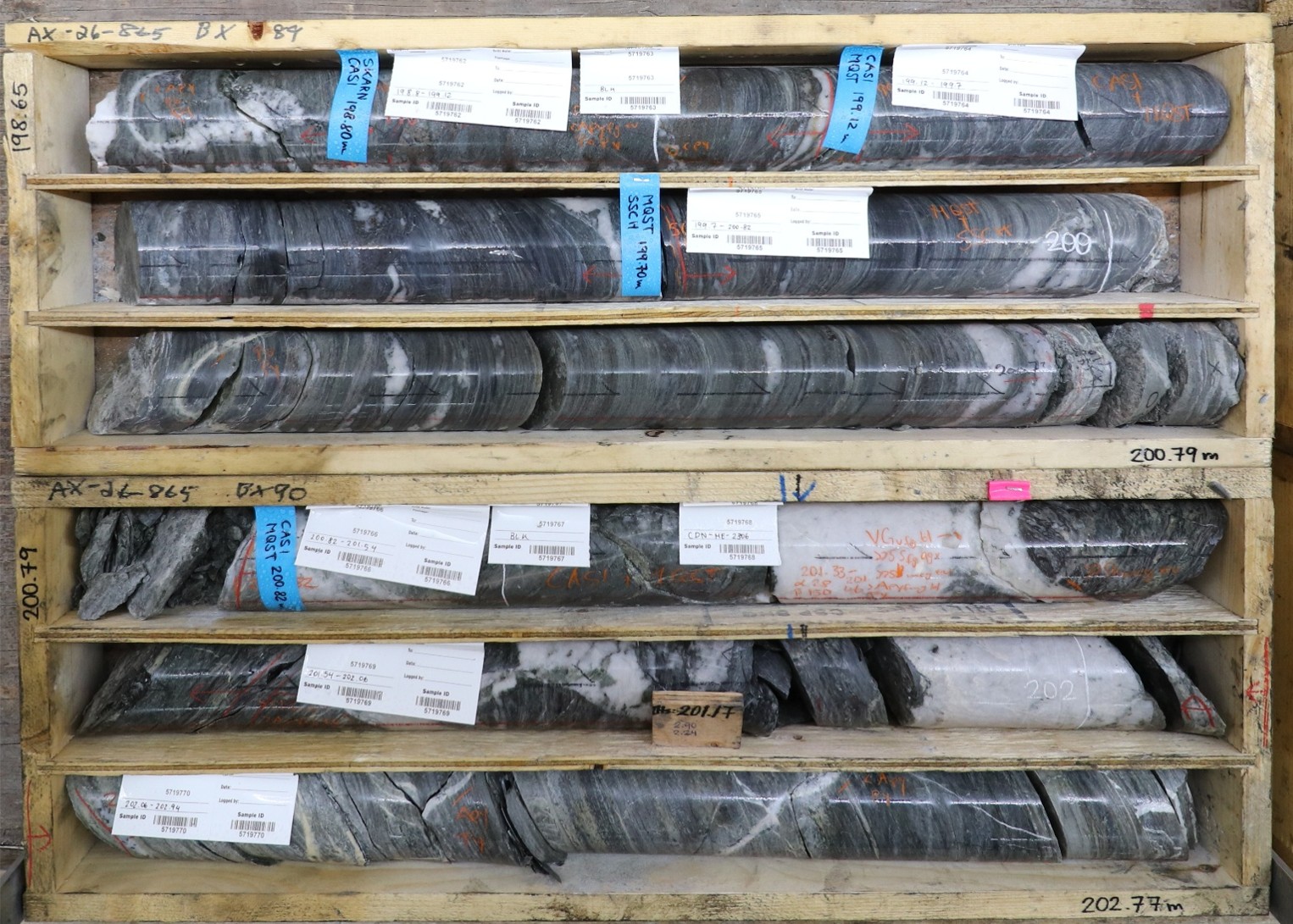
"We had the best hit in the world for silver - essentially 52 metres of 10% zinc lead, but 330 grams per tonne silver, 0.4% copper within that. The real high-grade kick was 8.4 metres of nearly 2,000 grams per tonne silver and 2.2% copper and 0.18% antimony."
More recently, the third confirmed copper-silver drill fence returned 6 metres of 1.6% copper and approximately 80 grams per tonne silver, with sub-intervals reaching 5% copper and 300 grams per tonne silver, and a very high-grade narrow interval of 24% copper - described as potentially the highest copper result from Irish exploration in over 60 years. Antimony has also been identified across multiple intersections, adding a fourth payable element to the deposit profile.
The 24x Exploration Upside Framework
The company has articulated a theoretical exploration upside of 24 times the current discovery footprint, derived from three independent multipliers. First, Ballywire in its entirety sits within a single gravity anomaly - the C-anomaly - out of four identified gravity highs along a 6-kilometre trend. Second, emerging northern and southern secondary trends suggest the potential for parallel mineralised zones. Third, the deeper copper-silver root system adds a vertical dimension not yet fully tested.
"We're talking about a 24x type of upside... we're absolutely optimistic, very much have our sights set on that type of potential."
This figure is a geological framework for exploration sequencing rather than a resource estimate, and it should be understood in that context. The company's stated approach is to complete first-pass drilling across the B, A, and D gravity anomalies before committing capital to infill drilling at spacings sufficient for resource classification.
Stone Park and Pallas Green 2.0
Stone Park sits immediately adjacent to Glencore's Pallas Green deposit, which hosts a resource of approximately 45 million tonnes alongside a secondary deposit of approximately 5 million tonnes. Group Eleven's exploration thesis at Stonepark is informed directly by what has been learned at Ballywire - specifically, that drilling systematically below the base of the zinc horizon can reveal a copper-silver root system that has historically been overlooked in Irish exploration. The company intends to apply this approach at Stonepark as part of its 15,000-metre program, which is expected to be substantially deployed across late 2026 and 2027. A separate target, the Carrickittle West prospect, is being drilled as the primary candidate for a new zinc-lead-silver discovery comparable in scale to the PallasGreen system.
Path to Resource Estimate and Ireland's M&A Landscape
The company is targeting a maiden mineral resource estimate within 12 to 18 months. Achieving MRE-standard drill spacings of 50 to 100 metres will require an infill phase following the current first-pass expansion program. Jaworski indicated the company plans to begin planning that infill campaign in approximately one year, once first-pass coverage of the principal gravity targets is sufficiently advanced to define a priority infill area.
The broader M&A environment in the Irish mineral district has accelerated noticeably. The Galmoy zinc mine is being restarted under new ownership with capital from Sprott-affiliated investors. The Irish Minerals Fund, a vehicle connected to Ireland's sovereign wealth fund, has committed investment to the sector. Glencore continues to advance PallasGreen.
"There's certainly...a lot of juicy mineralisation emerging in a very small area, which lends itself to those types of plays and how they've evolved over time," Jaworski observed, referencing the pattern of consolidation seen in historically prolific mining camps. Whether Group Eleven ultimately becomes an acquirer, a target, or a standalone development company remains an open question, though Jaworski acknowledged the trajectory of mineralisation and the camp dynamics make that question increasingly relevant.
The Investment Thesis for Group Eleven Resources
- Scale of discovery: Ballywire has returned 3.2 kilometres of zinc-lead-silver strike with confirmed copper-silver mineralisation across 430 metres - a discovery already large by Irish standards, with significant portions of the system untested.
- Grade differentiation: Silver values of 50-4,200 g/t are substantially above typical Irish-type deposits; copper and antimony provide additional metal revenue streams not historically associated with the district.
- Exploration optionality: Three gravity anomalies beyond the current discovery boundary remain largely undrilled, and secondary northern and southern trends are emerging - supporting management's 24x upside framework as a geological guide for future drilling.
- Deposit type: MVT deposits in Ireland have a consistent track record of high metallurgical recovery rates and clean concentrates that command premium pricing; Ballywire's mineralogy is expected to follow this precedent for the zinc-lead horizon.
- Copper and silver leverage: The depth system provides direct leverage to copper and silver price cycles at a time when demand for both metals is structurally elevated by energy transition and electrification.
- Funded exploration: Approximately C$18 million in cash supports ongoing five-rig drilling at Ballywire and the 15,000-metre program at Capital Star without near-term financing pressure.
- Resource estimate catalyst: A maiden MRE is targeted within 12–18 months, representing a potential re-rating event if the resource scale reflects the breadth of drill intercepts to date.
- Jurisdiction: Ireland is a stable, mining-friendly European jurisdiction with an established regulatory framework, skilled workforce, and six operating or past-producing mines as comparable benchmarks.
Macro Thematic Analysis
Ireland sits at the intersection of two powerful macro trends: the global push for domestic critical mineral supply in Western economies and the accelerating demand for zinc, copper, and silver driven by energy transition infrastructure. Zinc remains essential for galvanising steel used in wind and solar structures. Copper is the defining metal of electrification. Silver carries both industrial and monetary demand. Against this backdrop, Ireland - with a proven history of high-grade zinc production and a legal framework attractive to mining investment - is re-emerging as a strategic destination for capital. The involvement of sovereign wealth vehicles such as the Irish Minerals Fund and internationally recognised operators signals institutional recognition of the district's value. As Jaworski observed of the Ballywire copper-silver system:
"If the environment is there to create those types of grade, hopefully that typically means it's a big system - and that environment is probably prevalent at least along a few kilometres."
TL;DR
Group Eleven Resources has made one of Ireland's most significant zinc-lead-silver-copper discoveries in recent decades at Ballywire, with drilling now confirming high-grade copper-silver mineralisation across 430 metres of the system's depth, complementing 3.2 kilometres of zinc strike. Funded with approximately C$18 million and operating five drill rigs, the company is advancing toward a maiden resource estimate within 12 to 18 months while simultaneously testing a second major target at Stonepark adjacent to Glencore's 50-million-tonne PallasGreen deposit. The combination of world-class silver grades, emerging copper exposure, multiple untested exploration targets, and an accelerating Irish M&A environment positions Group Eleven as a company with material near-term catalysts.
FAQs (AI Generated)
Analyst's Notes





Subscribe to Our Channel


Stay Informed






