




Group Eleven Re-Assays Unlock 68% Grade Jump in Ballywire Germanium from 67,000m Drilling Campaign


Group Eleven's new assay method lifts Ballywire germanium grades 68% on average, adding a high-value byproduct to its Irish zinc-lead-silver discovery.
- Group Eleven re-analysed 220 germanium samples from five Ballywire drill holes using a more accurate assay method, lifting average grades by 68% compared with the previous technique.
- The strongest individual result returned 0.97 metres grading 94.6 g/t germanium as among the highest germanium intercepts reported at the project to date.
- CEO Bart Jaworski described a strong correlation between zinc and germanium grades, tied to germanium's association with the sphalerite mineral that hosts the deposit's zinc.
- Germanium trades near $200 per ounce outside China, up roughly 25% over the past year amid ongoing Chinese export restrictions and declining output at the Red Dog mine.
- A further 110 samples across 15 holes remain to be re-analysed with four rigs still active under a fully-funded drill campaign totalling over 67,000m-metre drill programme to date.
Group Eleven Resources (TSXV:ZNG) has re-run part of its assay library at the Ballywire discovery in Ireland using a more accurate germanium technique - and the results are materially higher than what the market has seen before. CEO Bart Jaworski shared the numbers: five previously reported drill holes have now returned germanium grades averaging 68% higher than the same samples analysed under the old method. For a discovery already carrying high-grade zinc, lead, silver and copper, the upgrade adds a fifth, increasingly strategic metal to the value equation with one trading near record prices amid a well-documented Western supply squeeze.
More Accurate Assay Unlocks Hidden Grade
For the life of the Ballywire programme, Group Eleven's germanium samples were analysed using lithium borate fusion, the industry-standard method at the time. After discussions with ALS Laboratories in Ireland, the company switched to sodium peroxide fusion, which digests more of the sample and reduces germanium loss to volatiles during the assay process. Jaworski explained the practical effect on the interview: previously unreported grades are now coming in as much as double the old figures, and more than triple in the highest-grade intervals.
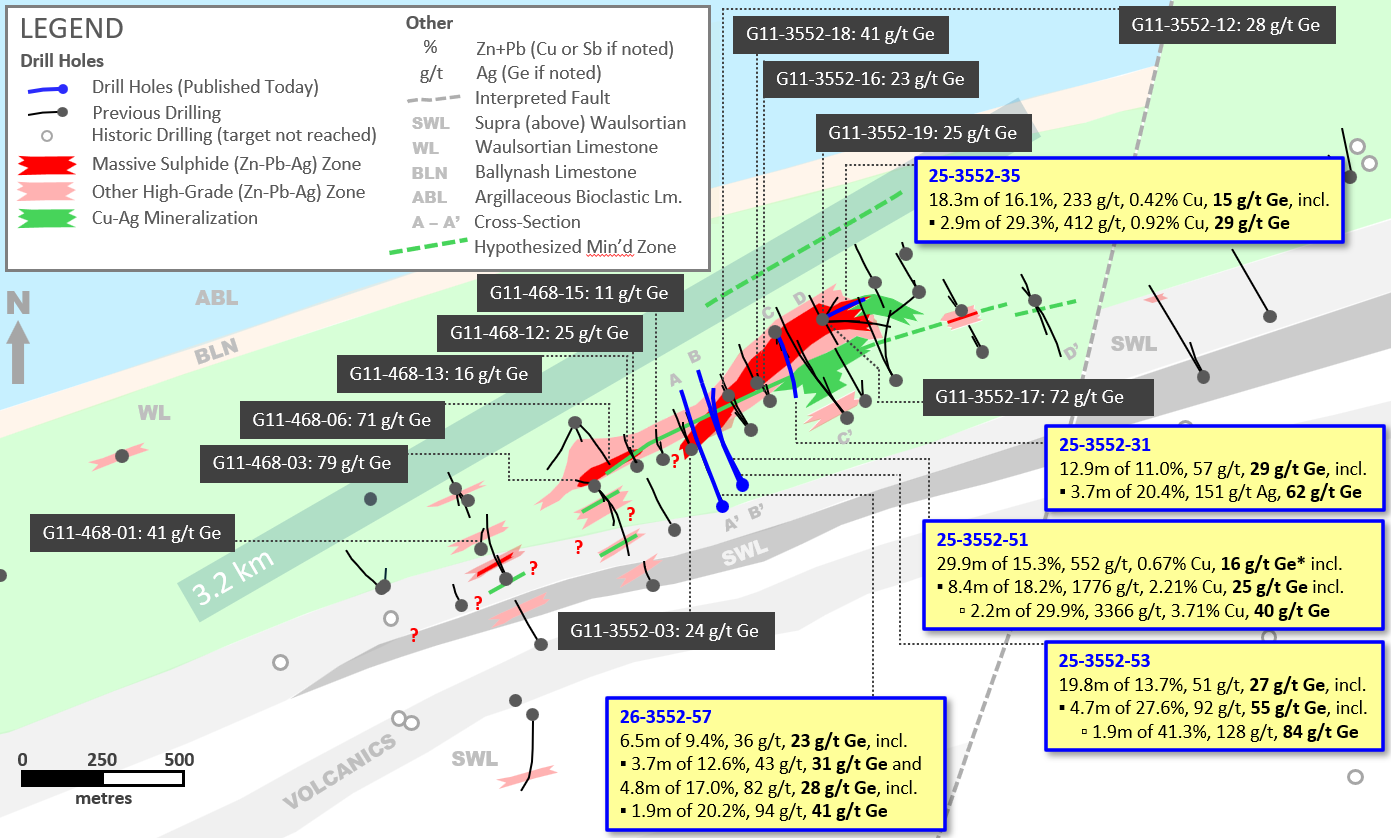
Of the 330 germanium samples originally submitted using the old method, 220 (spanning five drill holes) have now been re-analysed with the new method. The company had these results in-house for some time before releasing them, having paused to validate the new technique before putting numbers into the market.
Standout Intercepts Across Five Holes
The re-analysed intervals include some of the highest germanium grades reported at Ballywire to date: Hole 25-3551-31 returned 12.88m at 29.2 g/t germanium (with 10.95% zinc-lead and 57.4 g/t silver), including 0.91m at 90.4 g/t germanium, hole 25-3551-53 delivered 11.32m at 27.5 g/t germanium, including a narrower 0.97m interval at 94.6 g/t germanium, the highest single-sample grade in the batch. Hole 25-3551-51, already notable for near-2,000 g/t silver and over 2% copper in places, also carried 8.43m at 25.0 g/t germanium.
Jaworski was direct about the significance of these numbers against industry benchmarks, telling that the Kipushi deposit in the Democratic Republic of Congo, a United States Geological Survey (USGS) reference point for high-grade germanium-bearing zinc mineralisation runs around 64 g/t. Several of Ballywire's re-analysed intervals now exceed that.
Interview with Bart Jaworski, CEO of Group Eleven Resources
The Zinc-Germanium Relationship
A recurring theme was how tightly germanium tracks zinc grade at Ballywire. Jaworski attributed this to germanium's chemical association with sphalerite, the zinc-bearing mineral that hosts the bulk of the discovery's mineralisation. Jaworski said:
"The relationship look seems very strong, the correlation is very high. Whenever we see high zinc numbers, we tend to have the highest germanium numbers along with it."
He added that where zinc grades are lower but lead is comparatively higher, germanium tends to be scarcer - reinforcing that the metal is riding inside the same crystal structure as the zinc mineral, rather than occupying a separate zone. That matters for the economics: if it holds across the wider deposit, germanium recovery would piggyback on zinc concentrate production rather than requiring separate extraction infrastructure. As Jaworski put it when discussing a hypothetical future mining scenario:
"If Ballywire turns to mine one day and if we're producing zinc concentrate, we'd be getting that germanium for free."
Metallurgical test work to confirm actual recoveries has not yet started, and Jaworski was careful to caveat that no payability figures exist yet and the "for free" framing describes the geological relationship, not a confirmed economic outcome.
Germanium's Tight, China-Dominated Market
Germanium currently trades at roughly $200 an ounce outside China, up approximately 25% over the past year. China restricted germanium exports in 2023 and, despite subsequent claims of relaxation, Western supply remains tight, a dynamic reflected in the sustained price climb. The metal is used across AI infrastructure and fibre optics, both growth end-markets. Jaworski also flagged that Red Dog, the world's largest zinc mine and a major germanium source, is in production decline with output down roughly 45% over a five-year window and removing supply just as demand grows.
Crucially, Jaworski was clear this is a small, niche market: a single new mine entering production could meaningfully move pricing in either direction, which cuts both ways for investors weighing exposure. He named Kipushi as the only prospective new Western supplier he was aware of, alongside a handful of other junior zinc explorers with incidental germanium credits.
What's Left to Assay & What Comes Next
A further 110 samples across the remaining Ballywire holes are currently being re-analysed with the new method, with results expected before too long. Beyond that, an additional set of holes have not yet had a first-pass germanium assay at all, since germanium isn't part of the standard multi-element suite and requires its own analytical run.
Four rigs remain active at Ballywire, with roughly 15 additional holes currently in the pipeline. The company's germanium disclosure sits alongside a broader, fully-funded drilling campaign totalling over 67,000 meters (including 51,500 meters at PG West) is funded off the back of a C$12 million financing completed in March 2026.
Investment Thesis for Group Eleven Resources
- Germanium is now a quantified, high-value credit at Ballywire. The re-assay programme adds measurable NSR-per-tonne potential to a discovery already carrying strong zinc, lead, silver and copper grades, without requiring additional drilling.
- The re-assay uplift is substantial and reproducible. Average germanium grades rose 68% across the first five re-analysed holes versus the old assay method, with several intervals more than tripling.
- A concrete near-term catalyst is already in motion. 110 further samples across 15 holes are being re-analysed, with additional unassayed zones still to receive a first-pass germanium run.
- Supply-demand backdrop favours the metal, within limits. Germanium is up 25% year-on-year to $200 per ounce amid China's export restrictions and declining output at Red Dog but it remains a small, thinly-traded market vulnerable to a single new supply source.
- The zinc-germanium correlation simplifies future economics if it holds at scale,. Management describes germanium as riding inside the same sphalerite mineral as zinc, implying potential byproduct recovery rather than standalone extraction infrastructure.
- Metallurgy and payability remain the key gating items. No recoveries or payable terms exist yet; the next milestone investors should watch for before germanium's dollar contribution can be modelled.
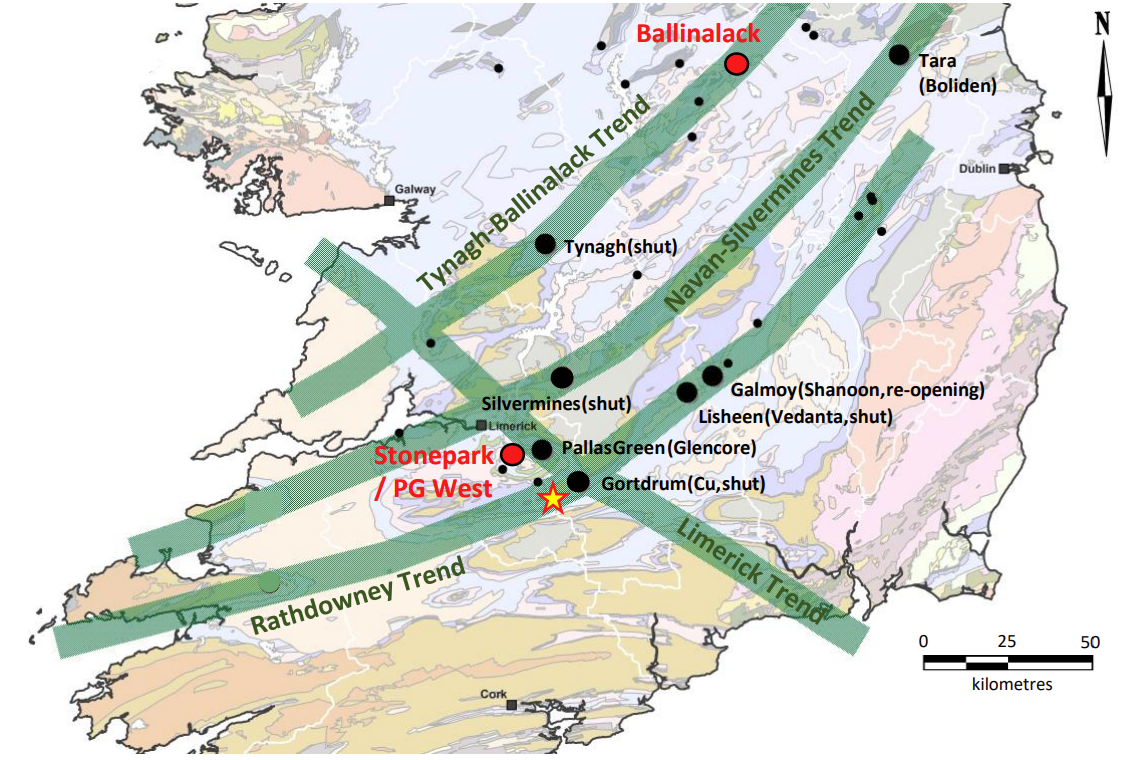
- Monitoring the remaining 110 re-assays and newly-assayed holes to sustain the 68% average uplift and the strong zinc-germanium correlation across the wider 6km trend, not just the five holes reported today.
Macro Thematic Analysis
Germanium has spent the better part of three years as a slow-burn story in the critical minerals space - important enough to draw policy attention, but small enough to stay off most generalist investors' radar. That's starting to shift. China's 2023 export restrictions remain effectively in place despite official signals of relaxation, and the metal's role in AI-related infrastructure and fibre optics gives it genuine structural demand tailwinds rather than a purely speculative bid. Prices outside China have climbed 25% over the past year to around $200 an ounce, and the decline of Red Dog, the world's largest zinc mine and a major germanium source, removes supply from an already tight market just as demand accelerates.
What makes Ballywire's germanium story notable isn't just the price backdrop; it's the assay methodology shift underneath it. A move from lithium borate to sodium peroxide fusion sounds like a technical footnote, but it materially changes what grade figures actually reach the market: a reminder that in niche, harder-to-assay metals, the analytical method itself can be a source of previously invisible value. As Jaworski framed the metal's investment appeal on the interview:
"We've got even better germanium numbers coming up on top of coincident with zinc, lead, silver, and copper. It's becoming a high-grade sample now boosted by germanium. Germanium is obviously a very interesting metal."
Germanium is genuinely scarce, genuinely in demand, and trading at multi-year highs but it is also, by Jaworski's own admission, a small market where a single new mine coming online could swing pricing meaningfully. For a company like Group Eleven, already advancing a large, multi-metal zinc-lead-silver-copper discovery, germanium functions as a high-value kicker layered onto an existing thesis rather than the thesis itself, one that strengthens the economic case for Ballywire without yet being fully quantifiable in dollar terms.
TL;DR
Group Eleven Resources re-analysed germanium samples from five Ballywire drill holes using a more accurate assay method (sodium peroxide fusion, replacing lithium borate fusion), lifting average grades 68% with some intervals more than tripling up to 94.6 g/t. CEO Bart Jaworski says the metal tracks zinc grade closely, meaning it may eventually be recovered as a byproduct of zinc concentrate rather than requiring separate infrastructure, though metallurgical work hasn't started. Germanium trades near $200 per ounce, up 25% year-on-year, amid Chinese export restrictions and declining output at Red Dog. A further 110 samples are being re-assayed, with four rigs still active across a fully-funded drill campaign totalling over 67,000m to date.
FAQ (AI-Generated)
Analyst's Notes





Subscribe to Our Channel


Stay Informed


