




Recovery Studies Clarify PGM Project Economics as Hybrids Keep Catalysts in Use


Continued catalyst use provides a market for platinum and palladium, while recoveries, processing costs, and development spending shape potential returns.
- Hybrids retain exhaust catalysts that use platinum group metals (PGMs), supporting continued automotive use as fully electric vehicles gain market share.
- EU hybrid and plug-in hybrid registrations rose 12.3% during January-September 2026, partly offsetting gasoline and diesel declines within a selected engine-equipped market that contracted 2.1%.
- Euro 7 tightens catalyst performance requirements, while subsequent design improvements can reduce the precious metal needed to meet those standards.
- Recovery studies help estimate potentially saleable platinum and palladium, providing a basis for comparing revenue with processing costs and development spending.
- Infrastructure requirements, permitting schedules, and capital discipline help determine the cost and timing of potential future PGM production.
Hybrid Growth Partly Offsets Declining Catalyst-Equipped Car Registrations
The European Automobile Manufacturers’ Association (ACEA) reported on October 22, 2026, that hybrid electric vehicles (HEVs) accounted for 36.3% of EU registrations during January-September, making them the largest powertrain category. HEVs and plug-in hybrid electric vehicles (PHEVs) retain combustion engines and exhaust catalysts, supporting PGM demand as battery electric vehicles (BEVs) gain market share.
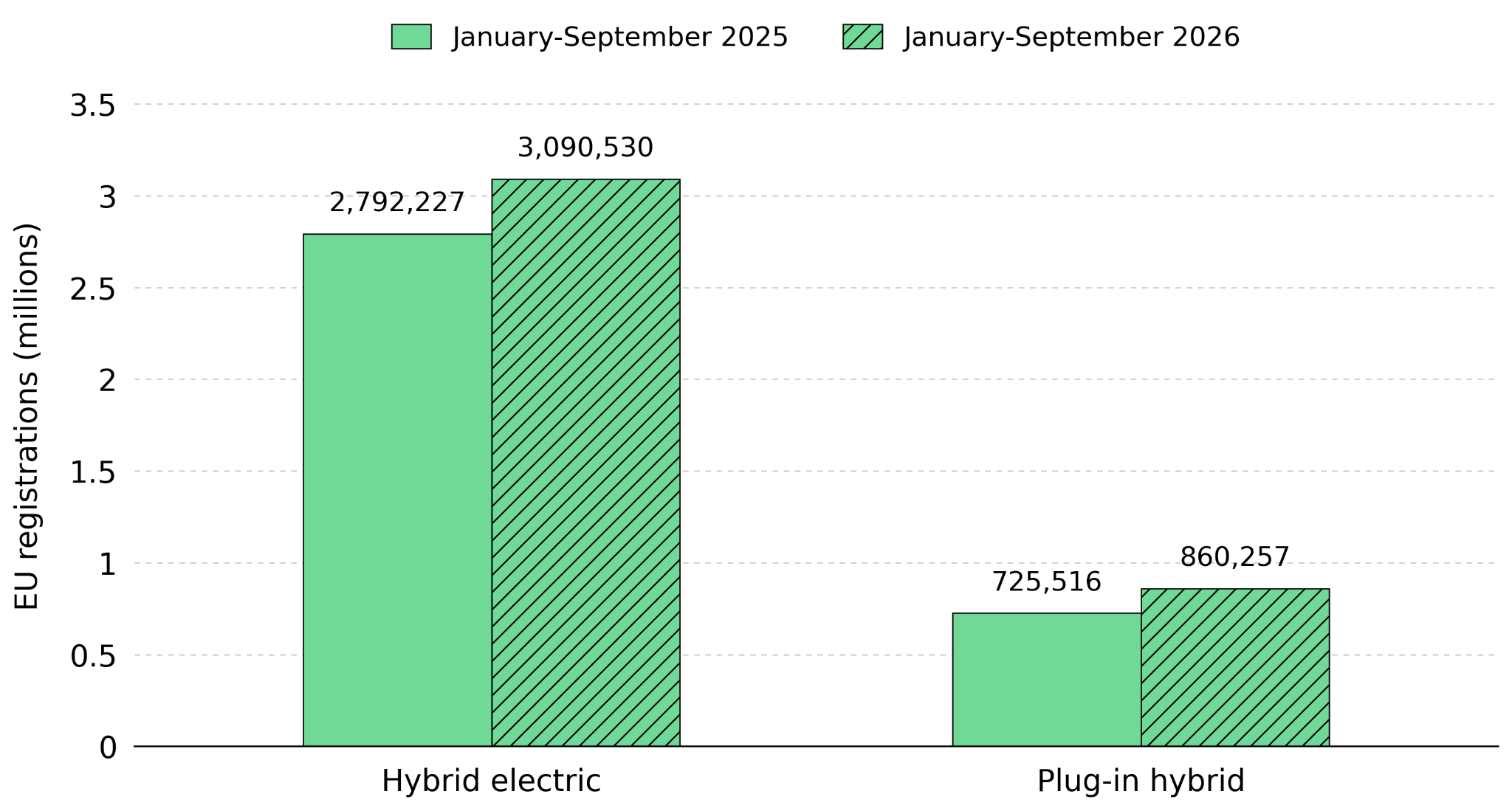
EU HEV registrations, including full and mild hybrids, rose 10.7% to 3.09 million during January-September 2026, while separately reported PHEV registrations increased 18.6% to 860,257. Combined registrations reached 3.95 million, up 12.3% from 3.52 million a year earlier, and accounted for 46.4% of EU new-car registrations, calculated from ACEA’s published tables.
During January-September 2026, EU BEV registrations rose 48.5% year over year, while gasoline and diesel registrations fell 19.1% and 19.5%, respectively. Combined HEV, PHEV, gasoline, and diesel registrations fell 2.1% to 6.36 million, showing that hybrid growth only partly offset gasoline and diesel declines. This calculation excludes ACEA’s mixed other-fuels category.
Hybrid Engines Continue to Require PGM Exhaust Catalysts
Hybrids retain combustion engines that require PGM exhaust catalysts, sustaining demand even when electric propulsion reduces fuel use. Frequent engine starts and stops can lower exhaust temperatures, reducing how effectively catalysts remove pollutants.
ValOre Metals is advancing processing studies at its wholly owned Pedra Branca platinum, palladium and gold project to help establish how much metal could be recovered and at what cost. Its July 30 update targeted a preliminary economic assessment (PEA) by the end of 2026, intended to clarify processing options, capital requirements and potential project economics.
Nick Smart, Chief Executive Officer of ValOre Metals, explains why hybrid vehicles sustain demand for PGMs:
“Importantly, hybrid vehicles also have a significant PGE use in the catalytic converter. And we're seeing a steady and ongoing demand for those types of vehicles relative to battery electric vehicles, which obviously don't use platinum and palladium.”
Euro 7 Raises Catalyst Performance Requirements
The UK Vehicle Certification Agency (VCA), in guidance updated September 17, 2026, confirms that Euro 7 applies to new light-duty vehicle types in the EU from November 29, 2026. Because the initial deadline covers new types rather than all new registrations, its effect on PGM demand depends on the production volumes and catalyst designs of newly approved models.
Johnson Matthey’s May 14, 2026, report forecasts a small initial increase in PGM content per European gasoline vehicle as Euro 7 tightens testing and durability requirements, despite unchanged headline gasoline and diesel emissions limits.
Thrifting reduces precious-metal use while maintaining catalyst performance, potentially lowering PGM requirements per vehicle after the initial introduction. The same report forecasts a shift back toward palladium in some platinum-rich European catalyst systems as manufacturers refine their designs.
Recovery Studies Clarify Potential PGM Project Returns
Potential sales depend on how much metal processing recovers and what a buyer pays for that output. A PEA combines these revenue assumptions with mining costs, processing costs, and capital expenditure (capex) to assess potential project returns.
Higher recovery adds project value only when the additional revenue justifies any increase in operating costs and capex. Net present value (NPV) estimates project value by discounting projected cash inflows and outflows to today’s dollars. Sensitivity analysis tests how metal prices, recoveries, costs, and production timing affect NPV and whether it remains positive.
Spending on recovery tests and economic studies helps compare processing options before larger capital commitments. Development choices should be assessed by the additional cash they could generate after operating costs and capex.
Hybrid Adoption Retains PGM Demand During Electrification
The International Energy Agency (IEA), in its Global EV Outlook 2026 published May 20, 2026, forecast 23 million electric-car sales worldwide in 2026. The total includes BEVs and PHEVs, so it cannot be treated entirely as a forecast of vehicles that eliminate demand for PGM exhaust catalysts.
Automotive PGM demand depends on the number of catalyst-equipped vehicles produced and the metal content of each system. Hybrid growth partly offsets declining gasoline and diesel registrations, supporting continued catalyst use during electrification. Changes in engine types, regional production, and catalyst design determine whether platinum and palladium consumption rises or falls.
The Investment Thesis for PGMs
- Tested recoveries and processing assumptions give explorers and developers a clearer basis for estimating potential metal sales and comparing revenue with project costs.
- Defined infrastructure requirements and achievable permitting schedules help establish capex, construction dependencies, and the timing of potential first sales.
- Separate platinum and palladium price assumptions help economic studies account for each metal’s contribution to potential project revenue.
- Staged technical spending directs capital toward work that can resolve processing choices and inform subsequent development decisions.
- Testing NPV across metal prices, recoveries, costs, and production dates helps identify development options that retain positive modeled value under different assumptions.
Hybrid adoption preserves an automotive use for platinum and palladium during electrification, providing a market against which future production can be assessed. The investment case strengthens when recovery testing and economic studies connect that opportunity with potentially saleable metal, competitive processing costs, and achievable development plans. Infrastructure requirements and permitting schedules help establish how much capital would be needed and when sales could begin. For explorers, technical work that clarifies these relationships provides a firmer basis for comparing development options across commodity cycles.
TL;DR
Recovery studies help estimate potentially saleable platinum and palladium, allowing project assessments to compare revenue with processing costs and development spending. Higher recovery can improve potential returns when additional metal revenue justifies the associated costs. Infrastructure requirements and achievable permitting schedules help establish capital needs and potential sales timing. Hybrids retain PGM exhaust catalysts, supporting continued automotive use during electrification, while vehicle production and catalyst design determine total consumption. For explorers, recovery testing, economic studies, and sensitivity analysis provide a clearer basis for comparing future development options.
FAQs (AI-Generated)
Analyst's Notes





Subscribe to Our Channel





Stay Informed


