




High-Grade Copper Confirmed at Pampa Medina: Marimaca Shifts Toward Bulk-Tonnage Mining


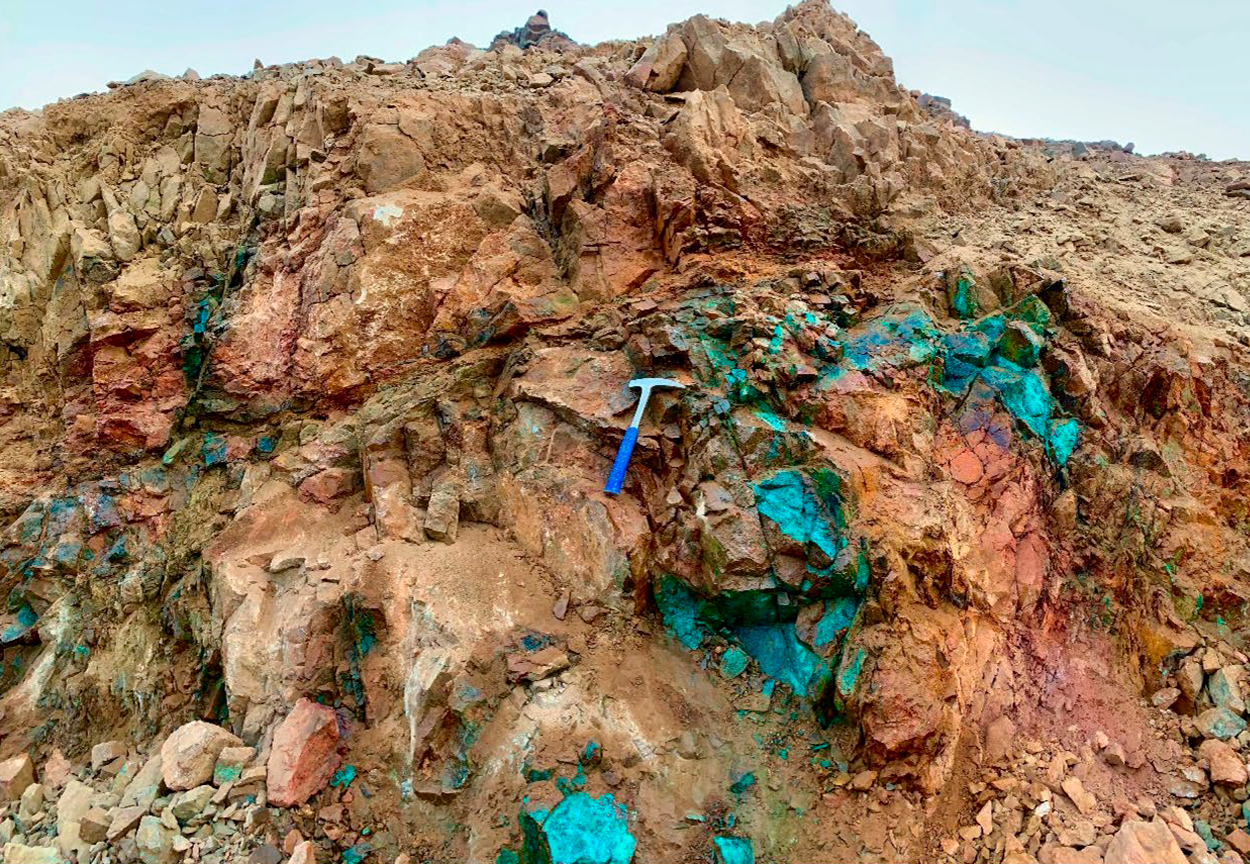
Marimaca Copper's Pampa Medina drilling confirms high-grade copper continuity, while mining methods, targeting, and project structure remain under review.
- Marimaca Copper's 150-metre-spaced drilling has confirmed continuity of high-grade copper and silver across Pampa Medina's central zone, with 36 of around 40 recent holes hitting economic widths and grades.
- Management has said it cannot yet repeatably predict where the project's highest-grade bornite and chalcocite zones will occur.
- Thick recent intersections are shifting mining-method thinking away from room-and-pillar extraction toward a bulk-tonnage, mechanised underground approach.
- Whether Pampa Medina will become a standalone operation or share infrastructure with the nearby MOD project has not yet been decided.
- A maiden Mineral Resource Estimate, due once the current delineation campaign concludes, will provide the first Inferred resource figures, but only across a small part of the prospective area.
What Has Happened
Marimaca Copper (TSX: MARI | ASX: MC2) has confirmed high-grade copper and silver continuity across the central zone of its Pampa Medina project in Chile's Antofagasta region, following a campaign of 150-metre-spaced drilling in which 36 of around 40 recent holes hit economic widths and grades. One recent hole returned a 96-metre sulphide envelope grading 1.19% copper and 11.7 grams per tonne silver, including 16 metres at 5.70% copper and 62.6 grams per tonne silver. Another hole, drilled around 600 metres to the east, returned 22 metres at 1.97% copper and 9.2 grams per tonne silver. A previously drilled hole located approximately 650 metres to the southeast returned 26 metres at 4.1% copper and 25 grams per tonne silver. Pampa Medina is a low-altitude, manto-style copper deposit hosted in Jurassic-Triassic sedimentary units, including sandstones, shales, tuffs, and conglomerates.
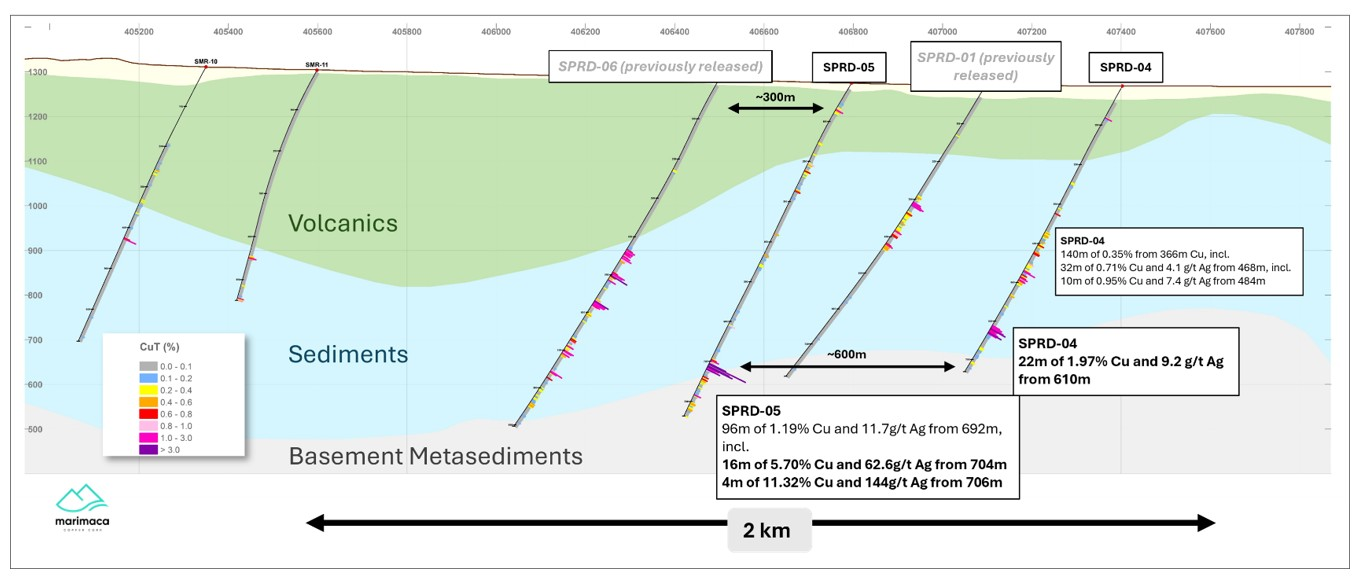
Geochemical Predictability: An Unresolved Targeting Problem
Pampa Medina's richest intercepts are tied to a specific rock chemistry, but that chemistry does not yet predict where the next high-grade run will appear. High-organic-matter black shales correlate strongly with the bornite and primary chalcocite zones that produce the project's ultra-high-grade results. Those shales occur consistently throughout the project area, but they are not always mineralised to the extent observed in the project's headline results.
Chief Executive Officer of Marimaca Copper, Hayden Locke, is direct about the limits of current targeting:
"In terms of where the bornite-rich and primary chalcocite-rich runs are, I would say we haven't yet worked out how to make that repeatable, because we do see the black shales very consistently over the whole project area, and not always mineralised as well as what we're seeing in the ultra-high-grade zone. So I'd say as we get more drill data, we will start to understand better the geochemical drivers of why those ultra-high-grade zones are there."
That distinction shapes how the project will be targeted going forward. Black shale alone is not evidence of bonanza-grade mineralisation, and its absence in some intervals does not rule out high-grade material elsewhere. The uncertainty carries into resource definition, since a model that cannot yet predict where the highest grades sit will treat some intervals more conservatively than others. Management has framed this as a matter of accumulating data rather than as a fixed limitation on the deposit.
Mining Method: From Room-and-Pillar to Bulk Underground
The choice of extraction method at Pampa Medina remains undecided, and recent results are shifting the thinking behind it. Two broad options are under consideration: a large open pit across a lower-grade zone, or underground extraction of higher-grade horizons measuring 20 to 60 metres in height. Recent thick intersections have shifted management's thinking away from a room-and-pillar-style underground operation toward a bulk-tonnage, mechanised approach.
That shift carries direct implications for projected costs and cutoff grades, both of which remain to be defined. The maiden resource estimate (MRE) is expected to include preliminary mining methods and preliminary economics, rather than a settled extraction plan. Shallow, high-grade mineralisation at the company's nearby Madrugador deposit appears open-pittable and is viewed by management as complementary to the MOD development.
MOD & Pampa Medina: Shared Infrastructure or Standalone Project
Whether Pampa Medina operates as an extension of the company's MOD project or as a standalone operation is still being evaluated. Pampa Medina's concessions are held under an option agreement with SCM Elenita, and the deposit sits approximately 25 to 28 kilometres from MOD, depending on the reference point. Pampa Medina's scale and grade now point more toward a standalone operation than to a simple extension of the existing project.
Locke frames the structural question as still open:
"We have been pondering that, because it certainly looks like there would almost certainly be some interplay between the two deposits, regardless of how big Pampa Medina gets. But Pampa Medina is certainly feeling more, as it would drive to a standalone operation that would piggyback on the infrastructure that we build from MOD: we're talking water, we're talking power, we're talking shared supply chain logistics, acid, all of that sort of stuff."
He added:
"At 25,000 tonnes or 30,000 tonnes of additional cathode, it makes sense to go back to the centralised processing facility; much bigger than that, you're probably going to build a standalone cathode project. And then there's the concentrator portion, or the sulphide portion of this, which is a completely different project and would require a standalone. So we are still pondering that."
The threshold Locke describes is specific. Additional cathode production of around 25,000 to 30,000 tonnes could likely be processed through MOD's centralised facility, while anything larger would require a standalone cathode project. The sulphide, or concentrator, component of Pampa Medina is viewed as an entirely separate undertaking, requiring its own infrastructure regardless of how the cathode question is resolved.
Sector Comparison: Pampa Medina Against Kamoa-Kakula & Kupferschiefer
Management is framing Pampa Medina's thickness and grade characteristics against established sediment-hosted copper deposits to support the case for a larger-scale mining method than originally anticipated. The mining-method shift away from room-and-pillar extraction is referenced relative to operations of that type used at comparable Copperbelt-style deposits. That contrast is being used internally to support the case for moving beyond a room-and-pillar design toward a method better suited to thicker, more continuous mineralisation.
What to Watch Next
The next milestone is the maiden Mineral Resource Estimate, due once the current 150-metre-spaced delineation campaign across the central area of interest is complete. The resulting figures will be classified as an Inferred resource, described as a snapshot in time covering only a small subset of the broader prospective area.
Locke puts it this way on what the maiden estimate will and won't settle:
"We will be very clear in saying this is the Inferred resource on a small subset of what we believe is prospective for mineralisation, and we will continue to drill so that people can start to wrap their own numbers around it. But also, when we put out the Inferred resource, there will be some preliminary economics wrapped around it, some preliminary mining methods, a little bit of understanding about how you'd actually exploit this, because it's all well and good to have the copper in the ground, but if you can't get it out economically, it's valueless to our shareholders."
Each of the three questions raised here, geochemical targeting, mining method, and project structure, will not be fully resolved by that first estimate. What the estimate does provide is preliminary economics and an initial read on the mining methods needed to extract the deposit economically, against which the open questions can then be tested.
FAQs (AI-Generated)
Analyst's Notes





Subscribe to Our Channel









Stay Informed


