Hot US Inflation Pulls Gold Lower as Fed Hike Bets Test Miners


Higher odds of a larger December Fed hike have pushed gold below $4,000/oz, with high-cost producers carrying the largest share of the margin pressure.
- On November 12, 2026, spot gold fell 1.4% to $3,931.54/oz by 0912 GMT, its third straight decline and lowest level since November 4, as the dollar reached a 19-month high.
- On November 10, the Bureau of Labor Statistics reported that October consumer prices rose 0.4% against a 0.3% forecast, with core prices up 0.3% against 0.2%.
- After the data, CME FedWatch showed an 89% probability of a 25 basis point December hike and an 11% probability of a 50 basis point move, up from zero before the release.
- Gold producers with third-quarter all-in sustaining costs above US$2,000/oz, including ASX-listed Northern Star and ASX- and LSE-listed Resolute Mining, face the largest proportional margin loss.
- The October Producer Price Index, due November 13, is the next test before the Fed's December 9 decision, with a spot close back above $4,000 the level that would signal reduced hike risk.
Higher Rate Expectations Pressure Gold Prices
Gold pays no interest, so higher expected rates raise the income forgone by holding it. A stronger dollar adds pressure as it makes dollar-priced bullion more expensive for buyers using other currencies. The Fed raised its target range to 3.75%-4.00% on September 16, its first increase since 2023, and held on October 28.
Core inflation rose 0.3% for a third straight month, and Fed Governor Christopher Waller has suggested a 50 basis point move could be appropriate, CoinDesk reported. The World Gold Council attributes gold's October decline partly to Fed rate-path repricing and speculative selling.
Local Currencies Offer No Cushion for Gold Holders
In October, gold fell 7.4% in Australian dollars, 7.2% in sterling and 8.0% in Canadian dollars, against 6.3% in US dollars, according to the World Gold Council.
Rate pressure also extends beyond the US. Bank of England policymaker Megan Greene argued on November 11 for proactively tightening UK policy, Reuters reported.
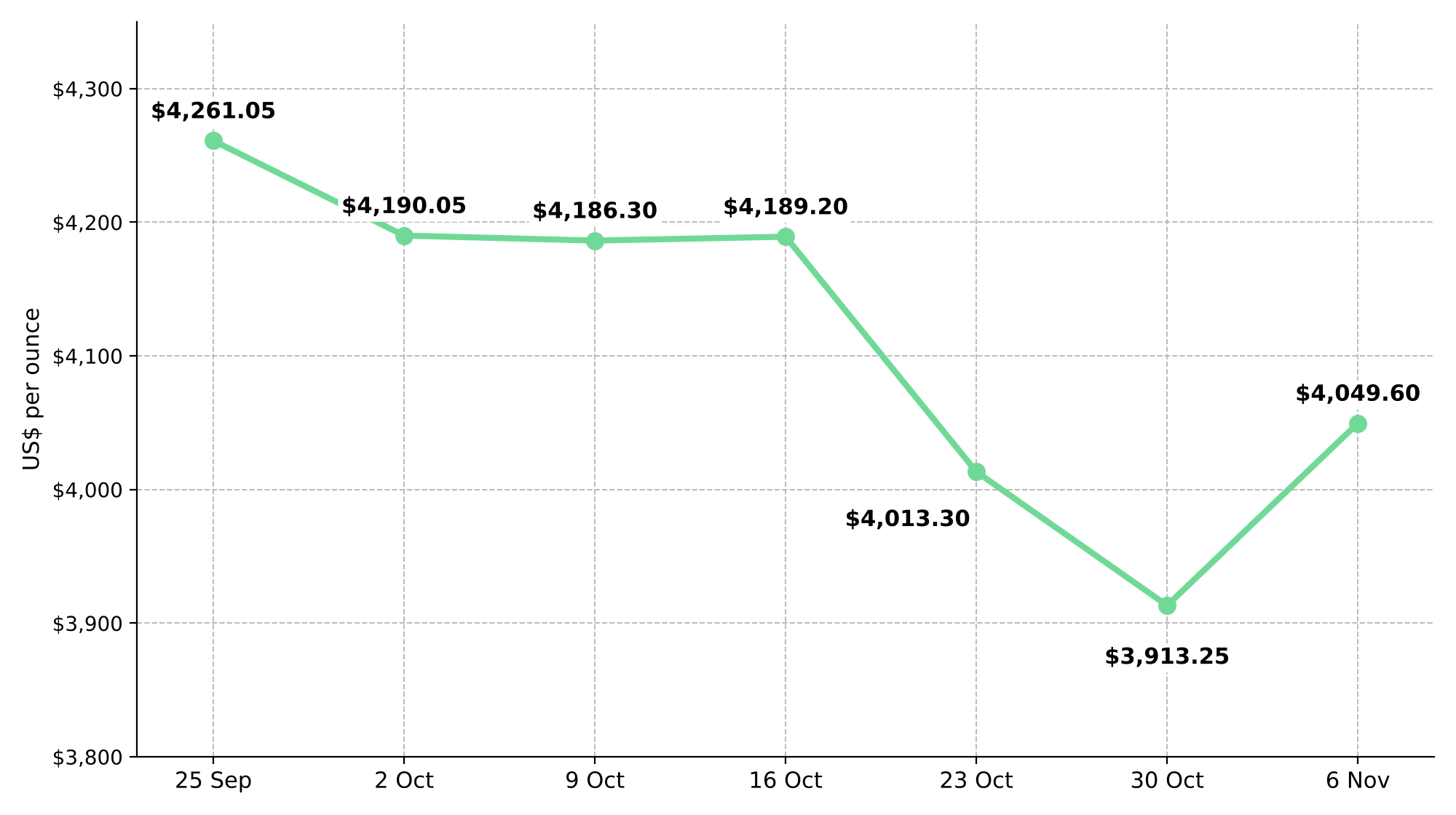
Spot gold has also moved through the $3,970 support level identified by Saxo Bank's Ole Hansen, and now sits 7.8% below the $4,262 third-quarter LBMA PM average that set producers' realised prices.
Fed Hike Odds Will Set Gold's Near-Term Range
With a 25 basis point hike largely priced, the 50 basis point odds are the variable to watch. If they fall back toward zero, gold could recover toward its pre-data level; the LBMA PM price was $4,049.60 on November 6. If they rise, the World Gold Council has said a test of $3,857/oz may still occur.
Lower energy prices could reduce inflation pressure, but the November CPI report is due December 10, a day after the Fed decision. A spot close above $4,000 after the November 13 PPI release would suggest the added hike risk has faded.
Higher Costs Leave High-Cost Producers More Exposed
All-in sustaining costs (AISC) measure the full cost of producing an ounce, including sustaining capital and site overhead. Every producer loses the same dollars per ounce when gold falls, but the loss is a larger share of margin for high-cost operations. At third-quarter costs, the drop from $4,262 to $3,931.54 cuts margin by 15.8% at $2,170/oz, against 12.6% at Agnico Eagle's $1,648/oz.
On the ASX, shutdowns, wet weather and higher fuel prices lifted September-quarter costs, Market Index reported, with Northern Star at A$3,217/oz (US$2,244/oz). ASX- and LSE-listed Resolute Mining reported US$2,506/oz.
AngloGold Ashanti, at $2,170/oz, attributed 61% of its annual cash-cost increase to external factors, including fuel and gold-linked royalties, which fall as prices decline. Shareholders in high-cost producers cannot know the December outcome in advance, and operating leverage means these shares can fall further than gold.
Cost Discipline Outweighs Fed Timing for Gold Miners
Gold is currently trading on the Fed's response to inflation rather than its role as an inflation hedge. For high-cost producers, valuations built on a sub-$4,000 gold price are more defensible than a bet on the December decision. Gold ETFs recorded net inflows in October despite the price decline, led by Europe, while North American funds saw a small outflow, according to the World Gold Council. Producers that lower costs now would enter any recovery with stronger margins.
Analyst's Notes





Subscribe to Our Channel





Stay Informed