A 43.29 g/t Gold Hit Takes Perfectstorm Past Tudor Gold's Porphyry: 7 Findings


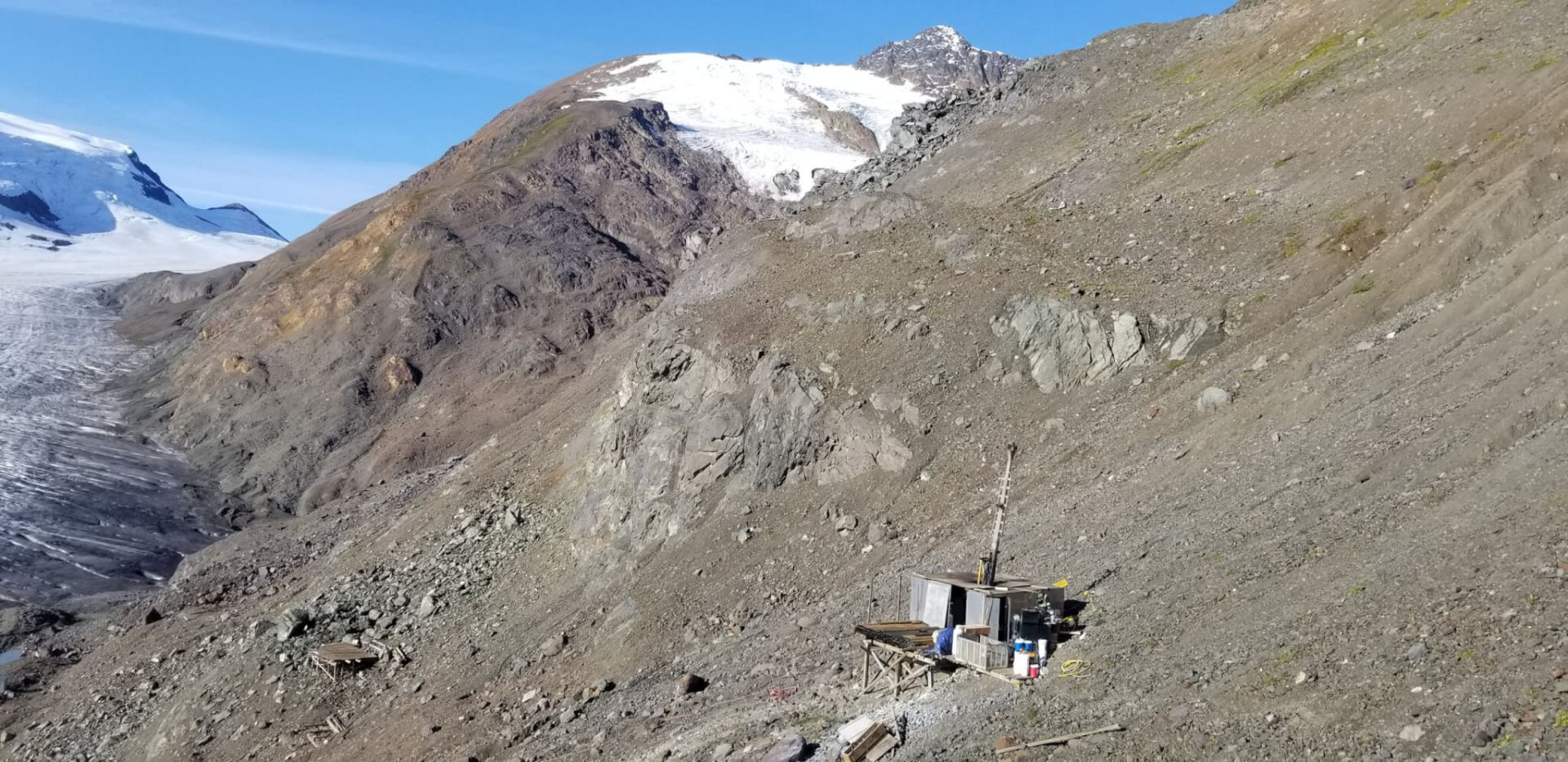
Tudor Gold's latest Perfectstorm holes outline a high-grade gold system 500 meters northwest of the porphyry as its 2026 drill program ends.
Project Overview
Tudor Gold (TSXV: TUD) holds an 80% interest in the 17,913-hectare Treaty Creek Project in British Columbia's Golden Triangle. The project borders Seabridge Gold's KSM property to the southwest and Newmont Corporation's Brucejack Mine property to the southeast. Its Goldstorm Deposit hosts Indicated Mineral Resources of 24.9 million ounces (Moz) of gold, 148.7 Moz of silver, and 3.048 billion pounds of copper. Goldstorm is the one deposit defined at Treaty Creek to date. The CBS, Eureka, and Perfectstorm zones are separate gold discoveries on the property.
On November 11, 2026, Tudor Gold reported results from 4 more holes at Perfectstorm and completed its 2026 Treaty Creek Exploration Program, with crews demobilizing from site. Two of the holes followed up surface sampling, and a third tested the PSP Zone at depth, the copper-gold porphyry system the 2026 program discovered. A porphyry is a large body of mineralization formed around an intrusion of igneous rock.
1. A New Gold System 500 Meters Northwest of the Porphyry
Perfectstorm's high-grade gold now extends to a new system about 500 meters (m) northwest of prior drilling on the porphyry.
The 2 follow-up holes identified a high-grade, low to intermediate sulfidation system. Epithermal systems are vein-hosted gold and silver deposits formed close to surface by hot fluids, and low to intermediate sulfidation is a subtype of that group.
The first hole returned 2.25 grams per tonne (g/t) gold and 3.10 g/t silver over 37.50 m from 127.50 m downhole, including 5.25 g/t gold and 6.93 g/t silver over 10.50 m. The same hole also cut 7.15 g/t gold and 1.58 g/t silver over 3.00 m from 162.00 m, and 1.91 g/t gold and 8.66 g/t silver over 6.50 m from 289.50 m.
2. The Batch's Highest Gold Grades Came From the Northwest
The second northwest hole returned the highest gold grades in the November 11 results, led by 9.00 g/t gold over 9.50 m.
That interval started 163.50 m downhole, with 9.66 g/t silver. It included 22.29 g/t gold and 21.52 g/t silver over 3.62 m, and within that, 43.29 g/t gold and 16.90 g/t silver over 1.20 m. Closer to surface, the same hole cut 0.80 g/t gold, 713.91 g/t silver, and 0.15% copper over 4.20 m from 45.00 m downhole.

3. Drilling Traces the Surface Zone 190 Meters Down-Dip
The northwest holes tested a vein and breccia system that surface sampling had mapped.
Prospecting through the 2026 season identified a strongly mineralized vein and breccia system approximately 25 m wide at surface, made up of multiple mineralized structures containing abundant chalcopyrite and galena. Breccia is rock broken into angular fragments and cemented back together, and chalcopyrite and galena are copper and lead sulfide minerals. Four of the surface samples returned up to 12.90 g/t gold and up to 444 g/t silver, indicating a precious-metal-rich structural system.
The first northwest hole cut 10.17 g/t gold and 11.85 g/t silver over 4.50 m, 190 m down-dip of the surface expression, measured down the incline of the structure. The second hole extended the mineralized zone along a strike length of 125 m, the distance along the structure's surface trend.
4. A Second Surface Structure Lies 210 Meters East
Surface sampling on another structure 210 m to the east returned up to 35.66 g/t gold.
The structure trends north to south, and the results indicate the possibility of multiple stacked sub-vertical structures, meaning near-vertical veins lying side by side. The top sample, taken from outcrop, returned 35.66 g/t gold, 142 g/t silver, and 0.941% copper. Additional prospecting across the area returned results indicating the possibility of multiple high-grade gold and silver structures.
5. The PSP Zone Gains 220 Meters at Depth
A third hole extended gold-dominant mineralization in the PSP Zone 220 m deeper than an earlier intercept, returning broad gold intervals down its length. The earlier intercept returned 0.85 g/t gold and 4.09 g/t silver over 34.50 m. The new hole cut 1.77 g/t gold and 2.31 g/t silver over 21.60 m from 366.00 m downhole, including 6.89 g/t gold and 5.86 g/t silver over 3.55 m. Further down, it returned 0.90 g/t gold and 1.27 g/t silver over 37.85 m from 472.15 m. At its deepest, it returned 0.93 g/t gold and 3.40 g/t silver over 49.80 m from 1,042.95 m downhole, including 2.34 g/t gold and 10.16 g/t silver over 3.90 m.
The PSP Zone lies approximately 1 kilometer (km) southwest of Goldstorm at its closest point and approximately 4 km northeast of Seabridge Gold's Iron Cap Deposit. It is on the northeast-southwest trending Sulphurets corridor, which hosts multiple porphyry deposits and prospects. The system remains open in all directions.
President and Chief Executive Officer of Tudor Gold, Joseph Ovsenek, described in October the kind of porphyry intercept the program was drilling for:
"Just more of the same. We're not looking to ring any bells. Just consistency, nice consistent long intersects of mineralization."
The new intercepts are consistent, broad, and gold-dominant, and they add volume to the mineralized system.
6. A 22,511-Meter Season Leaves 19 PSP Holes at the Lab
Tudor Gold completed its 2026 program with 22,511 m drilled in 44 holes. The company entered the season with a plan of 8,000 to 10,000 m and expanded it as results came in. Drilling discovered the PSP Zone and multiple zones of epithermal gold mineralization at Perfectstorm.
The PSP Zone has been defined by 23 holes announced to date, with a further 19 holes in the queue for assaying. A maiden mineral resource estimate (MRE) is expected to be prepared for the PSP Zone once all assays from the 2026 program have been received. A resource estimate for an additional deposit at Treaty Creek was among the company's 2026 plans.
Ovsenek tied the season's purpose to a second deposit in October, while drilling was still underway:
"We want to show everyone that, look, there's more than just one deposit here."
With drilling complete, the assays still at the lab are the next input to that estimate.
7. What the Results Do Not Yet Establish
True widths and the orientation of the mineralized body are not yet determined, and the latest holes leave assays outstanding.
All assay values are uncut, so high grades enter the reported averages at full value, and intervals are drilled lengths. The mineralized body is open in all directions, and further drilling is required to determine its orientation and true widths. Surface samples include select samples, which are selective by nature, and float samples, loose rock not in place, and both may not represent true grades. Samples were assayed at MSA Labs in Langley, British Columbia, a laboratory independent of the company.
Epithermal mineralization at Perfectstorm is harder to connect between holes than the porphyry, a point Ovsenek conceded in October:
"And look, we're still seeing some nice gold epithermal. It's a little tougher to string together than the porphyry, but we're still focused on that a bit as well."
Two further northwest holes, drilled through the new zone, have assays pending, and Perfectstorm has no MRE yet.
Key Takeaways for Investors
- Two holes drilled beneath surface samples identified a new high-grade gold-silver system about 500 meters northwest of prior porphyry drilling at Perfectstorm.
- One northwest hole returned 9.00 grams per tonne gold over 9.50 meters, including 43.29 grams per tonne gold over 1.20 meters.
- A deeper hole extended gold-dominant mineralization in the PSP Zone 220 meters at depth, including 0.93 grams per tonne gold over 49.80 meters.
- The 2026 program finished at 22,511 meters in 44 holes, with 19 PSP Zone holes awaiting assays before a maiden mineral resource estimate.
- True widths have not been determined, and most surface results come from select samples that may not represent true grades.
Bottom Line
Tudor Gold closed its 2026 season with Perfectstorm results that extend the zone in 2 directions. Northwest of the porphyry, drilling turned surface samples of up to 12.90 g/t gold into drill intercepts of 9.00 g/t gold over 9.50 m and 10.17 g/t gold over 4.50 m. The new system lies about 500 m from prior porphyry drilling, and the 4.50 m interval is 190 m down-dip of its surface expression. At depth, the PSP Zone gained 220 m and a 49.80 m interval at 0.93 g/t gold. With 22,511 m drilled and 19 PSP holes in the assay queue, the next step is the MRE planned once those assays arrive. Two further northwest holes drilled through the new zone have assays pending, and surface sampling on a structure 210 m east returned up to 35.66 g/t gold.
Analyst's Notes





Subscribe to Our Channel





Stay Informed