enCore Energy: The Domestic Uranium Producer Built for This Geopolitical Moment


enCore Energy runs two operational ISR uranium plants in South Texas, holds 30.94 Mlbs of S-K 1300 resources, and is purpose-built for a moment when the United States can no longer afford to import 92% of its nuclear fuel.
- enCore Energy (NASDAQ: EU) is one of the only fully operational pure-play ISR uranium producers in the United States, with two active Central Processing Plants producing in South Texas right now.
- Uranium spot prices rose to $101.50 per pound in late January 2026, their highest level since February 2024, before easing to approximately $92 per pound by early February, according to analyst pricing data.
- The United States sourced just 8% of reactor fuel domestically in 2024. The remaining 92% came from foreign suppliers, led by Canada at 36%, Kazakhstan at 24%, and Australia at 17%, according to the U.S. Energy Information Administration's 2024 Uranium Marketing Annual Report.
- U.S. officials are reportedly considering a special military operation to secure Iran's near-bomb-grade enriched uranium stockpile, a development that signals how profoundly uranium has crossed from energy commodity into strategic geopolitical asset.
- enCore holds 30.94 million pounds (Mlbs) Measured and Indicated and 20.54 Mlbs Inferred under the S-K 1300 standard, with less than 38% of planned extraction contracted through 2033.
The Strategic Signal That Changes the Uranium Story
In March 2026, Reuters and The Straits Times reported that U.S. officials were discussing whether to deploy special operations forces into Iran to locate and remove a stockpile of near-bomb-grade enriched uranium. International inspectors had not been able to verify its location for months following military strikes on Iranian nuclear facilities. The concern was that the material had been relocated or buried.
Whether or not that operation proceeds, the conversation itself is the signal. When a commodity becomes the subject of military contingency planning at the highest levels of government, it has crossed a threshold. Uranium is no longer just reactor fuel. It is a strategic geopolitical asset, and the implications for supply chains, prices, and domestic producers are direct and durable.
For investors, the relevant question is not what happens in Iran. It is which companies are positioned on the right side of that threshold. The answer points to domestic U.S. producers operating on American soil, under American law, with production already running.
"In the 1980s, the U.S. had enough domestic uranium supply to be self-sufficient, and it is possible to achieve this again."
A Global Market Running Into a Supply Wall
Nuclear energy now provides approximately 9% of the world's electricity from about 440 power reactors operating in 31 countries, according to the World Nuclear Association's February 2026 update. An additional 70 reactors are currently under construction worldwide, based on the WNA's 2025 Performance Report, with 59 of those in Asia alone. That expanding fleet translates directly into growing uranium demand for decades.
On the supply side, the picture is structurally tight. Global uranium production is dominated by a handful of countries. According to WNA 2024 production data, Kazakhstan accounted for 39% of world mine supply, followed by Canada at 24% and Namibia at 12%. Australia, often cited in older data, has fallen behind Namibia in current production rankings. That level of concentration in a handful of state-linked producers is precisely what makes supply security a policy priority rather than just a market concern.
"Uranium is a strategic critical mineral, reflecting its importance for energy security."
The spot market has begun to reflect the tightening. Uranium futures climbed from a 2025 low of $64 per pound in March to $81.70 by December 31, 2025, according to analyst pricing data. They then surged further, reaching $101.50 per pound in late January 2026, the highest since February 2024, before easing to approximately $92 per pound by early February, according to analysts. The long-term demand story, not near-term speculation, is driving that move.
Washington Is Responding. enCore Is Already Positioned.
The U.S. domestic supply picture, documented in the EIA's 2024 Uranium Marketing Annual Report released in September 2025, is clear: U.S. domestic uranium accounted for just 8% of total deliveries to American nuclear reactors in 2024, up from 5% in 2023. Canada led at 36%, Kazakhstan followed at 24%, Australia at 17%, Uzbekistan at 9%, with both Namibia and Russia each at 4%. The combined dependence on Kazakhstan and Uzbekistan, both of which are substantially state-controlled producers, stood at 33%.
The federal response has been substantial and bipartisan. Congress unlocked $2.72 billion in funding tied to the Prohibiting Russian Uranium Imports Act, which also banned Russian uranium imports effective August 11, 2024. In January 2026, the Department of Energy awarded contracts totaling $2.7 billion to three companies to build domestic enriched uranium capacity over the next decade. Uranium was reinstated to the U.S. critical minerals list for 2025, and fast-track permitting frameworks were activated for key domestic projects.
"Dependency on supply from State Owned Enterprises creates vulnerabilities and is not in the best interest of national security."Recent executive orders prioritize uranium production and nuclear energy expansion, streamlining regulations and declaring a national energy emergency to accelerate domestic energy independence."
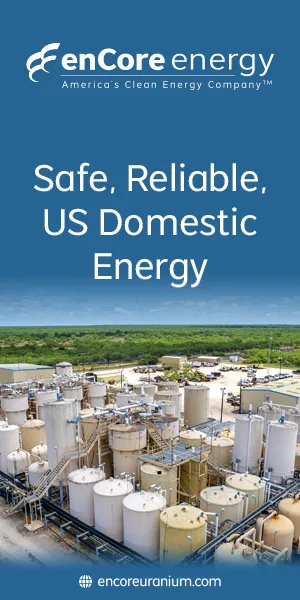
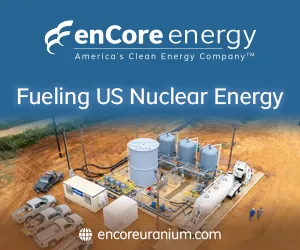
enCore Energy Corp. (NASDAQ: EU / TSX.V: EU) sits at the direct intersection of these policy and market forces. It is not a developer waiting for permits. It is not a royalty vehicle. It is a uranium producer with two Central Processing Plants actively running in South Texas today.
What enCore Actually Does, & Why the Method Matters
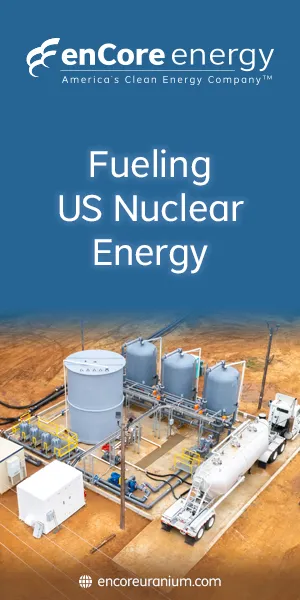
enCore is focused exclusively on In-Situ Recovery (ISR), the extraction method that now accounts for over 55% of global uranium production, according to WNA 2024 data. ISR injects oxygenated water into uranium-bearing sandstone to dissolve the metal and pump it to the surface, with no open pits, no underground tunnels, and no large waste rock piles. Industry data shows ISR capital expenditure runs at less than 15% of conventional mines, a structural cost advantage that gives ISR producers durability through price cycles.
"In-Situ Recovery is an extraction process with proven economic advantages and minimal environmental impact."
The leadership team reflects the depth of the company's operational focus. CEO Robert Willette brings more than 20 years of executive leadership across energy, manufacturing, and industrial sectors. The Technical Advisory Committee is chaired by Dr. Dennis Stover, who carries more than 50 years of direct ISR uranium experience. Seven analyst firms across the U.S. and Canada cover the stock. As of February 18, 2026, enCore carried a market capitalization of approximately $489 million USD at $2.52 per share, with 194 million shares issued and 202.5 million fully diluted.
Two Plants Running. A Pipeline Built Through 2030.
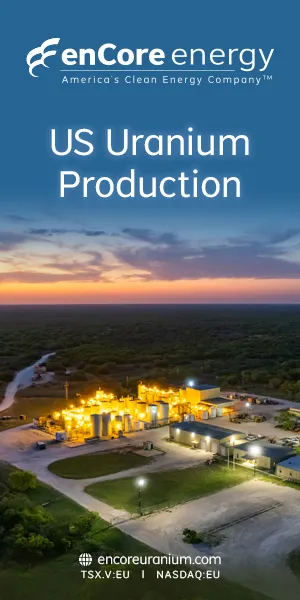
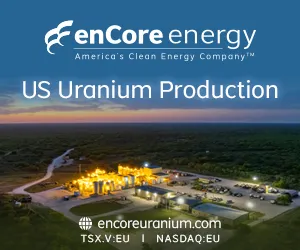
The Alta Mesa Central Processing Plant commenced production in Q2 2024 under a 70/30 joint venture with Boss Energy Limited, with enCore as managing partner. It is configured for 1 million pounds per year, with a design capacity of 2 million pounds annually including satellite Ion Exchange facilities. In 2025, the team commissioned 270 new production wells at the site, averaging one new well every 1.35 days.
"A total of 270 new production wells were turned on in 2025, averaging 22 per month or 1 every 1.35 days."
Wellfield 3 Extension is advancing toward final permitting. Wellfield 8 initial work has commenced. The Rosita CPP, with 800,000 lbs of annual capacity, operates a hub-and-spoke model capable of aggregating production from satellite Ion Exchange plants across a wide geographic footprint. Upper Spring Creek's first wellfield is nearly complete and awaiting final permitting.
Looking further out, the Dewey Burdock Project in South Dakota was approved for FAST-41 fast-track permitting in August 2025. It carries a pre-tax IRR of 39% at $86.34/lb, a 28-year mine life, and a $264.2 million initial capex of $18.72 per pound. The Gas Hills Project in Wyoming shows a pre-tax IRR of 54.8% at $87/lb, with initial capital of just $55.2 million, or $9.05 per pound of lifetime production. Both carry completed technical economics and pipeline positions in the company's stated schedule through 2030.
"Operations are presently underway at the Alta Mesa CPP and Rosita CPP."
The Pricing Strategy That Keeps Upside Open
enCore's sales structure is deliberately conservative on long-term commitment. Existing contracts represent less than 38% of planned extraction through 2033. The company's collared contract model provides inflation-adjusted price floors with meaningfully higher ceilings, protecting a revenue minimum while leaving the majority of future production available to capture price upside.
"Collared contracts have minimum price floors with significantly higher ceilings, ensuring a base level of revenue and exposure to higher prices in a rising uranium market."
With spot prices already trading above $90 per pound and the geopolitical backdrop providing a sustained risk premium, this posture is not passive. It is a deliberate bet that the uranium cycle has further to run, and that the majority of enCore's future production should be priced into that move, not locked in at today's rates.
"At current prices we plan to contract less than 50% of our planned annual extraction rates. Contracting will likely increase if spot prices begin to spike."
The Investment Thesis for enCore Energy
- enCore is one of the only pure-play ISR uranium producers in the U.S. with two plants already running, giving investors direct domestic production exposure with no development-stage risk.
- The company holds 30.94 Mlbs of Measured and Indicated resources and a pipeline of high-return projects extending through 2030, with room to grow production for years.
- Less than 38% of planned output is contracted through 2033, meaning the majority of enCore's future production is open to capture spot market upside as uranium prices rise.
- Washington banned Russian uranium imports, committed $2.7 billion to domestic enrichment, and placed uranium on the critical minerals list all policies that create structural demand for U.S. producers like enCore.
- With the U.S. sourcing just 8% of reactor fuel domestically and geopolitical pressure on foreign supply chains intensifying, enCore is directly positioned to benefit from a supply gap that policy alone cannot close overnight.
enCore Energy sits at the convergence of three forces that rarely align: a structural supply gap in a commodity the U.S. government has declared a national security priority, a geopolitical backdrop that has permanently elevated the strategic value of domestic uranium production, and an operational track record that puts the company in actual production while most of its peers are still waiting for permits. With two plants running, 30.94 Mlbs of Measured and Indicated resources, a high-return pipeline extending to 2030, and less than 38% of future output contracted, enCore is not a speculative bet on uranium, it is one of the clearest ways to own the domestic uranium supply story while preserving meaningful upside to where prices go from here.
TL;DR
enCore Energy has two uranium plants running in Texas today. The U.S. sources 92% of its reactor fuel abroad. Washington is spending $2.7 billion to fix that. Uranium hit $101.50/lb in January 2026. enCore has 30.94 Mlbs of resources and less than 38% of planned production contracted through 2033. The case is straightforward.
FAQs (AI-Generated)
Analyst's Notes





Subscribe to Our Channel








Stay Informed