




Latin Metals Targets Growth Through Meter-Based Earn-In Agreements


%20(1).webp)
Latin Metals: Pure prospect generator optioning Argentina/Peru projects for meter-based earn-ins. $80M-$180M committed drilling. No equity raises needed. Royalty evolution path.
- Latin Metals operates exclusively as a prospect generator in Argentina and Peru, running on $2-3M annually without drilling assets themselves, instead optioning projects to partners for 70-75% earn-in based on drilling meters rather than expenditure
- Currently has $80M in committed investment under option agreements, targeting $160-180M by year-end as all current projects get optioned out, driven by improved Argentina sentiment
- Has established relationships with Newmont, Barrick, and AngloGold Ashanti, with current partners including Moxico Resources (65,000-meter drilling program) and active drilling in Santa Cruz Province
- Concentrated in Argentina and Peru where CEO has deep relationships and local knowledge; controls ~500,000 hectares in northwest Argentina prospective for sediment-hosted gold deposits
- Structure designed to evolve into organic royalty company through NSRs and minority positions, with cash injections tied to resource estimates (dollars per ounce) rather than traditional buyouts
In an industry where junior mining companies typically raise capital to drill their own projects, Latin Metals has positioned itself as a pure prospect generator with a fundamentally different business model. Led by CEO Keith Henderson, a geologist with over 30 years of international experience, the company focuses exclusively on identifying high-quality assets in South America and partnering with well-capitalised operators to unlock value without the capital intensity of traditional exploration. As Argentina's mining sector experiences renewed investor interest following political changes, Latin Metals finds itself with a portfolio of advanced projects positioned to capitalise on this shift in sentiment.
The Prospect Generator Model Explained
Henderson articulates a clear distinction between Latin Metals and typical junior explorers.
"We run the company on very little money, typically $2 to $3 million per year. We try our very best not to raise money and not to dilute the shareholders and we take asset level dilution instead of shareholder dilution."
The company never conducts drilling itself, instead seeking partners who can earn majority positions (typically 70-75%) in projects by committing to specific drilling programs.
Critically, Latin Metals has evolved beyond traditional expenditure-based earn-ins. The company now structures agreements based purely on drilling meters rather than dollar commitments, recognising that major mining companies can allocate substantial overhead costs to projects without meaningful ground work. This metric-based approach ensures shareholder value is tied directly to exploration activity rather than accounting allocations.
Portfolio Construction and Geographic Focus
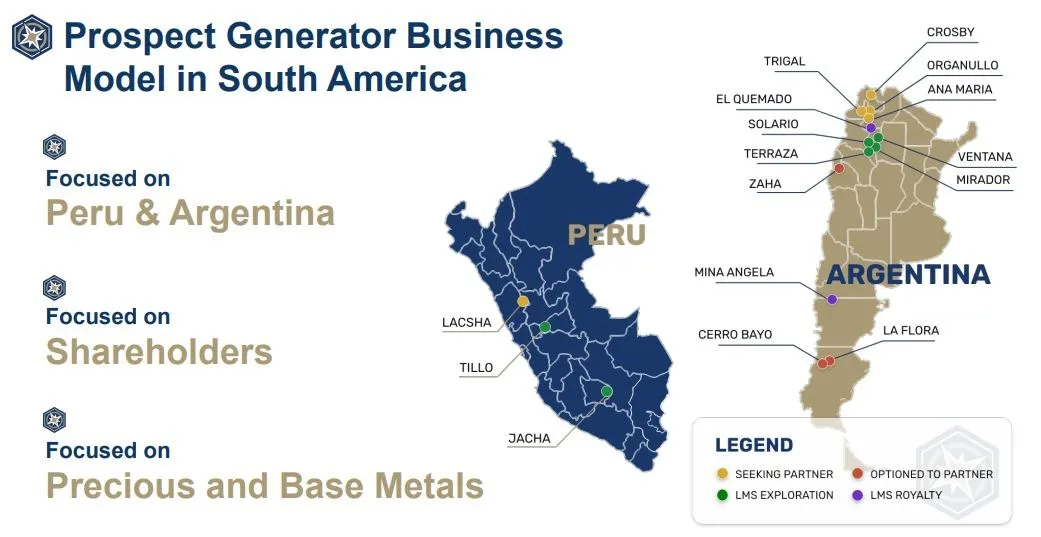
Latin Metals concentrates its efforts in Argentina and Peru, jurisdictions where Henderson has cultivated deep relationships and operational knowledge over many years. The geographic focus reflects practical considerations:
"After a while you get really comfortable working in a country, and people. You know where to turn to if you need help. You start to build relationships with the government and you know that you can work with the communities."
In Argentina specifically, the company operates at the provincial level, concentrating on three to four provinces with favourable mining frameworks as identified by Fraser Institute surveys. The company has assembled a significant land position, including approximately 500,000 hectares in northwest Argentina prospective for sediment-hosted gold deposits - a deposit type that accounts for roughly 20% of global gold production but has been largely overlooked in South America.
Current Project Pipeline and Partner Quality
The company's existing portfolio demonstrates its ability to attract substantial partners. The Zaha project in San Juan Province has been optioned to Moxico Resources, a London-based producer operating in Zambia's copper belt. This agreement represents one of the most significant earn-in structures Henderson has negotiated: 65,000 meters of drilling over five to six years, plus technical studies through feasibility. "Those are serious earn-ins, that's not an average earn-in," Henderson notes, emphasising the scale of commitment secured.
Another project in Santa Cruz Province's Deseado Massif - a region that has produced numerous discoveries over the past two decades - recently completed drilling with a well-financed partner, with results pending. The company also holds the Organullo project, previously under option to AngloGold Ashanti, which completed three years of permitting work and developed a high-sulfidation gold target model before returning the project. This reversion actually strengthened Latin Metals' position, as the asset is now permitted and de-risked in a much stronger gold price environment.
The Major Mining Company Relationship
Henderson's experience working with companies like Newmont, Barrick, and AngloGold Ashanti has shaped his understanding of what these operators seek and how they behave. While majors bring technical expertise and capital, they also exhibit what Henderson describes as a key weakness:
"The downside of the major companies is they are prone to a random change of direction."
However, this characteristic doesn't diminish value - it often enhances it. When AngloGold Ashanti withdrew from Organullo, they left behind permitted, advanced-stage exploration work completed when gold traded around $1,200 per ounce. With gold approaching $5,000, the project's economics and Latin Metals' optionality both improved substantially. The company now has multiple parties interested in the asset and can select partners based not just on commercial terms but on operational capability and community relations approach.
Interview with Keith Henderson, CEO, Latin Metals
Financial Structure and Value Realisation
Latin Metrics structures its option agreements to generate multiple value inflection points. Beyond the initial earn-in percentage (70-75%), partners typically receive the option to acquire an additional 5% at cash rates tied to resource estimates - calculated as dollars per gold-equivalent ounce. This approach creates significant cash injections at the resource definition stage without requiring partners to complete full economic studies.
The end-state vision is transformation into an organic royalty company. As projects advance and partners exercise their options, Latin Metals retains net smelter royalty (NSR) positions across a diversified portfolio. This structure provides leverage to commodity prices and project success without the capital requirements of operator-level participation.
Capital Efficiency and Growth Trajectory
Currently operating with $80 million in committed investment under option agreements, Henderson projects this figure will reach $160-180 million by year-end as the company executes additional partnerships.
"By the end of the year, I think that number is going to be 160 to 180 million, and I think at that point, all of our current projects will be optioned out."
Importantly, this growth occurs without corresponding increases in corporate overhead. The company maintains its $2-3 million annual cash requirement and expects to avoid equity financings through 2026, 2027, and potentially 2028. Henderson emphasises the implications: "It really is truly a story where if you want to own it, you got to go buy it."
Differentiation: The Pure-Play Philosophy
Perhaps Latin Metals' most distinctive characteristic is its adherence to a pure prospect generator model. Unlike competitors who eventually drill their own "flagship" projects - what Henderson terms "hybrid prospect generators" - Latin Metals has committed to never self-fund drilling.
"Every single prospect generator at some point in their life... eventually they all go, 'We should just drill one of our own projects,'. Once you're drilling and once you go down that road, you're raising money and you're spending money and it's just not the model."
This discipline reflects both strategic conviction and understanding of probability-weighted returns. Rather than concentrating capital and shareholder risk on a single drilling program, the model generates multiple exploration catalysts across different partners, geologies, and timeframes. With improved sentiment in Argentina creating demand for advanced-stage projects, this diversified catalyst stream positions the company for near-term re-rating.
The Investment Thesis for Latin Metals
- Capital-Light Model: $2-3M annual operating costs with no planned equity raises through 2028, eliminating shareholder dilution risk common in junior mining
- Catalysts Multiplier Effect: $80M-to-$180M committed investment pipeline creates multiple near-term drilling catalysts across diversified portfolio without corporate capital requirements
- Jurisdiction Timing: Positioned in Argentina as mining sentiment improves dramatically, with permitted, drill-ready projects meeting increased major mining company demand
- Partner Quality De-Risks Execution: Partnerships with Moxico (65,000-meter program), plus historical work by AngloGold Ashanti, Newmont, and Barrick validate technical merit
- Unique Earn-In Structure: Meter-based (not expenditure-based) agreements ensure partners deliver actual exploration work rather than overhead allocation
- Royalty Optionality: Long-term transformation into organic royalty company through NSR retention provides commodity price leverage without operational risk
- Management Alignment: Pure prospect generator discipline (no hybrid drilling) keeps capital focused on generative work and shareholder value maximisation
Macro Thematic Analysis
Latin Metals exemplifies the value creation potential when jurisdictional sentiment inflection meets operational preparedness. Argentina's political transformation under new leadership has catalysed a fundamental shift in mining exploration appetite, with major companies suddenly competing for advanced-stage assets they previously overlooked. Companies holding permitted, drill-ready projects in favorable provinces now control scarce bottleneck resources in an environment where capital seeking deployment exceeds available opportunities.
The prospect generator model capitalises on this dynamic through asymmetric leverage: modest corporate overheads generate exposure to hundreds of millions in third-party exploration investment, with each drilling program representing a catalyst independent of company cash requirements. As Henderson observes, "The demand for projects has increased very substantially in the last year," positioning Latin Metals' portfolio of mature Argentine and Peruvian assets precisely where capital wants to flow. The convergence of $5,000 gold, major mining company consolidation pressures, and South American jurisdiction re-rating creates a window where asset aggregators with local expertise and relationship capital can capture disproportionate value through intelligent partnering rather than capital deployment.
TL;DR
Latin Metals operates a pure prospect generator model in Argentina and Peru, structuring meter-based earn-in agreements that eliminate shareholder dilution while generating exposure to $80-180M in third-party exploration investment. With permitted projects meeting surging demand from major mining companies in newly favorable jurisdictions, the company is positioned for multiple near-term catalysts without capital requirements, ultimately evolving into an organic royalty company through NSR retention across a diversified portfolio.
FAQs (AI Generated)
Analyst's Notes





Subscribe to Our Channel



Stay Informed






















