




Kasiya's Monazite Recovery & the Heavy Rare Earth Value Layer Outside the Definitive Feasibility Study


Kasiya DFS shows US$2.2B NPV from rutile and graphite, plus excluded heavy rare earth monazite upside amid China's export controls.
- Kasiya's Definitive Feasibility Study (DFS) delivers a pre-tax net present value at an 8% discount rate (NPV8%) of US$2.2 billion and a 23% pre-tax internal rate of return (IRR) from primary rutile and natural flake graphite production.
- Monazite concentrate can be recovered from Kasiya's non-conductor tailings stream through additional gravity and magnetic separation, requiring no parallel rare-earth circuit and adding near-zero incremental cost to the primary flowsheet.
- Kasiya's monazite averages 2.9% combined dysprosium-terbium and 11.9% yttrium, approximately 7x higher than the average across Mt Weld, Mountain Pass, Bayan Obo, Weishan, and Maoniuping, the five largest global rare earth producing operations.
- China's export controls on dysprosium, terbium, and yttrium, imposed in April 2025 and tightened against Japan in January 2026, have created acute supply shortages in markets where Japan approaches 100% dependency on Chinese heavy rare earth supply and the US imports 100% of its yttrium requirements.
- The monazite stream and its potential revenue are entirely excluded from the current DFS, with mineralogical characterisation, recovery rate assessment at scale, and formal economic evaluation all pending.
Kasiya: Project Status & Scale
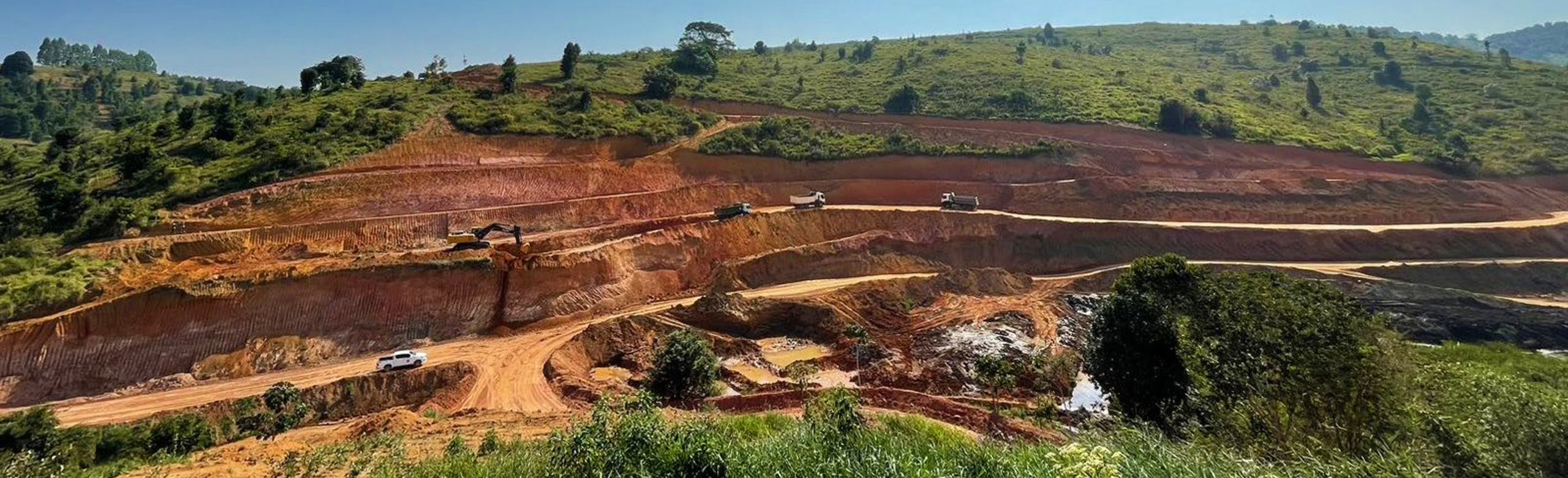
Kasiya is a Definitive Feasibility Study (DFS)-complete project in Malawi, targeting the world's largest simultaneous production of natural rutile and natural flake graphite. The resource stands at 2.1 billion tonnes, grading 0.96% rutile for 20.3 million tonnes of contained rutile and 0.95% total graphitic carbon for 20.0 million tonnes of contained graphite. A first-ever Measured Resource has been declared against a soft, blanket-style mineralisation in saprolite that requires no drilling, blasting, crushing, or milling. Ore extraction proceeds as a free-dig operation from flat, shallow deposits.
At a steady-state throughput of 24 million tonnes per annum, Kasiya targets annual production of 222,000 tonnes of natural rutile and 275,000 tonnes of natural flake graphite across a 25-year initial life of mine. Development proceeds in two phases: Phase 1, covering Years 1 to 4, operates at 12 million tonnes per annum, scaling to 24 million tonnes per annum from Year 5. Capital cost to first production is US$727 million, with total life-of-mine development capital of US$1,239 million and sustaining capital of US$431 million. Operating cost is US$450 per tonne of product, free on board Nacala. The project's pre-tax net present value at an 8% discount rate (NPV8%) is US$2.2 billion, against a pre-tax internal rate of return (IRR) of 23%.
Sovereign Metals (ASX: SVM | AIM: SVML | OTCQX: SVMLF) carries Rio Tinto as a 19.9% strategic investor. Non-binding memoranda of understanding are in place with Mitsui & Co. for rutile offtake and Traxys North America for graphite. The DFS scope covers only primary rutile and graphite by-product production. Monazite potential is explicitly excluded from all published economics.
Monazite Recovery: Flowsheet Origin & Processing Route
Kasiya's monazite stream carries near-zero incremental cost because it is extracted from material the rutile flowsheet already treats as waste. Monazite concentrate is recovered from the non-conductor tailings stream produced following electrostatic separation of a heavy mineral gravity concentrate in the existing circuit. This material, which would otherwise be discarded in the standard separation process, is subjected to additional gravity separation and then magnetic separation to yield the monazite product. No complex processing is required, and no parallel rare-earth circuit is needed.
The cost structure follows directly from the extraction architecture. Because monazite is isolated from a waste stream already generated by the primary flowsheet, its production adds no primary processing load and requires no dedicated circuit capital. Conventional rare-earth operations build their cost base around ore extraction and parallel full rare-earth processing circuits specifically designed for the rare-earth minerals. Kasiya's route bypasses that cost structure entirely; the capital and operating expenditure behind the near-zero incremental cost is the primary rutile circuit, which already exists in the project design. Detailed assessments of recovery rates at scale and full flowsheet integration remain pending, and their outcomes will define the volume available for formal economic evaluation.
Heavy Rare Earth Composition & the 7x Ratio
Kasiya's monazite concentrate falls into a compositional category that the world's largest rare-earth operations do not. The concentrate averages 2.9% combined dysprosium-terbium (DyTb), reaching up to 3.9%, and 11.9% yttrium, reaching up to 17.3%. Neodymium-praseodymium (NdPr) content averages 21.8%. The five largest global rare earth producing operations, Mt Weld in Australia, Mountain Pass in the US, and Bayan Obo, Weishan, and Maoniuping in China, average 19.4% NdPr, 0.4% DyTb, and 1.7% yttrium across their respective products. Kasiya's DyTb and yttrium concentrations are approximately 7x higher than the average for both elements.
The differential reflects a structural feature of the global rare earth supply base. The five comparator operations collectively account for over 70% of global rare earth output, but their deposits are dominated by light rare earths, principally lanthanum and cerium, which are abundant and low-value. Mountain Pass, the primary domestic rare-earth source for the US, reports 0.0% DyTb and 0.0% yttrium in its product. The gap between the 0.4% DyTb average across the five largest operations and Kasiya's 2.9% average suggests Kasiya's potential to produce a very high-value rare earth product capable of supplying advanced technology and defence systems.
Chinese Export Controls & Western Supply Dependency
China's export controls on dysprosium, terbium, and yttrium, introduced in April 2025, converted a longstanding supply dependency into an active operational constraint for Western and Japanese manufacturers. Those controls were extended and tightened specifically against Japan on 6 January 2026, concentrating pressure on the largest non-Chinese consumer of heavy rare earths. The effect has been acute supply shortages across end markets that depend on these elements, at a time when the world's largest non-Chinese rare-earth operations lack sufficient heavy rare-earth content.
Japan's position illustrates the structural depth of the exposure. Despite 15 years of active diversification efforts, Japan remains approximately 60% dependent on Chinese rare earth imports overall, with dependence approaching 100% for heavy rare earths specifically. The US carries a parallel vulnerability for yttrium, meeting 100% of its requirements through imports. Both nations are significant consumers of the elements now subject to Chinese export controls.
The demand condition that Kasiya's monazite stream could address is therefore measurable rather than prospective. The three elements in which the concentrate is most heavily concentrated, at approximately 7x the global comparator average for DyTb and yttrium, are precisely those for which China has imposed active export controls and created acute shortages in the two largest non-Chinese consumer markets. The commercial development of the stream remains subject to evaluation programme outcomes, but the market conditions it would enter are active today.
Defence & Aerospace End-Use Applications
Dysprosium and terbium are essential for high-temperature permanent magnets used in defence systems and precision weapons.
Yttrium serves a distinct but equally critical function across multiple aerospace and industrial application categories. In aerospace, it is used in thermal barrier coatings. Yttrium is also present in radar and laser systems, alloy strengthening, and semiconductor manufacturing.
DFS Exclusion & the Evaluation Programme
The published economics for Kasiya assign no value to the monazite stream. The pre-tax NPV8% of US$2.2 billion and the 23% pre-tax IRR reflect only the primary rutile and graphite operation. No monazite revenue, no by-product credit, and no associated capital or operating cost allocation appear in the DFS. Whatever the evaluation programme ultimately establishes as the stream's financial contribution, it represents incremental value relative to this published baseline.
The evaluation programme currently underway comprises three defined workstreams: detailed mineralogical characterisation of the monazite concentrate; assessment of heavy rare-earth recovery rates at scale using the proposed flowsheet; and a formal economic evaluation of the by-product stream. Preliminary laboratory recovery at Sovereign's Lilongwe facility has confirmed the mineral's presence and separability. The transition from that confirmation to a scaled, economically characterised by-product stream requires completing ongoing work.
The cost basis and compositional baseline are not among the open variables. The near-zero incremental cost derives from the flowsheet architecture and is fixed by the project design. The DyTb and yttrium concentrations in the monazite were confirmed by preliminary analysis. What the evaluation programme will determine is the volume recoverable at commercial scale and the formal economic value attributable to that volume, against a supply environment in which the demand case for the elements concerned is no longer prospective but active.
Investment Thesis for Sovereign Metals
- Kasiya's Definitive Feasibility Study returns a pre-tax net present value at an 8% discount rate of US$2.2 billion and a 23% pre-tax internal rate of return from primary rutile and natural flake graphite production, against capital to first production of US$727 million.
- The project's soft, free-dig saprolite ore requires no drilling, blasting, crushing, or milling, supporting a published operating cost of US$450 per tonne of product at a steady-state throughput of 24 million tonnes per annum across a 25-year life of mine.
- Kasiya's monazite concentrate can be recovered from the project's non-conductor tailings stream at near-zero incremental cost, bypassing the need for a parallel full rare-earth processing circuit required by primary rare-earth miners.
- The concentrate averages 2.9% combined dysprosium and terbium and 11.9% yttrium, approximately 7x higher than the average across the five largest global rare-earth-producing operations, none of which are primary heavy rare-earth sources.
- China's export controls on dysprosium, terbium, and yttrium, introduced in April 2025 and tightened against Japan on 6 January 2026, have created acute supply shortages in markets where Japan approaches 100% dependency on Chinese heavy rare earth supply, and the US imports 100% of its yttrium requirements.
- The monazite stream and its potential revenue contribution are entirely absent from the current Definitive Feasibility Study, with formal economic evaluation, mineralogical characterisation at scale, and recovery rate assessment all pending.
The DFS base case assigns the monazite stream no value, making the evaluation programme's outcomes incremental upside to a project already publishing a pre-tax NPV8% of US$2.2 billion. The supply conditions a validated stream would address, active Chinese export controls on dysprosium, terbium, and yttrium, are present in end markets today.
TL;DR
Kasiya is a DFS-complete project in Malawi targeting the world's largest output of natural rutile and natural flake graphite, with a published pre-tax NPV8% of US$2.2 billion and a pre-tax IRR of 23%. A third mineral stream, monazite concentrate recoverable from the project's existing rutile flowsheet at near-zero incremental cost, has dysprosium-terbium and yttrium concentrations approximately 7x higher than the average across the five largest global rare-earth-producing operations. This stream is entirely absent from the current DFS economics. China's export controls on dysprosium, terbium, and yttrium, introduced in April 2025 and tightened against Japan in January 2026, have created acute supply shortages in end markets, where Japan approaches 100% dependency on Chinese heavy rare-earth supply, and the US imports all of its yttrium requirements. The evaluation programme underway will determine the commercial scale of this stream; until it concludes, its contribution is not included in the figures used to value the project.
FAQs (AI-Generated)
Analyst's Notes





Subscribe to Our Channel




Stay Informed


