




Lifezone Metals Advances US Autocats Refinery Plan After Pilot Metal Production


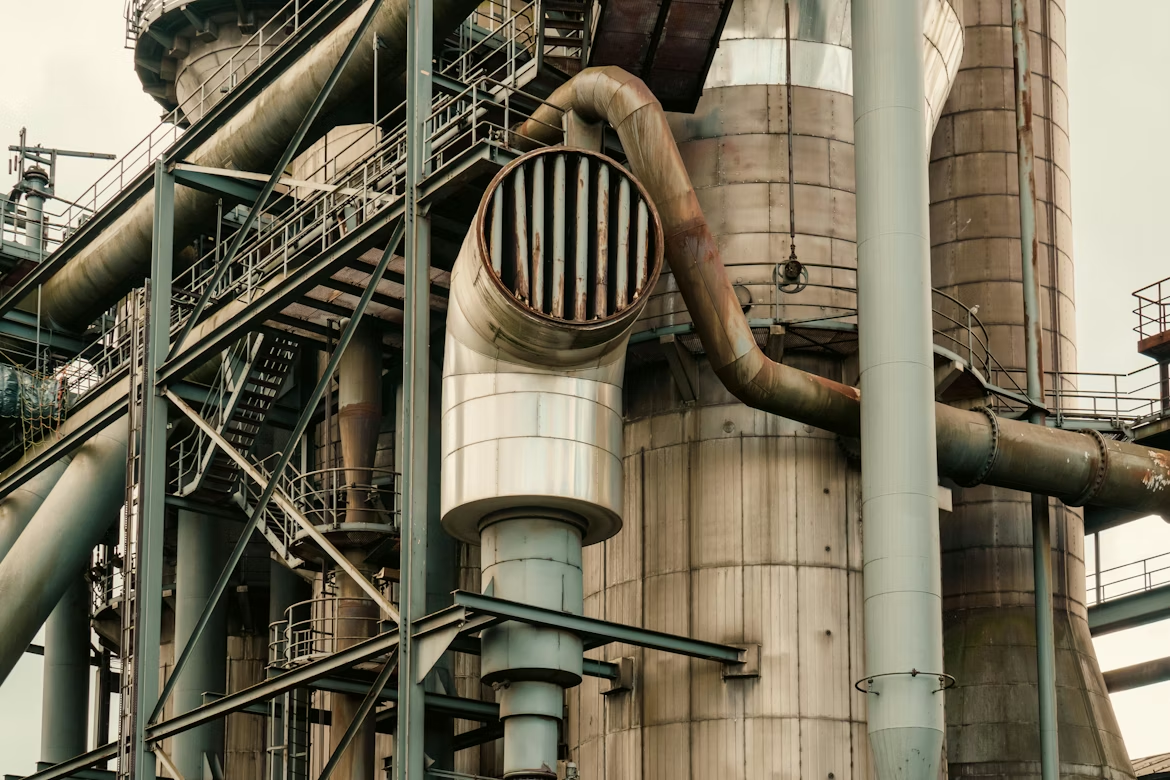
Lifezone Metals produces the first refined platinum, palladium, and rhodium from US Autocats, ahead of a targeted second-quarter 2026 investment decision.
- Lifezone Metals has produced its first refined samples of platinum, palladium, and rhodium from US-sourced spent automotive catalytic converters, using its in-house hydrometallurgical process.
- The technical programme ran for 24 months, covered 1,179 locked-cycle and pilot batch tests, processed 1 ton of US-sourced Autocats monolith material, and delivered recoveries above 99% for platinum and palladium and 95% for rhodium.
- The campaign has locked down the flowsheet and informed design criteria for a planned US precious metals recycling refinery, with engineering design and feasibility study work nearing completion.
- Lifezone's hydrometallurgical route is designed to offer lower emissions than traditional smelting and refining, zero sulfur dioxide emissions, and a shorter production and working capital pipeline than conventional pyrometallurgical processing.
- The technical case has advanced materially, but final purity optimisation, feasibility completion, grant outcomes, financing support, and a second quarter 2026 investment decision still separate pilot success from commercial implementation.
Lifezone's Autocats Project Has Moved Beyond Concept Validation
Lifezone Metals has produced its first samples of platinum, palladium, and rhodium from US-sourced spent automotive catalytic converters, using its in-house hydrometallurgical process. That changes the project's status. The question is no longer whether chemistry can, in principle, produce separated precious metals. The question is now whether that demonstrated process can be converted into a commercial US refinery on acceptable technical, financial, and operating terms.
Pilot plant work continued through the first quarter of 2026, with extensive batch, locked-cycle, and continuous pilot plant work now completed. That places the project in the interval between process demonstration and investment approval. Engineering design and feasibility study work are advancing and nearing completion, while a financial investment decision for a commercial US plant remains targeted for the second quarter of 2026.
Chief Executive Officer and Director of Lifezone Metals, Chris Showalter, puts it this way:
"Achieving the first-ever production of platinum, palladium, and rhodium metal samples from spent Autocats marks a historic milestone towards industrial implementation of Lifezone's Hydromet Technology."
The Technical Case Has Now Been Substantially De-Risked
The scale and duration of the test programme are what move this update beyond a laboratory milestone. Lifezone ran 24 months of work across 1,179 locked-cycle and pilot batch tests on 1 ton of US-sourced Autocats monolith material. That is large enough to establish continuity across leaching, purification, separation, and metal reduction steps, rather than relying on isolated bench-scale outputs. In process-risk terms, the programme reduces uncertainty around whether the flowsheet works as an integrated sequence.
The reported results are strong in the dimensions that matter most for refinery design. Platinum and palladium recoveries exceeded 99%, rhodium recovery reached 95%, and stage 1 product purities were above 99% for platinum and palladium. Those figures indicate that the chemistry has moved through the full chain from extraction to refined metallic products. They do not yet mean that final commercial-specification products have been fully locked in, but they materially narrow the technical unknowns that would normally sit between laboratory hypotheses and engineering definitions.
Chief Technology Officer of Lifezone Metals, Dr. Mike Adams, is precise on this point:
"The test work confirmed high recoveries (up to 99% Pt & Pd and 95% Rh, as per test no. 0172) of these critical metals to platinum, palladium, and rhodium metal products, using our technology."
That distinction is where the de-risking sits. The project has not become risk-free. It has, however, moved from proving recoverability to demonstrating an integrated route that has produced metal, at pilot and locked-cycle scale, from the exact US-sourced feed category the company intends to process.
Flowsheet Definition Now Supports Plant Design Rather Than Laboratory Hypothesis
A recycling refinery is not financed solely on the strength of a metal sample. It gets financed on the strength of a repeatable flowsheet, defined operating parameters, and enough engineering confidence to support plant design. The Autocats programme has now reached that stage. The test work campaign and the locking down of the flowsheet support engineering design and feasibility work, and were undertaken specifically to inform design criteria for the planned US refinery.
That is a narrower and more useful claim than declaring the project commercially ready. Proof of process shows that metal can be produced. A design basis shows that the process can now inform equipment selection, operating conditions, reagent assumptions, and refinery configuration. That is the bridge between scientific success and project definition. Without it, feasibility work remains theoretical. With it, feasibility begins to rest on an operating process window rather than on assumed chemistry.
The in-house structure carries practical implications for iteration speed. Simulus Laboratories was brought into Lifezone in 2023, and that internal capability shortened laboratory testing times, avoided delays from external labs, maintained intellectual property confidentiality, and improved cost control. Iteration cycles could be run faster and with tighter control over process knowledge. For a proprietary hydrometallurgical route, that internal capability shortens the path from test outcome to design adjustment. It does not remove scale-up risk, but it does reduce the friction that often slows complex metallurgical development programmes.
The Advantage Claim Rests on Process Efficiency, Emissions Profile & Working Capital Compression
Lifezone's strategic argument for the Autocats project extends beyond metal recovery. It is possible that the route may do so with a different operating profile from conventional smelting and refining. The hydrometallurgical process is expected to generate less carbon dioxide emissions per ton of metal than traditional smelting and refining, while producing zero sulfur dioxide emissions. In a recycling context, that affects both the permitting profile and the operating conditions under which a domestic refinery could compete.
The second mechanism is production-pathway length. Conventional pyrometallurgical routes typically involve multiple stages across smelting, intermediate handling, refining, and metal recovery, each of which can extend the time between feed acquisition and saleable product. Lifezone's hydrometallurgical route is expected to compress that pipeline. A shorter production cycle means less time with metal tied up in process inventory. In financial terms, that can reduce working capital requirements because fewer dollars remain trapped in the plant before conversion into revenue-bearing refined metal.
The third mechanism is plant structure. Lifezone has structured the project for scalability and capital efficiency, targeting a modular approach built around smaller, more targeted refining capacity rather than the larger, fixed infrastructure associated with smelting complexes. The process claim rests on the route's configuration, not on a generic assertion that hydrometallurgy is superior in all settings. If commercialised successfully, the combination of a lower-emissions profile, a shorter working capital duration, and potentially lower capital intensity would economically differentiate the plant.
Technical Success Does Not Yet Remove Commercial & Execution Risk
The project has advanced far enough that the main residual questions are no longer about whether precious metals can be recovered from US Autocats but whether the process can be optimised to final target specifications and handed cleanly into a board-approved commercial decision. Lifezone still has further refining optimisation work ahead, targeting more than 99.95% purity for platinum and palladium and more than 99.9% for rhodium. That means the current stage 1 purity results are a significant milestone, but not the end state.
Engineering design and feasibility study work are nearing completion, which means they are not yet complete. A financial investment decision is still anticipated in the second quarter of 2026, and commercial plant implementation and construction are future steps. Feasibility completion must precede decision approval, and decision approval must precede plant implementation; none of those later steps should be pulled forward.
Grant support is another unresolved variable. Applications were submitted in January 2026 to advance the pilot plant and move into commercial activities, but no grant award outcome has been confirmed. That leaves the project with a materially stronger technical foundation, but without confirmed clarity on all funding elements. The distinction is central to valuation discipline. Technical proof reduces one class of risk. It does not, by itself, authorise construction, close financing, or secure execution.
The Strategic Prize Is a Domestic, Closed-Loop US PGM Refining Position
The industrial logic behind the project sits in the US supply structure as much as in metallurgy. The US is structurally dependent on foreign sources for about 2 million ounces of platinum group metals annually, primarily from South Africa and Russia. Those metals are essential across automotive emissions systems, defence and aerospace manufacturing, medical technologies, and hydrogen and fuel-cell applications. Rhodium carries additional weight because it sits within the highest US supply chain risk category, which increases the strategic value of any domestic refining route that can recover it.
That makes the Autocats project more than a recycling experiment. The Lifezone model outlines a domestic, closed-loop chain from scrap yards to refined metals, using US feedstock and US refining. If implemented, that would place the company in a niche where the processing route and location both matter. The first module could produce 220,000 ounces of platinum, palladium, and rhodium annually. That first module could nearly match the output of the only significant primary platinum group metals mine in the US and produce more than five times the current annual rhodium output from the country's only producing mine.
Showalter frames the ambition plainly:
"Our customized flowsheet lays a strong foundation for the Company's overarching aspiration to become the US' closed loop, traceable and responsibly sourced critical metals solution."
The strategic relevance is strengthened but not fully realized through partner alignment. Glencore has invested US$1.5 million for a 6% stake and holds an option to fund 50% of the project capital. That is meaningful external support because it links the project to a counterparty with substantial commodities trading and metals-market reach. It is not a substitute for a final investment decision, and it does not remove the need for the refinery to clear its remaining optimisation and feasibility gates.
Outstanding Conditions Before the Investment Decision
The next stage is now narrow enough to monitor through a short list of specific milestones. First, the engineering design and feasibility study must be completed. That is the point where the technical package becomes decision-grade rather than developmental. Second, the remaining optimisation work must demonstrate that final target purities can be consistently achieved, especially for rhodium, where both purity and recovery influence downstream commercial acceptance.
Third, the market needs clarity on grant applications submitted in January 2026. Even if grant funding is not the core determinant of project economics, it affects implementation support and the capital structure required to transition from pilot-scale success to commercial activity. Fourth, the company needs to reach the targeted second quarter 2026 board-approved or financial investment decision. A delay would not necessarily invalidate the technical case, but it would indicate that commercial, financing, or implementation conditions remain unresolved.
The final watchpoint is the handoff itself. Pilot-scale technical success has now been demonstrated. The remaining question is whether Lifezone can convert that into a refinery build decision without a gap opening between metallurgical confidence and executable project planning.
The Investment Thesis for Lifezone Metals
- The Autocats project now rests on integrated pilot and locked-cycle test work, which materially reduces the chance that the planned US recycling refinery is being designed around unproven chemistry.
- The value proposition extends beyond metal recovery into process architecture, because a domestic refining route with lower emissions and a shorter working capital cycle would create a different margin structure from conventional smelting and refining if implemented as planned.
- The main risk has shifted from whether the process works to whether Lifezone can complete the final optimisation, engineering, and decision steps needed to translate a proven flowsheet into an approved plant.
- The strategic relevance of the project is tied to domestic supply-chain positioning, as US dependence on imported platinum group metals and the risk to rhodium supply give a successful local recycling refinery significance beyond its initial module size.
- Glencore's equity position and capital option enhance project credibility by providing external commercial alignment, but they do not eliminate the need for a clean investment decision supported by completed feasibility work.
- This project gives Lifezone exposure to a second industrial pathway that is shorter-cycle than mine development, but the investment case remains conditional on execution discipline over the next decision window.
The investment case here is narrower than a broad corporate strategy argument and stronger than a simple pilot-plant headline. Lifezone has reduced a meaningful layer of technical risk in a project aimed at a strategically relevant US refining gap. The next disclosures need to show that this technical proof can now carry the weight of commercial approval.
TL;DR
Lifezone Metals has produced its first refined platinum, palladium, and rhodium from US-sourced spent automotive catalytic converters, moving the Autocats project from concept validation into pre-investment decision execution. The technical proof now rests on 24 months of work, 1,179 locked-cycle and pilot-batch tests, 1 ton of monolith feed, and recoveries above 99% for platinum and palladium, and 95% for rhodium. That body of work has locked down the flowsheet sufficiently to support completion of refinery design and feasibility, which is a material shift in project maturity. The unresolved question is whether final purity optimisation, feasibility completion, grant outcomes, and a targeted second quarter 2026 investment decision can convert metallurgical success into a commercial US plant. The project carries materially greater technical credibility than it did before April 2026, but it has not yet crossed into financed implementation.
FAQs (AI-Generated)
Lifezone produced refined platinum, palladium, and rhodium metal samples from US-sourced spent automotive catalytic converters. The company presented this as the first refined platinum group metals produced from spent Autocats using its in-house hydrometallurgical technology.
It has been shown that the process can recover and separate precious metals through an integrated flowsheet rather than in isolated laboratory steps. Over 24 months, 1,179 tests on 1 ton of monolith feed delivered recoveries above 99% for platinum and palladium and 95% for rhodium.
Lifezone still needs to complete final purity optimisation, finish engineering design and feasibility study work, and reach a board-approved or financial investment decision targeted for the second quarter of 2026. Grant outcomes and implementation planning also remain unresolved.
Rhodium sits within the highest US supply chain risk category, which increases the strategic value of any domestic refining route that can recover it. It is also one of the metals the project has now produced from US Autocats feed.
Glencore has invested US$1.5 million for a 6% stake and holds an option to fund 50% of the project capital. That provides external commercial support, but it does not replace the need for feasibility completion and an investment decision.
Analyst's Notes





Subscribe to Our Channel


.png)


Stay Informed


