




Maple Gold Launches Fully Funded 25,000m Drill Campaign, Targets Mid-2027 PEA for Douay/Joutel


Maple Gold's internal study points to two potential mines at its 5.2Moz Douay/Joutel gold project, with a funded 25,000m Joutel programme ahead of a 2027 PEA.
- Maple Gold's internal scoping study concluded that the 5.2 million ounce Douay/Joutel project could support two mines, likely feeding a central mill at Douay.
- An updated resource and Preliminary Economic Assessment (PEA) are targeted around mid-2027, with tender processes for engineering firms already under way.
- Joutel's historical 6 g/t cut-off left nearby ground untested, and a fully funded C$9 million, 25,000 metre programme aims to double the Joutel resource at similar grades.
- At roughly US$30 per ounce, Maple Gold trades below Canadian peers with published PEAs, a gap Patankar sees as the main re-rating opportunity.
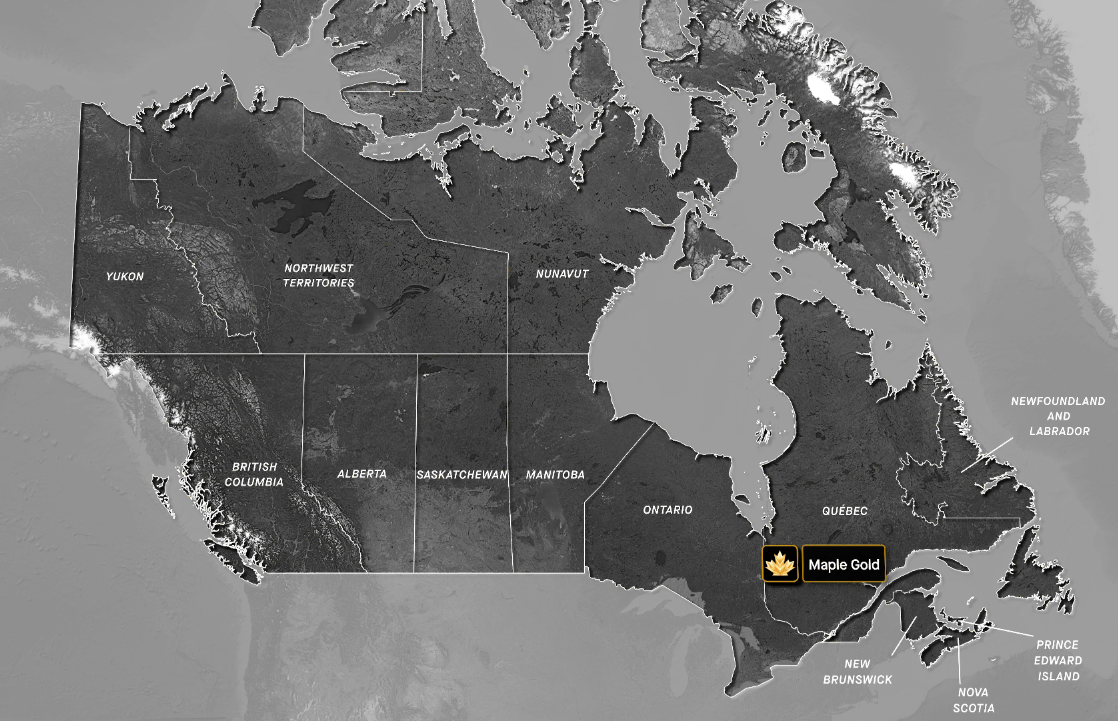
Québec's Abitibi Greenstone Belt has spent much of the past year back in favour with investors. Record gold prices and renewed interest from major producers have drawn capital back to one of Canada's most productive gold districts. Maple Gold Mines Ltd. (TSXV:MGM) has been one of the clearer beneficiaries. President and CEO Kiran Patankar says the company's market value has risen roughly tenfold over the past year, from around C$25-30 million to approximately C$237 million. The company now reports a combined 5.2 million ounce gold resource across its 100%-owned Douay/Joutel Gold Project. With a Preliminary Economic Assessment (PEA) now targeted for mid-2027, the investment case is moving from how many ounces Maple Gold can find to how those ounces might be mined.
Joutel: The Ounces Left Behind
Between 1974 and 1993, the Joutel Mining Complex produced 1.1 million ounces at an average grade of 6.5 g/t. Most of that gold came from a steeply dipping unit, 3-30 metres wide, known as the Main Iron Carbonate Horizon (MICH). Under Agnico Eagle, the mining cut-off grade was set at 6 g/t in a very different price environment.
"It's kind of crazy to think about it in today's $4,000 plus gold price environment but material that was below six grams at [Joutel] was left behind, not even drill tested. So for us, we see real opportunity there to bring that into potentially for our PEA."
The winter programme supports that view. Nineteen of 22 holes (86%) intersected the target mineralisation. The best result, from hole JO-26-18 between the Eagle and Telbel shafts, returned 8.6 g/T over 4.2 metres within 2.5 g/T over 18.3 metres. High-grade mineralisation now extends up to 450 metres beyond the old workings.
The fully funded, C$9 million, 25,000 metre fall programme is designed to upgrade Inferred ounces, fill gaps between the old mines and test ground near existing infrastructure that has never been drilled. Patankar says the priority is to improve the first five years of a potential mine plan, where returns are most sensitive. He has also set a goal of doubling the Joutel resource at similar grades.
Internal Scoping Study Ahead of the PEA
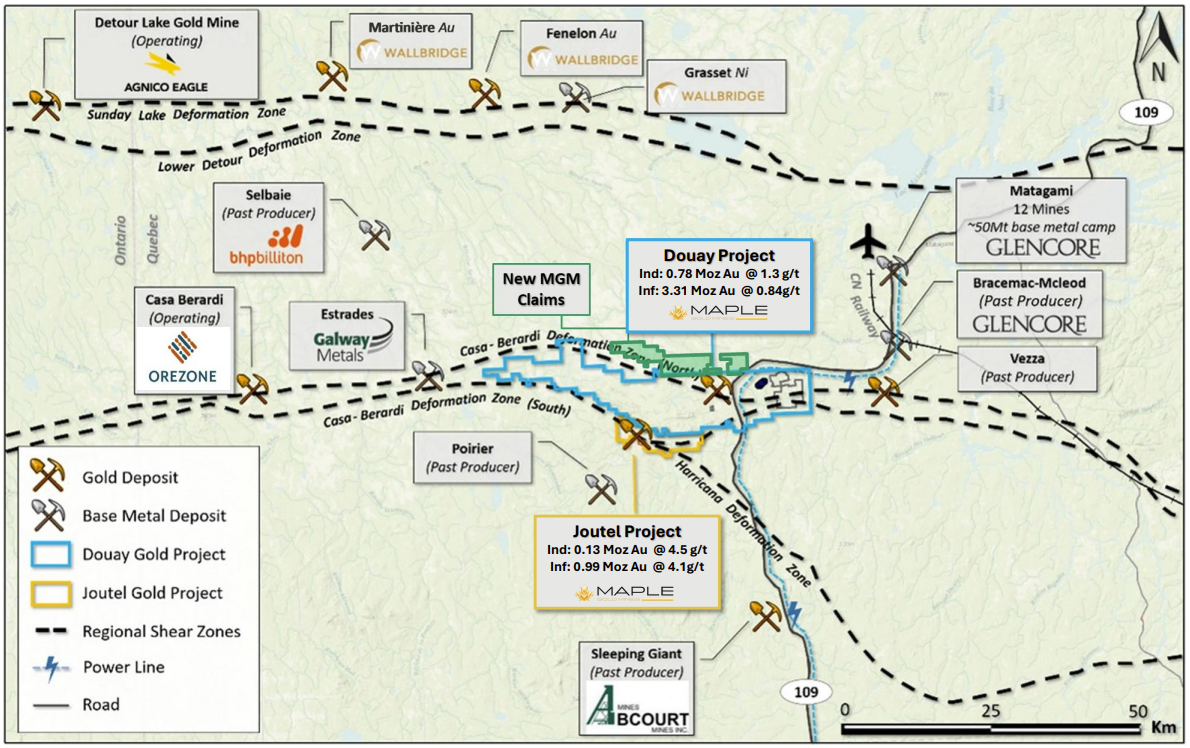
The 5.2 million ounce estimate combines two very different deposits. Douay is a large, lower-grade system hosting 779,000 ounces Indicated at 1.33 g/t and 3.3 million ounces Inferred at 0.84 g/t. Joutel, home to the historical Eagle-Telbel mines, hosts a maiden underground resource of 126,000 ounces Indicated at 4.53 g/t and 992,000 ounces Inferred at 4.11 g/t.
Maple Gold ran its own scoping work in parallel with the resource update before going to PEA. Patankar says the study compared two processing routes: a whole-ore leach circuit suited to Douay, and a gravity, flotation, regrind and leach circuit better suited to Joutel. It also tested throughput rates from 5,000 to 40,000 tonnes per day. A further question was whether the deposits could justify their own mill, or would be better treated as satellite feed for existing processing capacity in the region.
Patankar describes the study as deliberately realistic because it was built for internal decision-making rather than for the market. The company is now running tender processes to select engineering firms for the PEA.
Building Conservatism Into the Numbers
Patankar says several choices were made to avoid overstating Joutel. The maiden resource leaves a 100 metre crown pillar for stability and a 10 metre buffer around every historical mined-out area, even though he expects much of that buffer to be mineralised. The intention is to show a larger standalone project rather than a remnant operation picking at the edges of old stopes.
The scoping study also assumed all-new shafts, despite existing shafts on site. Patankar estimates the replacement value of a new shaft to 900-1,000 metres in the region at roughly $100 million. That points to potential upside if existing infrastructure can be reused, although dewatering and rehabilitation costs have not yet been estimated.
Recovery assumptions follow the same logic. The study assumed 77% gold recovery at Joutel, compared with the 90%-plus that Patankar says Agnico Eagle achieved during operations. A new metallurgical programme is now under way to replace historical data with current test work. Patankar does not expect a return to historical levels, but says even modest gains can materially change mine economics.
Interview with Kiran Patankar, President & CEO of Maple Gold Mines
A Central Mill & a Clearer Valuation Path
The development concept emerging from the study is a central mill, likely at Douay, close to its lower-grade open-pit style mineralisation. Higher-grade Joutel material would be trucked roughly 25-30 kilometres over existing roads, which would probably need upgrading. Patankar describes Joutel as a high-grade sweetener that could lift the mill's overall head grade to well over 1 g/T. Early Douay mining would likely begin around Douay West and Nika, where overburden is thinner, grades are higher and drill spacing is tighter. Most of Douay's Indicated ounces sit in these areas. Patankar links the move to a PEA directly to valuation. Maple Gold trades at roughly US$30 per ounce of resource. Most Canadian peers with 5 million ounce-plus projects near infrastructure already have PEAs and trade on multiples of net present value (NPV).
"If you ask me to guess what's going to get us to a billion dollar valuation, it's not going to be infill drilling a 5.2 million [ounce] deposit. It's going to be showing the economic path on that with two potential mines as a single complex and it's going to be making new discoveries across the overall land package."
Funding, Partners & Risks
Maple Gold held about C$23 million in cash at mid-year and roughly C$20 million at the time of the interview. The company says this funds exploration and general and administrative (G&A) costs. Patankar says all-in drilling costs remain around C$300-400 per metre despite broader cost inflation. Three rigs are active at Joutel, and camp upgrades are expected to support four to six rigs this winter. Agnico Eagle is the largest shareholder at approximately 12.5%, and former Agnico Eagle senior vice-president Marc Legault sits on the board. Agnico Eagle also holds a back-in right to acquire a 50% interest in Douay/Joutel by paying C$12 million plus twice cumulative expenditures. That right is linked to Maple Gold reaching a defined development milestone, which includes a Pre-Feasibility Study (PFS) or feasibility study with an NPV of at least C$300 million. Around 4.3 million of the 5.2 million ounces are Inferred, and progressing beyond a PEA will require significant infill drilling. The internal study's findings have not been published, and Joutel's recovery assumptions still rest on historical data.
The Investment Thesis
- Maple Gold holds a 5.2 million ounce gold resource on a 481 km² land package in Québec, with highway access and grid power already in place.
- The completed internal scoping study has moved the company from a pure exploration story towards development, with a PEA targeted for mid-2027.
- Joutel provides high-grade underground ounces, and none of the winter or fall 2026 drilling is yet reflected in the resource estimate.
- At roughly US$30 per ounce, Maple Gold trades below peers whose projects already carry PEAs, which leaves room for a re-rating if the study delivers.
- The company is well funded with about C$20 million in cash and drilling costs of C$300-400 per metre.
- Key risks include a resource weighted towards Inferred ounces, unpublished internal study findings and Agnico Eagle's 50% back-in right.
- Investors should monitor fall assay results at Joutel, pending Douay results and the updated resource and PEA expected around mid-2027.
Macro Thematic Analysis
The first wave of the current gold exploration cycle favoured newer frontiers. Patankar points to discoveries in the Guiana Shield, Morocco's Central Atlas and the Yukon, funded as exploration capital finally became available again. The Abitibi took longer to attract the same attention, despite a production history that Patankar puts at more than 200 million ounces. That is now changing. Major producers are making strategic investments in the belt and merger activity is picking up. Agnico Eagle's acquisition of O3 Mining is one recent example, and Maple Gold has since hired O3's former head of corporate development, Alex Rodriguez. Gold above US$4,000 per ounce also changes the economics of old mining camps. Joutel's maiden resource uses a 1.7 g/t cut-off, compared with the 6 g/t historically applied.
"The market's starting to wake up and have this 'aha' moment and saying wow you've got x number of ounces at x grade but you got a highway and you've got power and you've got mines all around you ... It's been a long way, it's been a few years coming for people to kind of recognise what the value of the Abitibi was."
Infrastructure lowers capital intensity relative to remote discoveries, and large undeveloped gold resources with highway and grid access are scarce in Canada. The open question for Maple Gold is whether its PEA can translate that geographic advantage into economics the market will value.
TL;DR
Maple Gold Mines (TSXV:MGM) has completed an internal scoping study on its 5.2 million ounce Douay/Joutel Gold Project in Québec's Abitibi and says it believes the project could host two mines feeding a central mill. The company is running tender processes for engineering firms and targets an updated resource and PEA around mid-2027. A fully funded C$9 million, 25,000 metre programme at Joutel aims to upgrade and expand high-grade ounces left untested under Agnico Eagle's historical 6 g/T cut-off. Maple Gold trades near US$30 per ounce against peers that already have PEAs. Key risks are a largely Inferred resource, unpublished study findings and Agnico Eagle's 50% back-in right.
FAQs (AI Generated)
Analyst's Notes





Subscribe to Our Channel



Stay Informed


