Integra's 2027 Show-Me Moment Comes Into Focus


Integra Resources CEO George Salamis on Florida Canyon's 74% reserve jump, DeLamar's fast-tracked permitting, and the path to 300,000 ounces.
- Integra Resources' Florida Canyon mine has resolved the haulage bottleneck that caused two quarters of guidance misses in early 2026, and the company maintains its 70,000-75,000 ounce full-year production guidance.
- A July 2026 technical report lifted Florida Canyon's mineral reserve by 74% and its average annual production by 17%, extended mine life to 2033 and outlined $0.8 billion in life-of-mine after-tax free cash flow.
- The DeLamar project in Idaho cleared a major catalyst in May 2026 when its Notice of Intent was published in the Federal Register, starting formal National Environmental Policy Act (NEPA) permitting, with a Record of Decision targeted for the second half of 2027.
- DeLamar's 2025 feasibility study shows a one-year payback and a 97% after-tax internal rate of return at current metal prices, placing it among just five U.S. gold-silver development projects that pass Integra's own scarcity screen.
- Management is actively evaluating acquisitions to accelerate Integra's path toward a targeted 250,000-300,000 ounce multi-asset production platform, while Florida Canyon's cash flow funds the organic pipeline.
Precious metals investors gathered at the Beaver Creek Precious Metals Summit have spent much of this cycle chasing production growth in safe jurisdictions, and few names sit closer to that theme than Integra Resources Corp. (TSXV: ITR | NYSE: ITRG). The Great Basin-focused gold-silver company has spent the past two years turning a legacy Nevada mine into a self-funding platform for two much larger development projects, and 2026 was always going to be the year that thesis got tested against real production numbers.
Speaking on the sidelines of the conference, President, CEO and Director George Salamis walked through a transitional year - one defined by early operational stumbles at Florida Canyon, a materially upgraded mine plan, and accelerating permitting momentum at the company's flagship DeLamar project in Idaho. With roughly US$111 million in treasury at 30 June 2026, an updated technical report that added 74% to Florida Canyon's reserve, and a DeLamar feasibility study showing a one-year payback at current metal prices, Integra's pitch to investors has shifted from potential to delivery. The company's own roadmap is blunt: 2025 was a year of transition, 2026 is about stability and de-risking, and 2027-2028 is when growth arrives.
Florida Canyon's Rough Start & the Fix
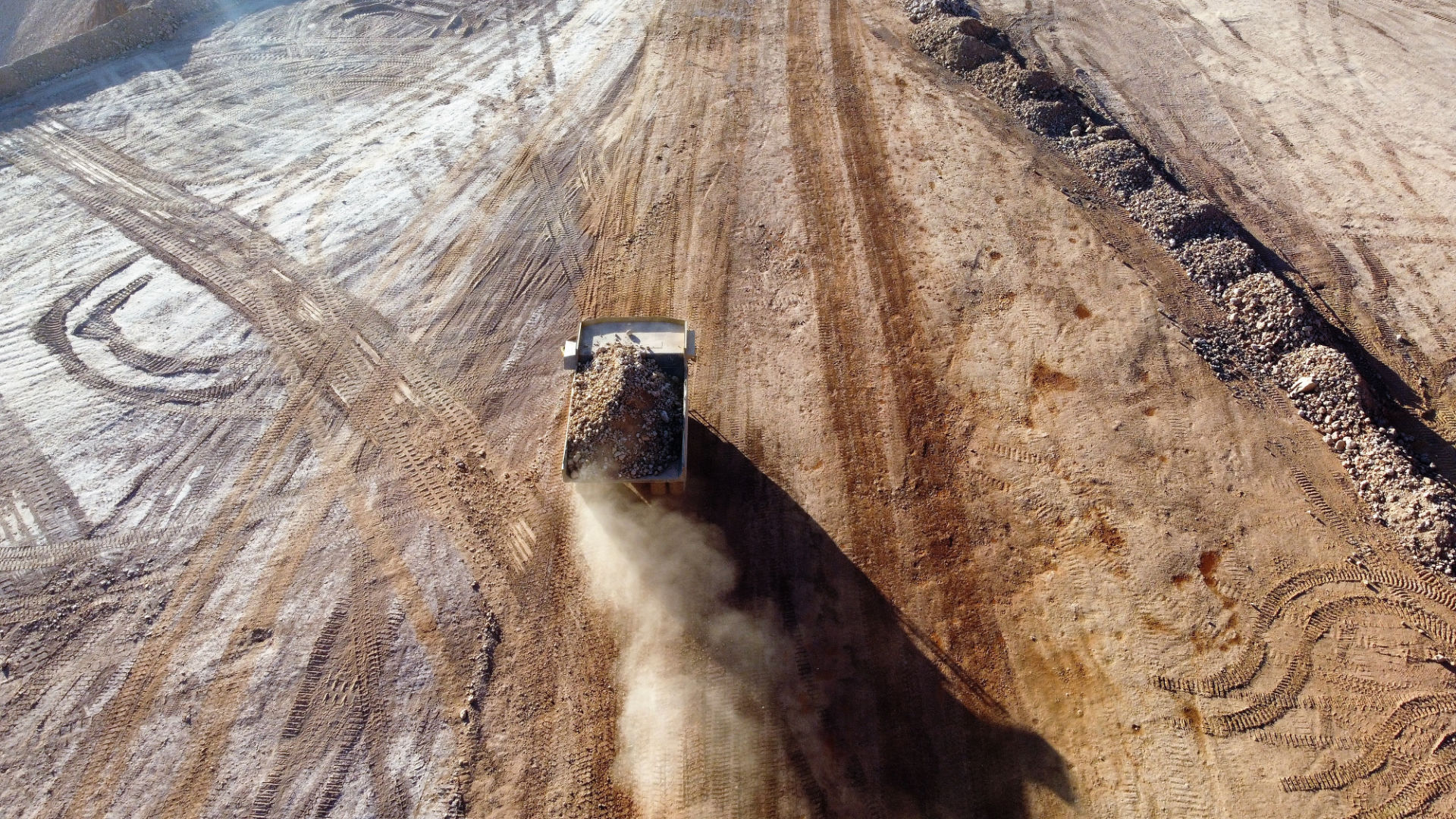
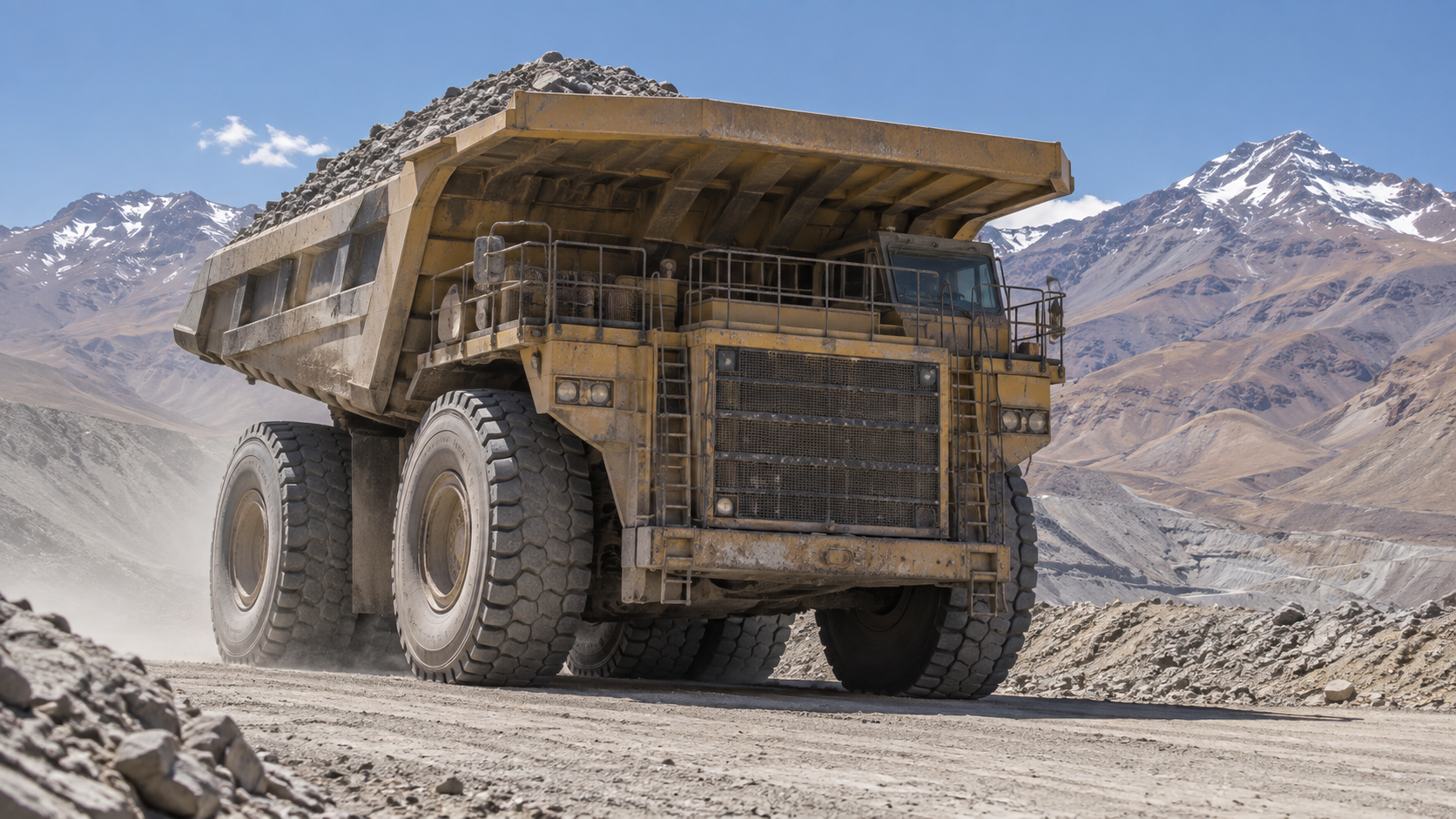
Integra's production year began with two difficult quarters. Salamis was candid that the company fell short of its own quarterly guidance in the first half of 2026, attributing the miss to "little things not big things." The big piece of the puzzle, haulage, which means getting ore out of the open pits and down to either the crusher or the heap leach pad efficiently, had already been solved with newly purchased haulage capacity. Salamis described it as nine-tenths of the problem. The smaller issues came from mining new ore bodies and feeding low-grade stockpile material that is newly economic at current gold prices. That stockpile carried a lot of fine material that had to be blended with in-situ ore. Until the blending recipe was right, it disrupted solution circulation on the heap leach pad. Salamis said getting it right took a while, but the company is now through those issues and he expects the coming quarter to be a very good one.
The stakes for getting this right are significant. Integra's 2026 guidance calls for 70,000 to 75,000 ounces of gold production at a total cash cost of $2,300 to $2,500 per ounce sold and mine-site all-in sustaining costs (AISC) of $3,300 to $3,500 per ounce sold. In the first half of the year the company produced 29,014 ounces at a cash cost of $2,463 per ounce and an AISC of $3,344 per ounce. Costs are within the guided range, but production at that pace leaves a demanding second half. Salamis maintained that full-year guidance is still achievable.
He was equally direct about how the market is pricing the company, calling its valuation "grossly unfair" and pointing to 2027 as the real test:
"It's unfair for that specific reason - the show-me aspect of Florida Canyon and what can it do ... I think we'll demonstrate that. But ... next year will be the real show-me. Can we get to that 80,000 to 85,000 ounces a year of production? Can we drop those costs materially below $3,000 an ounce? ... We feel that we can, but ... there's still a lot of scepticism out there with that asset because of its legacy."
That legacy issue is central to how Integra is valued today. Florida Canyon changed hands several times before Integra acquired it for $68 million in 2024, and the market has been slow to reprice the asset even as the operating picture has improved.
A Materially Bigger Mine Plan
The clearest evidence of that improvement came in Integra's July 2026 technical report and updated life-of-mine plan for Florida Canyon. Mineral reserves rose 74%, from 685,000 to 1,191,000 ounces. Mine life extended by three years, from 2030 to 2033, plus two additional years of residual leaching. Average annual gold production is now guided 17% higher, from 70,000 to 82,000 ounces. The updated plan puts life-of-mine after-tax free cash flow at $0.8 billion, with a base-case after-tax net present value (NPV5%) of $601 million, rising to $723 million at a spot gold price assumption of US$4,200 per ounce.
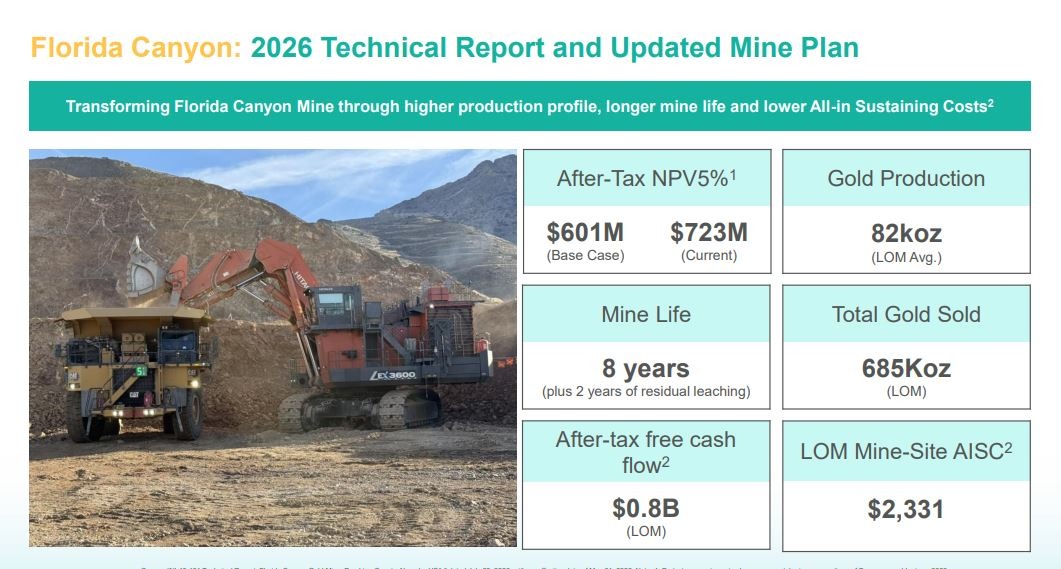
Funding that growth is expensive in the near term. Salamis said Florida Canyon alone will absorb roughly $75 million of investment this year. That covers newly purchased haulage capacity and a heap leach pad expansion originally planned for 2027, which has been pulled forward into 2026 to keep pace with record tonnage moved to the pad. He expects that spending to be complete by year-end, with cost pressure easing into the first quarter of 2027.
DeLamar Moves Through the Permitting Gauntlet
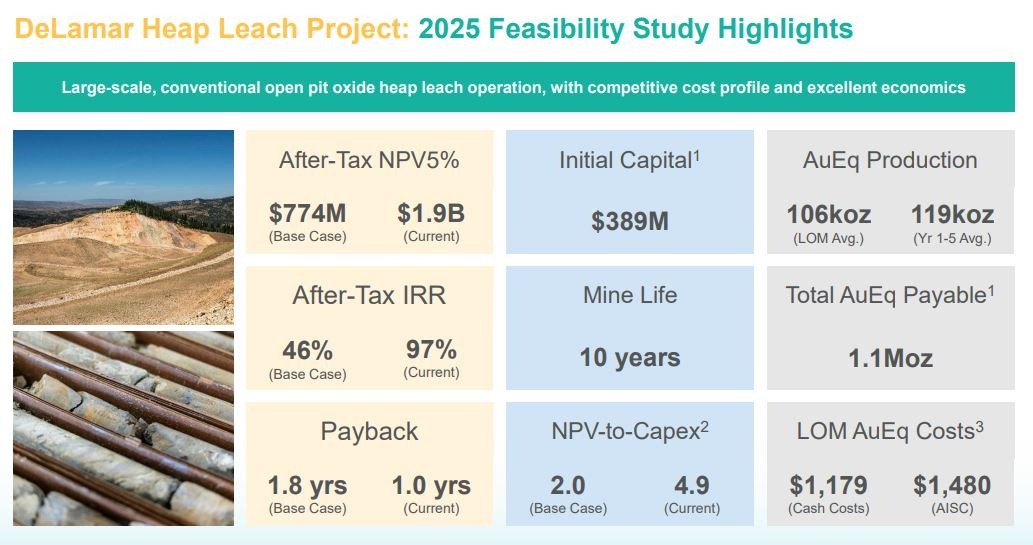
If Florida Canyon is the cash engine, DeLamar in southwestern Idaho is the project the market is being asked to underwrite. The 2025 feasibility study puts DeLamar's after-tax NPV5% at $774 million at base-case metal prices, or $1.9 billion at current prices of US$4,500 per ounce gold and US$65 per ounce silver. The base-case after-tax internal rate of return (IRR) is 46%, rising to 97% at current prices, and the payback period is 1.8 years at base case, compressing to one year at current prices. The project is designed for average annual production of 106,000 gold-equivalent ounces over a 10-year mine life, with the first five years averaging closer to 119,000 ounces.
According to Salamis, permitting is moving faster than in previous cycles. DeLamar's Notice of Intent was published in the Federal Register in May 2026, formally starting the project's NEPA review. The project was selected in January 2026 for the U.S. Federal Permitting Improvement Steering Council's FAST-41 Transparency Projects Program, named for Title 41 of the Fixing America's Surface Transportation Act, which is intended to accelerate coordination among federal regulators. Salamis said federal response times are noticeably quicker than they have ever been. Part of the reason is that federal regulators in Idaho, including the Bureau of Land Management's (BLM) state office, have moved past Perpetua Resources' Stibnite project and can now focus on DeLamar as the next most advanced project in permitting. Public scoping comments came back no worse than expected, he added, and support from the community surrounding DeLamar has been overwhelmingly positive. A Record of Decision (ROD) is expected in the second half of 2027, with Integra targeting spring 2028 for construction-start permits in hand.
Integra has also moved to reduce social and financing risk ahead of that milestone. In 2025 the company signed a relationship agreement with the Shoshone-Paiute Tribes covering stewardship, economic participation, governance and life-of-mine commitments at DeLamar. A US$61 million bought-deal financing in February 2026 funds 2026 and 2027 early works, procurement and strategic land acquisition around the project.
Unlocking Value Between the Pits
Beyond the headline growth projects, Salamis pointed to a subtler source of upside at Florida Canyon itself. After two years of operating the heap leach mine, Integra has been drilling the "saddle" areas between several of Florida Canyon's open pits. This ground was historically treated as waste because it sat between, rather than inside, defined ore bodies:
"If you start to consider that those high walls actually contain ore ... waste converting to ore is a big savings ultimately. When it was waste, you weren't deriving any profit from it. Now, if you count it as ore, that changes the game."
Salamis believes that, given enough drilling, that saddle material could make its way into a mine plan fairly quickly.
The company's 2026 drilling programme, at 50,000 metres the largest in its history, is split 42,500 metres at Florida Canyon, 5,500 metres at Nevada North and 2,500 metres at DeLamar. A large share of the Florida Canyon metreage targets near-mine oxide growth, both in the saddles between pits and in historical waste dump material. Conceptual estimates for the North and South mine dumps alone range from 19 to 32 million tonnes and 15 to 24 million tonnes respectively. That material was originally mined in the late 1980s to mid-1990s, when gold traded at $325 to $450 an ounce and cut-off grades were roughly double today's. None of it is yet classified as a mineral resource. A further target is the historic Standard Mine, roughly five miles south of Florida Canyon, which produced more than 220,000 ounces between 2004 and 2015 and is scheduled for renewed drilling before the end of 2026.
Interview with George Salamis, President & CEO, Integra Resources
Nevada North: From Sequential to Parallel
Rounding out the portfolio is Nevada North, which comprises the Wildcat and Mountain View deposits, with Wildcat roughly 30 miles from Florida Canyon. A 2023 preliminary economic assessment (PEA) outlined a 13-year mine life averaging about 80,000 gold-equivalent ounces annually, an after-tax NPV5% of $310 million and a three-year payback at a base-case gold price of $1,700 per ounce, materially below today's market.
Integra's original plan had been to move the Florida Canyon mining team and equipment to Nevada North once Florida Canyon's mine life was exhausted, Salamis said. With Florida Canyon now running longer, the two operations are more likely to run in parallel, each with its own equipment and staff, still managed out of Florida Canyon and self-funded by its cash flow by that point. The 2026 drilling and de-risking work at Nevada North feeds an updated technical report that Integra has scheduled for 2027.
Investment Thesis for Integra Resources
- Florida Canyon's operational reset appears largely complete: the haulage bottleneck is resolved, the blending issues have been worked through, and 2026 guidance of 70,000-75,000 ounces remains intact.
- The 74% reserve increase and 82,000-ounce average annual production target from 2027 materially change Florida Canyon's cash-generating capacity, with $0.8 billion of life-of-mine after-tax free cash flow in the updated plan.
- DeLamar's feasibility economics, a one-year payback and 97% after-tax IRR at current prices, place it among five U.S. gold-silver development projects that pass Integra's screen for projects with a feasibility or pre-feasibility study completed since 2023.
- FAST-41 selection and overwhelmingly positive local community support reduce permitting-timeline risk into the targeted H2 2027 Record of Decision, though NEPA processes remain subject to delay.
- Near-mine growth from inter-pit saddles and historical waste dumps at Florida Canyon offers low-capital, high-margin ounce additions that could extend mine life further.
- Management has signalled appetite for mergers and acquisitions (M&A) to accelerate the path to a targeted 250,000-300,000 ounce multi-asset production platform, alongside an organic pipeline funded by Florida Canyon's cash flow.
- Watch items include Q3/Q4 2026 production against guidance, updated Florida Canyon resources from dump and saddle drilling, and any DeLamar project-financing announcements as the Record of Decision approaches.
Macro Thematic Analysis
Integra's story sits inside a broader re-rating case for U.S.-jurisdiction gold developers. The Immediate Measures to Increase American Mineral Production executive order, signed in March 2025, directs federal agencies to fast-track permits, expand land access and mobilise capital for domestic mineral production. DeLamar's selection for the FAST-41 Transparency Projects Program in January 2026 is one of the more concrete signs of that push reaching individual projects. For a sector that has historically treated U.S. permitting timelines as a structural discount to net asset value, faster and more predictable federal coordination is a genuine re-rating lever, not just a talking point.
Scarcity reinforces the case. Integra ran its own screen of primary gold-silver development projects globally, as at December 2025. It started from 1,452 projects with resource estimates, then removed those outside the U.S., primary underground projects, projects without a valid feasibility or pre-feasibility study since 2023, those averaging under 100,000 gold-equivalent ounces a year, and those with initial capital above $500 million. Only five projects remain, DeLamar among them. That scarcity is part of why Salamis is already thinking about the next leg of growth beyond the current three-asset portfolio:
"We're always looking [for acquisitions]. It would be nice to slide something in between now and sort of DeLamar producing ... into the pipeline ... We've got enough organically. So, it's always this judgement. What do we have organically that can solve that math, if you will, to get us to 300,000 ounces quicker? ... But we are looking."
That combination is a profile few U.S. gold names currently offer at Integra's valuation: a self-funding producer, a flagship development project midway through federal permitting, and management openly hunting for bolt-on M&A.
TL;DR
Integra Resources CEO George Salamis says the company's rough start to 2026 at Florida Canyon is behind it. Haulage has been resolved and the ore-blending issues fixed, supporting maintained guidance of 70,000-75,000 ounces. A July technical report lifted Florida Canyon's reserve 74% and average annual production 17%, with $0.8 billion in projected life-of-mine after-tax free cash flow. DeLamar's permitting is moving faster than in past cycles, helped by FAST-41 selection. A Record of Decision is targeted for H2 2027, and the feasibility study shows a one-year payback at current metal prices. Salamis also flagged ongoing M&A interest to accelerate Integra toward a 300,000-ounce target.
FAQ (AI-generated)
Analyst's Notes





Subscribe to Our Channel



Stay Informed