




Middle East Supply Disruptions & Hawkish Fed Expectations Are Driving Commodity Market Repricing


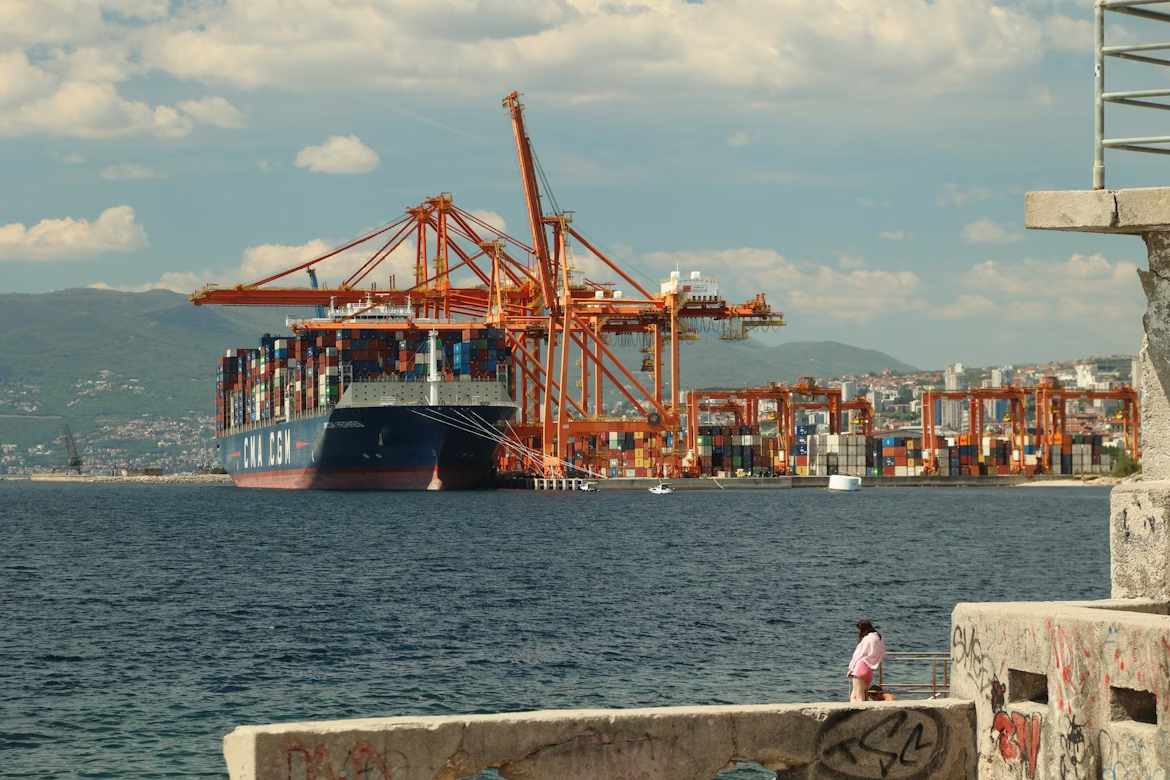
Oil, gold, and rare earth markets face volatility as Hormuz supply risks, elevated Treasury yields, and geopolitical competition intensify.
- Brent crude fell 0.4% to $110.83/bbl and spot gold declined 0.3% to $4,467.59/oz on May 20 as markets temporarily priced in optimism around US-Iran negotiations.
- The US-Israeli conflict with Iran has effectively closed the Strait of Hormuz, which normally carries roughly one-fifth of global oil supplies, according to the International Energy Agency.
- Gold is losing momentum as Treasury yields and the US dollar continue rising simultaneously. Reuters reported benchmark 10-year Treasury yields are sitting near a more than one-year high while the dollar trades near a six-week high.
- Institutional investors are increasingly focused on operational lag risk rather than ceasefire headlines because shipping, insurance, and refinery procurement systems cannot normalize immediately even if diplomacy succeeds.
- The current easing narrative breaks down if the US-Iran talks collapse and military action resumes, or if the Federal Reserve unexpectedly shifts away from its higher-for-longer rate stance.
Oil & Gold Markets Reprice Middle East Risk as Diplomacy Eases Immediate Strait of Hormuz Supply Fears
Oil prices eased on May 20 after U.S. President Donald Trump said the conflict with Iran would end “very quickly,” while Vice President JD Vance noted that Washington and Tehran had made “substantial progress” in negotiations. Brent crude slipped 45 cents to $110.83 per barrel, while WTI crude fell 27 cents to $103.88 per barrel. Meanwhile, gold prices also retreated as investors shifted toward dollar-linked assets. Spot gold declined 0.3% to $4,467.59 per ounce, while June gold futures dropped 0.9% to $4,471.10 per ounce.
The market reaction appears counterintuitive until investors distinguish between financial positioning and underlying physical supply risks. Despite the pullback in oil prices, the International Energy Agency continues to view potential disruption in the Strait of Hormuz as the most significant threat to global oil supply. Approximately 20% of the world’s seaborne oil trade normally passes through the strait. As a result, markets are not pricing in a fully resolved supply crisis, but rather a lower probability of near-term escalation.
Elevated Treasury Yields, Middle East Oil Disruptions & Rare Earth Competition Drive Commodity Volatility
Commodity markets are being repriced by persistent energy supply constraints and tighter macro-financial conditions. Middle Eastern oil disruptions, falling US crude inventories, tanker rerouting, higher insurance costs, and refinery delays continue tightening effective supply availability despite intact production infrastructure.
At the same time, elevated Treasury yields and a stronger US dollar are reinforcing higher-for-longer rate expectations amid persistent inflation pressures. Meanwhile, geopolitical competition over critical mineral supply chains is intensifying as the US and EU expand efforts to reduce dependence on China, with Russia warning that Western-backed infrastructure development in Central Asia is reshaping global resource competition.
Markets Expect Prolonged Oil Supply Tightness Even if Iran Conflict De-Escalates
Fujitomi Securities analyst Toshitaka Tazawa told Reuters on May 20 that oil prices are likely to remain elevated because crude supply will not quickly return to pre-war levels even if a peace deal is reached. Physical commodity systems recover more slowly than political negotiations, with shipping, insurance, refinery scheduling, and inventory rebuilding operating on extended timelines.
If negotiations continue progressing, crude prices could gradually moderate while remaining structurally elevated through the second half of 2026 due to tightening inventories. In an escalation scenario, renewed US military action and constrained Hormuz traffic could push oil materially higher while increasing recession risks through transport and manufacturing cost inflation. The Federal Reserve is also not currently positioned to offset a commodity-driven inflation shock through rapid rate cuts.
Energy-Intensive Industries & Rare Earth-Dependent Supply Chains Face Rising Geopolitical Cost Pressure
Airlines, manufacturers, logistics operators, and other fuel-intensive industries remain exposed to prolonged energy cost inflation. At the same time, sectors reliant on rare earth inputs, including EVs, semiconductors, renewable infrastructure, and defense systems, face rising geopolitical supply-chain risk as the US, EU, China, and Russia compete for resource access.
Companies with diversified supply chains, stronger balance sheets, and lower energy intensity are generally better positioned to withstand prolonged volatility than businesses dependent on single-region sourcing models.
Investors should also avoid treating diplomatic headlines as reliable trading signals, as shifting US policy rhetoric continues creating significant overnight geopolitical risk.
US-Iran Negotiation Stability, Fed Hawkishness & Oil Inventory Data Will Determine Whether Commodity Weakness Persists
The current market stabilization thesis relies on two assumptions remaining intact simultaneously: first, that US-Iran negotiations continue without immediate military escalation; and second, that inflation remains persistent enough to keep the Federal Reserve hawkish.
A confirmed collapse in negotiations followed by renewed US military action would likely reverse the recent decline in oil prices and intensify fears around physical supply shortages. Conversely, evidence of rapidly cooling inflation or a sudden dovish Fed pivot could weaken the dollar and reignite gold momentum despite easing geopolitical tensions.
Three indicators should be monitored continuously over the coming weeks: diplomatic statements from Washington and Tehran, weekly API and EIA crude inventory data, and Treasury yield movements following Federal Reserve communications, particularly the Fed’s April meeting minutes released at 1800 GMT on May 20. The interaction between those signals will determine whether current commodity weakness represents stabilization or merely a pause before another volatility cycle.
Analyst's Notes





Subscribe to Our Channel




Stay Informed

























