




District-Scale Development: The Case for Exploration During Construction


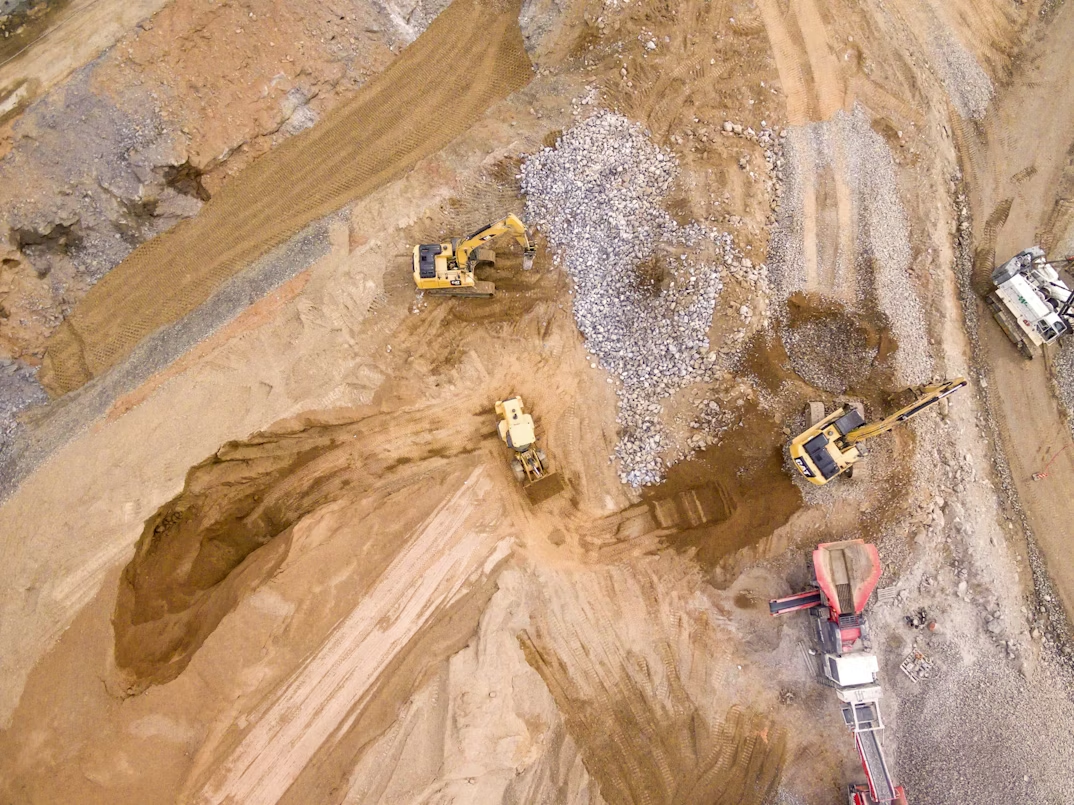
Cabral Gold accelerated exploration during construction at Cuiú Cuiú, using high-grade drill results to support Phase 2 growth before production.
- Cabral Gold raised C$20 million in March 2026 while its Cuiú Cuiú oxide project was 60% complete, choosing to accelerate exploration rather than wait for Fourth Quarter 2026 production to generate cash flow.
- The company released drill results on May 13, 2026, intersecting 10.2 metres at 8.7 grams per tonne (g/t) gold at Jerimum Cima, located three kilometres outside the existing 1.2-million-ounce resource, demonstrating continued high-grade mineralisation two months after the financing.
- District-scale projects favour drilling during construction when the share price has appreciated enough to reduce dilution, drill results justify immediate follow-up, and delaying exploration would push the resource update beyond the production ramp-up.
- The strategy compresses the timeline between first production and an updated resource estimate that supports a Phase 2 decision, allowing the company to demonstrate expansion potential while operating margins validate Phase 1 economics.
- Execution risk remains: over 70% of junior mining projects historically do not reach production, and exploration spending committed during construction locks in dilution but delivers results only if the company reaches production on schedule.
Capital Allocation During Construction
The construction phase of a mining project typically consumes all available capital and management attention. Equipment procurement, civil works, hiring, and commissioning occupy a narrow window where delays cascade and cost overruns compound. Junior miners are capital-intensive ventures, constantly requiring funds for drilling, studies, and development, with dilution from frequent equity raises being common. Most developers defer discretionary exploration spending until commercial production, when predictable cash flow can fund additional work without further dilution.
District-scale projects alter this calculation. District-scale mining is an exploration and development approach that views mineral systems on a large, regional scale, with the goal of discovering multiple deposits from the same mineralised district or region and servicing each from one central processing hub. A company with 50 peripheral targets and multiple known deposits tests whether the operation can expand beyond its initial design capacity and whether Phase 2 unlocks hard rock resources that dwarf the oxide starter project. Resource growth during construction compresses the timeline to a revised mine plan. A developer that drills during construction can release results within months of commissioning, demonstrating mine life extension while operating margins validate the economics. The risk lies in execution: over 70% of junior mining projects historically do not reach production, and exploration spending committed during the build locks in dilution but delivers results only if the company reaches production on schedule.
Emerging Practices & Industry Progress
Developers with district-scale assets increasingly treat exploration as a parallel workstream during construction rather than a deferred activity. Cabral Gold Inc. (TSXV: CBR | OTCQX: CBGZF | FRA: C3J) announced a C$20 million bought deal financing in March 2026, with its Cuiú Cuiú oxide project 60% complete and commissioning planned for the third quarter of 2026. The company had secured $45 million in gold-denominated debt to fund construction and reported on-schedule progress despite wet-season delays. The bought-deal structure eliminated execution risk for the financing itself, and the absence of warrants or broker warrants reduced future dilution.
President and Chief Executive Officer of Cabral Gold, Alan Carter, explained the decision to accelerate exploration during construction:
"With these kinds of drill results, the run-up in the share price, it has backed off a little bit, given the drop in the gold price, but it's still significantly above where it was, back in May last year, when we did the last equity financing at the 34-cent raise. We'd like to get more aggressive with the drilling here, the exploration drilling, so that we can grow the global resource much quicker."
The company released drill results on May 13, 2026 that intersected 10.2 metres grading 8.7 grams per tonne (g/t) gold from 99.5 metres depth, including 1.3 metres at 62.5 g/t gold from 108.4 metres depth, at the Jerimum Cima target located three kilometres outside the existing 1.2-million-ounce resource base, with the two holes separated by 205 metres, suggesting a high-grade zone extending at least 455 metres along strike. The result followed a March 12, 2026, intersection at the same target that returned 9.5 metres at 87.4 g/t gold.
Carter framed the strategy as accelerating value creation through resource growth.
"We think we can increase the value of this company faster if we can grow the global resource base here faster, and we can demonstrate the economic viability of stage two through a PEA faster."
The company's two-stage development plan envisions Phase 1 mining near-surface oxide material at 3,000 tonnes per day to generate cash flow and de-risk the larger Phase 2 hard-rock project. Phase 2 requires demonstrating economic viability through a preliminary economic assessment (PEA), which depends on resource growth in the hard-rock category. The September 2022 resource estimate modelled 900,000 ounces in hard rock, considering only three deposits: Central, MG, and JB. With C$20 million in new capital, Cabral planned to add multiple rigs to the three already operating and accelerate testing across the district's 50-plus peripheral targets, compressing the timeline between first production and an updated resource estimate that supports a Phase 2 decision.
Remaining Challenges
Drilling during construction introduces execution risk. The C$20-million raise commits capital to exploration while the Phase 1 project remains unfinished. Equipment delays, permitting gaps, or unforeseen civil works could require cost overruns, leaving the company with exploration results but insufficient funds to reach production. Cabral mitigated this risk by securing full construction funding before announcing the raise. The company had completed earthworks during the wet season, poured concrete foundations, and begun erecting structures, with equipment arriving on site.
The company also faced permitting constraints. Phase 1 construction proceeded under trial mining licenses, which cap annual throughput at 500,000 tonnes, equivalent to 1,500 tonnes per day, while the pre-feasibility study (PFS) released in July 2025 modelled 3,000 tonnes per day. In March 2026, Cabral announced it had received the Licença Prévia (LP), the preliminary license required for the full mining license in Brazil. The LP allows the company to expand Phase 1 beyond the trial mining license limit and provides a pathway for Phase 2, but it does not eliminate permitting risk for future expansions.
Regional & Jurisdictional Perspective
Brazil's Tapajós region, where Cuiú Cuiú is located, represents an emerging gold district. Tocantinzinho entered production in 2023 after 20 years of exploration and development, providing infrastructure precedent and de-risking the jurisdiction for subsequent projects. Placer mining historically dominated the Tapajós, with an estimated one million people participating in the region's gold rush during the 1980s. Cuiú Cuiú was among the largest placer camps in the district, producing 2 million ounces from stream sediments.
Carter highlighted the geological validation provided by the company's location adjacent to G Mining's Tocantinzinho mine, the third-largest gold producer in Brazil at 180,000 ounces annually.
"We're on the same geological structure. We're in the same host rock. The amount of placer gold that was recovered from Cuiú Cuiú was 2 million ounces. The amount of placer gold that was coming to Tocantinzinho was 200,000 ounces. We have multiple deposits here. That's the other big difference. And as I said, 50-plus peripheral targets."
A soil geochemistry program returned a seven-kilometre anomaly at Cuiú Cuiú, open along strike, compared to a one-kilometre anomaly at Tocantinzinho. The company's exploration strategy focuses on tracing placer gold to hard-rock sources, using drainage geochemistry to prioritise targets. Several high-grade placer drainages remain unexplained by known deposits, suggesting additional mineralisation within the district. The permitting environment in Brazil requires sequential approvals, with the LP serving as the gateway to the full mining license. Trial mining licenses provide interim production authorisation but cap throughput, creating a bridging mechanism for companies advancing from exploration to production.
Industry Outlook
The transition from developer to producer marks an inflexion point in valuation methodology. Exploration companies trade on resource potential and jurisdictional risk. Producers trade on cash flow multiples and operating margins. Developers occupying the gap between these categories face a choice: sequence capital deployment conservatively or compress timelines by raising exploration capital during construction.
District-scale projects favour compression when three conditions align: the share price has appreciated enough to reduce dilution, drill results justify immediate follow-up, and the district contains sufficient targets that deferring exploration delays the resource update beyond the production ramp-up. Cabral's May 2026 drill results, released two months after the March financing and demonstrating continued high-grade mineralisation at Jerimum Cima, validated the decision to accelerate drilling during construction. Whether the strategy succeeds depends on execution. The company must commission Phase 1 on schedule, deliver drill results that extend the resource base, and demonstrate that the expanded resource supports Phase 2 economics.
For the broader junior sector, the approach signals a shift in how district-scale developers allocate capital. Construction no longer marks the end of exploration funding. It marks the beginning of a parallel workstream where drilling during the build de-risks the next phase while the first phase proves the operating thesis. The model works only when permitting, financing, and geology align, but when they do, it accelerates the path from single-asset producer to multi-deposit district play.
FAQs (AI-Generated)
Analyst's Notes





Subscribe to Our Channel




Stay Informed






















