




New 43-101 and Oversubscribed Financing Position Kingman for 2026 Exploration


Kingman Minerals revives 140-yr Arizona gold mine with 688g/t samples, $2.1M raised, drone survey Dec 2025, Q1 2026 drilling. Historic producer, modern exploration, $4M market cap.
- Kingman Minerals is reviving a 140-year-old gold-silver mine in Arizona's Mohave County with interim CEO Simon Studer leading exploration efforts after acquiring the Rosebud Mine
- The company recently raised $1.5 million (oversubscribed from $500k) with 65% from European investors, bringing total funding to $2.1 million to finance 2026 exploration work
- Historic underground sampling revealed extremely high grades up to 688 grams per ton gold, though no compliant resource exists yet; a new 43-101 technical report compiles all historical data
- Planned work includes drone-based magnetometry in December 2025 followed by Q1 2026 drilling to test continuity of productive veins and explore depth potential beyond the shallow oxide zone
- With only 42 million shares outstanding (potentially 70 million fully diluted) and ~US$4 million market cap, management believes the asset is significantly undervalued given its high-grade potential and 140-year production history
Kingman Minerals Ltd. represents an intriguing opportunity in the junior exploration space: a company working to unlock value from a historic high-grade gold and silver mine in Arizona that has been largely overlooked by modern exploration. The Rosebud Mine, located in Mohave County, was discovered 140 years ago and produced during the 1920s and 1930s, yet previous operators never adequately explored the deeper sulfide mineralization that could represent the bulk of the deposit. With fresh capital, a newly completed technical report, and an exploration program set to begin in early 2026, the company is positioning itself to demonstrate whether this forgotten asset deserves a market rerating.
Interim CEO Simon Studer, though not a traditional mining executive, brings an unconventional background as an anthropologist who transitioned into the mining sector through exposure to Argentina's lithium industry. Now leading Kingman Minerals, he's assembled a team of experienced mining professionals to systematically explore what he characterises as a "major disconnect" between the project's 140-year history and its approximate US$4 million market capitalization.
Corporate Structure and Recent Financing
Kingman Minerals recently completed a significant financing milestone, closing an oversubscribed $1.5 million raise that was initially targeted at just $500,000. According to Studer, "More than 65% came from over here from Europe and then the other 35% from specific individuals in Canada," bringing total cash to approximately $2.1 million. This capital infusion cleaned up the balance sheet and provides funding for the entire 2026 exploration program.
The financing structure reveals careful capital management. Previous to these recent rounds, the company had been making installment payments to acquire the 20 claims comprising the Rosebud Mine from a private Vancouver-based individual. Management and insiders converted accumulated fees, forgiven debt, and their own money into the financing on the same terms as outside investors. The total acquisition cost was approximately $150,000 USD, representing what management views as an exceptionally favourable entry point for controlling a historic producing asset.
Insider ownership stands at approximately 60%, with the share structure showing roughly 42 million shares outstanding, potentially expanding to 70 million fully diluted. Studer emphasised the alignment between management and new shareholders: "They got in at the same terms and conditions as us, the insiders. So they will have the same chance."
The Asset: What's Known About Rosebud Mine
The Rosebud Mine operated as a small-scale underground operation with workings extending about 180 meters along the surface and descending through three levels to approximately 100 meters depth. It was part of a historic mining camp in the Music Mountain area that contained several small mines during the early 20th century. Production records exist dating back to 1909, though comprehensive data from the early production years remains limited.
The property's modern exploration history includes work by two companies during the 1990s and again in 2006-2007. However, as Studer explained, previous operators focused exclusively on the oxide zone:
"They always just worked on the oxide zone which is about the 100 meters where the high-grade veins were basically exposed and have been mined, and the drilling never went further down to understand the bigger kind of system, the sulfide part of the system."
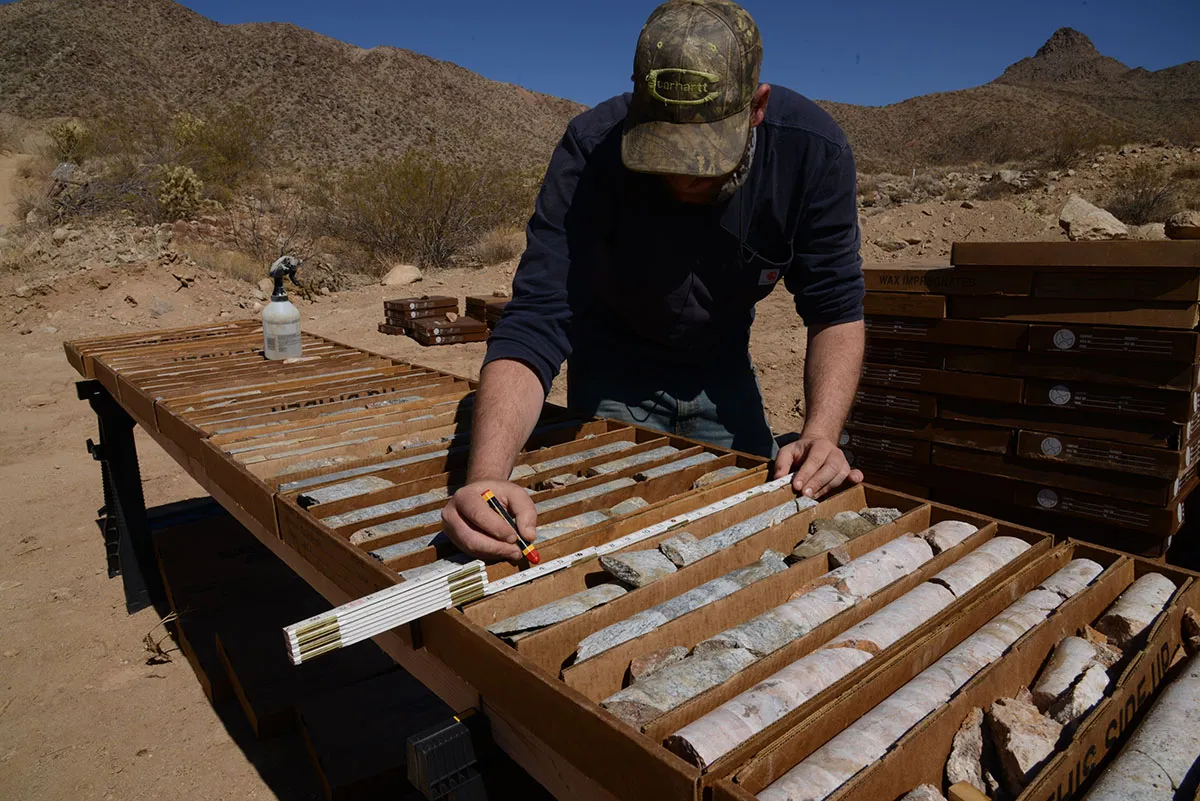
In 2020, Kingman sent a team of mining engineers into the existing underground tunnels to collect channel samples. The results were striking, with values reaching 688 grams per ton gold from material left behind by previous miners.
Technical Data and the 43-101 Report
Kingman recently produced a NI 43-101 technical report that compiles all historical information into a unified document. This report is not a resource estimate but rather a comprehensive compilation of past drilling, geological understanding, and forward exploration plans. The company completed two drilling programs in 2020 and 2021 before COVID-related complications and market conditions forced a pause in activities.
Historical references from the 1980s suggest potential for 664,000 ounces of gold and 2.6 million ounces of silver, though these figures are non-compliant with modern standards. According to Studer,
“these historical estimates just took basically the veins as they were, and how they had been productive over time, and then they would apply it among all the veins that you can even trace from surface, but that obviously is not compliant."
The property shows evidence of at least eight distinct sub-parallel shear zones or vein structures. Surface observations reveal numerous trenches and workings across the broader property, though much of this historic work lacks documented results. Historical drilling grades have ranged around 9-13 grams per ton gold over 2-meter intervals, though the underground channel samples demonstrated much higher grades in specific locations.
Interview with Simon Studer, Interim President & CEO, Kingman Minerals
2026 Exploration Program: Magnetometry and Drilling
The company has budgeted approximately $500,000 USD for its initial 2026 exploration program, which begins with drone-based magnetometry scheduled to start mid-December 2025. This geophysical survey will cover not just the 20 claims containing the Rosebud Mine but the entire Mohave project area of approximately 590 hectares. The magnetometry aims to provide structural understanding through 3D modelling of geological contacts and identify convergence zones where multiple structures intersect - typically the most prospective areas for high-grade mineralization.
Following the geophysical work, drilling is planned for Q1 2026. The company is currently in permitting discussions with the Bureau of Land Management (BLM). In 2021, Kingman had already received approval for a 24-hole program, so Studer expects the new permit process will move relatively quickly.
The initial drilling strategy focuses on the "lowest hanging fruit" - testing continuity along strike of the two most productive historic veins to the southeast. Studer explained:
"Really first step is to get an understanding of the continuity along strike of the productive veins to the southeast and that's the kind of safe or the lowest hanging fruit in terms of drilling that we expect will deliver results with which we will hope to be able to excite the market."
The drilling will initially be relatively shallow, optimised to intersect parallel vein structures efficiently while staying within permitted disturbance limits. Deeper drilling to test the sulfide potential remains a subsequent objective once the surface geology is better understood.
Broader Geological Potential
Beyond the immediate vein targets, Kingman's geological team sees potential for a larger mineralising system. The property sits in Mohave County, Arizona, a region known for both epithermal precious metal deposits and porphyry copper systems. The Walker Lane trend extends from Nevada through this area, and Arizona's Laramide porphyry arc has made the state a significant copper producer.
Studer referenced Mineral Park, a copper-molybdenum-silver mine located approximately 27 kilometers from Roseud, as a relevant analogue for the type of larger system that might exist at depth.
"Beyond the epithermal kind of low sulfidation deposit that we have, is it part of a porphyry system?" Arizona is a big copper producer and the best reference point for us to that kind of potential... is Mineral Park."
This represents the unexplored question that drone magnetometry and eventual deeper drilling might help answer: whether the high-grade epithermal veins at surface are related to a larger mineralising system below.
Management's Value Creation Strategy
As interim CEO, Studer frames his role as unlocking value that hasn't been recognised by the market.
"There is a 140-year history in a $4 million market cap. There is a lot of untold aspects to this story."
His approach involves systematic work to demonstrate continuity of known mineralization, expand the vein inventory, and potentially identify new targets that previous operators missed. When asked about his "interim" title, Studer explained:
"I'm here to deliver results and I hope the results speak for themselves."
The team supporting Studer includes individuals with over 40 years of mining experience each, covering accounting, capital markets, and technical expertise. Dr. Peter Born serves as one technical advisor with extensive exploration experience, while Bradley Peek holds the Qualified Person designation and is based in the United States.
Market Positioning and Valuation Context
Management's investment thesis centers on a valuation disconnect. With approximately 42 million shares outstanding (potentially 70 million fully diluted), the current market capitalization of roughly US$4 million values the company significantly below what management considers comparable peers exploring similar high-grade vein systems with substantial historical production.
The strategy to unlock the value involves proving near-term continuity of known veins before expanding to test the parallel structures and deeper potential, requiring a staged approach to capital deployment.
The Investment Thesis for Kingman Minerals
- Exceptional grade potential: Underground channel samples up to 688 g/t gold demonstrate the high-grade nature of mineralization, with historic drilling showing 9-13 g/t over 2-meter intervals - grades that are economically compelling even in small-scale scenarios
- Underexplored asset with production history: 140 years of mining activity validates the deposit, yet no company has systematically explored the sulfide zone below 100 meters depth, leaving the bulk of the potential system untested
- Compelling valuation entry point: With ~US$4 million market cap, 42 million shares outstanding (70 million fully diluted), and $2.1 million in treasury, investors are accessing a permitted, drill-ready project with minimal market recognition relative to the historic production and high-grade results
- Near-term catalysts: Drone magnetometry results expected December 2025, followed by Q1 2026 drilling program targeting strike extensions of productive veins - providing multiple news flow opportunities over 6-month period
- Favourable jurisdiction: Arizona mining jurisdiction with existing underground infrastructure (2,000+ meters of workings), BLM permitting relationship already established, and proximity to infrastructure in Mohave County
- Multiple value creation pathways: Project could support small-scale production scenario, resource definition leading to takeout by larger producer, or discovery of larger porphyry system at depth - providing optionality on outcome
- Management-shareholder alignment: 60% insider ownership with management having invested on same terms as recent outside investors, creating aligned incentives for value creation
- Strategic positioning: Located 27km from Mineral Park mine in a region hosting both epithermal gold-silver and porphyry copper systems, providing geological precedent for larger-scale mineralization
Macro Thematic Analysis
The junior gold exploration sector faces a persistent challenge: rising drilling costs and discovery timelines have made grassroots exploration increasingly expensive relative to market capitalisations, creating opportunities in overlooked historic districts. Kingman Minerals exemplifies a counter-trend: reviving known high-grade mineralization with modern techniques rather than pursuing greenfield discovery. The Rosebud Mine's 688 g/t underground samples and 140-year production history provide proof-of-concept that previous operators lacked the capital or technology to fully exploit.
As Studer observed, "What the old-timers left behind really is very exciting from our point of view." With gold above $4,000/oz, mineralization that was sub-economic decades ago now warrants systematic re-evaluation, particularly in established mining jurisdictions like Arizona where permitting frameworks exist and infrastructure costs are minimised.
TL;DR: Executive Summary
Kingman Minerals offers exposure to a high-grade Arizona gold-silver project with 140 years of production history, underground samples up to 688 g/t gold, and a ~$4M market cap that management believes significantly undervalues the asset. With $2.1M in treasury, the company plans December 2025 drone magnetometry followed by Q1 2026 drilling to test strike extensions of productive veins that previous operators never adequately explored below the shallow oxide zone. The combination of proven high grades, systematic modern exploration approach, 60% insider ownership, and multiple value creation pathways (resource expansion, small-scale production, or porphyry discovery) positions the company as a high-risk/high-reward opportunity in the junior gold space.
FAQ's (AI Generated)
Studer views his interim role as delivering exploration results that validate the asset's value. He stated he hopes to be replaced when the project's merit justifies bringing in more experienced production-focused management - framing replacement as a success metric rather than instability.
Previous companies focused exclusively on the oxide zone above 100 meters and never tested the deeper sulfide system. Kingman's approach includes systematic 3D modeling via drone magnetometry and drilling designed to understand the complete geological system, not just shallow surface mineralization.
The budget covers drone magnetometry across 590 hectares, comprehensive geological mapping, permitting costs, and initial shallow drilling to test strike continuity of productive veins. Studer emphasised staying within permitted disturbance limits while optimising drill targeting based on magnetometry results before requiring additional capital.
Management is taking a staged approach: Q1 2026 drilling tests vein continuity, results determine whether to expand to parallel vein inventory, then assess if scale justifies resource calculation or small-scale production scenario. Studer acknowledged gold deposits require extensive drilling for resource definition, making this a multi-year process.
With 42 million shares outstanding (70M fully diluted) and ~$4M market cap, Studer believes Kingman is "extremely undervalued" compared to peers exploring similar high-grade veins. He noted comparable companies typically have significantly larger share counts and market caps relative to their exploration stage and historical data.
Analyst's Notes





Subscribe to Our Channel






.jpg)
Stay Informed






















