




Oil Falls Toward $90 After Iran-US Strike Pause, but Limited Hormuz Transits Challenge Market Repricing


Oil falls toward $90 after the Iran-US strike pause, but limited Hormuz shipping and lingering geopolitical risks keep Brent above the EIA forecast.
- Brent fell 4.1% to 5% to $91.97 to $92.82 a barrel, while WTI dropped 4.5% to 5.2% to $84.67 to $85.29 after briefly trading below the $90 threshold.
- European natural gas also fell, with the Dutch TTF August contract dropping 8.6% to $66.29 per megawatt-hour after reaching a one-year high near $73.
- US stock futures rallied, while European equities rose across every sector except energy, signaling broader confidence in the Iran-US strike pause.
- Oil prices fell after Iran agreed to a conditional halt in attacks and Oman mediated talks to reopen the Strait of Hormuz, but fewer than 10 commodity vessels transited the waterway each day over the weekend, showing shipping activity has yet to recover.
- Despite the pullback, Brent remains above the EIA's $74 a barrel forecast for the third quarter of 2026, indicating the market still prices in geopolitical risk beyond the agency's base case.
Lower Geopolitical Risk Premium Drives Crude, Gas, & Equity Markets Lower
Oil and European natural gas prices fell after the US and Iran paused two weeks of strikes, reducing the immediate geopolitical risk premium. Brent crude fell as much as 5% toward $90 a barrel, while the Dutch TTF natural gas benchmark dropped 8.6% to $66.29 per megawatt-hour, its largest one-day decline in more than a year.
The rally extended beyond commodities as US stock futures advanced and European equities rose across every sector except energy, indicating markets expected the current de-escalation to continue.
Commercial Shipping Remains Constrained Despite Diplomatic Progress
Diplomatic efforts had yet to restore shipping, with fewer than 10 commodity vessels transiting the Strait of Hormuz each day over the weekend even as Oman and Iran worked to reopen the waterway. Maritime traffic through Bab el-Mandeb also declined after Yemen's Houthis struck Saudi oil installations along the Red Sea coast.
The pause followed the US decision to suspend its bombing campaign after President Trump's advisers warned the military was running out of viable targets and that continued strikes could further deplete US weapons stockpiles. Iran said it would resume strikes only if the US attacked again, underscoring that the strike pause remains conditional and could quickly unravel.
Geopolitical Risks Keep Brent Above the EIA's Base Case
MST Marquee analyst Saul Kavonic said shipping through the Strait of Hormuz is likely to recover gradually as operators wait for stronger security assurances before sending empty vessels through the route.
The EIA's Short-Term Energy Outlook assumes the June 18 US-Iran memorandum of understanding holds, forecasting Brent at $74 a barrel in the third quarter and $82 for 2026. Even after Monday's pullback, spot Brent remained above both forecasts, highlighting how rapidly geopolitical disruptions can invalidate the agency's baseline scenario.
Europe enters winter with its second-lowest natural gas storage level in 15 years, while disrupted Qatari LNG shipments through the Strait of Hormuz threaten to slow refilling further and leave inventories below seasonal targets.
Lower Oil Prices Ease Diesel Costs for Mining Operations
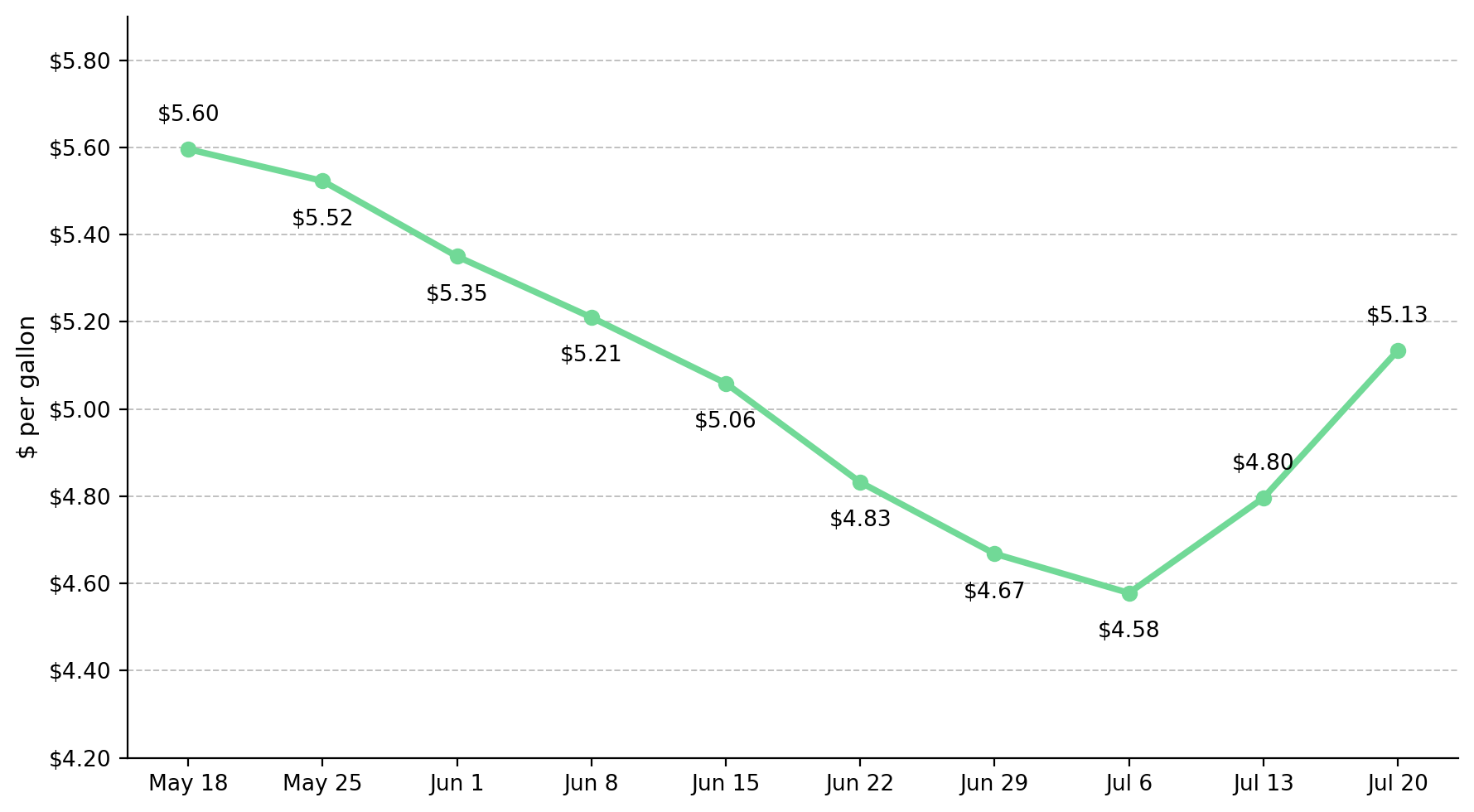
Fuel costs remain a key operating expense for mining companies. The EIA's national average retail diesel price reached $5.134 a gallon on July 20, up $0.338 from the previous week and $1.322 from a year earlier, raising the cost of running diesel-powered haul trucks and processing equipment. A sustained decline in crude prices would ease those operating costs, while a rebound would keep them elevated.
Oil prices have fallen, but shipping activity will show whether the pause is taking hold. Fewer than 10 commodity vessels transited the Strait of Hormuz each day over the weekend, and MST Marquee analyst Saul Kavonic expects shipping to recover gradually as operators wait for stronger security assurances before returning empty vessels to the route.
The next few days will show whether the current halt in attacks can hold or whether hostilities resume. One week of lower diesel prices does not confirm a sustained decline because the EIA's weekly data still reflects prices before the weekend's selloff. For mining companies, vessel traffic through the Strait of Hormuz is a better indicator of future fuel costs than short-term moves in oil prices.
$100 Brent Reclaim Would Reverse the Selloff and Raise Mining Fuel Costs
Monday's oil price decline will be tested by shipping conditions rather than price action alone. Fewer than 10 commodity vessels transited the Strait of Hormuz each day, indicating commercial traffic has yet to normalize and that a geopolitical risk premium remains in oil prices despite the recent pullback.
Brent rising back above $100 a barrel or renewed Iranian or Houthi strikes would likely reverse Monday's decline, push diesel costs higher, and further delay Europe's natural gas storage rebuild ahead of winter.
The next key updates are the EIA's Weekly Petroleum Status Report on Wednesday and the Short-Term Energy Outlook on August 11. Any change to the agency's $74 a barrel Brent forecast for the third quarter would indicate whether recent US-Iran hostilities have altered its assumption that the truce will hold.
Analyst's Notes





Subscribe to Our Channel




Stay Informed


