




Hormuz Attacks Lift Brent to $97.93, Favoring Mines Less Reliant on Diesel



Hormuz attacks lifted Brent to $97.93, favoring mines less reliant on diesel as refining constraints pushed diesel margins to a record $106 a barrel.
- US forces struck three Iranian oil tankers on September 5, while the Islamic Revolutionary Guard Corps (IRGC) navy said it targeted three tankers and three US vessels, increasing disruption risk near the Strait of Hormuz.
- Brent reached $97.93 on September 7, its highest since July 24, showing how shipping risk can support oil prices.
- On August 31, Persian Gulf refined product exports were near 40% of pre-war levels, versus 70-80% for crude, supporting diesel margins and distillate-focused refiners more than crude producers.
- The US diesel crack spread reached a record $106 a barrel on September 1, versus its historical range of $20 to $40, favoring refiners producing more diesel while raising costs for diesel-intensive mines.
- A rise in distillate stocks from 104.2 million to above 110 million barrels would signal a narrower diesel shortage and lower fuel-cost risk for mines.
Strikes on Hormuz Shipping Lift Brent to a Six-Week High
US Central Command said American forces struck three Iranian oil tankers, including one off Kharg Island, Iran’s main crude export terminal, while the IRGC navy said it targeted three tankers on unauthorized Hormuz routes and three US vessels, raising supply disruption risk. Brent reached a six-week high of $97.93 before trading at $96.19, while West Texas Intermediate (WTI) reached $91.03, showing that shipping attacks are supporting near-term oil prices.
Hormuz averaged 10 commodity ships a day over the prior 10 days, the lowest since May, showing that the disruption extends beyond the attacked vessels. US commercial crude inventories remained ample at 424.5 million barrels, 1% above the five-year average, making diesel refining margins a clearer opportunity than crude scarcity.
Refinery Outages Cut Product Supply & Expand Diesel Margins
Persian Gulf refined-product exports are near 40% of pre-war levels, versus 70-80% for crude, while refinery outages are 60% above the seasonal average. Eighteen Ukrainian strikes on Russian refineries, matching the previous month’s record, further reduced supply from another major exporter. US distillate stocks stand at 104.2 million barrels, 14% below the five-year average, while crude remains above its average, supporting diesel margins but raising costs for diesel-dependent mines.
US refineries ran at 98% of capacity, including Midwest plants at 103.5% of rated capacity, yet distillate output fell from 5.2 million to 5.1 million barrels per day, showing that higher utilization cannot close the supply gap. Limited refining capacity and no additional capacity scheduled before winter can keep diesel margins high even with ample crude.
Post-Ceasefire Recovery Lag Extends Distillate Upside Into 2027
Daan Struyven, Co-Head of Global Commodities Research at Goldman Sachs, warned that shipping disruptions could broaden and intensify, raising the risk that refined-product shortages outlast the conflict. The EIA’s August 2026 Short-Term Energy Outlook assumes Middle East crude output returns near pre-conflict levels only in early 2027, while a slower recovery in product exports could keep diesel margins high beyond an initial ceasefire.
4.3x Diesel-Propane Cost Gap Favors Mines With Flexible Loads
Mines buy delivered diesel rather than crude, so fuel costs include both the crude price and the diesel crack spread, which measures the refining margin. Ultra-low sulfur diesel (ULSD) in New York Harbor reached $4.351 per gallon, up 87% year over year, while WTI rose 31%, favoring diesel-focused refiners while raising costs for diesel-intensive mines.
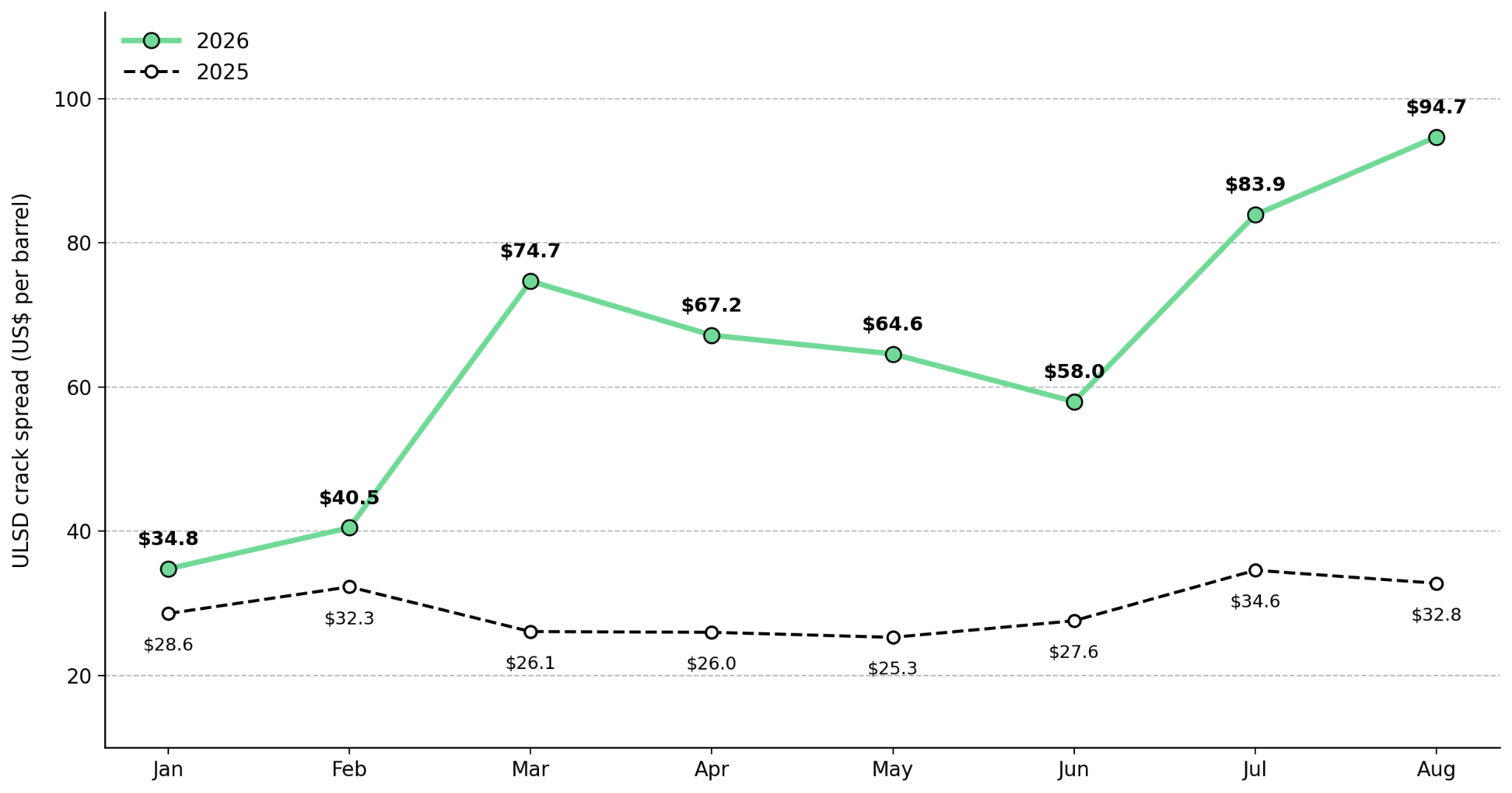
Propane at Mont Belvieu cost $0.680 per gallon, with inventories 25% above the five-year average, equal to $7.44 per million British thermal units versus $31.67 for ULSD. That 4.3x gap, up from 2.3x a year earlier, favors mines that can shift generators, camp heating, and ore dryers to propane, while diesel-dependent haul fleets and drill rigs remain exposed. Goldman Sachs more than doubled its 2027 US diesel margin forecast to $63 per barrel, leaving diesel-intensive mines exposed because crude-linked hedges do not cover refining margins.
Watch 115M Distillate Stocks for a Mine Fuel Cost Reversal
Gulf refined-product exports near 40% of pre-war levels and US distillate inventories 14% below the five-year average keep diesel supply tight, favoring refiners producing more diesel while raising costs for diesel-intensive mines.
If US distillate inventories rise above 115 million barrels, the prior year’s level, diesel should fall from its $106 record toward the historical range of $20 to $40. The decline would improve crude-linked cost models and reduce the risk that all-in sustaining cost guidance understates fuel expenses.
Weekly US distillate inventories determine whether the diesel shortage continues to support refining margins and raise mining fuel costs. A reading below 110 million barrels supports diesel-focused refiners and mines with limited fuel exposure; a rise above 110 million warrants reassessment, while a move above 115 million strengthens the case for diesel-intensive mines.
Analyst's Notes





Subscribe to Our Channel
.png)




Stay Informed


