




Houthi Strikes Push Brent to $99 as Refinery Limits Support Diesel Margins


Why falling crude forecasts may not bring fuel prices down: crack spreads, distillate stocks and refinery utilization now drive the market into 2027.
- On September 8, Houthi attacks on Saudi energy facilities lifted Brent futures $2.00, or 2.06%, to $99.00 per barrel, while West Texas Intermediate (WTI) reached $94.60, its highest since June 8.
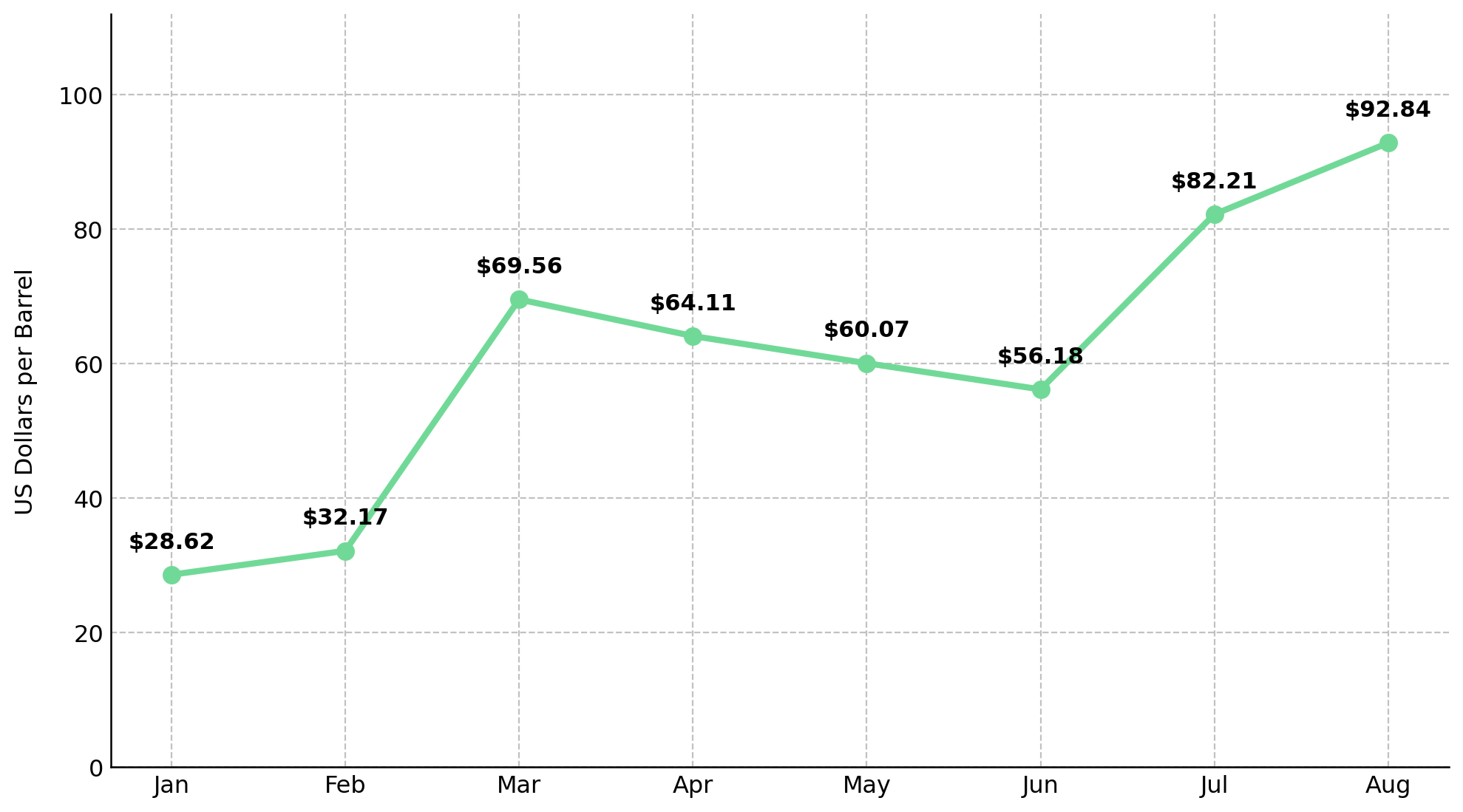
- Energy Information Administration (EIA) showed the US Gulf Coast ultra-low sulfur diesel (ULSD) crack spread reached $92.84 per barrel in August, up 224% from $28.62 in January, making refining margins rather than crude prices the main mining cost channel.
- Goldman Sachs forecast Brent averaging $85 per barrel in December and $80 in 2027, while Brent options pricing implied a 25% probability of exceeding $100 in March 2027.
- US refineries ran at 98.0% of operable capacity in the week ending August 28, while distillate output fell to 5.126 million barrels per day from 5.253 million a year earlier and inventories remained 14% below the five-year average.
- A sustained Brent price below $85 per barrel would lower mine fuel costs only if the diesel crack spread also narrows, allowing lower crude prices to pass through to diesel.
Saudi Attacks Lift Brent to $99 as $100 Odds Rise
Houthi attacks on Saudi energy facilities and Tehran’s threat of economic warfare against the US lifted Brent futures $2.00, or 2.06%, to $99.00 per barrel. Brent reached an intraday high of $99.22, its highest since July 24, while WTI reached $94.60. Goldman Sachs said Brent options pricing implied a 25% probability of Brent exceeding $100 in March 2027, up from about 6% a month earlier.
The attacks on Saudi energy facilities halted operations at some sites and wounded 73 people. The outages hit an already tight US fuel market, where EIA data showed distillate inventories 14% below the five-year average.
Refineries at 98% Capacity Support ULSD Margins as Distillate Output Falls
US refineries operated at 98.0% of capacity in the week ending August 28, and averaged 97.2% over four weeks, while Midwest refineries ran at 103.5% of nameplate capacity. Crude inputs rose 627,000 barrels per day year over year to 17.5 million, but distillate output fell to 5.126 million from 5.253 million and operable capacity fell to 18.027 million from 18.160 million. Senior industry executives told Reuters that diesel supply would remain tight because refineries lacked spare capacity, Russia had banned exports, and peak winter demand was approaching.
Oil and gas flows through the Strait of Hormuz remain disrupted because tanker traffic is constrained. US Central Command said US forces struck three Iranian tankers, including one near Kharg Island. Traffic through the strait slowed after Iran threatened retaliation. Before the conflict began in late February, the strait carried about one-fifth of global oil and liquefied natural gas supply.
Late Throughput Recovery Pushes High Fuel Costs into 2027 Mine Budgets
Restoring pre-war oil flows depends on the restart schedule rather than negotiations. Daniel Hynes, Analyst at ANZ, projected full recovery in late first quarter or early second quarter 2027, after producers set 2027 cost guidance and update fuel-price assumptions in January. Miners would therefore set costs before diesel refining margins fall, using hedges arranged when Brent traded in the $60s
Weekly US diesel data show whether the diesel crack spread is narrowing alongside Brent. EIA publishes US Gulf Coast ultra-low sulfur diesel (ULSD) spot prices and distillate inventories against the five-year average. These measures show whether diesel supply is recovering without requiring a forecast of the conflict.
54% Diesel Hedge Halves Cash-Cost Impact of a 10% Price Move
Reported mining examples show how crude-based guidance can understate actual cost exposure. A $61-per-barrel Brent assumption contrasts with increases of 30% to 70% for diesel, 40% for freight, and about 10% each for explosives and cyanide. At $100 oil, the estimated portfolio impact reaches $40 to $50 per ounce.
Diesel hedges can halve how much fuel-price changes reach mine cash costs. With diesel representing about 10% of operating costs and 54% of annual needs hedged at C$0.71 per liter against a C$0.78 benchmark, a 10% price change moves cash costs by about $4 per ounce after hedges, versus about $8 without them.
What happens in Hormuz is too uncertain to determine how much capital to commit. Published hedge coverage and fuel-price assumptions show how much price risk is protected, but these hedges track crude and diesel prices rather than refining margins.
What to Track Before the Oil Trade Turns
Brent above $95 per barrel and the US Gulf Coast ULSD crack spread above $80 support refining-margin exposure and integrated energy positions because tight diesel supply keeps product prices high relative to crude.
A sustained Brent price below Goldman Sachs’ $85-per-barrel December 2026 forecast would weaken the current oil trade, while the bank forecast $80 for 2027. Lower crude alone would not confirm that shift unless the diesel crack spread also fell toward January’s $28.62 per barrel.
Weekly EIA Gulf Coast ULSD spot prices and distillate stocks should be tracked against the five-year average to determine whether diesel supply is recovering. Rising inventories and lower ULSD prices would confirm falling refining margins, reducing support for the oil trade.
Analyst's Notes





Subscribe to Our Channel





Stay Informed


