Uranium Contract Price Hits $96.50, Deeper Supply Deficits Ahead


Reactor life extensions, utility under-contracting and rising costs are tightening uranium supply, favoring producers with uncontracted future supply.
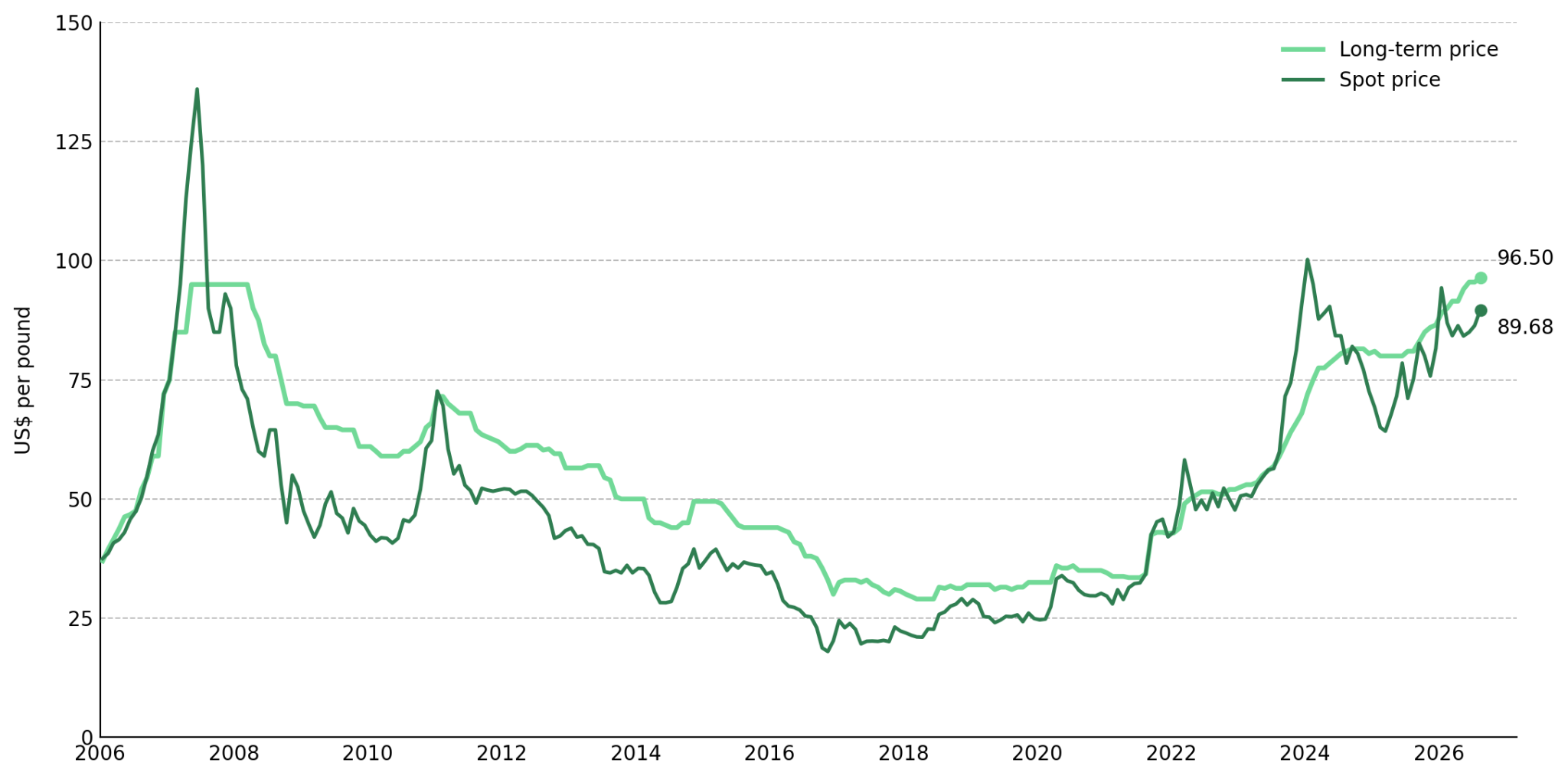
- The uranium long-term price closed in August 2026 at $96.50 per pound, above its 2007 peak.
- Google's 22-year deal for up to 50% of Loviisa's nuclear output underwrites a life extension through 2050.
- Price cases run from Jefferies' $95 per pound long-term forecast to Citi's $140 by late 2027. The EIA holds nuclear at 18% of US generation through 2027.
- Producers with uncommitted output capture current term prices first.
AI Power Demand Lifts Uranium Term Price to $96.50 per Pound
The uranium long-term price, the rate utilities pay for U3O8 (uranium concentrate, or yellowcake) under multi-year contracts, closed August 2026 at $96.50 per pound, according to UxC and TradeTech month-end averages published by Cameco. That tops the $95.00 peak the series recorded in 2007 and early 2008, in nominal terms. Spot, the price for immediate delivery, neared $90 per pound this week, its highest since early February.
The long-term price matters more to miners than spot, because it sets the revenue a producer can lock in before committing capital to a mine. It rose $10.00 between December 2025 and August 2026 against an $8.13 month-end spot gain, leaving utilities paying $6.82 more per pound at end-August for future supply than for spot material.
Data Center Power Deals Extend Reactor Lives, Locking In Uranium Demand to 2050
Uranium demand is arriving through existing reactors first. On 9 September 2026, Google agreed to a 22-year purchase of up to 50% of the output of Fortum's Loviisa nuclear plant in Finland. Fortum said the deal provides economic certainty for the lifetime extension and upgrade it is targeting through 2050, Reuters reported. A life extension adds decades of fuel requirements without new-build construction or licensing risk.
The pressure compounds because utility contracting still trails consumption. Utilities placed about 116 million pounds under long-term contracts in 2025, below the replacement rate needed to cover fuel consumed, according to Cameco, adding to uncovered future requirements. UBS sees deficits widening into the 2030s, according to the Wall Street Journal.
Flat Nuclear Share and Rising Mine Costs Split Uranium Price Forecasts
The US Energy Information Administration's September 2026 Short-Term Energy Outlook holds nuclear at 18% of US generation through 2027 despite record power use. AI therefore reaches uranium through fuel contracts before it lifts nuclear's generation share. The largest producer also signals that new pounds cost more. Kazatomprom Chief Executive Officer Meirzhan Yussupov told The Wall Street Journal:
"New realities are signaling that the era of 'cheap' uranium is fading away."
Citi analysts think uranium could reach $140 per pound by late 2027. Jefferies raised its long-term forecast 36% to $95 per pound, a flat-price case against August's term print. On the downside, UBS flags near-term macro headwinds, and several mine projects could add supply over five years. UxC President Jonathan Hinze said a public backlash slowing data centers could delay new reactors, the Wall Street Journal reported. The EIA already cites a Texas pause on new data center grid connections.
Utility Term Buying Favors Uncommitted Uranium Output
Producers that sold forward at fixed prices realize the higher term price only as those contracts expire. Miners with uncommitted output can sign at current term prices, raising the value of every unsold pound. Higher-cost operations lose margin where costs outpace contract prices.
The test is whether output responds to price. On an analyst call reported by the Wall Street Journal, BHP Chief Executive Officer Brandon Craig called uranium very attractive but, at this stage, only a copper byproduct.
That leaves the supply response to pure-play miners. For developers, the test is the price behind the published net present value (NPV). A study run below $95 per pound understates current term support, while one needing $140 relies on Citi's upside case.
Contract volumes are negotiated privately, so the next term print is unknowable, and UBS notes spot has swung since nearing $100 per pound this year. Exploration-stage uranium equities that fund drilling through share issues can lose most of their value in a rising market when financing or permitting fails, favoring explorers with a strong balance sheet and jurisdiction.
Existing Reactor Demand Sets Long-Term Value for Miners
Uranium is bought years before it is burned, so data center demand lifts the price only through signed power contracts. At Loviisa, Google's purchase funds a life extension that keeps the plant buying fuel through 2050.
Company value follows the price utilities sign for years ahead, and companies with unsold pounds and a funded path to production capture it first. Small modular reactor demand remains conditional, a developer's upside rather than its core value. With BHP keeping uranium a copper byproduct, the world's biggest miner is an unlikely bidder, so developers fund growth through offtake contracts, debt and equity.
Uranium's base is existing reactors. Utilities contracted below replacement in 2025, and UBS forecasts deficits widening into the 2030s. A slower data center build-out removes a headline, not a fuel requirement, and the next wave of supply will be from developers able to finance it.
Analyst's Notes





Subscribe to Our Channel








Stay Informed