




Rua Gold Takes Fully Funded Auld Creek Gold-Antimony Project to Fast-Track Permitting


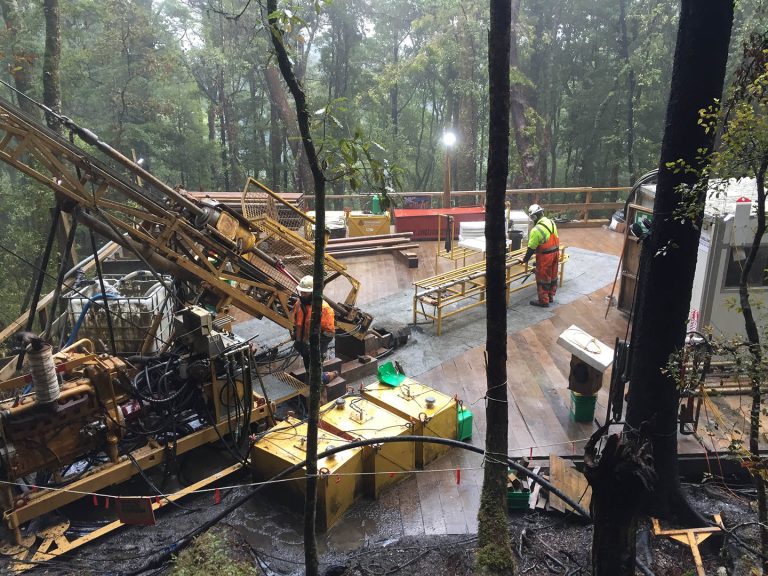
Rua Gold (TSX:RUA) targets a Q2 2027 Fast-Track permit for its high-grade Auld Creek gold-antimony starter mine, backed by record drill grades and C$25M cash.
- Rua Gold plans to submit its Fast-Track application for Auld Creek in October 2026 and is targeting a permit decision by Q2 2027.
- The starter-mine PEA returns an after-tax NPV5% of $42.4 million and a 17% IRR at $3,300 per ounce gold, on $132.6 million of initial capital.
- Recent intercepts of up to 82.9 g/t gold and 24.8% antimony, plus the first visible gold, point to resource growth beyond 200,000 gold equivalent ounces.
- Management treats gold as the value driver and uses antimony output to attract metal-trader financing that a gold-only project would not.
- A C$33 million raise in January 2026 leaves the company funded to Q2 2027, when it expects C$10-15 million to remain.
New Zealand has legislated a fast-track approvals regime that can take a mine from application to permit in roughly six months. Rua Gold (TSX:RUA, NZX:RGI) has built its strategy around that window. In an interview with Crux Investor, Chief Executive Officer Robert Eckford explained how the company plans to move its Auld Creek gold-antimony project from maiden resource to mine permit in little more than a year. Rua Gold is seeking approval for a compact starter mine first. Four drill rigs are meanwhile working to grow the deposit behind it.
Permitting First, Resource Growth Next
Rua Gold holds more than 120,000 hectares of permits in the Reefton Goldfield on New Zealand's South Island, covering around 95% of the district. Reefton historically produced over 2 million ounces of gold at grades up to 50 g/t. Auld Creek sits at the centre of the goldfield. Early miners left it untouched because its gold occurs alongside high levels of antimony. That antimony now makes it a critical mineral project. Mineralisation also starts at surface rather than beneath old workings.
Mineral resource estimate outlined roughly 200,000 gold-equivalent (AuEq) ounces which comprises 54,000 ounces Indicated at 5.7 g/t AuEq and 148,000 ounces Inferred at 3.7 g/t AuEq. Eckford said the estimate covers only the upper part of a system that typically extends beyond a kilometre in this district. Endura Mining's neighbouring Blackwater project carries a resource to 1,500 metres depth and is on track for first gold in December 2026.
Rather than drill for several more years, management took the starter resource straight into permitting. In July 2026, the New Zealand government accepted Auld Creek as a listed project under the Fast-Track Approvals regime. The company plans to submit its substantive application in October 2026. Eckford expects a completeness check by November, which starts the six-month clock. He is targeting a permit decision in Q2 2027.
PEA Economics and a Deliberately Small Footprint
The Preliminary Economic Assessment (PEA) published in April 2026 models a 5.5-year underground starter mine producing about 26,665 AuEq ounces a year. At a long-term gold price of $3,300/oz, it shows an after-tax NPV5% of US$42.4 million, a 17% IRR and a 3.3-year payback. At a spot price of $4,700/oz, NPV could rise to $113 million, with a 36% IRR and a 2.2-year payback. Initial capital is estimated at $132.6 million. All-in sustaining costs (AISC) are $1,850/oz. Eckford estimated free cash flow of around $30 million a year at the long-term price.
Eckford was open that the starter case is a vehicle for permitting rather than the end goal. "We're not expecting a billion dollar project here to be built by a small junior company. We're really focused on a bite-size high margin high-grade mine, which means a small capex footprint," he said.
The expansion lever sits in the plant design. New Zealand permits cover the plant footprint rather than throughput. Engineers are therefore building in space to lift capacity from 250,000 tonnes a year to 500,000 tonnes a year. Eckford said a second Reefton deposit would emerge by Q1 2027 as the next "spoke" in a hub-and-spoke model feeding the central plant.
Highest-Grade Drilling to Date
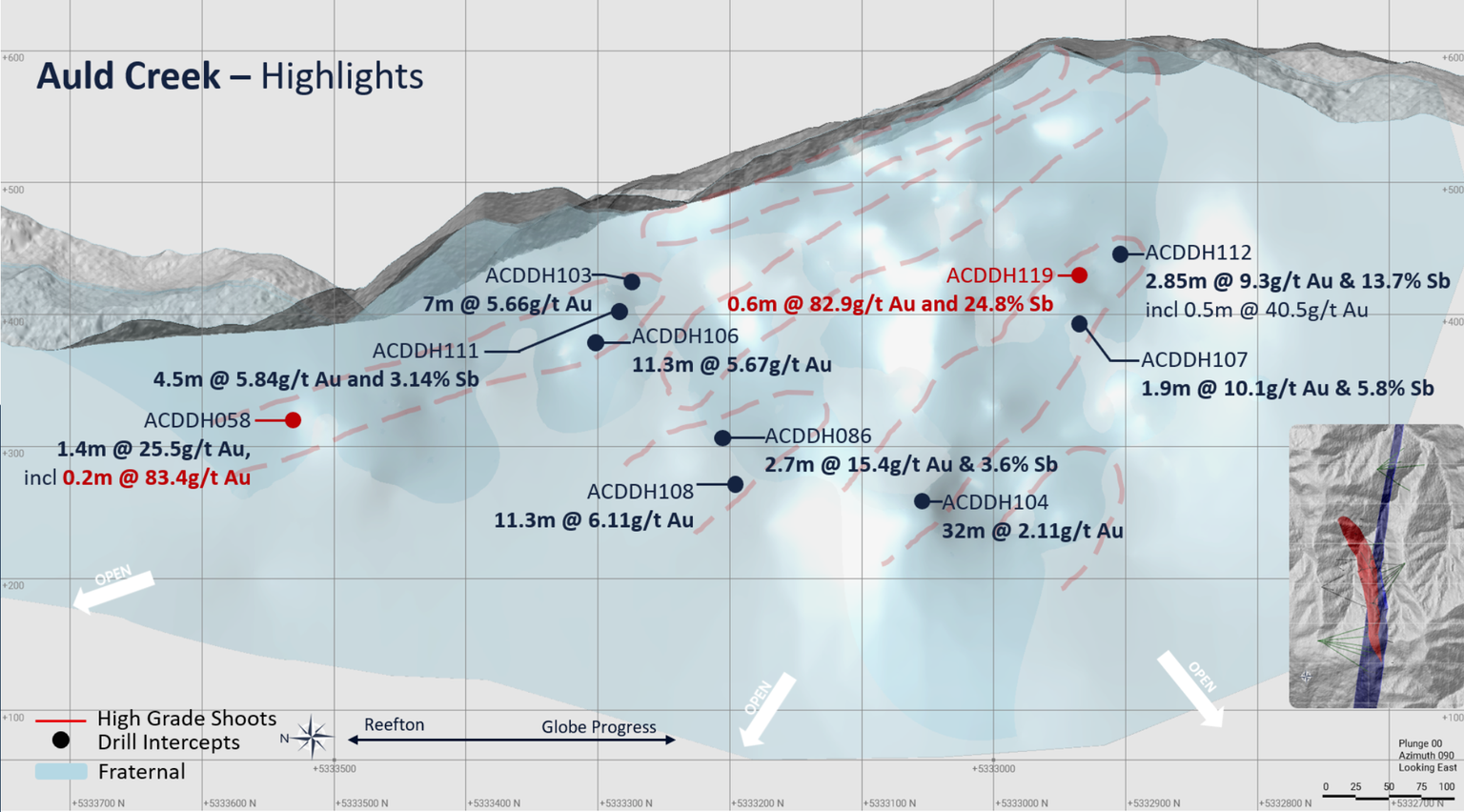
Rua Gold has completed 19,600 metres of drilling at Auld Creek, exceeding its 19,000-metre target. The latest results include the project's highest grades so far returning 0.6 metres at 82.9 g/t gold and 24.8% antimony and 2.85 metres at 9.29 g/t gold and 13.71% antimony. The company also reported its first visible gold at the project and mineralised zones locally exceeding 20 metres in width.
The deposit now extends over 1,000 metres along strike and more than 500 metres down dip. It remains open in all directions. Assays from 18 further holes are pending. An updated MRE is due in Q4 2026, with the Pre-Feasibility Study (PFS) also scheduled for Q4 2026. Eckford indicated that PFS drilling has converted a substantial share of Inferred ounces to Indicated.
Antimony as a Financing Lever
Eckford does not want the investment case to rest on antimony prices, which he described as highly volatile.
"Gold is our underlying commodity. That's our value driver. The antimony is a really strategic piece for us because it creates financing opportunities. It creates interested parties that wouldn't be interested in a gold only project."
Rua Gold plans to produce an antimony concentrate alongside a gold concentrate. Eckford said the company is in discussions with around four groups on offtake terms. He expects metal traders to take part in project financing alongside debt, with existing shareholders also given a share. That process is expected to begin around mid-2027, once a permit decision is in hand.
Treasury, Shareholders & Team
In January 2026, Rua Gold raised C$33 million at C$1.10 per share, with no warrants attached for investors. Eckford said the order book reached C$75 million against an initial C$25 million target. With a market capitalisation of about C$150 million and institutional holders including Franklin, Konwave, Libra and ICM, Eckford put cash at about C$25 million. That funds the PFS, Reefton drilling, permitting and the Glamorgan programme. He expects C$10-15 million to remain by Q2 2027.
Eckford previously co-founded Aris Mining and served as its CFO. Former Aris COO Richard Thomas sits on Rua Gold's board and advises on the PFS. COO Simon Henderson brings more than 40 years of New Zealand exploration experience. Simon Delander, VP Risk, Stakeholder and Regulatory Affairs, joined from Endura Mining, where he led that company's permitting process.
Interview with Robert Eckford, CEO of Rua Gold
Glamorgan: Epithermal Optionality in the North
The Glamorgan Project lies in the Hauraki Goldfield on the North Island, a region that has produced 15 million ounces of gold and 60 million ounces of silver. It sits just over 3 kilometres from OceanaGold's Wharekirauponga (WKP) deposit. WKP holds 1.5 million ounces at 17.3 g/t gold in the Measured and Indicated categories. Eckford credited Henderson with the WKP discovery. Two years of surface work have defined three drill targets at Glamorgan. Drill permits covering five years were secured in July 2026. A fully funded 9,000-metre programme is due to start in Q4 2026.
Outlook for Investors
Rua Gold's investment case now rests on execution over the next nine months. The company must lodge its application in October, publish a PFS that confirms the resource conversion Eckford described, and secure a permit decision by Q2 2027. The starter mine's economics are modest at long-term prices but improve sharply at spot. Recent intercepts, including the project's first visible gold, suggest room for growth along strike and at depth.
Glamorgan adds separate exploration upside beside one of New Zealand's highest-grade epithermal deposits. Both programmes are funded, which limits near-term dilution risk. The open questions are how project financing will be structured and whether a second Reefton deposit can deliver hub-and-spoke scale. The October submission, the Q4 2026 PFS and the permit decision form a clear sequence of catalysts to track.
The Investment Thesis for Rua Gold
- A permit-first strategy targets a Fast-Track decision by Q2 2027, following an October 2026 application.
- The PEA starter case shows an after-tax NPV5% of US$42.4 million at US$3,300/oz gold, rising to US$113.0 million at US$4,700/oz.
- Record intercepts of up to 82.9 g/T gold support growth beyond the 200,000-ounce starter base.
- Antimony output gives the company access to metal-trader offtake and financing that a gold-only project would not attract.
- About C$25 million in cash funds permitting, the PFS and Glamorgan drilling without an immediate equity raise.
- Key risks include permitting delays, modest starter-case economics at long-term prices, project financing terms and antimony price volatility.
- Investors should monitor the Q4 2026 MRE and PFS for Inferred-to-Indicated conversion and any movement in capex guidance.
Macro Thematic Analysis
Permitting has become one of the main sources of value erosion in mine development. Projects in many established jurisdictions spend a decade or more between discovery and construction. New Zealand has moved in the opposite direction. The government has also stated a 10-year goal to double mining exports. OceanaGold's Wharekirauponga project has already been approved through the process in under four months and is now under construction.
A compressed timeline changes how juniors create value. The traditional route is to drill for years before engaging regulators. Rua Gold is instead permitting a small, high-grade starter mine early and growing into a larger plant. If the model works, the permit becomes the main de-risking event rather than resource size.
Antimony adds a second theme. Western governments and industrial buyers are seeking non-Chinese sources of the metal, which is used in defence, flame retardants and energy storage. That positions gold-antimony deposits as a way for Western buyers to challenge China's dominance of antimony processing. It also draws in metal traders as potential financing partners. Eckford sees these forces converging at Reefton.
"It's the first time in my 20 year career that you've been able to go this quickly. And it's because we've got community support, we've got local indigenous support, we've got federal support, and we've got commodity support."
The durability of this alignment will be tested as the first fast-track mining applications move through the system.
TL;DR
Rua Gold (TSX:RUA, NZX:RGI) is using New Zealand's Fast-Track Approvals regime to move its Auld Creek gold-antimony project in the Reefton Goldfield from maiden resource to permit decision within about 15 months. The starter mine is built on a 200,000-ounce AuEq resource and a PEA showing an after-tax NPV5% of $42.4 million at $3,300 gold, or $113.0 million at spot. A substantive application is due in October 2026, with the PFS and updated resource in Q4 2026 and a decision targeted for Q2 2027. Recent drilling returned the project's highest grades, including 82.9 g/t gold. About C$25 million in cash funds the plan, including a 9,000-metre programme at Glamorgan.
FAQs (AI Generated)
Analyst's Notes





Subscribe to Our Channel


Stay Informed


