Myriad Uranium’s Copper Mountain Extends Beyond Historic Resource


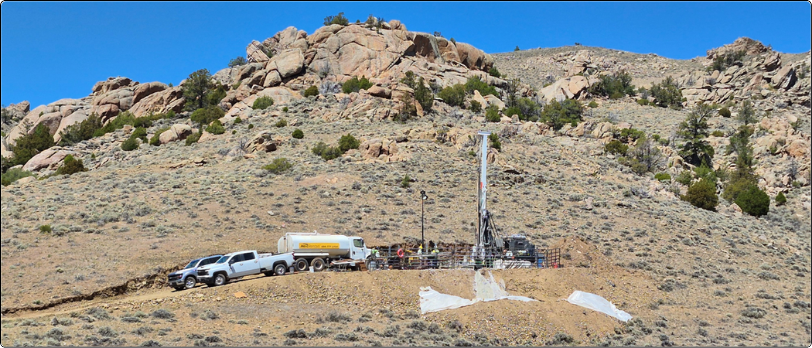
Myriad Uranium's Phase II drilling at Copper Mountain, Wyoming lifts grades and expands district potential across a 26.6 Mlb historical resource.
- Copper Mountain carries a 26.63 Mlb historical resource and an exploration target of up to 655 Mlbs, and Myriad has consolidated 100% ownership for the first time in almost 50 years.
- Phase I assay results at the Canning deposit came in 20-60% higher than historical gamma-probe grades across 34 holes.
- Phase II drilling is currently underway, with the Lucky Cliff prospect and new geophysical targets adding mineralisation entirely outside the historic resource footprint.
- The optioned Breccia Pipe portfolio in Arizona and the retained carried interest in the sold Red Basin project give Myriad partner-funded exposure without additional capital commitment.
- Myriad holds approximately $10 million in cash against a $6 million Phase II budget, and its NASDAQ or NYSE American listing application is roughly 80% complete.
Uranium's slow-burn recovery has a new focal point: data centres. As AI infrastructure pushes electricity demand higher, utilities and hyperscalers alike are turning to nuclear power for firm, round-the-clock generation - and that is pulling a fresh pool of capital toward domestic U.S. uranium supply. Myriad Uranium Corp. (CSE:M) sits squarely in that story. Its flagship Copper Mountain Uranium Project in Wyoming carries a historical resource of 26.63 Mlbs eU₃O₈ and an exploration target running into the hundreds of millions of pounds, and the company has just wrapped its first Phase II drill results confirming grades well above what 1970s-era gamma probes indicated. CEO Thomas Lamb discussed what Phase II has found so far, how the company is sequencing its next steps, and why it is being deliberate about spending.
Copper Mountain's Historical Resource & Exploration Target
Copper Mountain is an 18,000+ acre land package in Fremont County, Wyoming, one of the most heavily-drilled uranium districts in the United States. Union Pacific, through subsidiary Rocky Mountain Energy Company (RMEC), drilled more than 2,000 boreholes across the property in the 1970s, delineating seven deposits and 15+ prospects, and had designed a six-pit, hub-and-spoke conventional mine plan centred on the Canning deposit, targeting production in 1983. Those plans were shelved after uranium prices collapsed in the wake of the Three Mile Island incident.
The resulting historical estimate across the seven deposits stands at 26.63 Mlbs eU₃O₈ in 48.95 Mt at an average grade of 269 ppm (RMEC, 1977). A separate 1982 assessment by Bendix Field Engineering Corporation for the U.S. Department of Energy put the district's broader exploration target at 1,111 to 2,971 Mt at 100 ppm eU₃O₈, or 222 to 594 Mt at 500 ppm eU₃O₈ - potentially containing between 245 Mlbs (in the Control Area, 80% held by Myriad) and 655 Mlbs (in the wider Assessment Area, 62% held). It's important to note that a Qualified Person has not done sufficient work to classify either estimate as a current mineral resource, and Myriad is not treating them as such; both remain historical and conceptual under NI 43-101 until confirmed by new drilling.
Lamb pointed to the district's long production history as part of the appeal:
"500,000 pounds were produced in the '50s and '60s at a mine in the very centre of our project called Arrowhead. Twenty years later, Union Pacific through subsidiary Rocky Mountain Energy, came back and decided to really invest at Copper Mountain. They drilled 2,000 boreholes and discovered [and] delineated seven deposits."
Myriad consolidated 100% ownership of the project in August 2026 through a merger with partner Rush Rare Metals Corp - the first time the district has had a single owner in almost 50 years.
Phase I Results Outperform Historical Gamma Grades
Myriad's first modern drilling at Copper Mountain in decades, a 34-hole programme at the Canning deposit completed in November 2025, was designed to test whether the 1970s gamma-probe-based grades held up. They did, and then some. Chemical assays across the 34 holes came in 20-60% higher than the historical equivalent-uranium (eU₃O₈) grades, depending on cut-off: 20% higher at a 200 ppm cut-off, 50% higher at 500 ppm, and 60% higher at 1,000 ppm.
One hole, CAN0034, saw grade improve by more than 250%, from 344 ppm eU₃O₈ (gamma) to 833 ppm U₃O₈ (assay) over 0.5 m at 454 m depth. The company attributes the gap to radiometric disequilibrium - a natural mobility of uranium and its daughter products that historic operators, relying solely on probe data, could not fully capture. Myriad's own modelling shows the assay data has increased mineralised shell volume by 15% relative to the historical gamma-probe model.
Interview with Thomas Lamb, CEO of Myriad Uranium Corp.
Phase II Drilling, Testing Deposits & Opening New Targets
Phase II is a two-stage, roughly 5,000-metre programme that commenced in July 2026, funded from Myriad's cash position of roughly $10 million against a budgeted $6 million spend - with scope to expand if results and market conditions warrant it. Stage 1 is aimed at the historic deposits: first-pass holes planned or underway at Gem, Hesitation, Arrowhead and Mint, alongside continued Canning drilling depending on rig availability, with Fuller and Allard to follow once permitting and access are complete.
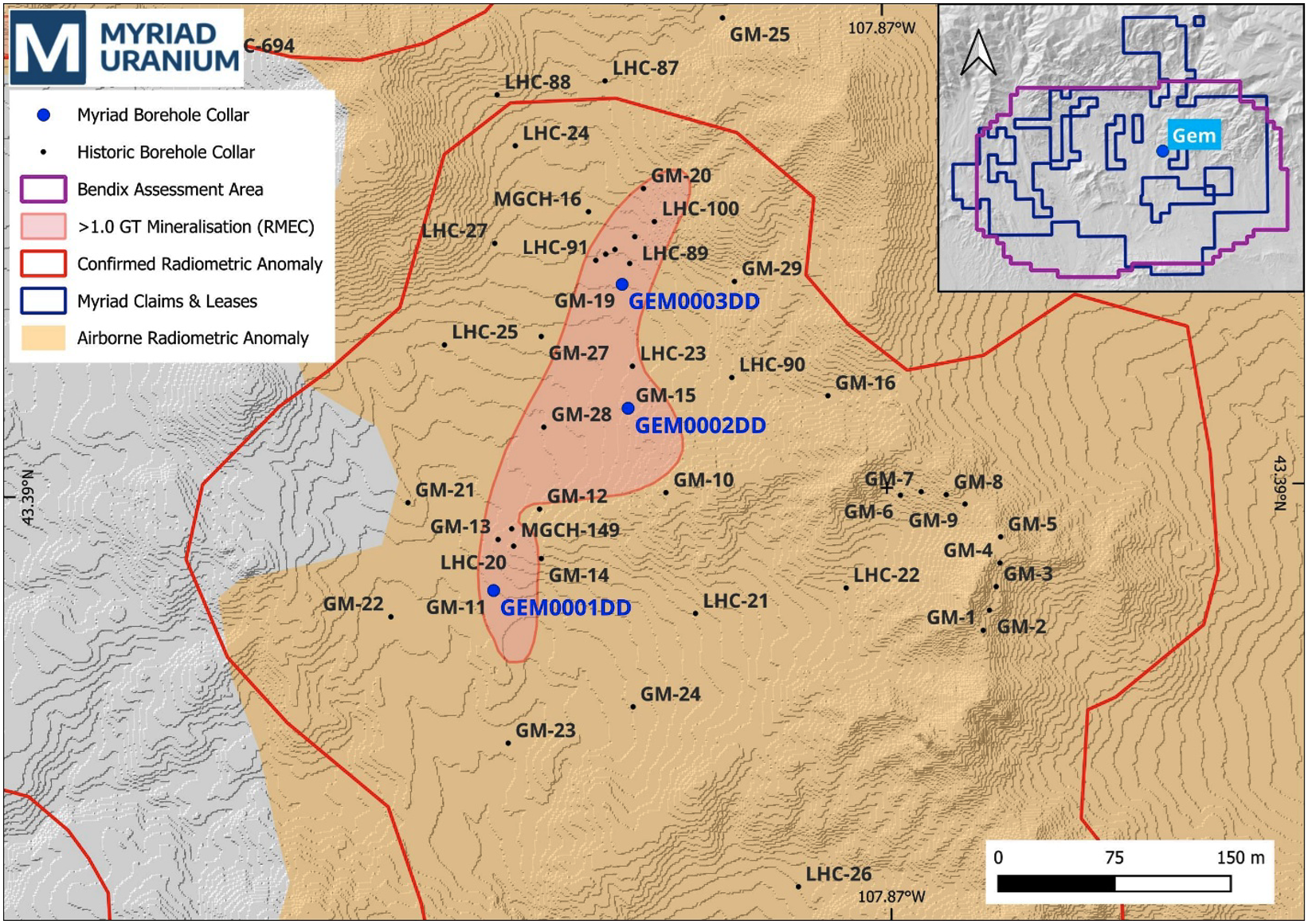
Stage 2 is testing new ground. At Lucky Cliff, a prospect north of the historic resource area and outside the Bendix exploration target entirely, four holes totalling 716.6 m intersected 50 mineralised intervals above 100 ppm eU₃O₈, with a best interval of 19.96 m at 269 ppm eU₃O₈ from 18 m depth and a peak grade of 1,336 ppm. A district-wide radiometric and magnetic survey has since identified further drill-ready targets including Poison Spider, Berger, Skunkovitch and West Gem on the granite-hosted side, and Cedar Ridge, Fannie and Piedmont on the sedimentary side plus additional more targets, several with historic drilling by Union Pacific or Anaconda Copper.
Recent gamma results from a separate hole programme at Gem, announced this month, extend the pattern: three holes totalling 507 m intersected 21 mineralised intervals above 100 ppm, with the longest at 34.90 m grading 210 ppm eU₃O₈ from 10.65 m, and a peak grade of 1,368 ppm.
The Breccia Pipe Option & the Red Basin Exit
Beyond Copper Mountain, Myriad holds a 23-target breccia pipe portfolio on the Arizona Strip, acquired in June 2026 and optioned to Wedgemount Resources on a three-year earn-in to 75%. Myriad receives $75,000 cash plus a 9.9% equity stake in Wedgemount, which must spend C$4,000,000 over the option period, with a right to form a 50/50 joint venture and earn back 25% by spending a further CDN$5,000,000. One target, the Wate Uranium Breccia Pipe carries a historical resource of 1.12 Mlbs eU₃O₈ in 71,000 t at 0.79% (also historical, not current). The portfolio sits near Energy Fuels' Pinyon Plain Mine, which produced 638,700 lbs U₃O₈ at an average grade of 2.23% in the second quarter of 2025 and is described by the company as America's highest-grade and most profitable uranium mine.
Myriad also retains a 10% free carried interest in the Red Basin Project in New Mexico, sold in May 2026 to Subatomic for $2.5 million cash plus a strategic alliance covering future deal flow. Myriad had acquired the project for C$525,000 roughly 14 months earlier, making the sale a better-than-6x cash-on-cash return.
Financial position & capital discipline
As of September 2026, Myriad had 140,149,847 common shares outstanding (195,045,625 fully diluted) and a market capitalisation of roughly C$67.27 million, with 0% short interest as a percentage of float. Lamb was explicit that the company does not intend to drill simply for the sake of a headline resource update. Discussing peers who have brought historical resources current without the market reaction they expected, he said:
"We've seen a couple of our peers in the sector, very smart management, great cap tables, where they've gone out and drilled, brought their resources current with big drill programmes, and spent a lot of money on that, and then their market caps and their valuations have not gone the direction that everybody anticipated. So we want to make sure we do things that hopefully dramatically increase the share price."
The company is also preparing a U.S. listing application, for NASDAQ or NYSE American, described as roughly 80% complete.
Investment Thesis for Myriad Uranium
- Copper Mountain's historical resource (26.63 Mlbs eU₃O₈) and exploration target (up to 655 Mlbs) sit on 100%-owned, consolidated ground for the first time in nearly 50 years, within 5 km of rail, highway and power infrastructure.
- Phase I assay results running 20-60% above historical gamma grades suggest the district's 1970s-era resource base may be conservative - a re-rating catalyst if confirmed at scale.
- Lucky Cliff and the newly identified geophysical targets represent mineralisation entirely outside the historic resource and Bendix exploration target areas, offering blue-sky upside beyond the known pounds.
- The Breccia Pipe option (Wedgemount-funded) and the Red Basin carried interest give Myriad optionality without further capital commitment from the company itself.
- Management holds a meaningful personal stake and has signalled explicit reluctance to spend for spending's sake, prioritising drill programmes it believes will move the share price rather than simply the resource count.
- Monitor: assay results from the Stage 1 historic-deposit holes (Gem, Hesitation, Arrowhead, Mint) as the next test of whether the Phase I grade uplift holds project-wide.
- Monitoring of the progress on the NASDAQ/NYSE American listing application, which could widen the investor base materially if completed.
- Considerations for investors: none of the resource or exploration target figures are current under NI 43-101, and a maiden compliant resource is still a multi-drilling-phase, multi-year proposition.
Macro Thematic Analysis
Uranium's investment case has shifted since the sector's last major cycle. Where prior rallies were driven primarily by utility contracting and supply disruption, the current one is increasingly framed around data centre and AI power demand - large technology firms seeking firm, carbon-free electricity are turning to nuclear as a credible baseload option, and that is drawing a different class of capital into the space. Myriad's own experience illustrates the shift directly: its Red Basin project in New Mexico was sold not to a traditional mining acquirer but to Subatomic, a new venture backed by 8VC and Overmatch - technology-sector investors positioning at the intersection of AI and energy security.
Lamb frames the opportunity in similar terms:
"If you believe in the uranium thesis, uranium prices going higher, data and AI is coming, we showed with our Red Basin project that private money with huge pools of capital. Obviously in the tech sector, they're coming in so we have one of these enormous projects in the US."
For a project like Copper Mountain, that dynamic matters on two fronts. First, U.S.-domiciled, U.S.-permitted uranium projects carry a scarcity premium as utilities and policymakers push to reduce reliance on Russian and Kazakh supply. Second, Copper Mountain's proximity to established infrastructure and its potential for both conventional and in-situ recovery mining give it optionality that lower-grade, more remote projects lack. The comparison Lamb draws to Bannerman Resources' large-scale Namibian project - a similar-style, large-tonnage deposit that has attracted major Chinese and other institutional capital - is instructive: scale and grade continuity, not just headline grade, appear to be what the market is now willing to fund. Whether Copper Mountain can demonstrate that continuity across its full seven-deposit footprint is the question Phase II is designed to answer.
TL;DR
Myriad Uranium has consolidated 100% ownership of its Copper Mountain Uranium Project in Wyoming, home to a historical resource of 26.63 Mlbs eU₃O₈ and an exploration target running as high as 655 Mlbs. Phase I assay results came in 20-60% higher than historical gamma-probe grades, and early Phase II results at the Lucky Cliff and Gem prospects - both outside the historic resource footprint - show similarly encouraging near-surface intercepts. With roughly $10 million cash on hand, a $6 million Phase II budget, an optioned Arizona breccia pipe portfolio, a retained carry in the sold Red Basin project, and a NASDAQ/NYSE American listing application in progress, management says it is prioritising capital discipline over drilling for its own sake.
FAQ (AI-generated)
Analyst's Notes





Subscribe to Our Channel


Stay Informed