




Scotia Metals Aims Big: Exploring Nova Scotia's 37,000-Hectare Lithium Frontier


.jpg)
Scotia Metals holds Nova Scotia's largest lithium land package, adjacent to the Brazil Lake deposit, with drilling planned at Green Wolf in 2026.
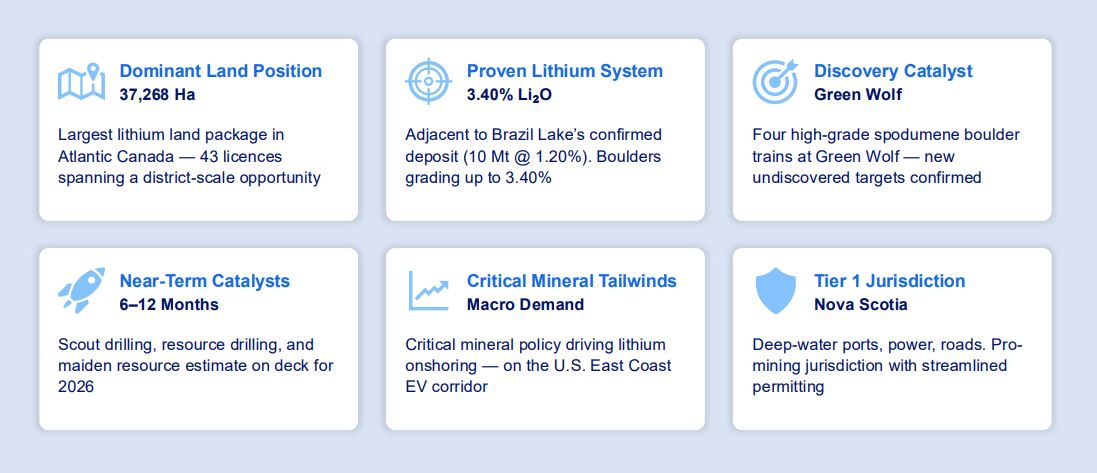
- Scotia Metals now holds the largest lithium land position in Nova Scotia, spanning 37,268 hectares across 43 exploration licences.
- The company's ground sits directly along strike from the Brazil Lake spodumene deposit, and Green Wolf boulder samples have returned grades up to 3.40% Li₂O.
- Management includes veterans of Galaxy Resources/Allkem, K92 Mining, and other successful resource-company exits.
- The company raised approximately $5.8 million alongside listing and maintains a tight share register split roughly 50/40 between insiders and repeat backers.
- Scout drilling is planned for Q3 2026, though the timeline for a maiden resource is stated inconsistently across sources.
Lithium markets are stirring after a punishing 2022–24 correction, and spodumene pricing has led the recovery - rebounding from roughly US$816 a tonne in the third quarter of 2025 to more than US$2,200 a tonne entering 2026. Against that backdrop, newly listed Scotia Metals Corp is positioning itself as the largest lithium landholder in Nova Scotia, a jurisdiction historically explored for gold and tin, with almost no modern lithium exploration until now. The company, formerly Cross River Ventures Corp, completed its business combination with Scotia Lithium Corp in late July 2026, bringing in a management team with a record of building and monetising lithium and precious-metals companies.
Chief executive Rodrigo Roso has spent more than 20 years in capital markets, transacting on and building companies involved in projects totalling roughly US$35 billion in aggregate capital expenditure, with the last five years focused specifically on lithium assets across multiple global jurisdictions. Roso describes Scotia as a twofold proposition: an asset with defined technical merit, and a platform built by a team he says is accustomed to moving quickly and at scale. Speaking to Crux Investor, Roso set out the company's land package, its Green Wolf discovery target, the capital raised to fund the current programme, and the plan to move from surface boulder prospecting toward a maiden resource.
Financial Metrics and Capital Structure
Scotia Metals closed a concurrent financing alongside its listing for gross proceeds of roughly $5.8 million - $4.3 million in hard dollars at $0.25 per share (17,200,000 shares) and $1.5 million in flow-through shares at $0.325 (4,615,400 shares). The flow-through proceeds are earmarked for eligible Canadian exploration expenses at the project, which the company must incur by the end of 2027. The company had 23,167,340 shares issued pre-listing, rising to 44,982,740 issued shares on listing and 48,582,740 fully diluted, including 3,600,000 warrants at $0.25 with one year remaining.
Insiders hold approximately 50% of the register, with a further 40% held by investors who have backed the management team's earlier companies - repeat backers Roso describes as people prepared to hold on and bet on the company's success rather than trade around news flow. That structure, in Roso's view, keeps the register concentrated among parties aligned with a multi-year exploration and development plan rather than short-term traders. Roso pointed to the team's fundraising track record directly:
"Our team has an incredible ability to raise the money we need for those type of projects - not only in the capital markets, but also from strategic partners."
Project Overview
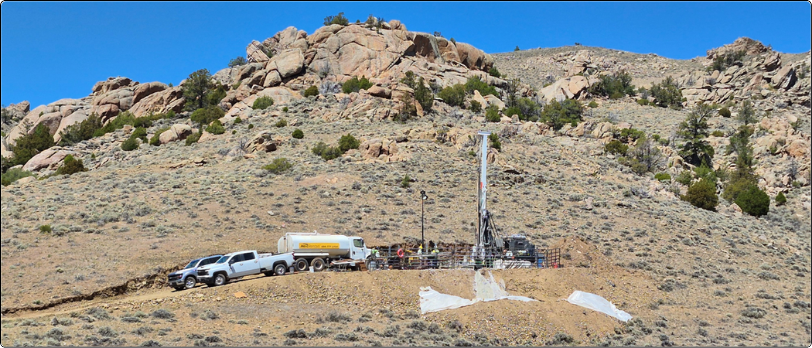
Scotia's ground covers 37,268 hectares across 43 exploration licences and more than 80 kilometres of prospective strike along a shear-zone-controlled corridor in Nova Scotia's South Mountain Batholith region. The land package sits directly along strike from the Brazil Lake spodumene deposit, a privately held resource estimated at 10.0 million tonnes at 1.20% Li₂O under JORC guidelines, built from 97 drill holes totalling 26,700 metres plus 70 historic holes totalling 6,600 metres, and reporting metallurgical recoveries of 90-97% through dense media separation with a concentrate grading approximately 7.7% Li₂O. At the Green Wolf target, less than 8 kilometres up-ice of Brazil Lake, first-pass prospecting has returned more than 30 ore-grade boulders grading 1% to 3.40% Li₂O across at least five distinct boulder trains spanning roughly 3.5 by 1.5 kilometres.
Individual spodumene crystals in the boulders exceed 2 centimetres in width and 7 centimetres in length, and samples fluoresce salmon-pink under ultraviolet light, which the company says confirms fresh, largely unweathered spodumene rather than degraded material - a distinction that matters for dense media separation economics. Management reads the size, angularity, and distribution of the boulders as evidence of multiple proximal pegmatite sources rather than a single occurrence, and notes that boulder dispersion at Brazil Lake itself typically travels less than one kilometre from source, implying the parent pegmatites at Green Wolf likely sit within Scotia's own land package.
Infrastructure and Jurisdiction
Roso repeatedly returned to logistics as a differentiator for the project, and the presentation materials support that framing. The site sits roughly 300 kilometres from Halifax, with Shelburne Port an hour's drive away offering a 13-metre draft suitable for deep-water vessels and barges, and Yarmouth Port 15 minutes away for barge transport to larger vessels at Shelburne or Halifax. Halifax Port itself offers a 17-metre draft capable of handling ultra-large container vessels, with global shipping and rail connectivity and year-round, ice-free operation. Halifax International Airport provides full commercial service, with Yarmouth Airport nearby for private and emergency use, and the Harvest Highway connects project areas with heavy-haulage, wide-load capability.
A major high-voltage transmission line runs approximately 14 kilometres from the project, and the temperate coastal climate supports year-round drilling. Nova Scotia's government has signalled strong federal and provincial support for critical minerals, which management says translates into an expedited permitting environment relative to more remote Canadian and international jurisdictions - a point Roso raised directly when asked why retail investors should back a prediscovery explorer rather than an established producer.
Interview with Rodrigo Roso, Director & CEO of Scotia Metals
Near-Term Catalysts
The 2026-2027 work programme centres on detailed till sampling and ground geophysics (IP/AMT, gravity) to prioritise drill targets at Green Wolf, followed by roughly 1,500 metres of initial scout drilling and approximately 7,500 metres of follow-up resource-definition drilling, feeding into an NI 43-101 filing. In parallel, the company plans to fly high-resolution geophysics across the remaining North, Central, and South blocks in the second quarter of 2026, alongside first-pass mapping, prospecting, and regional till sampling to generate additional drill targets beyond Green Wolf.
Roso also pointed to acquisitions as a parallel growth path, describing dealmaking as the team's "bread and butter" built up across prior companies, and saying Scotia has already held meetings with a bank mandated to source opportunities. The stated intent is to fast-track more advanced, later-stage projects into the portfolio alongside organic drilling, rather than rely solely on the drill bit to build scale. Roso told Crux Investor the company's intention is to reach a maiden resource "next year" - which, if the timeline holds, would place it in 2027 - and argued that a comparatively modest resource of 15 to 30 million tonnes could already support a viable development decision in Nova Scotia, given the jurisdiction's infrastructure and permitting advantages.
Investment Thesis for Scotia Metals
- Scotia Metals controls the largest lithium land position in Nova Scotia (37,268 Ha across 43 licences), directly along strike from the defined 10.0 Mt Brazil Lake spodumene resource.
- The Green Wolf target has returned 30+ boulder samples grading 1% to 3.40% Li₂O across at least five boulder trains, indicating multiple untested pegmatite sources.
- Management has direct experience building and monetising lithium and precious-metals companies, including senior roles at Galaxy Resources/Allkem and exits at Northern Empire and Underworld Resources.
- A tight share register - roughly 50% insiders and 40% repeat backers - may reduce near-term overhang risk from the recent $5.8 million financing.
- Scout drilling (~1,500 m) is scheduled for Q3 2026, with follow-up resource-definition drilling (~7,500 m) planned to support an NI 43-101 filing.
- Spodumene pricing has more than doubled since Q3 2025, and forecasters see a structural lithium deficit re-emerging from 2029 - a tailwind if drilling confirms bedrock mineralisation.
- Watch item: the maiden resource timeline is stated inconsistently between the interview ("next year") and company materials (2026) - investors should confirm the target date directly with the company.
Macro Thematic Analysis
Lithium's 2022-23 supply surge triggered a sharp price collapse as too many projects came online at once, but 2025 marked a stabilisation phase, and spodumene (SC6) pricing has since led the recovery - tightening ahead of lithium chemical prices as converters compete for feedstock amid supply disruptions in China, including closures linked to Jiangxi and CATL. Recent forecast revisions have raised 2026-27 spodumene price decks by roughly 61% and lithium chemical decks by around 29%, with producer equities outperforming on operating leverage and average producer target prices rising by roughly 57%. Longer term, EV adoption and energy storage demand are expected to sustain a multi-year compound growth rate, with a structural deficit of roughly 100kt lithium carbonate equivalent forecast to re-emerge around 2029-2030 as current supply additions, including higher estimates from China, Australia, and recycling, prove insufficient against rising EV sales across China, Europe, and North America.
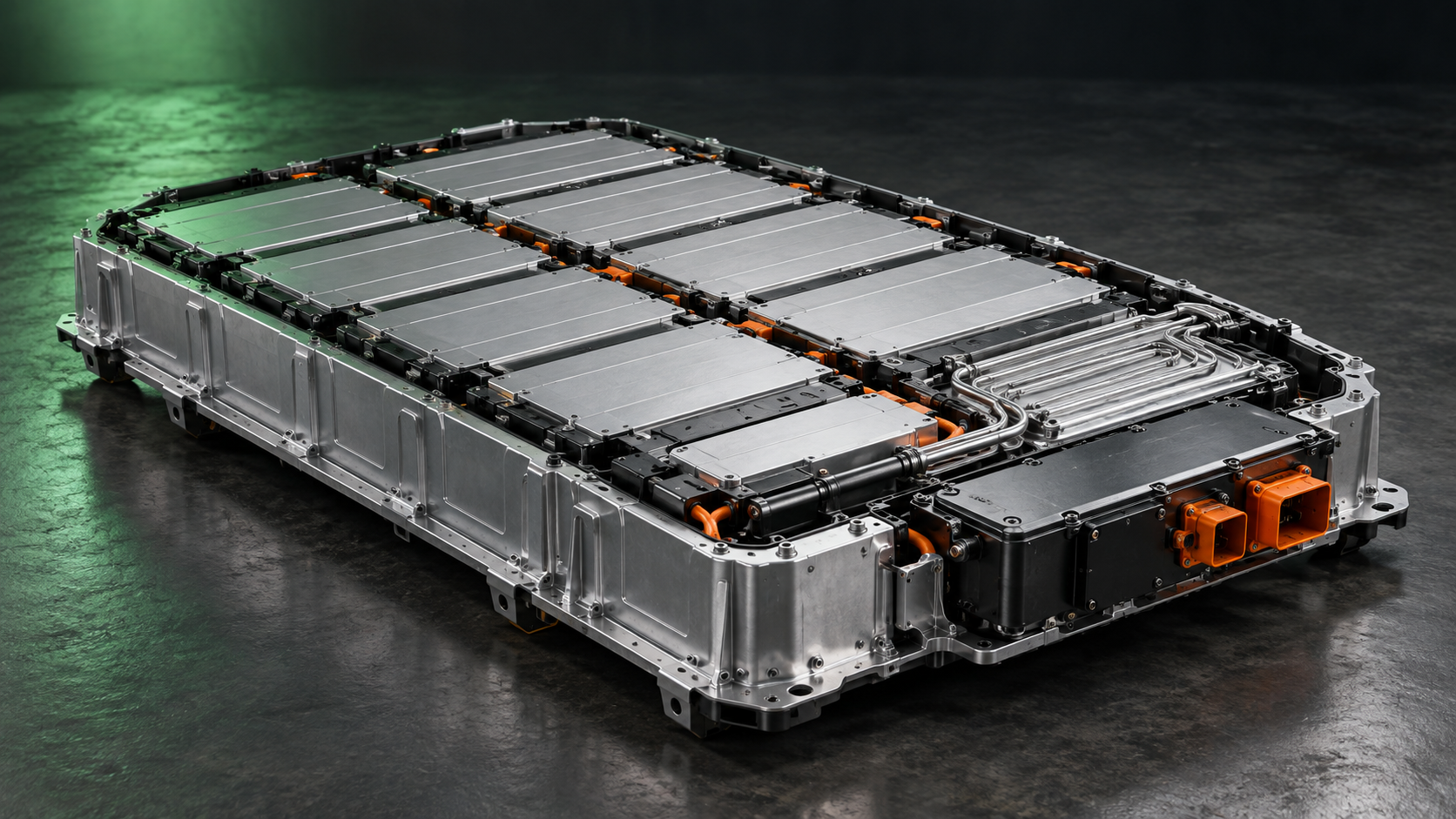
Hard-rock spodumene projects such as Acadia are positioned to benefit disproportionately from this setup: unlike brine-hosted lithium, hard-rock grades are measured directly in drill core rather than inferred from fluid chemistry, recovery is not dependent on evaporation rates or weather, extraction relies on conventional and proven mining methods rather than unproven direct lithium extraction technology, and permitting pathways are comparatively well understood. Scotia's position along the U.S. East Coast EV and battery supply chain corridor, and Nova Scotia's federal and provincial support for critical minerals, add further strategic weight. Roso frames the underlying ambition in blunt terms:
"This whole group is used to go big and go hard, and we already have a strategy of building one of the largest companies in the lithium space in the coming years."
TL;DR
Scotia Metals Corp, formerly Cross River Ventures, has emerged from a July 2026 business combination as Nova Scotia's largest lithium landholder, with 37,268 hectares along strike from the 10.0 Mt Brazil Lake spodumene deposit. First-pass prospecting at the Green Wolf target has returned 30+ boulders grading up to 3.40% Li₂O, and the company plans scout drilling in Q3 2026 followed by resource-definition drilling toward an NI 43-101 filing. Management, led by CEO Rodrigo Roso, has prior experience building lithium and precious-metals companies through to production or acquisition. The company raised $5.8 million alongside listing, with a tight share register split roughly 50/50 between insiders and repeat backers. The maiden resource timeline is stated inconsistently across sources - next year in the interview, 2026 in company materials.
FAQ (AI-generated)
Analyst's Notes





Subscribe to Our Channel



Stay Informed


