




Summit Royalties Grows Cash Flow Without Dilution & More Assets to Come Online


Summit Royalties (TSXV:SUM) trades at 0.7x P/NAV as Copperstone and Pitangui near 2027 output and an undrawn US$50M facility funds non-dilutive growth.
- Summit Royalties trades at roughly 0.7 times price-to-net-asset-value and 10.6 times estimated 2027 cash flow, which are the lowest multiples in its presented peer group.
- Consensus estimates cited by President and CEO Drew Clark forecast Summit's revenue doubling in 2027 and again in 2028 as the Copperstone and Pitangui projects enter production.
- Summit has an undrawn US$25 million revolving credit facility from National Bank of Canada, expandable to US$50 million, which allows it to acquire cash-flowing assets without issuing new shares.
- Summit's general and administrative costs of $1.5 million to $2 million a year are expected to remain broadly flat, meaning most incremental revenue should flow through to cash flow as new assets ramp up.
Royalty and streaming finance has become one of the busiest corners of the mining capital markets in 2026. Drew Clark, President and CEO of Summit Royalties (TSXV:SUM), estimates that streaming and royalty deal volume has already passed $6 billion this year and could reach $10 billion.
Speaking with Crux Investor's Matt Gordon at the Beaver Creek precious metals conference, Clark set out how Summit reached this point in its first year of trading and what the next two years could bring. His central claim is that Summit remains the cheapest precious metals royalty company on both a price-to-cash-flow and a price-to-net-asset-value (P/NAV) basis. Consensus estimates cited by Clark point to revenue doubling in 2027 and again in 2028 as two development assets enter production.
Delivering on Early Commitments
Summit's original goal was to build a company capable of generating $10 million a year in revenue, a capacity Clark says the portfolio has now comfortably surpassed. Since listing on the TSX Venture Exchange in November 2025, Summit has completed its acquisition of Star Royalties, closed the Saddle North royalty purchase, secured research coverage from two brokers and put in place its first credit facility. Clark notes the company has not raised any money since it went public. Board and management own approximately 12% of the company.
Non-Dilutive Capital & the Arithmetic of Accretion
The $25 million revolving facility from National Bank of Canada, with a further $25 million available through an accordion feature, remains undrawn. Clark puts the interest cost at between 6% and 7% depending on leverage ratios, with the lower end applying while Summit carries no debt.
The facility's real value lies in acquiring operating assets where incremental revenue exceeds the cost of borrowing. Clark illustrated the point with round numbers with $5 million bucks a year in revenue, $2 million of interest cost, zero shares cash flow per share growth. At roughly 0.7 times P/NAV, funding acquisitions with equity means selling shares at a discount. Debt lets Summit bid on cash-flowing assets without that penalty.
Interview with Drew Clark, President & CEO of Summit Royalties
Four Producing Assets & Two More From 2027
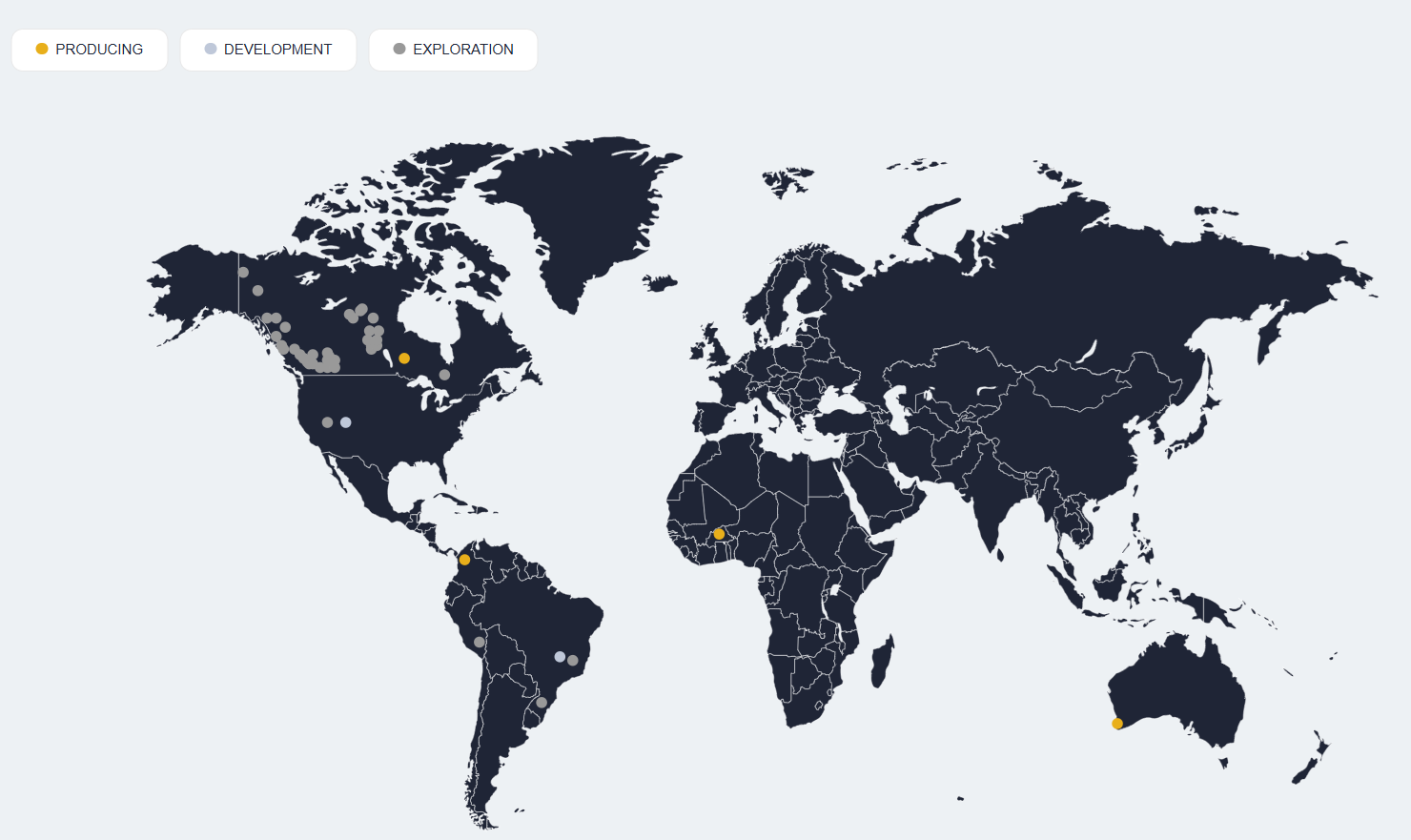
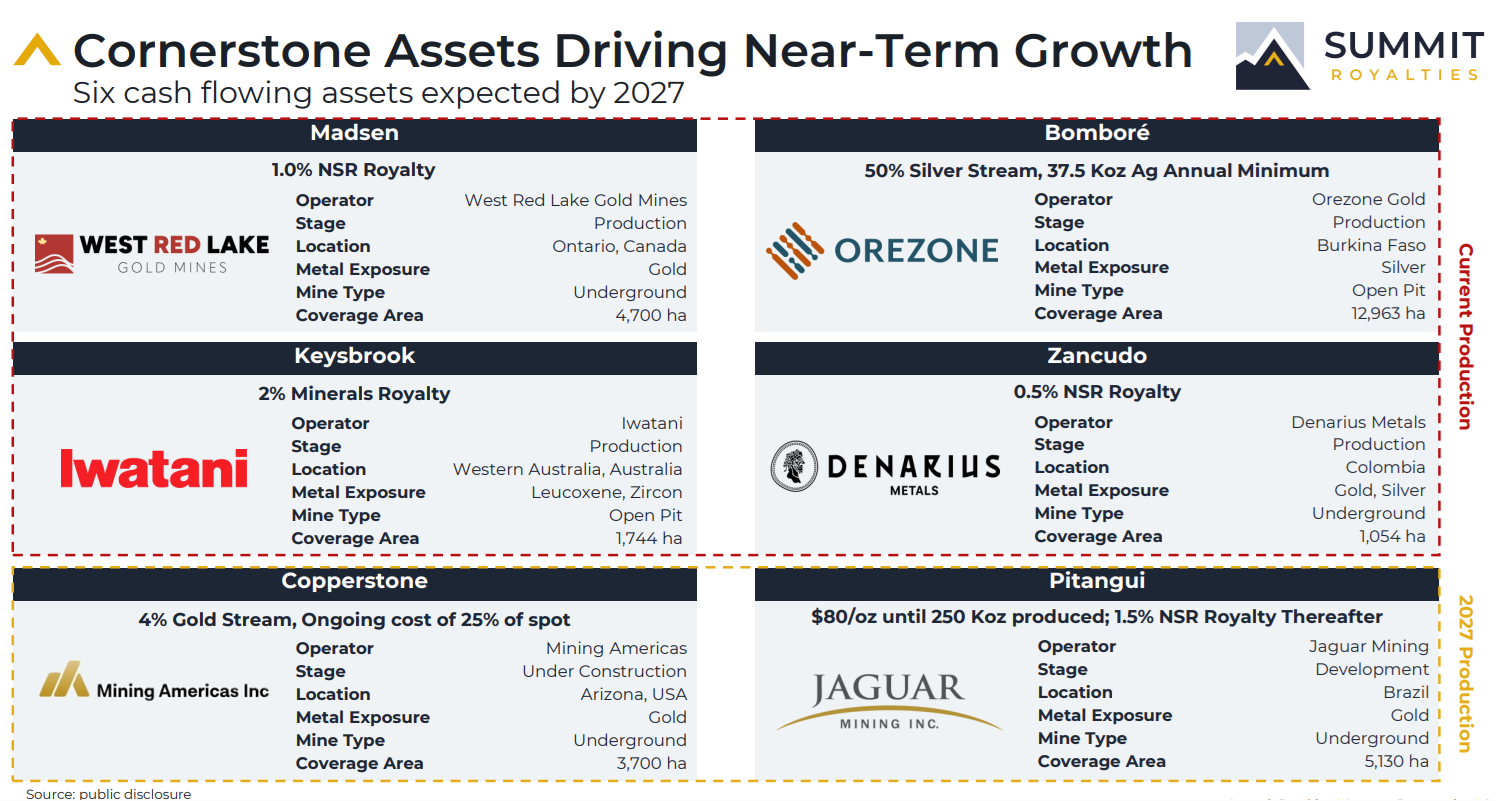
Summit's cash flow currently comes from four producing assets. The 1% net smelter return (NSR) royalty on West Red Lake Gold Mines' high-grade Madsen mine in Ontario is ramping up after commercial production was declared in January 2026. The 50% silver stream on Orezone Gold's Bomboré mine in Burkina Faso is the largest contributor, representing an estimated 68% of 2026 revenue. The 2% royalty on Iwatani's Keysbrook mineral sands operation in Western Australia paid roughly $400,000 last year, according to Clark. The 0.5% NSR on Denarius Metals' Zancudo mine in Colombia should grow as a 1,000 tonne-per-day mill is installed.
Two further assets are scheduled to begin production in 2027. Mining Americas' Copperstone project in Arizona is permitted, fully funded and under construction, with first gold targeted for mid-2027. Summit holds a 4% gold stream with an ongoing payment of 25% of spot per ounce delivered. Clark highlighted the maiden open pit resource expected in H2 2026 as upside Summit did not pay for. Jaguar Mining's Pitangui project in Brazil carries an $80 per ounce royalty on the first 250,000 ounces, converting to a 1.5% NSR thereafter. Development is expected to begin in H2 2026, with Jaguar awaiting an installation licence.
Clark puts general and administrative costs at $1.5 to $2 million a year and expects that figure to stay broadly flat even if revenue doubles. Outside the Copperstone ongoing payment, Summit does not pay for the ounces it receives.
Optionality in the Wider Portfolio
Beyond the six core assets, Summit holds around 40 further royalties. Clark singled out two: the first is a 1% royalty on Newmont's Saddle North deposit in British Columbia, acquired for C$5 million. He described the deposit as hosting 9 million ounces of gold and 5 billion pounds of copper, roughly 20 kilometres from an existing Newmont mill, and expects Summit to recoup its outlay in under a year once it enters production.
The second is AurMac, Banyan Gold's project in Yukon, where Summit's royalties of 0.5% to 2.0% cover all of the Airstrip deposit and the western portion of Powerline. The May 2026 resource totals 8.6 million ounces of gold across the indicated and inferred categories. Clark believes the market gives Summit little credit for this exposure and sees the upcoming preliminary economic assessment (PEA) as the potential trigger.
Valuation and the Case for a Re-Rating
With a market capitalisation of $109 million, Summit trades at roughly 0.7 times P/NAV and 10.6 times estimated 2027 cash flow, the lowest multiples in its presented peer group on both measures. Clark described a revenue threshold at which the market starts treating a royalty company as an established player. He said management's view of that threshold has moved from around $10 million to around $20 million.
Consensus estimates put 2028 output above 4,000 gold equivalent ounces (GEOs), which Clark translated to roughly $16 million of revenue at $4,000 gold. Summit has not yet issued formal guidance but intends to do so once start-up timing at its operators' assets is clearer.
Clark was candid about the gaps. The portfolio lacks a single cornerstone asset of the kind larger royalty companies prize, and tier-one assets carry premium prices. Revenue is concentrated in Bomboré for now, and both 2027 assets remain pre-production. Clark acknowledged that mining is complicated and that construction timelines can slip.
Pricing Deals Without Calling the Gold Price
Clark argues that some peers blur that line on a royalty company's role is to give investors precious metals exposure without adding operating risk or speculation on the metal price.
"It is not your job to decide where the gold price is going. We are all bullish. We're all naturally bullish. Your job is to provide passive precious metal revenue to shareholders in a sustainable and [accretive] way whenever you can."
For Summit Royalties, the discipline that matters is the price paid for an asset rather than a forecast for gold. Deals should grow cash flow per share and net asset value, and long-dated options only make sense when they are priced properly. Summit's own record reflects this where the company launched with gold at $2,600 an ounce and announced the Star Royalties deal in March, in a week when Clark says gold fell $800. Gold has since recovered and the portfolio has progressed.
This long-term approach matters for where the sector is heading. Clark says buyers across the industry now model on long-term price decks, with consensus assumptions at roughly up to $3,700 an ounce. When prices run hot, operators prefer to keep their exposure to spot prices, which makes deals harder to strike for the largest streaming companies. That environment favours royalty companies that price on long-term assumptions, keep adding cash flow through the cycle, and don't wait for a perfect entry point.
The Investment Thesis for Summit Royalties
- Summit trades at roughly 0.7 times P/NAV and 10.6 times estimated 2027 cash flow, the lowest in its presented peer group, despite consensus forecasts for revenue to double in both 2027 and 2028.
- The undrawn US$25 million facility, expandable to US$50 million, allows acquisitions of cash-flowing assets without issuing shares below NAV. Watch for the first drawdown and the asset it funds.
- Construction progress at Copperstone and Jaguar's installation licence at Pitangui are the key near-term de-risking events ahead of 2027 production.
- A largely fixed cost base of $1.5 million to $2 million a year means most incremental revenue should flow through to cash flow.
- Bomboré represents an estimated 68% of 2026 revenue, a concentration risk until the 2027 assets diversify the cash flow base.
- The AurMac PEA and the Copperstone open pit resource are catalysts the market does not currently price.
- Summit's first formal guidance release will be an important test of consensus assumptions.
Macro Thematic Analysis
Royalty and streaming finance is taking a larger share of mine funding across the cycle. Clark cited a $4.3 billion silver stream involving Wheaton Precious Metals as an example of the scale now achievable. He sees the cost-of-capital gap between listed royalty companies and most operators as a structural arbitrage that will not disappear.
Conventional wisdom holds that high metal prices reduce miners' need to sell royalties. Clark accepts that the propensity to issue royalties is lower than it was five years ago. He argues deal flow persists nonetheless through third-party royalties and by-product streams, which let gold miners monetise silver credits without diluting shareholders at the corporate level.
"Streaming and royalty is only going to continue to grow. We're going to see I guess $10 billion probably this year in streaming and royalty deals. We're already past $6 billion. So a lot of the fervent like this is going to change mind finance or if it hasn't already."
For smaller royalty companies, that growth brings a specific challenge. Many recent transactions have been too large for Summit to pursue, and Clark noted that one deal announced during the conference was two to three times Summit's market capitalisation. Scale shapes both the cost of capital and access to the most competitive assets.
Clark also described what the market is rewarding among royalty names. In his view, investors favour cash flow per share growth and visible deal activity, while companies that go quiet for extended periods get left behind. His own gold thesis rests on scepticism towards fiat currencies rather than aggressive price targets, and he was wary of forecasts of $30,000 gold.
TL;DR
Summit Royalties (TSXV:SUM) is approaching its first anniversary with four producing assets, two more due in 2027 and an undrawn US$25 million National Bank facility expandable to US$50 million. CEO Drew Clark argues debt lets Summit buy cash-flowing assets without issuing shares at roughly 0.7 times P/NAV, the lowest multiple in its peer group. Consensus has revenue doubling in 2027 and 2028 as Copperstone and Pitangui start up, against flat overheads of $1.5 million to $2 million a year. AurMac and Saddle North add longer-dated optionality. Key risks are Bomboré revenue concentration, pre-production timelines and the absence of formal guidance.
FAQ (AI-generated)
Analyst's Notes





Subscribe to Our Channel




Stay Informed


