




Mogotes Metals Stacks Three Copper Porphyry Options


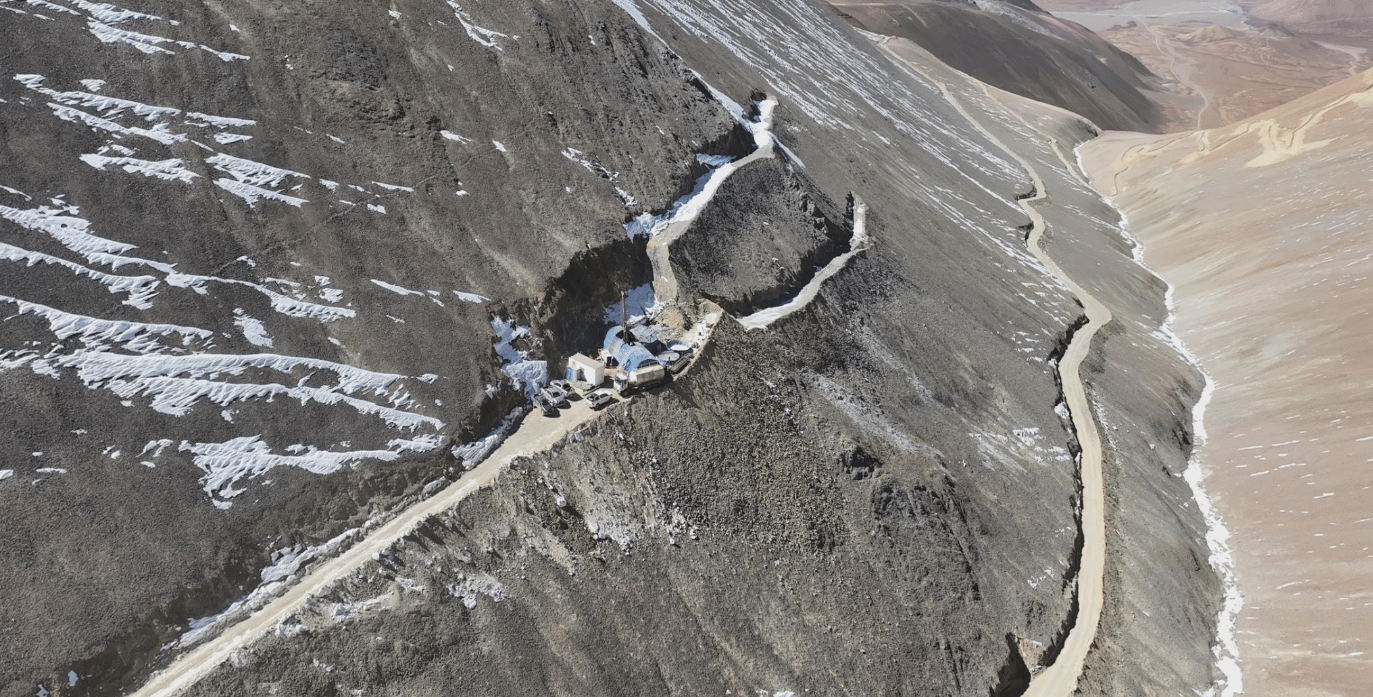
Mogotes Metals CEO Allen Sabet details the $16M Rio Tinto earn-in in Montana, the low-cost Beskauga option in Kazakhstan, and Filo Sur's 20,000m season.
- Mogotes Metals applies a consistent screening filter across its three copper-gold assets, prioritising ground with drilled intercepts exceeding 100 metres at 1% copper-equivalent in workable jurisdictions.
- The Copper Cliffs earn-in with Rio Tinto in Montana caps Mogotes' committed spend at $16 million for 51% of the project, with a built-in buy-back mechanism that would double the company's money if exercised.
- The Beskauga option in Kazakhstan offers exposure to a historical multi-million-ounce gold-copper resource at some of the lowest drilling costs available anywhere in the world.
- Three counter-cyclical drilling seasons across Argentina/Chile, Montana and Kazakhstan give investors catalysts spread across the full calendar year rather than concentrated in one season.
- Near-term catalysts include pending Montana permitting decisions, Kazakhstan assay results expected within months, and the ongoing Filo Sur programme running inside Rio Tinto's 15-month exclusivity window.
Mogotes Metals Inc. (TSXV:MOG) has built its story around a specific kind of asset: porphyry systems that have already been drilled by someone else, walked away from, and left for a junior with the right technical read to pick up cheaply. In an interview with Crux Investor, President and CEO Allen Sabet laid out the vetting logic behind Mogotes' three-project portfolio - the flagship Filo Sur project in Argentina and Chile's Vicuña district, the Copper Cliffs earn-in with Rio Tinto in Montana, and the Beskauga option in Kazakhstan - and why running all three at once, rather than betting everything on one, is the point rather than a distraction. With copper prices at record levels and majors increasingly willing to option out early-stage exploration rather than run it themselves, Sabet's pitch is that Mogotes has found three separate ways to be first through an opportunity window that most of the market has already written off.
A Vetting Process Built on Drilled Mineralisation
Sabet was explicit about what Mogotes looks for before committing capital: advanced projects with high exploration potential in a workable jurisdiction, defined narrowly. Rather than chasing green-field targets with only surface sampling, the company wants ground that has already returned drilled intercepts of over 100 metres at 1% copper-equivalent or better - proof that a mineralised system exists and can be expanded upon. Both Copper Cliffs and Beskauga clear that bar by a wide margin, according to Sabet, with Copper Cliffs showing more than 1,000 metres of continuous mineralisation and Beskauga close behind on nearly 950 metres of comparable grade.
The bigger constraint, in his telling, is not finding projects that fit the criteria, but finding them before someone else does. Sabet argued that most investors and even some technical teams evaluate opportunities by consensus rather than independent judgement, generating a red-flags list that rules out everything rather than asking what a deposit could become at depth or along strike. Combined with capital and speed, that gap is what let Mogotes secure both Copper Cliffs and Beskauga on terms Sabet believes were well below what the underlying mineralisation would command as a standalone listing.
Copper Cliffs: A Structured Option With Built-In Downside Protection
Copper Cliffs sits in Montana's historic Copper Cliff district, a porphyry system Rio Tinto explored across more than 32,000 metres of historical drilling before optioning it to Mogotes in April 2026. Under the deal, Mogotes can earn 51% of the project by spending $16 million on exploration over a three-year term, all of it in the ground rather than as cash to Rio Tinto.
"If we got a three-year term for the first stage, spend $16 million, we get 51% of the project. That's ours. We're in the driver's seat. We control it from there forward."
Rio Tinto retains a 90-day window after that first stage to buy back a 2% stake for US$32 million, double Mogotes' spend, which would leave Mogotes holding 49% of a project a major has chosen to pay a premium for, rather than 51% under Mogotes' own control. Either outcome, Sabet argued, works for shareholders: Mogotes doubles its money and keeps a substantial minority in a project Rio Tinto has validated, or it retains outright control of the exploration programme. The company's project manager on Copper Cliffs is geologist Peter Ellsworth, whose university thesis on the deposit's alteration and mineralisation - written decades before Mogotes' involvement - forms part of the technical basis for the current programme. Mogotes is targeting 8,000 to 9,000 metres of drilling this year on a budget of roughly US$5.5 million, contingent on permits submitted under a statutory approval timeline; if they arrive on schedule, drilling could begin before winter.
Interview with Allen Sabet, CEO, Mogotes Metals
Beskauga: Turning Cheap Drilling Into the Primary Exploration Tool
Beskauga came to Mogotes through a different route: an exclusive option that a prior holder had let lapse after roughly five years, at which point Mogotes moved quickly to secure its own three-year option over ground discovered by a private Swiss technical team. A historical, NI 43-101-referenced resource estimate - not yet verified or relied upon by the company's own Qualified Person - points to several million ounces of gold and hundreds of thousands of tonnes of copper in the indicated and inferred categories combined, built on tens of thousands of metres of prior drilling.
What distinguishes Beskauga for Sabet is cost. Diamond drilling in Kazakhstan runs at a fraction of Andean or North American rates, and Mogotes operates its own sample-preparation laboratory on site, cutting assay turnaround costs further.
"Kazakhstan is one of the lowest cost places in the world for mining works and drilling. We have our own prep lab, so we reduce the assay cost by half."
Because the deposit sits beneath roughly 40 metres of clay overburden, surface exploration techniques are largely ineffective, making drilling itself the primary tool for defining the resource rather than a step that follows geochemistry and geophysics. Mogotes is budgeting roughly C$8 million for up to 50,000 metres of combined reverse-circulation and diamond drilling this year, alongside a mining licence application, with the stated goal of reaching a preliminary economic assessment within six months and a pre-feasibility study roughly six months after that.
Filo Sur: The Flagship Backdrop
Filo Sur remains Mogotes' largest single commitment and the project underpinning its Rio Tinto relationship more broadly. The 2025–2026 season delivered 6,208 metres of drilling and two discoveries on the Macho Muerto Fault Zone: the high-grade Albor breccia (180 metres at 0.98% copper-equivalent from 108 metres, including 58 metres at 1.77% CuEq) and the Cruz del Sur gold-copper porphyry (308 metres at 0.46% CuEq and 334 metres at 0.45% CuEq in a single hole). New channel sampling has also expanded the Cuenca porphyry target to roughly 1.3 by 0.5 kilometres, while Luz del Sol and Meseta remain queued for a first drill test. Rio Tinto's US$15 million placement, closed in August, comes with a 15-month exclusivity period over Filo Sur - the clock against which the 2026–2027 season, planned at up to 20,000 metres, will play out. Sabet indicated the alliance concept could extend to Kazakhstan as the relationship develops, though nothing there is yet formalised.
Three Drill Seasons, One Calendar Year
Sabet frames the counter-cyclical scheduling as a deliberate design choice rather than a coincidence. Filo Sur drills through the Southern Hemisphere summer, while Copper Cliffs and Beskauga run through the Northern Hemisphere season, giving Mogotes overlapping news flow across the full year rather than a single seasonal window.
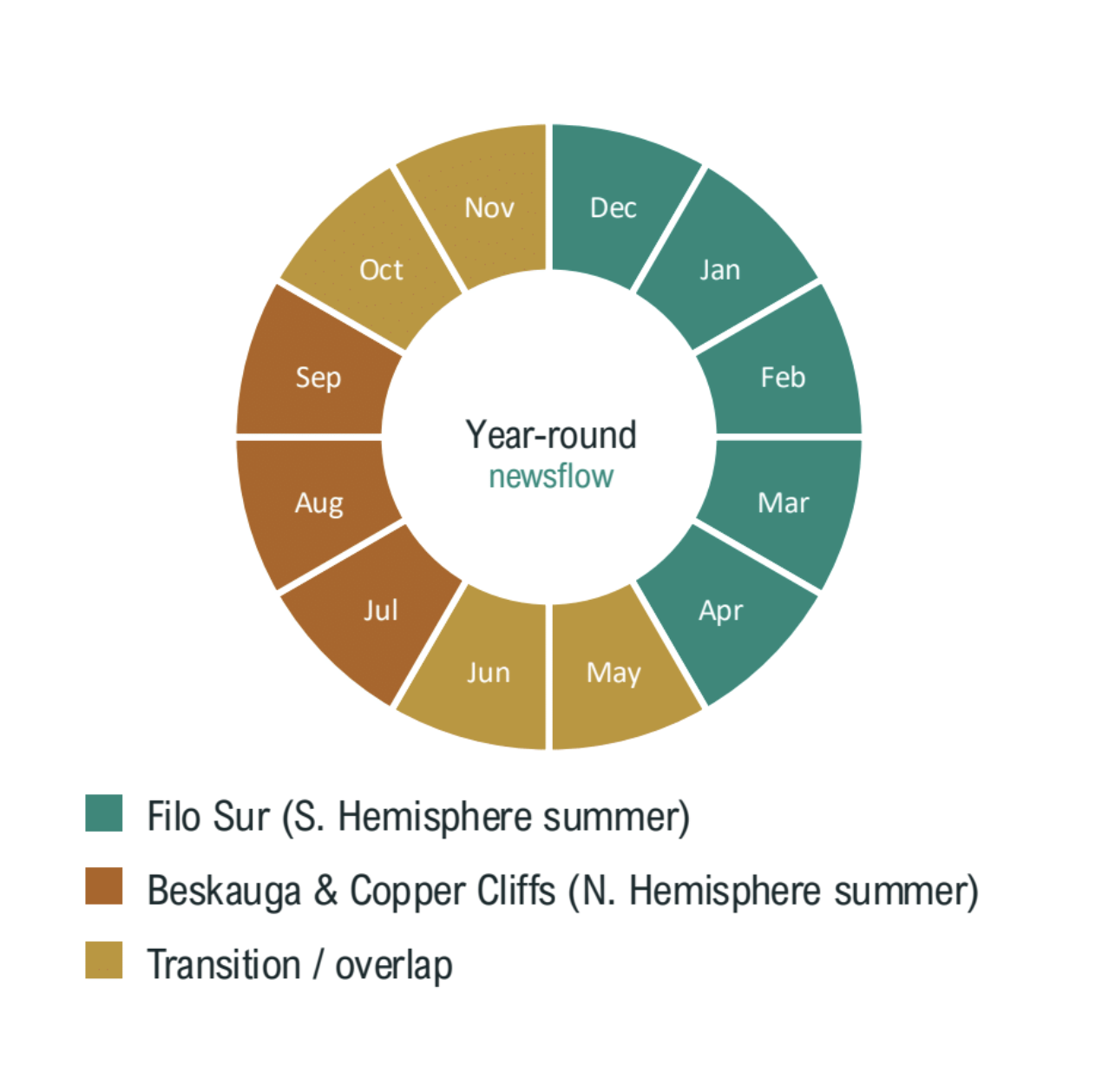
Over the next twelve months, that means up to 20,000 metres at Filo Sur, 8,000 to 9,000 metres at Copper Cliffs pending permits, and up to 50,000 metres at Beskauga making a combined programme of roughly 80,000 metres across three jurisdictions, funded from a treasury the company has said sits at approximately C$75 million following its recent financings.
The Investment Thesis for Mogotes Metals
- Mogotes applies a consistent screening filter across all three assets: drilled intercepts of over 100 metres at 1% copper-equivalent or better in a workable jurisdiction, reducing blind-exploration risk relative to green-field peers.
- The Copper Cliffs earn-in caps Mogotes' downside at a known $16 million spend for 51% of the project, with a built-in buy-back mechanism that doubles the company's money if Rio Tinto exercises it.
- Beskauga's historical resource, while unverified under current standards, points to a multi-million-ounce gold-copper system that Mogotes can advance at some of the lowest drilling costs available globally.
- Three counter-cyclical drilling seasons across the Southern and Northern Hemispheres give investors overlapping catalysts throughout the year rather than a single seasonal news window.
- Rio Tinto's involvement across both Filo Sur and Copper Cliffs, with a stated intention to extend the alliance concept to Kazakhstan, provides a degree of technical validation beyond Mogotes' own team.
- Monitor the Copper Cliffs permitting decision and first assay results from Beskauga's current drill programme, both expected within the next few months, as near-term re-rating catalysts.
- Watch for Rio Tinto's decision on its Copper Cliffs buy-back option once the initial US$16 million earn-in stage is complete, as it will determine whether Mogotes ends up controlling or co-owning the project.
Macro Thematic Analysis
Mogotes' broader pitch depends on a read of the market in which majors have become more willing to option out early-stage risk than to carry it themselves. Rio Tinto explored both the geology neighbouring Filo Sur and the Copper Cliffs porphyry directly, then chose in each case to hand the drill bit to a smaller, more nimble operator rather than run the programme in-house. Sabet's explanation was pragmatic rather than triumphant: in a lower commodity-price environment, a major with a global portfolio of shallower, higher-grade alternatives had no reason to chase mineralisation sitting 600 to 1,000 km deep in Montana. A much higher copper price, and a much tighter concentrate market, changes that calculus - not necessarily for Rio Tinto's own balance sheet, but for the economics a junior like Mogotes can underwrite on a fraction of the capital.
That is the thread connecting all three projects: each is a previously-drilled, previously-shelved system that current prices and Mogotes' own low-cost operating model make workable again. Sabet's framing of the underlying logic applies as much to Kazakhstan and Montana as it does to Filo Sur itself:
"We are aggressively advancing and that's the right thing to do when you have the capital and you're in a low-cost jurisdiction because NPV is higher the closer you bring the scenario to reality."
The market read-through is that Mogotes is betting on convergence between grade already proven in the ground and a copper price now high enough to fund the drilling required to prove up scale. That is a reasonable bet in a genuine bull market for the metal, but it also depends on execution across three separate permitting and drilling regimes simultaneously - a structurally more complex proposition than a single-asset explorer faces. Whether investors reward the diversification or discount it for complexity is likely to become clearer as results land from all three projects over the coming year.
TL;DR
Mogotes Metals is running three copper-gold porphyry projects at once: the flagship Filo Sur in Argentina-Chile, a $16 million earn-in for 51% of the Copper Cliffs project in Montana optioned from Rio Tinto, and a three-year option over the Beskauga deposit in Kazakhstan, where ultra-low drilling costs let the company use drilling itself as its primary exploration tool. CEO Allen Sabet frames the strategy as picking up previously-drilled, previously-shelved systems that today's copper price makes economic again, with Rio Tinto's buy-back right at Copper Cliffs, unverified historical resource figures at Beskauga, and staged funding obligations across all three projects as the key risks to watch over the next twelve months.
FAQ (AI-generated)
Analyst's Notes





Subscribe to Our Channel







Stay Informed






















