




Serabi Gold's Palito Reinterpretation Points to a Potentially Larger Mineralized System



Serabi Gold's Palito reinterpretation and Coringa drilling highlight larger mineralized systems, with resource estimates targeted for the first quarter of 2027.
- Serabi Gold drilled 20,831 meters in the first half of 2026 across the Palito Complex and Coringa Mine.
- A structural reinterpretation of the G1-G3 corridor at Palito suggests that several previously isolated structures may form a single continuous system.
- Drilling at Piauí returned a 9.93-meter interval, a broader mineralized envelope than the narrow intersections reported elsewhere in the program.
- Coringa results extend mineralization by more than 200 meters beyond the current underground development at Meio.
- Updated Mineral Resource Estimates (MREs) for both operations are targeted for the first quarter of 2027.
What Has Happened
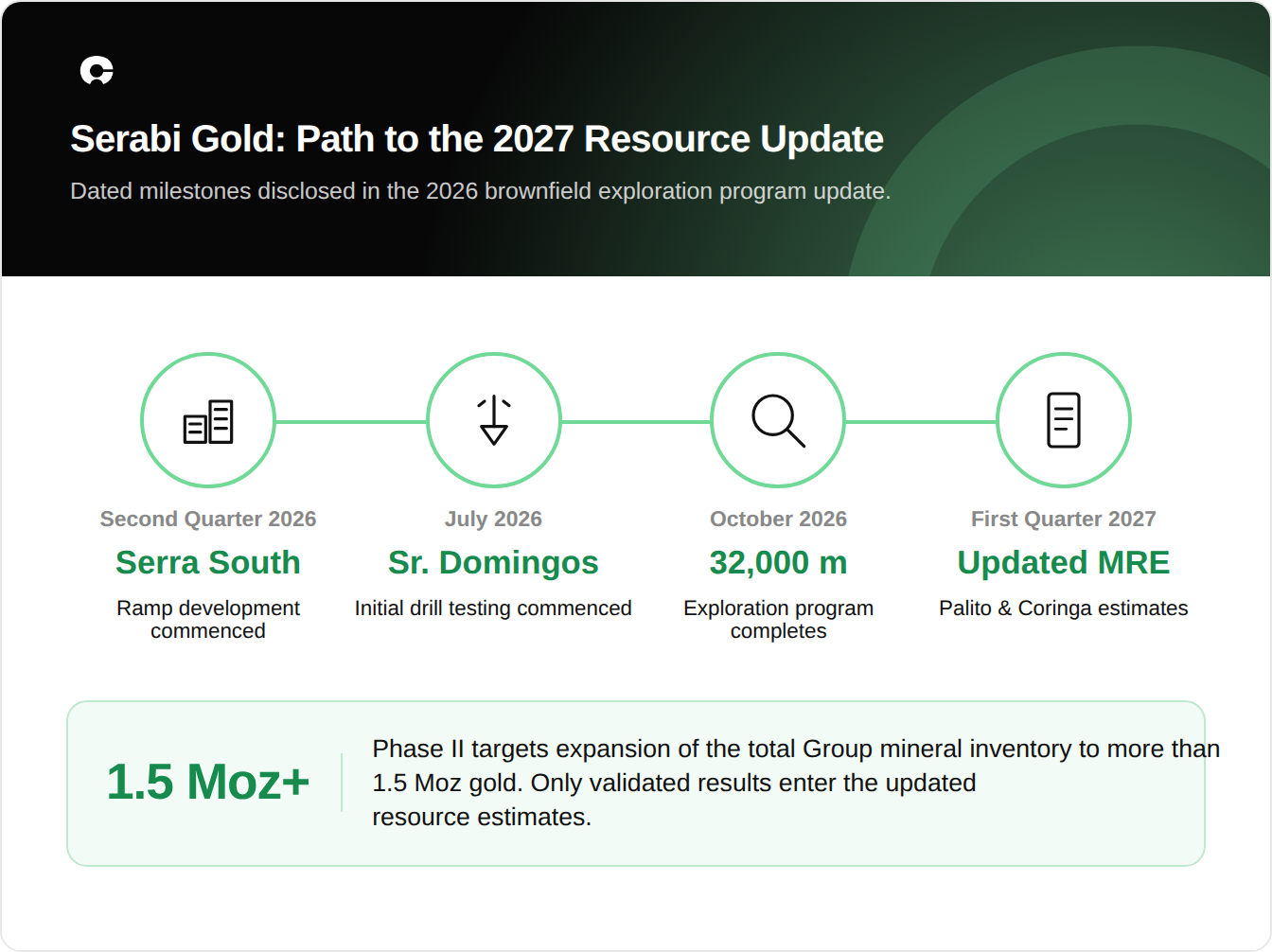
Serabi Gold (AIM: SRB | TSX: SBI | OTCQX: SRBIF) reported results from the first half of its 2026 brownfield exploration program at the Palito Complex and Coringa Mine in Pará State, northern Brazil. The Company completed 20,831 meters of diamond drilling, split between 11,522 meters across 37 holes at Palito and 9,309 meters across 42 holes at Coringa, within a program totaling 32,000 meters. Six drill rigs are operating across the two sites, and the program is expected to be completed in October 2026.
Coringa returned 1.38 meters at 11.85 grams per tonne of gold, including 0.42 meters at 37.10 grams per tonne, at Serra South, and 1.70 meters at 16.13 grams per tonne, including 0.45 meters at 35.59 grams per tonne, at Meio. Palito returned 1.12 meters at 6.12 grams per tonne, including 0.43 meters at 15.20 grams per tonne, at Massa.
Alongside the drill results, Serabi also reported a structural reinterpretation of the G1-G3 corridor at Palito, and stated that the exploration team is concentrating drilling on specific priority trends while maintaining continuous coverage of the main zones. All validated results from the program will be incorporated into the updated Mineral Resource Estimates (MREs) for Palito and Coringa, which are expected in the first quarter of 2027.
The G1-G3 Reinterpretation & What It Could Change at Palito
Serabi's exploration team integrated historical drilling, underground mapping and revised structural modeling across the G1-G3 corridor, producing a geological framework in which several mineralized structures previously considered isolated potentially form a larger, more continuous mineralized system. The revised model incorporates structural offsets, branching vein systems and previously unrecognized dilation zones, which the Company states may positively impact future exploration targeting and resource estimation. A diamond drilling program has been designed for the second half of 2026 to test the priority targets generated from the updated interpretation.
The 2026 drilling returned both narrow high-grade intersections and one broad, lower-grade interval at Palito. Senna, Massa and Tatu returned narrow high-grade intersections, including 0.28 meters at 7.22 grams per tonne gold and 0.25 meters at 6.50 grams per tonne at Tatu, where the company states that additional geological evaluation is required to establish their continuity and overall significance. Piauí returned 9.93 meters at 1.06 grams per tonne gold, containing two internal higher-grade intervals of 0.25 meters at 6.26 grams per tonne and 0.25 meters at 4.95 grams per tonne, which the company states supports the interpretation of a broader mineralized envelope containing discrete higher-grade zones. Ongoing geological modeling is evaluating the geometry and continuity of the Piauí mineralized system.
Coringa Results Point to a District-Scale Structural Corridor
At Coringa, drilling has focused on identified targets along the trend northwest and southeast of the currently producing Serra and Meio zones. Serra South, discovered in 2025 approximately 500 meters southeast of the currently producing Serra zone, returned 1.38 meters at 11.85 grams per tonne of gold, including 0.42 meters at 37.10 grams per tonne, and a second interval of 1.00 meters at 14.65 grams per tonne, including 0.25 meters at 57.20 grams per tonne. A further hole returned 2.20 meters at 5.89 grams per tonne and a second interval of 1.19 meters at 6.87 grams per tonne, including 0.49 meters at 16.55 grams per tonne, which the company states confirms continuity of the mineralized system along strike and at depth. Ramp development of the Serra South zone commenced in the second quarter of 2026.
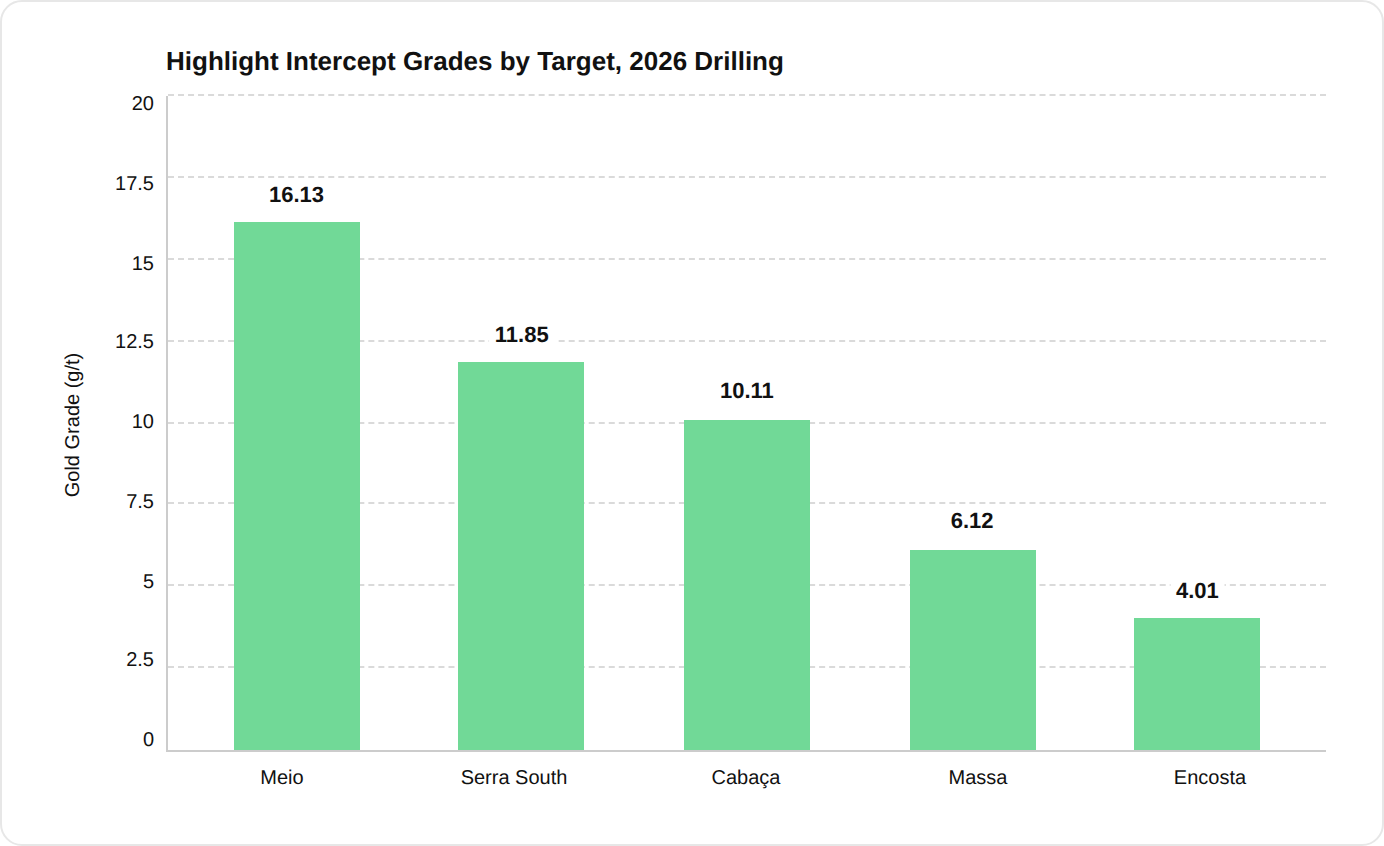
At Meio, the 16.13 grams per tonne intercept combines with additional positive intersections from four further holes to define a mineralized corridor extending more than 200 meters beyond the limits of the current underground development. Satellite target results further demonstrate the potential for additional mineralized centres outside the primary Serra and Meio zones: Cabaça returned 1.00 meters at 10.11 grams per tonne gold including 0.25 meters at 40.30 grams per tonne from approximately 42 meters downhole, and Encosta returned 1.50 meters at 4.01 grams per tonne from approximately 4 meters downhole, providing initial confirmation of a target defined by coincident soil-geochemical and induced-polarization anomalies and supporting an open strike opportunity extending for more than 300 meters.
Two earlier-stage targets advanced behind them. At Sr. Domingos, multiple priority drill targets were generated from discrete induced-polarization anomalies within a previously untested portion of the Coringa district, in the first systematic drill evaluation of the target, designed to determine whether the geophysical responses are associated with sulfide-bearing structures similar to those hosting gold mineralization elsewhere at Coringa. At Pista, multiple drill targets have been defined along an approximately 400-meter gold-in-soil anomaly supported by historical artisanal workings, continuous quartz-vein structures, and rock-chip results of up to 7.46 grams per tonne gold.
Brownfield Ounces & the Quality of the Assay Record
Serabi is in the second year of its Phase II organic growth strategy, which aims to expand the Group's total mineral inventory to more than 1.5 million ounces of gold. In its 2026 brownfield exploration update, the company reported that the 2025 program increased consolidated Measured and Indicated resources to 730,800 ounces of contained gold (2,485,800 tonnes at 9.1 grams per tonne) and consolidated Inferred resources to 653,300 ounces (2,506,700 tonnes at 8.1 grams per tonne). The 2026 program targets high-probability near-mine mineralization at both operations.
One qualification belongs on the results themselves. All drill results have been sent to ALS for assay testing, but the company labels certain results as "Palito Result," meaning the assays have been sent to ALS and the test results have not yet been received; therefore, the figures represent Serabi's internal assay results. Several of the Meio and G3 intercepts, including the 16.13 grams per tonne Meio result, carry that label, while the Serra South, Cabaça and Encosta results are reported as ALS Results. Only validated results will be incorporated into the updated MREs.
The exploration team has also changed how it allocates drilling. Serabi states that results to date have supported a number of new prospective models and reinterpretations, and that the team is concentrating efforts on specific priority trends while ensuring continuous coverage of the main zones, enabling a more proactive stance, optimizing resource allocation, reducing rework, and improving overall operational efficiency. The program totals 32,000 meters and is expected to be completed in October 2026.
What to Watch Next
Drilling in the second half of 2026 will test the priority targets generated by the updated G1-G3 interpretation at Palito. Follow-up drilling designed for the second half of 2026 is intended to test the lateral and vertical continuity of the mineralized structure at Encosta; initial drill testing at Sr. Domingos commenced in July, and multiple drill targets have been defined at Pista. The 32,000-meter program is expected to be completed in October 2026.
Updated MREs for Palito and Coringa are expected during the first quarter of 2027, incorporating all validated results from the 2026 brownfield exploration program. That update is the point at which the year's drilling and the revised Palito interpretation are reflected in the company's reported mineral inventory.
FAQs (AI-Generated)
Analyst's Notes





Subscribe to Our Channel









Stay Informed






















