




The Financing Problem Behind the HPA Supply Gap


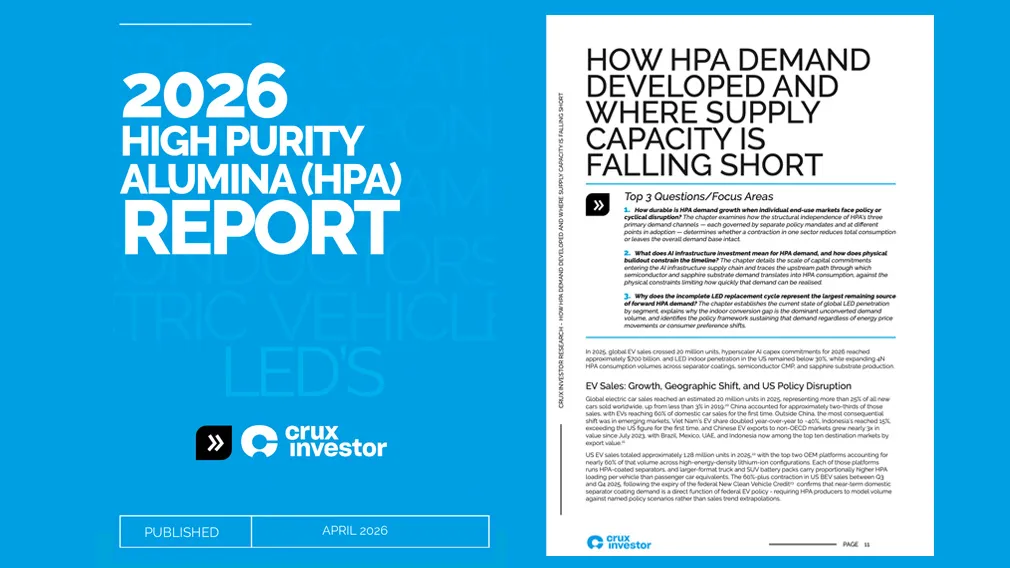
HPA powers LEDs, EVs, and semiconductors. Demand is locked in, but supply is constrained by financing, not resources.
In Crux Investor Research’s 3rd Report, we turn our attention to a material that sits at the core of modern high-performance manufacturing systems: high-purity alumina (HPA).
Often grouped under the broader alumina or specialty chemicals category, HPA is frequently misunderstood as a niche derivative rather than a critical enabling input. Yet across LEDs, electric vehicle batteries, and semiconductor manufacturing, it occupies a non-substitutable role defined not by cost, but by performance requirements.
Rather than treating HPA as a conventional commodity, the report examines how the market actually functions in practice. It explores how demand is structurally embedded within policy-driven and performance-critical industries, why pricing is determined through bilateral contracts rather than transparent benchmarks, and how supply is constrained not by geology, but by financing, qualification timelines, and technical complexity. In doing so, the report reframes HPA not as a cyclical materials market, but as a bottleneck input within advanced industrial supply chains.
Our objective remains the same: to make complex resource markets legible to investors by focusing on structure, mechanics, and incentives rather than narrative.
Structured as a practical reference, the report walks through the core mechanics of the global HPA market: demand that is effectively locked in across three independent end-use channels, a supply base that is both geographically concentrated and analytically opaque, and a pricing system governed by qualification cycles and long-term contracts rather than spot markets. It also examines how emerging demand from AI-driven semiconductor infrastructure, the incomplete global LED replacement cycle, and evolving EV battery requirements are expanding the demand base faster than new supply can be financed and delivered.
Finally, the report highlights the defining constraint on the market today: capital. Despite strong and verifiable demand growth, high upfront costs, long revenue lead times, and limited lender appetite mean that new supply is increasingly dependent on government-backed financing. This introduces a disconnect between demand expansion and supply response, shaping the investment landscape for HPA producers.
Access the 2026 HPA Report to understand how a critical advanced material market functions in reality - and why demand certainty, supply opacity, and financing constraints may matter far more than traditional commodity dynamics.
Analyst's Notes





Subscribe to Our Channel
.png)







Stay Informed


