




What the Geology at Hycroft's Brimstone & Vortex Systems Reveals


Hycroft Mining's 2025-2026 drill program reveals a Midas mine analog, a deep magmatic source, and what the Brimstone and Vortex systems signal to investors now.
- Hycroft Mining holds a measured and indicated resource of 16.4 million ounces of gold and 562.6 million ounces of silver at the Hycroft Mine in Winnemucca, Nevada, as disclosed in the February 2026 Initial Assessment Technical Report - a 55% increase from the prior 2023 estimate.
- The ore-bearing mineral at Brimstone is naumannite - the same mineral that defined the Ken Snyder Midas mine discovered by Franco-Nevada - providing the Hycroft team with a directly comparable fault-hosted vein targeting framework.
- Tetrahedrite recovered approximately 400 metres below surface at Brimstone, a mineral that forms at 700 metres to 1 kilometre depth, confirms that a deep magmatic source is driving high-grade silver mineralisation upward through the fault network.
- At least 3 separate fluid events have moved through the Hycroft system, producing a revenue split of approximately 40% silver and 60% gold across the measured and indicated resource base.
- The 2025-2026 drill program is scaling to 5 rigs targeting approximately 24,000 metres, with a preliminary economic assessment (PEA) for Brimstone and Vortex targeting completion by early 2027.
What Has Happened
Hycroft Mining (NASDAQ | HYMC) is advancing a 2025-2026 exploration drill program at the Brimstone and Vortex high-grade silver systems at the Hycroft Mine in northern Nevada. The February 2026 Initial Assessment Technical Report disclosed a 55% increase in measured and indicated gold and silver mineral resources to 16.4 million ounces of gold and 562.6 million ounces of silver. President and Chief Executive Officer Diane Garrett provided detailed technical commentary on the geological mechanisms driving the discovery, covering mineralogy, depth indicators, fluid-event history, geophysics, structural mapping, and geochemical pathfinders. Each finding carries direct implications for how the team targets resource extensions and approaches underground mine planning.
Identifying the Deep Magmatic Source
The ore-bearing mineral at Brimstone is naumannite - the same mineral that defined the Ken Snyder Midas mine discovered by Franco-Nevada. The Hycroft team is applying the same structural targeting methodology used at Midas - fault-hosted, steeply dipping vein shoots controlled by intersecting fault systems - to guide drill hole placement at Brimstone and Vortex. Management is using this framework to extend a system that already hosts 27.7 million ounces of measured and indicated silver at a cut-off grade of 68.57 grams per tonne silver.
The deeper confirmation of that source comes from tetrahedrite. Because tetrahedrite typically forms at depths of 700 metres to 1 kilometre, its presence approximately 400 metres below surface - in the same core holes containing well-defined silver veins only 20 metres above - means the conditions that formed the mineral were generated by a source substantially deeper than the current drill depth. Management confirmed this pattern across multiple core holes.
Garrett, explained the implications:
"In some of the core holes where we had very clearly defined veins, we also had very chunky crystals of silver. You could see them from across the room, which is associated with a mineral called tetrahedrite that was found 20 metres in the same hole below the veins, and it should never be there because tetrahedrite forms like 700 to 700 metres to a kilometre in depth. It tells us that something deep below is pushing that up higher."
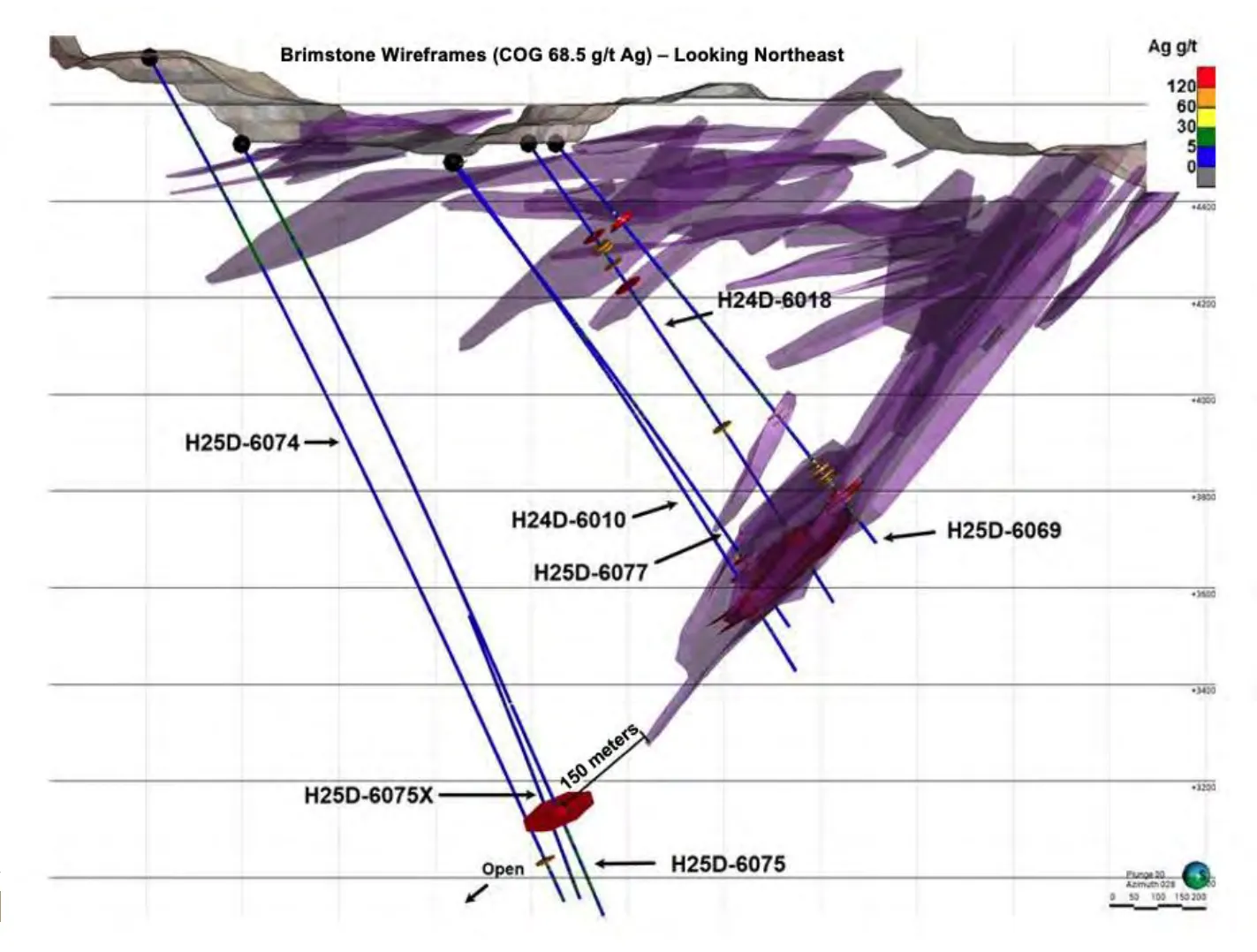
Induced-polarity geophysics conducted in 2025 delineated a 500-metre-diameter anomaly beneath the Brimstone system, interpreted as the deep magmatic conduit that sourced the metal-bearing fluids now preserved in the vein structures. Three holes placed into this anomaly returned either high-grade intercepts or the full pathfinder geochemical suite consistent with the Brimstone system. Step-out drilling also extended known high-grade mineralisation approximately 150 metres down-dip beyond the previous deepest drilling at Brimstone.
Why Hycroft Carries Both Significant Gold & Silver
Most precious metal deposits record only trace quantities of the secondary metal. Hycroft carries both gold and silver at commercially significant grades because their deposition occurred in at least 3 separate, distinct fluid events - each imprinting a different dominant metal over the prior one. The result is a revenue split of approximately 40% silver and 60% gold across a measured and indicated resource of 16.4 million ounces of gold and 562.6 million ounces of silver, as reported in the February 2026 Initial Assessment Technical Report. Management notes this imprinting - silver over gold, gold over silver - is interesting geologically but does not complicate physical mining.
Garrett described the multi-event character of the system:
"At Hycroft, there were multiple mineralising events depositing. We see that the gold, the deposition of gold in the system, was a completely different event than the deposition of silver. So we're learning a lot about this system as we go."
Management notes that 16.4 million ounces of gold and 562.6 million ounces of measured and indicated silver do not accumulate without a massive, powerful natural event - a characterisation consistent with a system recharged by high-volume fluids at least 3 times.
Navigating Toward the Source
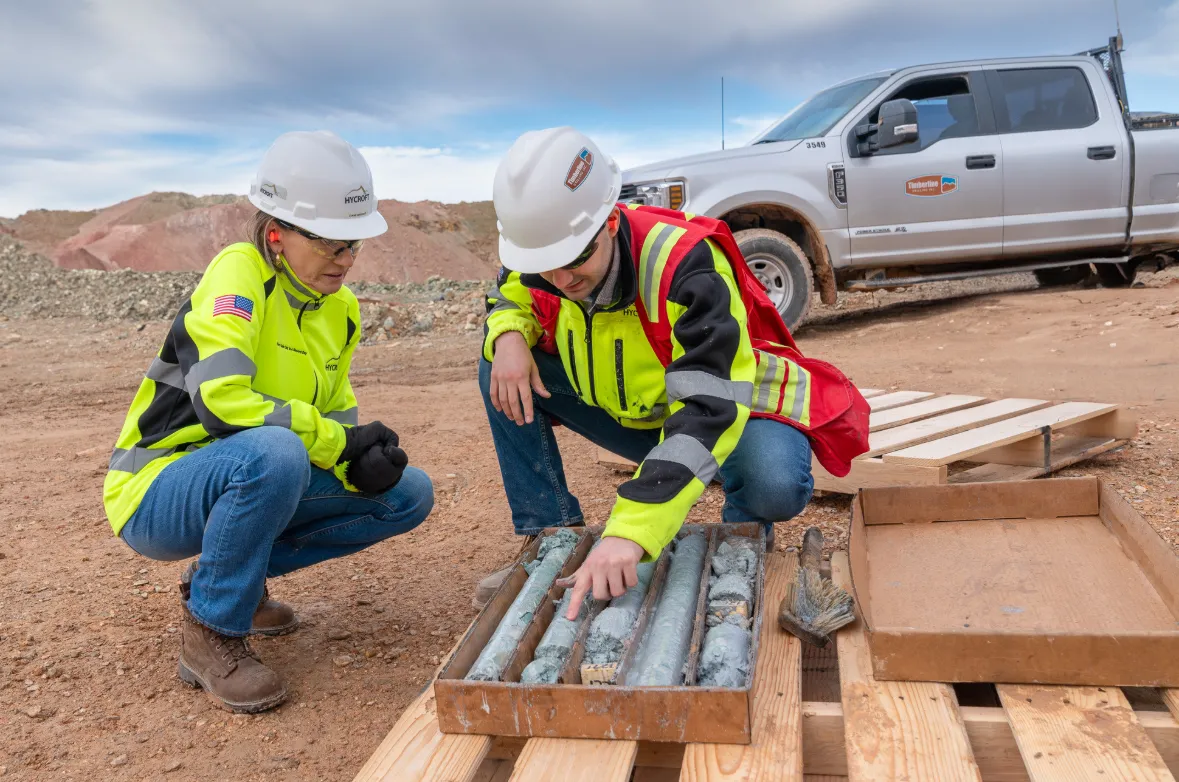
The exploration team uses zinc, selenium, pyrite, naumannite, and tetrahedrite as the primary pathfinder indicators at Hycroft. Management confirmed that pyrite is a non-negotiable co-occurrence: gold and silver mineralisation at the Hycroft Mine does not occur without accompanying pyrite. This rule applies consistently across the deposit, serving as a primary indicator for the exploration team. The 3 holes placed into the deep geophysical anomaly at Brimstone all returned the correct pathfinder suite, confirming the team remained within the system at depths where no prior drilling existed.
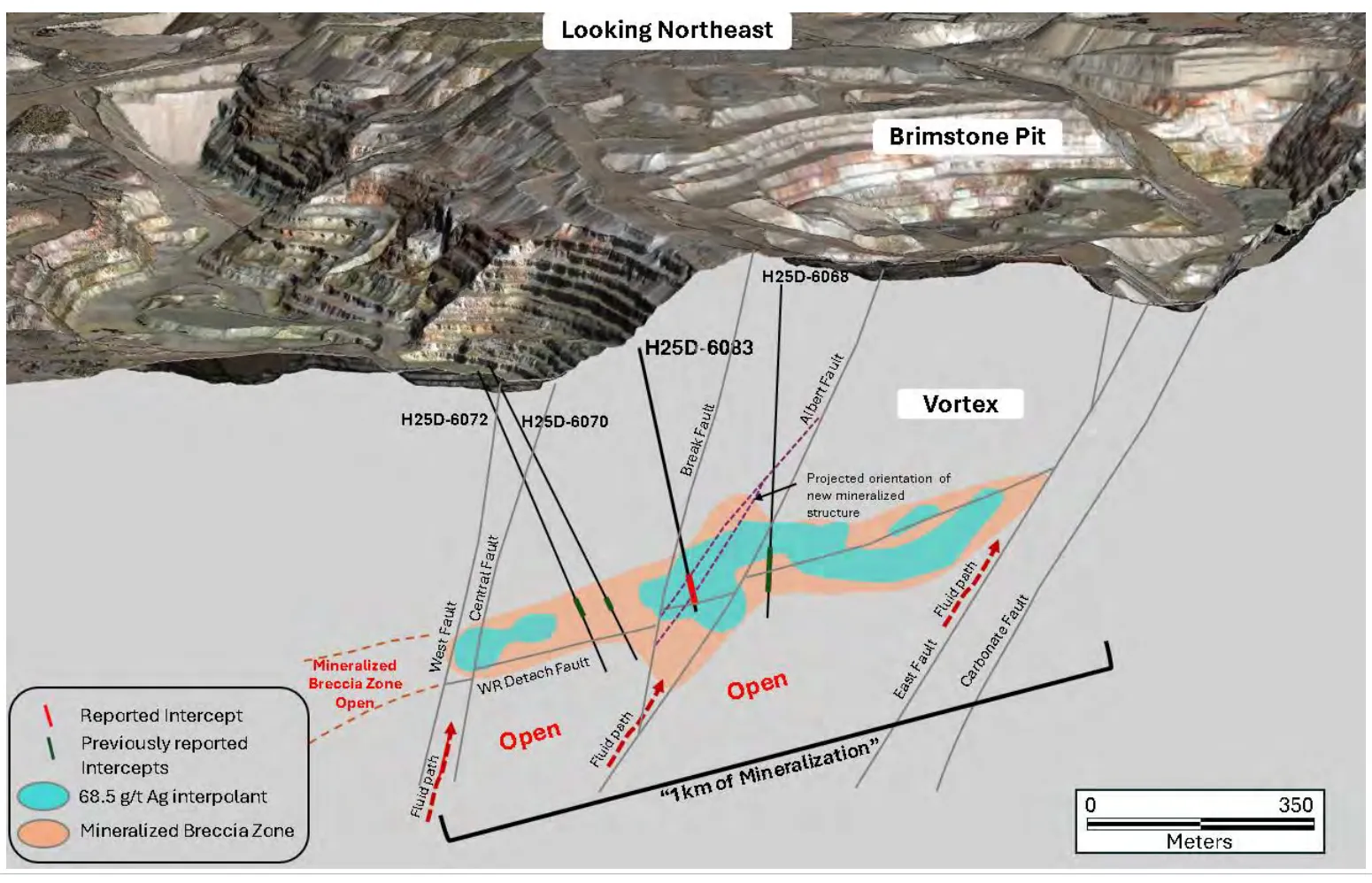
Every drill hole in the 2025-2026 program is also surveyed with a 360-degree downhole televiewer. The resulting images are integrated into a 3D geological model to help guide drilling in previously untested areas. At Brimstone and Vortex, where steeply dipping vein shoots are hosted within a complex multi-fault network, this structural data determines whether adjacent holes are testing the same vein or parallel structures, and at what depth the system continues or terminates.
Garrett described the methodology:
"When we drill a hole we're also putting what we call a televiewer down the hole and we're not just surveying the hole so we know, uh, the direction and the orientation, but it's taking 360-degree images all the way down the hole so we're able to put into a 3D model what these structures are doing, how many there are, where they're headed or they offset."
By generating structural data in parallel with grade data, the company is gathering the geometry needed to support the mine design components of a Preliminary Economic Assessment (PEA), which management is targeting for Brimstone and Vortex by early 2027.
Why Nevada & Why Now
The Hycroft Mine sits in Humboldt County, northern Nevada, within what management describes as a district-scale land package of more than 64,000 acres, less than 10% of which has been explored. Nevada is the jurisdiction of record for several of the highest-grade epithermal gold and silver deposits in US history, including the Midas mine, and provides established permitting pathways, active rail infrastructure, and accessible contractor networks. Hycroft Mining carries approximately $189 million in cash and no debt, with an 85% institutional shareholder base. The Hycroft Mine is already permitted for both heap leach and milling operations, with existing on-site infrastructure that management estimates would cost more than $1 billion to replicate.
What to Watch Next
The 2025-2026 drill program is scaling up from 2 core rigs and 1 reverse-circulation (RC) rig to 5 rigs in the second half of 2026, targeting approximately 24,000 metres across Brimstone and Vortex. A PEA for the sulfide milling operation is in progress. An updated resource estimate and initial underground mine plan for Brimstone and Vortex are targeting completion by early 2027, contingent on 2026 drilling results.
FAQs (AI-Generated)
Analyst's Notes





Subscribe to Our Channel








Stay Informed






















