




AI Hardware Supports Platinum Demand Beyond Cars



Storage and electronics support platinum demand, while recovery tests and economic studies clarify potential future supply.
- Artificial intelligence (AI) hardware uses platinum in data storage, selected chipmaking processes, and glass-fiber manufacturing, adding industrial demand beyond vehicle catalysts.
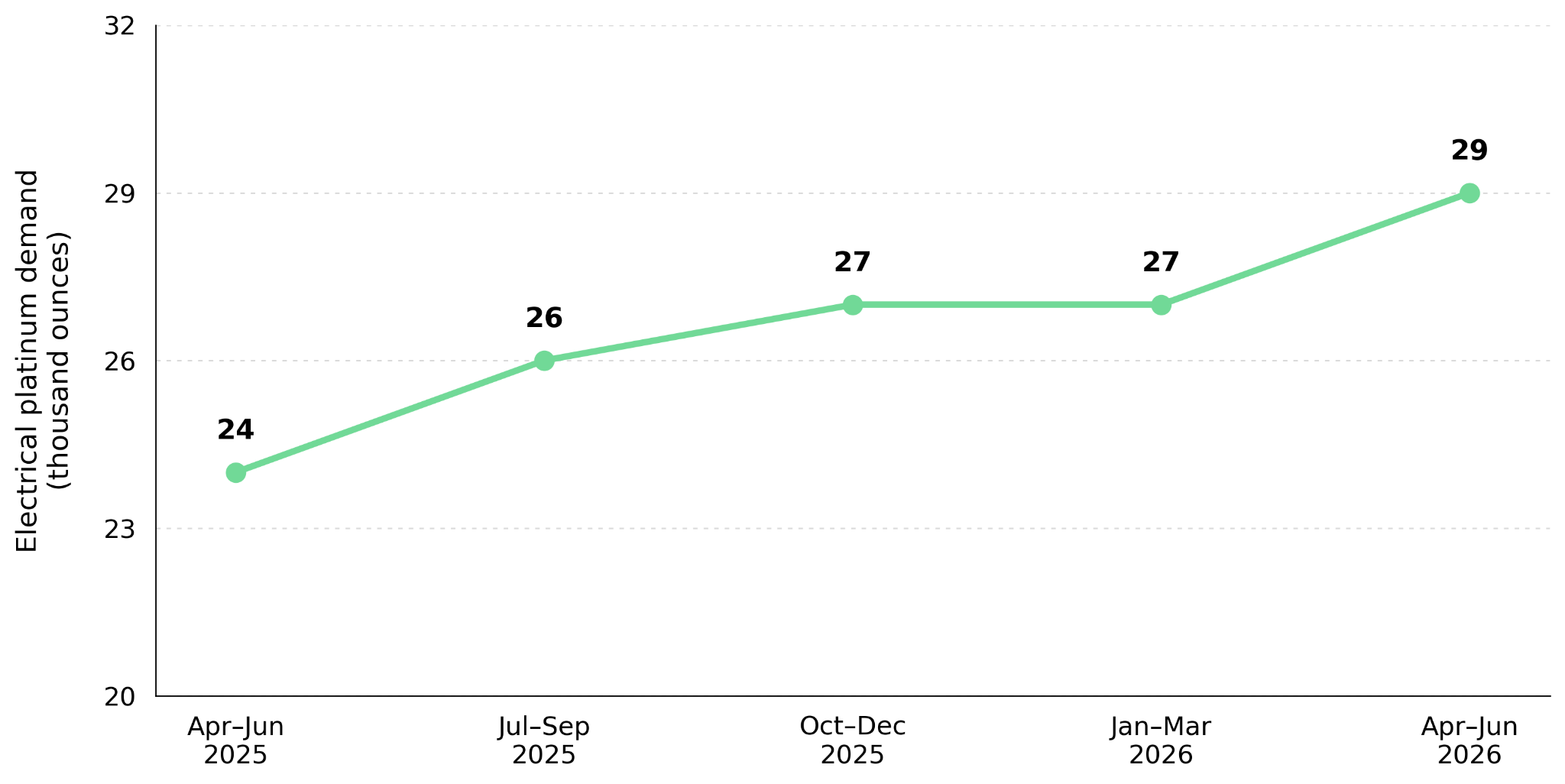
- Electrical platinum demand rose 22% year over year to 29,000 ounces in the second quarter of 2026, while automotive platinum demand is forecast to fall 4% for the full year.
- Higher semiconductor sales, equipment billings, and wafer shipments indicate manufacturing expansion, but platinum consumption depends on which production processes use the metal and in what quantities.
- Platinum group metals (PGMs) have different end uses, so exploration valuations must distinguish platinum content, recovery rates, and the recovered metal customers will pay for.
- Explorers offer exposure to potential future platinum supply, with processing tests and economic studies helping assess whether their resources could be developed economically.
Industrial Growth Broadens Platinum Demand Beyond Vehicle Catalysts
The World Platinum Investment Council (WPIC), using independent analysis by Metals Focus in its September 9, 2026, Platinum Quarterly, forecasts industrial platinum demand rising 5% to 2.385 million ounces in 2026, while automotive demand falls 4% to 2.904 million ounces. Electrical platinum demand reached 29,000 ounces in the second quarter of 2026, up 22% year over year, showing increased consumption outside vehicle catalysts.
In its October 5, 2026, release, the Semiconductor Industry Association (SIA) reported August global chip sales of $159.7 billion, up 8% from July and 144.3% from August 2025. World Semiconductor Trade Statistics (WSTS) compiles the sales series as a three-month moving average. Because sales measure revenue and reflect prices, product mix, and shipment volumes, those increases cannot be converted directly into additional platinum consumption.
AI Hardware Expansion Supports Platinum’s Industrial Demand
AI hardware links platinum consumption to data storage, selected chipmaking processes, and glass-fiber manufacturing.
Hard disk drives (HDDs) use platinum and ruthenium in magnetic recording layers. Heat-assisted magnetic recording (HAMR) allows more data to be stored in the same disk area, with iron-platinum thin films helping keep the stored data stable at higher densities.
Additional storage can come from more HDDs, higher-capacity drives, or solid-state drives (SSDs). Platinum consumption depends on HDD production and the amount of metal used per drive, so storage growth alone cannot establish equivalent growth in platinum demand.
Electronics Expansion Supports Platinum Demand Across Production Processes
Selected chipmaking and sensor processes use sputtering, which transfers platinum from a source material called a target onto a surface to form a thin coating with specific electrical properties.
Platinum-rhodium equipment draws molten glass into fine fibers used to make electrical-grade glass fabrics. These fabrics provide insulation and a structural base for printed circuit boards (PCBs), which connect electronic components in AI hardware.
Metal requirements depend on glass-fiber capacity additions and equipment replacement, so circuit-board output alone cannot determine platinum purchases. Reported glass-sector platinum consumption also includes non-AI applications.
Manufacturing Investment Supports Potential Platinum Demand Growth
Spending on new manufacturing capacity supports platinum demand when it leads to additional output from processes that use the metal. Equipment installation and production schedules therefore determine when planned expansion can translate into platinum consumption.
SEMI, the global semiconductor industry association, reported in its September 3, 2026, release that equipment billings reached $40.53 billion in the second quarter of 2026, up 23% year over year and 11% from the preceding quarter. Its July 14, 2026, Mid-Year Total Semiconductor Equipment Forecast projected 2026 equipment sales of $165.9 billion, up 23.2% year over year. These figures quantify actual and forecast equipment spending, while platinum consumption depends on production from processes that use the metal.
SEMI’s July 29, 2026, release reported worldwide silicon wafer shipments of 3,573 million square inches in the second quarter of 2026, up 7.4% year over year. Wafer shipments measure material supplied for chipmaking, while equipment billings measure spending; neither directly quantifies platinum consumption.
Industrial Demand Growth Supports Exploration for Future Platinum Supply
AI hardware growth broadens platinum’s industrial uses, increasing the relevance of exploration projects advancing toward an initial economic assessment. Processing tests and infrastructure studies help clarify how their resources could support future supply while establishing a more defined development path.
ValOre Metals is targeting a Preliminary Economic Assessment (PEA) for its wholly owned Pedra Branca project in Brazil in the fourth quarter of 2026 (Q4 2026). Processing tests and preliminary water and power studies are advancing alongside that assessment, helping establish a clearer basis for project planning. The work builds on a March 2022 inferred resource of 2.198 million combined platinum, palladium and gold ounces, with additional exploration zones offering potential for resource expansion.
Nick Smart, Chief Executive Officer of ValOre Metals, explains how supply constraints can pressure PGM prices:
“We see significant headwinds in terms of supply constraints around supply, and we're starting to see that play through, in terms of that balance: ongoing demand, constrained supply creating pressure on prices.”
Investment Selling Can Pressure Platinum Prices Despite Industrial Growth
WPIC’s September 9, 2026, forecast puts electrical platinum demand at 118,000 ounces in 2026, approximately 1.7% of total demand of 7.089 million ounces. It also projects a 265,000-ounce surplus and net investment outflows of 83,000 ounces for 2026. AI-related consumption is recorded within existing industrial categories, so electrical demand is not an AI-only demand estimate.
Investment selling can release platinum into the market while manufacturers continue buying for production, so industrial demand growth does not guarantee higher prices. Exploration project valuations should test lower metal prices, higher capital costs, and different recovery rates to show how these assumptions affect potential returns.
The Investment Thesis for Platinum Group Metals
- Platinum’s use in storage and selected electronics manufacturing provides potential end markets beyond vehicle catalysts for projects containing recoverable platinum.
- Reported electrical platinum consumption provides a more direct basis for demand assumptions than semiconductor revenue, which can rise through higher prices without additional metal use.
- Producer margins depend on operating costs and metal prices, while developer returns also depend on construction costs and recovery rates, limiting reliance on industrial demand growth alone.
- Metal-specific resource estimates and processing tests help explorers assess how much platinum could be recovered and sold, providing inputs for initial project economics.
- Power, water, and transport access, together with permitting requirements, affect the cost and timing of bringing potential platinum supply to market.
AI hardware expansion broadens platinum’s industrial end markets beyond vehicle catalysts, adding another source of demand for potential future supply. For explorers, resource definition, processing tests, and economic studies can make that opportunity easier to value by clarifying recoverable platinum and potential production costs. The investment focus should be on progress that connects geological resources with economically recoverable metal, giving industrial demand growth a concrete role in assessing future project returns.
TL;DR
AI hardware supports platinum demand through data storage, selected chipmaking processes, and glass-fiber equipment, providing end markets beyond vehicle catalysts. Manufacturing expansion creates potential demand, but chip sales and equipment spending cannot measure platinum consumption directly. Explorers can clarify their potential contribution through platinum-specific resource estimates, processing tests, and economic studies. These studies help establish how much metal could be recovered, sold, and produced economically. The opportunity lies in connecting identifiable industrial applications with credible future supply, while assessing project costs, infrastructure, permitting, and metal prices rather than assuming hardware growth guarantees higher platinum prices.
FAQs (AI-Generated)
Analyst's Notes





Subscribe to Our Channel









Stay Informed


