




Selkirk Copper Targets Up to 20% More Minto Output: 6 Feasibility Points


Selkirk Copper's Minto feasibility study targets 10% to 20% more mill throughput and 3% to 4% better copper recovery while keeping costs near the base case.
Project Overview
Selkirk Copper Mines (TSX-V: SCMI | OTCQX: SKRKF | FRA: IO20) is advancing a restart and redevelopment plan for the former Minto copper-gold-silver mine in central Yukon, Canada. The Selkirk First Nation indirectly holds a controlling equity stake in the company. The site already has a processing plant rated at 4,100 tonnes per day (tpd) and a 400-person camp. Selkirk Copper's feasibility study (FS) objectives aim to increase the metal produced by the plant while keeping costs near the preliminary economic assessment (PEA) base case.
The recently completed PEA delivered a 13-year mine life and C$186 million in initial capital. At planning prices of US$5.00 per pound for copper, US$3,600 per ounce for gold, and US$50 per ounce for silver, the after-tax net present value is C$494 million at a 7% discount rate. At those prices, the internal rate of return is 48%, and the payback is 1.9 years. Management says the FS is targeting completion by mid-2027.
1. The PEA Met Its Cost & Life Objectives but Fell Short on Output
The PEA met or beat 7 of the 8 study objectives Selkirk Copper set in October 2025, and the one it missed measures metal produced. Indicated and inferred resources rose 280%, while measured and indicated contained copper rose 182%, against a goal of doubling them. The 13-year mine life fell within the 12-to-15-year objective, and the integrated underground and open-pit mine plans reached the 4,100 tpd mining rate and mill throughput.
Initial capital came in at C$186 million, against an objective of C$200 million to C$225 million, based on vendor quotes and optimizations for both the mine and the mill. The study also established a C1 cash cost of US$1.56 per pound of copper net of by-product credits, a C$338 million sustaining capital estimate, and a C$71 million scoping-level closure cost. C1 cash cost is the direct site-level cost of producing a pound of copper, minus the revenue earned from co-mined metals.
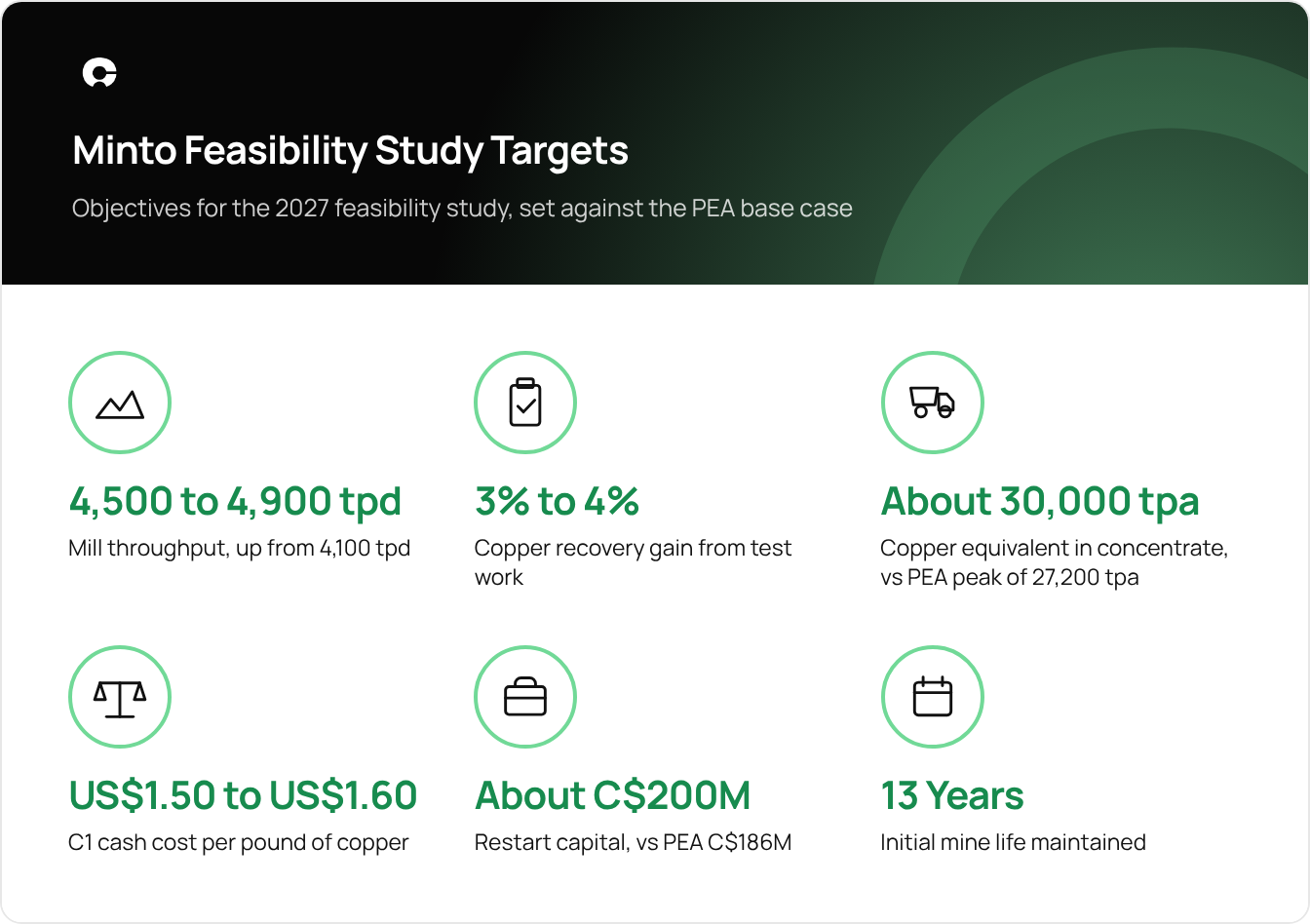
The output objective was about 30,000 tonnes per annum (tpa) of copper equivalent, and the PEA reached 27,200 tpa at peak concentrate production. Payable metal peaks at 59.9 million pounds of copper equivalent in 2030 and averages 40 million pounds over the mine life. The FS objectives restate a concentrate metal output target of about 30,000 tpa of copper equivalent.
2. Mill Throughput Is Targeted to Rise 10% to 20%
Selkirk Copper is targeting an increase in mining rate and mill throughput from 4,100 tpd to 4,500-4,900 tpd, a 10%-20% lift in mine and mill output. The company plans to reach it through updated mine plans and mill optimization work on the plant already on site.
At 4,100 tpd, the PEA rate is equivalent to 1.5 million tonnes a year. The PEA production profile is a platform to extend mine life and increase annual production by up to 20%, matching the upper bound of the FS throughput objective.
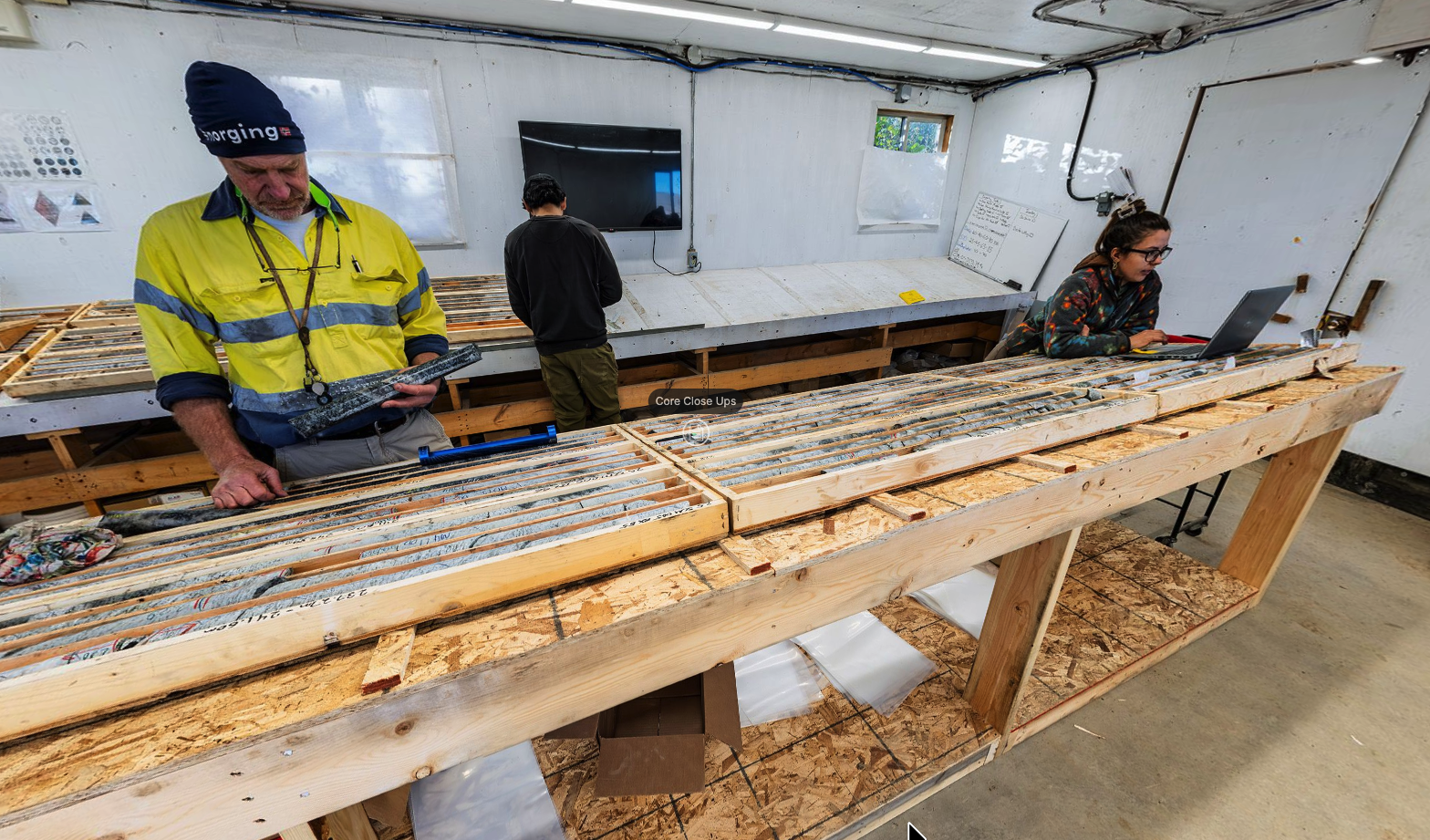
The mill runs a conventional flowsheet of 3-stage crushing, grinding in semi-autogenous and ball mills, gravity concentration, and flotation. Grinding mills tumble rock into fine particles, gravity concentration separates heavy mineral grains by weight, and flotation separates copper minerals from waste rock using air bubbles. Its design goal is 92% concentrator availability, and the plant is built to process a blend of underground and open-pit material, delivering consistent production and concentrate quality.
3. Copper Recovery Depends on Better Oxide Modeling
Selkirk Copper is also targeting a 3% to 4% increase in copper recovery through metallurgical test work. The PEA flowsheet delivers total recoveries of 89% for copper, 85% for gold, and 77% for silver. FS test work is aimed at improving copper, gold, and silver recoveries, in line with historical recoveries.
One input to that work is the oxide ratio, soluble copper divided by total copper, which the company uses to estimate copper recovery and profitability. Lower copper recovery is associated with higher copper oxide content. Total copper is reported for all 163,000 samples in the assay database, while soluble copper was analyzed only selectively for 123,000 samples. Selkirk Copper is increasing the frequency of soluble copper analyses and running a sequential leach study, a test that dissolves copper minerals in stages to show which minerals contain the copper. It is also collecting additional samples to better understand partially oxidized material.
Phase 2 metallurgical testing is collecting samples for 5 master composites, blended samples built to represent a zone's average grade and mineralogy. The work focuses on the areas expected to be mined in the first 5 years of production, and results are expected this fall to inform an updated recovery formula for the 2027 FS.
4. Phase 2 Drilling Sits Outside the PEA Mine Plan
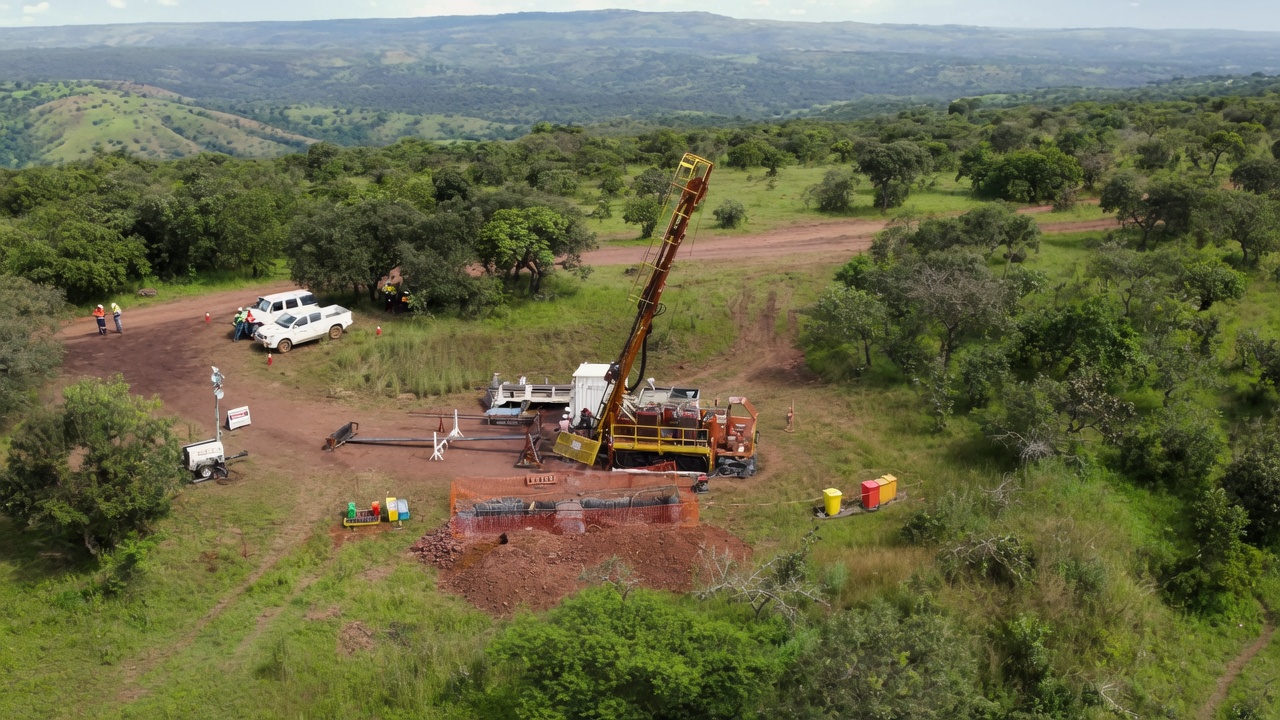
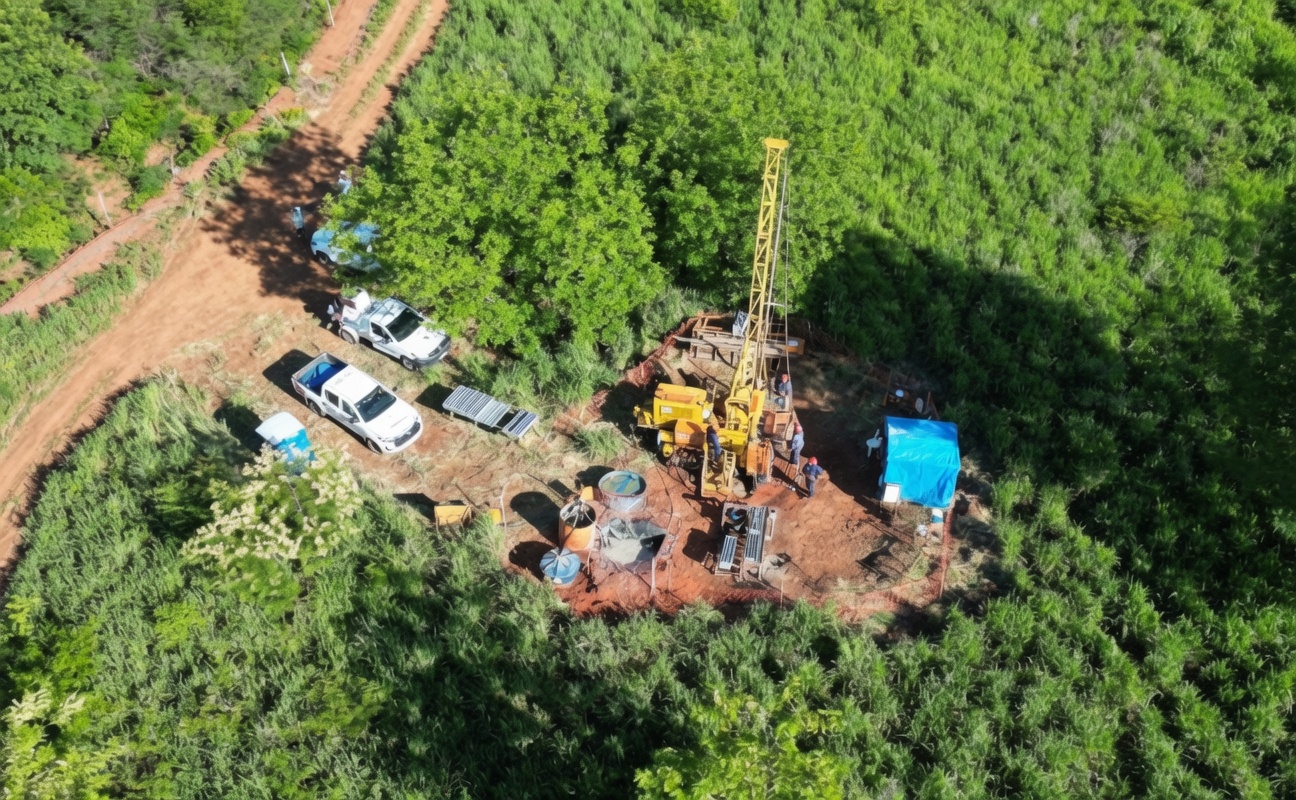
Grade and resource conversion are the FS's other focus, and the PEA mine plan excludes the roughly 50,000-meter Phase 2 drill program. By October 1, 2026, the company had drilled 53,000 meters (m) in that program, which is designed to upgrade indicated and inferred resources to measured and indicated in support of the FS.
The PEA drew on a mineral resource estimate (MRE) effective June 10, 2026, with 940 million pounds of copper at 0.89% copper in measured and indicated resources. Phase 2 results reported on September 29, 2026, include a 35 m step-out, a hole drilled beyond the edge of earlier drilling, in the southern part of the 202 Lens at Minto North. It returned 9.27% copper, 7.43 grams per tonne (g/t) gold, and 54.9 g/t silver over 5.4 m, or 15.11% copper equivalent. That grade ranks within the 99th percentile of more than 4,300 significant historical intercepts at Minto. A second step-out returned 1.25% copper equivalent over 17.6 m, and the 202 Lens remains open to the northwest for expansion. Parts of the Copper Keel area returned grades that may not warrant inclusion in a mine plan.
President and Chief Executive Officer of Selkirk Copper, Colin Joudrie, links the next round of mine plans to grade and metal in concentrate:
"You always want to get better, a little bit tighter mine plans, probably a higher average grade that will allow us to produce just a little bit more metal in the concentrate."
The Phase 2 results that feed those plans are still arriving. Drilling is anticipated to continue until mid-October 2026, assay turnaround is currently about 8 weeks, and results are expected to be released through the fall and winter of 2026.
5. Cost Targets Stay Near the PEA Base Case
Selkirk Copper is pairing the output targets with cost targets: a C1 cash cost of US$1.50-US$1.60 per pound of copper and restart capital kept at about C$200 million. Under the FS objectives, the capital estimate can be modified to meet the mine and mill throughput objectives, and the sustaining capital and closure cost estimates are to be maintained as their definitions expand.
Of the PEA total of C$185,854,222, C$22,563,843 is contingency. That estimate uses a Class 5 cost classification, with an accuracy range of plus 100% to minus 50%. Much of the infrastructure is in place, however, and many equipment and work quotes are of much higher confidence. Costs expected before a restart decision are estimated at C$20 million to C$25 million, mostly for expenses not directly tied to a construction decision.
Joudrie measures the PEA capital figure against the company's own earlier guidance:
"Our capital costs are a little bit lower than we guided. It's around 186 million Canadian dollars. We were sort of guiding in the 225 range."
The FS objective of about C$200 million is above the PEA figure of C$186 million and at the low end of the earlier objective of C$200 million to C$225 million.
6. FS Aims to Hold 13-Year Mine Life & Lift Conversion
The FS objectives maintain the initial 13-year mine life and aim to increase the amount of the resource the mine plans to convert. Management says it expects to complete an updated MRE incorporating the Phase 2 assays in the first quarter of 2027, in time to update the mine plans.
Joudrie sets out the order of the work once the assays are in:
"What we're really doing with that information: update the MRE, and then we'll take another run at a series of mine plans that just get us that better material, hit the mill at the right time."
The company's planned timeline to restart production in the second half of 2028 remains intact. The metallurgical results are due this fall, and management is targeting the first quarter of 2027 as the next published inputs to the recovery and conversion targets.
Key Takeaways for Investors
- The preliminary economic assessment met or beat 7 of its 8 objectives but reached 27,200 tonnes per annum of copper equivalent at peak against a target of about 30,000 tonnes per annum.
- Selkirk Copper is targeting mill throughput of 4,500 to 4,900 tonnes per day, up from 4,100 tonnes per day, through updated mine plans and mill optimization.
- The feasibility study targets a 3% to 4% increase in copper recovery, through metallurgical test work.
- The roughly 50,000-meter Phase 2 drill program is excluded from the current mine plan and is designed to upgrade resources to the measured and indicated categories.
- The company aims to keep C1 cash cost at US$1.50 to US$1.60 per pound of copper and restart capital at about C$200 million.
Bottom Line
Selkirk Copper's PEA delivered the mine life, throughput, and initial capital it aimed for, and the FS objectives restate the one target it did not reach: about 30,000 tpa of copper equivalent. The company is pursuing that figure for an existing plant. Its routes are 4,500 to 4,900 tpd of throughput, a 3% to 4% gain in copper recovery, and Phase 2 drilling the PEA mine plan excludes, with 53,000 m completed by October 1, 2026. Cost targets remain close to the PEA, with C1 cash cost of US$1.50 to US$1.60 per pound of copper and restart capital of about C$200 million. The metallurgical results are due this fall, and the MRE update management is targeting the first quarter of 2027, giving investors published figures to set against the recovery and conversion targets. Both arrive well ahead of the planned restart in the second half of 2028.
Analyst's Notes





Subscribe to Our Channel



Stay Informed


