




ATEX Resources' Valeriano 2-Billion-Tonne Copper System to Enter Phase VII Drilling


ATEX Resources (TSX:ATX) targets B2B breccia growth at Valeriano, Chile, as Phase VII drilling tests a high-grade copper starter mine and district upside.
- Valeriano's 2025 MRE outlines roughly 2 billion tonnes at around 0.8% CuEq, containing about 34 billion pounds of CuEq and 14.2 million ounces of gold.
- The B2B breccia, estimated by management at roughly 30-35 million tonnes grading about 1.4-1.5%, is open to the south and east and could underpin an underground starter mine.
- Phase VII drilling begins within weeks and will test the breccia's southern and up-dip extent, with an updated MRE expected in the second half of 2027.
- Management says ATEX trades at around one cent per pound of copper in the ground, compared with two to three cents for peers.
- ATEX holds C$141 million in cash and acquired two porphyry targets at Nuevo Horizonte in January 2026, supporting a potential district-scale story.
Large copper-gold discoveries are scarce, and those in established mining jurisdictions are scarcer. ATEX Resources Inc. (TSX:ATX) owns 100% of the Valeriano copper-gold project in Chile, a porphyry system that the company's 2025 Mineral Resource Estimate (MRE) puts at roughly 2 billion tonnes grading around 0.8% copper equivalent (CuEq). Chile supplies about a quarter of the world's copper, and investor appetite for scale in safe jurisdictions has held up despite recent macro volatility.
Interim President and CEO Chris Beer outlined how ATEX plans to spend the next 18 months. The priority is to grow a higher-grade breccia zone that sits above the main porphyry, and to test whether Valeriano is the first of several comparable systems in the district. Phase VII drilling is due to begin within weeks. The investment case now turns on two questions. How large can the high-grade zone become, and is there more than one Valeriano?
Valeriano Scale First, Grade Emerging
The 2025 MRE contains 475 million tonnes of Indicated resource at 0.58% copper and 0.88% CuEq, plus 1.51 billion tonnes of Inferred resource at 0.50% copper and 0.75% CuEq. That equates to around 34 billion pounds of CuEq and 14.2 million ounces of gold. Beer noted that the porphyry is unusual in its geometry. Most porphyries are either deeply buried or eroded down to surface. Valeriano's mineralised system starts several hundred metres below surface, which points to an underground operation. A high-grade porphyry core begins roughly 800 metres down. Metallurgy is a further support. Two rounds of metallurgical work have produced high copper recoveries with no deleterious elements such as arsenic identified so far. Beer added that at a 1% copper or CuEq threshold, around 25% of the value sits in precious metals.
Interview with Chris Beer, Interim President & CEO of ATEX Resources
The B2B Breccia: A Potential Starter Mine
ATEX intersected the B2B breccia in spring 2024 while drilling the high-grade porphyry below. Beer described the zone as roughly 30 to 35 million tonnes grading approximately 1.4% to 1.5%, starting around 400 metres below surface. The company released a summary of the Phase VI programme in September. Beer said it returned some of the highest-grade intersections in company history, particularly where holes cut the sub-vertical breccia at right angles. The breccia remains open to the east and to the south. Drilling east of the zone also returned around a kilometre of mineralisation grading 0.72%. Phase VII will step out south and drill up-dip towards surface to establish the ultimate size and grade of the breccia. ATEX has not yet run a starter-mine study. Beer offered an illustrative scale of around 15,000 tonnes per day, or roughly 5 million tonnes per annum, and said grades of 1.5% to 2% would make that case compelling. Beneath the breccia sits a long-life, high-grade copper resource suited to block caving, which Beer framed as a longer-term opportunity.
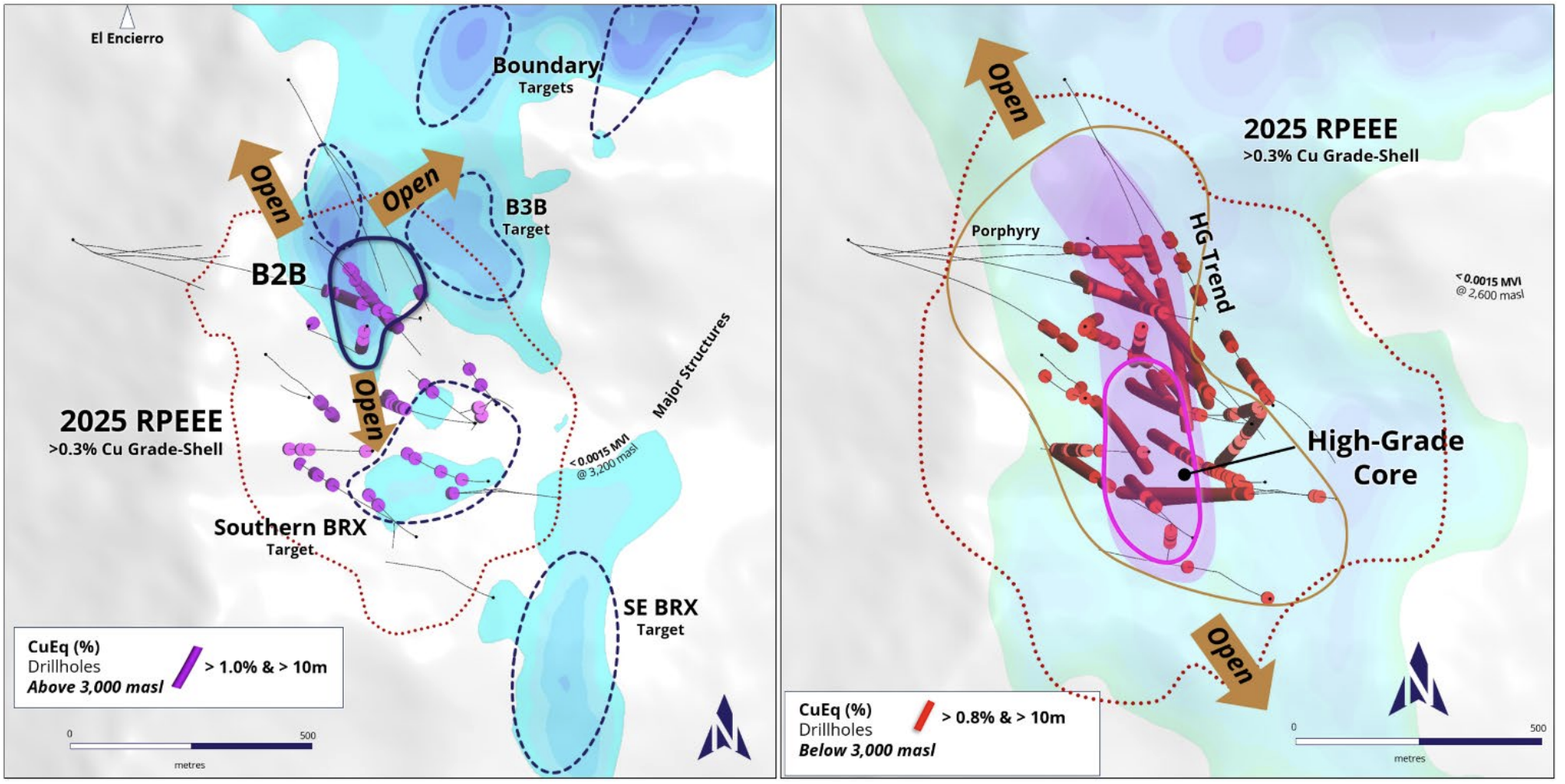
Drilling efficiency has also been a feature of the programme. ATEX drills deep "mother" holes and then branches lateral holes off them, a technique borrowed from oil and gas. Beer estimated this saved more than 10,000 metres in a 30,000-metre programme.
Valuation Gap and Capital Allocation
ATEX shares performed strongly in 2025. Beer said the market capitalisation reached around C$1.5 billion before settling near C$1 billion. The company held C$141 million in cash as of June 2026. Beer was direct about where the valuation stands relative to peers and what could close the gap.
"Right now, we're trading at a penny a pound in the ground while some of our peer group are trading at two or three pennies. And then as you get closer to production or you've done an economic study, then you can attract 4-5 cent a pound valuation."
That framing explains the dual focus on breccia expansion and district exploration. Last year's drill programme cost around $75 million, according to Beer. Capital allocation for the next 18 months is centred on expanding the breccia, refining its grade, and determining whether Valeriano anchors a wider district. ATEX's shareholder register includes Agnico Eagle as a strategic investor and Pierre Lassonde with a stake of around 10%. Beer stressed that the company does not take that support for granted.
Building a District: Nuevo Horizonte
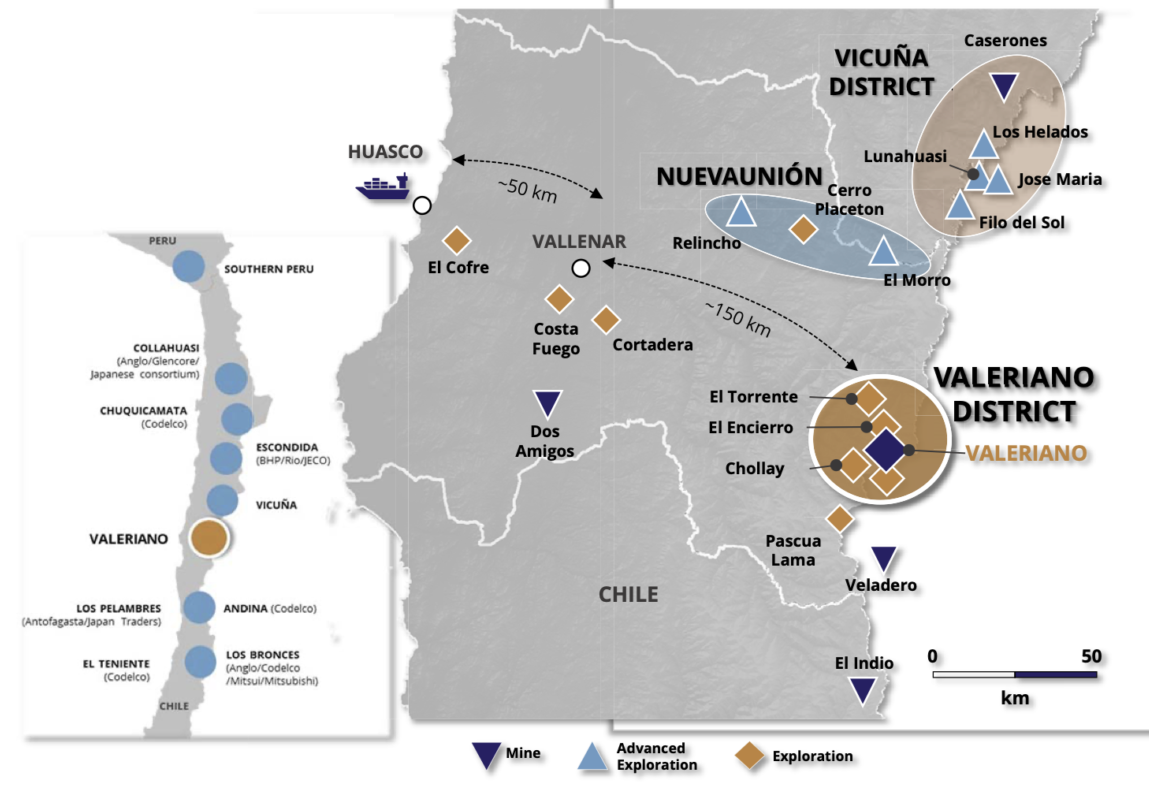
In January 2026, ATEX acquired two porphyry systems at auction to the south of Valeriano. Beer said they appear to share a similar geochemical signature. Geophysics is planned, and Beer believes the company could identify a "Valeriano 2" within the next 12 months. The template is 80 kilometres to the north. There, the discoveries now associated with NGEx Minerals and the wider Vicuña district grew from several billion tonnes into a far larger system after a high-grade breccia zone was found. BHP ultimately became a partner in that district. Beer referenced the Lassonde curve, which tracks how junior miners are valued through the discovery cycle, and argued that time value of money favours drilling these targets as quickly as possible.
Chile's Policy Shift
The jurisdictional backdrop has improved. President José Antonio Kast has been in office since March 2026, and Beer said the new government is already accelerating permitting. It is also reviewing a value-added tax (VAT) regime that weighs on explorers, and has floated a range of pro-mining initiatives. Beer suggested Chile is conscious of Argentina's recent push for investment and of the need to protect its share of global copper output. The valley around Vallenar, where Valeriano is located, has little history of responsible mining. Recent activity is changing that, including a nearby project that has attracted investment from G Mining Services. Beer also noted that enrolment in geology and engineering programmes is rising in Chile, which should support recruitment as the district develops.
Key Risks
Valeriano remains an exploration-stage project with no economic study. The starter-mine concept is illustrative only, and capital intensity has not been estimated. The breccia begins around 400 metres below surface, so any development would be underground. The Nuevo Horizonte targets are conceptual and have not yet been drilled. ATEX is also led by an interim CEO, and a permanent leadership decision is outstanding. Beer acknowledged that some investors now want to see economics or a second discovery before re-engaging.
The Investment Thesis for ATEX Resources
- Valeriano hosts a 2025 MRE of roughly 2 billion tonnes at around 0.8% CuEq, placing it among the larger undeveloped copper-gold porphyries globally.
- The B2B breccia offers a higher-grade, shallower starting point that could underpin a smaller underground starter mine ahead of any bulk block-cave development.
- Phase VII drilling, starting within weeks, will test the breccia's southern and up-dip extent and is the next major catalyst to watch.
- ATEX trades at around one cent per pound of copper in the ground, according to management, below peers at two to three cents.
- C$141 million in cash funds the next phase of drilling without an immediate need to raise capital.
- Early work at Nuevo Horizonte could add a second large porphyry system and support a district-scale narrative.
- Key risks include the absence of an economic study, underground depth, interim leadership, and exploration outcomes at new targets.
Macro Thematic Analysis
Copper demand is being pulled in several directions at once. Grid expansion, electrification, data centres, and defence all require more metal, while new mine supply remains slow to arrive. Discoveries of large, high-quality deposits have become rare, and development timelines often run beyond a decade. That imbalance has sharpened the value of district-scale systems in stable jurisdictions, and Chile's Vicuña district shows how that value can be recognised. Successive discoveries there attracted major-company interest and ultimately a partnership with BHP.
Beer sees a similar opportunity taking shape around Valeriano, and he framed the company's strategy in terms of not missing it.
"We just continue to drill this district. When I look back five years from now, I wouldn't want to be like, 'We had the Valeriano, we expanded it, but we failed to recognize it as a district.' We also have you know, strong investor in Agnico and we don't take that investment for granted.
Policy is moving in the same direction. Chile's new government is prioritising faster permitting and investment attraction, conscious that its position as the world's largest copper producer cannot be taken for granted. For explorers, that combination of geological scale, supportive policy, and a structurally tight copper market creates a favourable setting. The challenge for junior developers is converting that backdrop into a valuation the market recognises. That typically means demonstrating economics, growing grade, or proving that a single discovery is part of something larger. ATEX is attempting all three at once. The coming 12 to 18 months will show whether the district thesis gains the geological support it needs.
TL;DR
ATEX Resources owns the Valeriano copper-gold project in Chile, where the 2025 MRE outlines roughly 2 billion tonnes at around 0.8% CuEq. Interim CEO Chris Beer says the near-term priority is the B2B breccia, a zone of roughly 30-35 million tonnes grading about 1.4-1.5% that could support an underground starter mine. Phase VII drilling begins within weeks and will test the breccia to the south and towards surface. ATEX also acquired two porphyry targets at auction in January that may point to a wider district. Management argues the stock trades at about one cent per pound in the ground versus two to three cents for peers. The company holds C$141 million in cash.
FAQs (AI Generated)
Analyst's Notes





Subscribe to Our Channel
%20(1)%20(1).jpg)
.jpg)
Stay Informed


