




Alkane Resources' Tomingley Hedge and Capital Tailwind on Growth Expansions


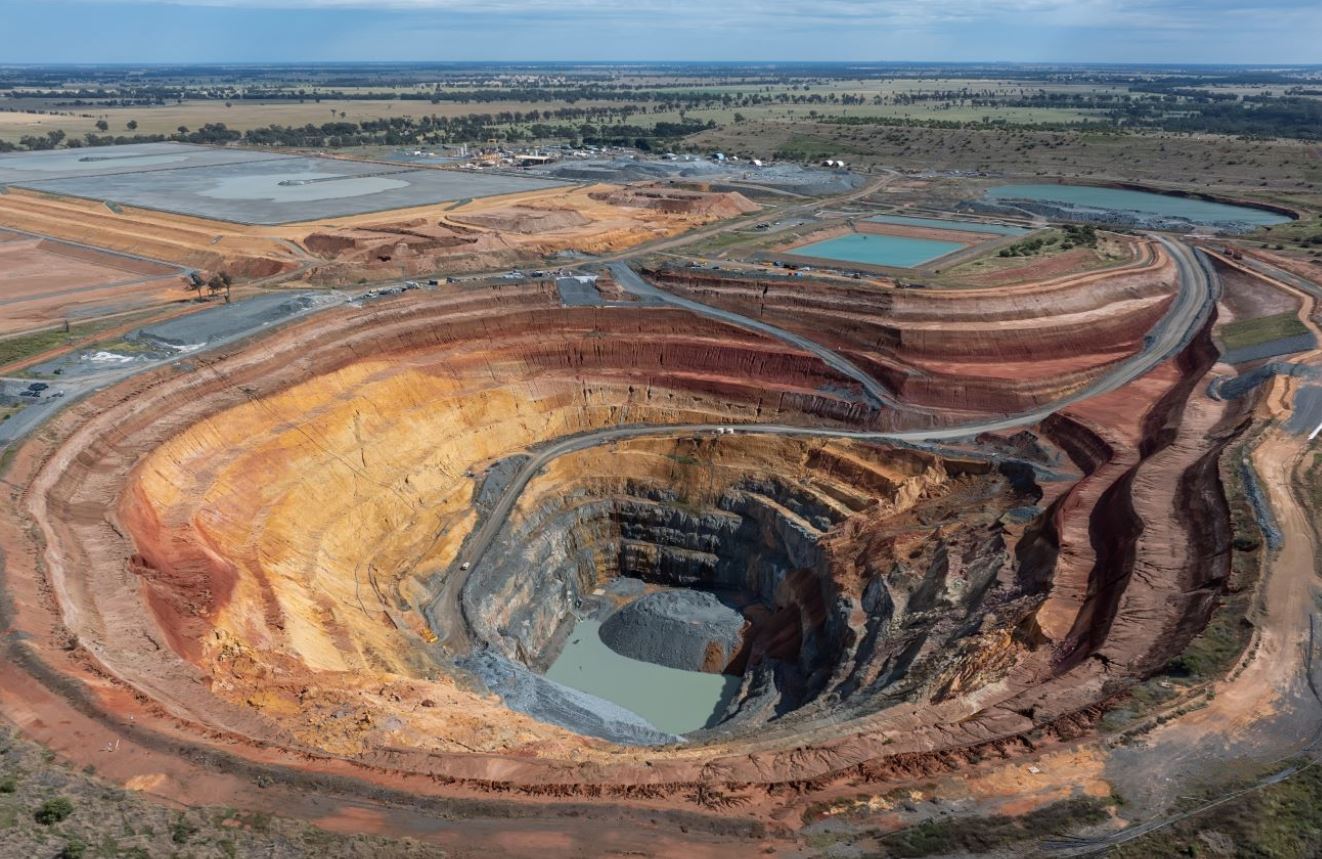
Alkane Resources holds output near 170koz as Tomingley hedges expire, capex falls away and Björkdal targets 50koz, setting up stronger cash flow from FY2028.
- Alkane Resources produces about 170,000 gold-equivalent ounces a year, and its FY2027 guidance of 163,000 to 177,000 ounces implies flat output.
- Management estimates that the expiry of the final Tomingley hedges after June 2027 will add roughly A$90 million to FY2028 profit.
- Most of the company's A$160 million to A$190 million in FY2027 growth capital is one-off spending that should fall away and lift free cash flow.
- Björkdal project in Sweden is targeting a 50,000-ounce annual run rate during calendar 2027, up from 40,800 ounces, using higher-grade Storheden ore.
- The company's liquidity of about A$549 million supports a dividend, a share buyback and potential acquisitions of producing assets with growth upside.
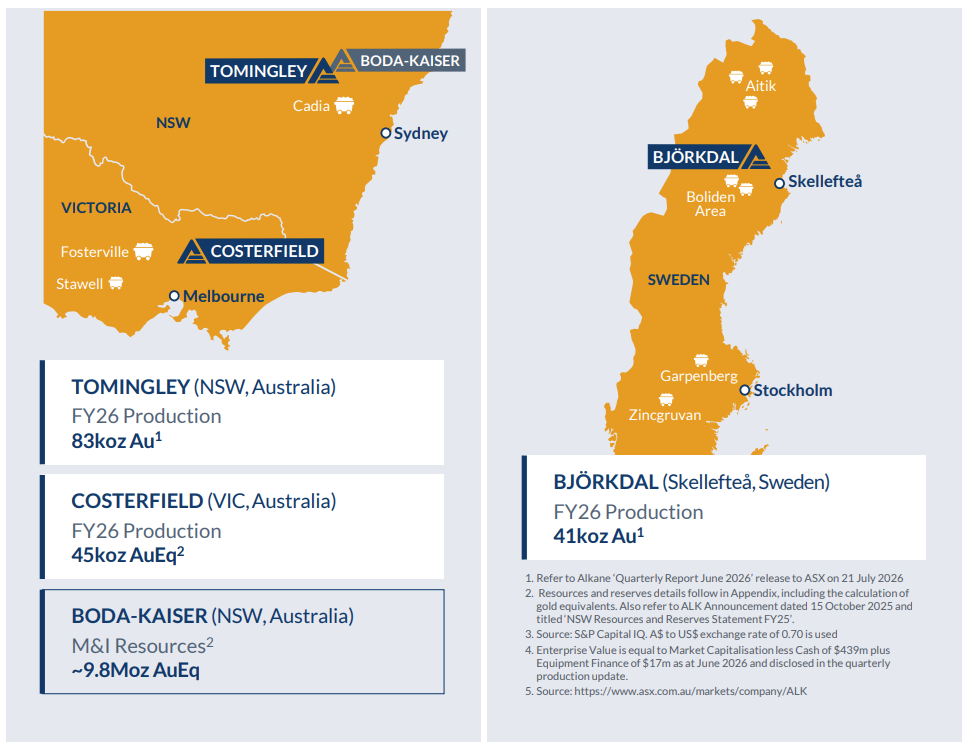
Mid-tier gold producers have spent 2026 generating record margins, yet corporate deal-making has fallen short of what many bankers expected. Alkane Resources (ASX:ALK, TSX:ALK, OTCQX:ALKRY) is squarely in the middle of that tension. The company runs three operating mines, Tomingley and Costerfield in Australia and Björkdal in Sweden, and produces roughly 170,000 gold-equivalent ounces a year. Speaking in Colorado Springs, Managing Director and CEO Nic Earner acknowledged that FY2027 guidance implies little growth in ounces. His case is that the more important story for investors lies elsewhere: rising cash generation as legacy hedges expire, a capital programme that is front-loaded into the current year, and a deliberately measured approach to acquisitions.
Production Holds Steady While Capital Spending Peaks
Alkane produced about 169,000 gold-equivalent ounces (AuEq) in FY2026, made up of 83,000 ounces from Tomingley, 45,000 AuEq ounces from Costerfield and 41,000 ounces from Björkdal. FY2027 guidance of 163,000 to 177,000 AuEq ounces puts the midpoint at around 170,000 ounces. Earner accepts the analyst view that, measured purely on ounces, the business is in a post-growth phase for now.
The spending profile tells a different story. Earner said the company is investing more than A$150 million in capital this financial year, with company guidance putting growth capital at A$160 million to A$190 million. Guidance also includes A$45 million to A$53 million for near-mine exploration, plus a further A$10 million to A$12 million for Boda-Kaiser and other exploration. The main projects are the Newell Highway realignment at Tomingley, which opens access to the San Antonio open pits, a significant tailings storage expansion at Björkdal, first development into the new Storheden mining area, and the Brunswick South area at Costerfield.
The Tomingley road diversion gives Alkane access to open-cut ore containing, in Earner's words, "low 200,000 ounces". San Antonio's open pit Ore Reserve stands at 214,000 ounces. A second ore source lets the company choose between underground and open-pit feed for the mill. Earner said this should allow unit costs to be held broadly flat, and potentially reduced, depending on how the feed blend is optimised.
Hedges & Capital Roll-Off Set Up FY2028
Alkane reports on an Australian financial year running from July to June. Earner pointed to two changes that arrive once FY2027 ends in June 2027. The first is the expiry of the final remaining gold hedges at Tomingley. He described these as roughly A$3,000 an ounce out of the money on around 26,000 ounces still to be delivered, and put the resulting uplift at roughly A$90 million that would flow through as profit in FY2028.
The second is the tail-off of the accelerated capital programme. The highway works, the Björkdal tailings lift and much of the current development spending are one-off items that fall away once complete. Earner was clear that this outcome does not depend on growth in ounces.
"The amount of cash we're going to generate where prices remain steady next year will automatically lift. So we will get profit growth."
He added that many of the analysts covering the company already anticipate this step-change. That suggests the story is less about a surprise and more about whether the market is pricing forward cash flow rather than flat production.
Björkdal: Storheden Key to Margins
Björkdal is the group's highest-cost asset. FY2027 all-in sustaining cost (AISC) guidance is A$3,300 to A$3,700 per AuEq ounce at Björkdal, compared with A$2,600 to A$2,900 at Tomingley and A$2,700 to A$3,000 at Costerfield. Consolidated AISC guidance is A$2,900 to A$3,200 per ounce. Once growth capital is included, Earner estimated all-in costs across the group at A$4,000 to A$5,000 per ounce, depending on the pace of execution.
Management's objective is to hold the Australian cost base steady and bring Björkdal down. Storheden, located about 700 metres from the main Björkdal system, is central to that plan. It hosts Indicated Resources of 1.1 million tonnes at 2.51 g/t gold and Inferred Resources of 1.8 million tonnes at 2.11 g/t gold. Earner expects grade to come down once the deposit is converted to Ore Reserves on a 2.5-metre mining width. He also expects permitting within two years. Open-cut mining has started separately at Nylunds.
Together, these sources underpin a target of reaching a 50,000-ounce annual run rate at Björkdal during calendar 2027, up from 40,800 ounces in FY2026. Earner said this would bring Björkdal's costs closer to A$3,000 an ounce. On his own rough arithmetic, 50,000 ounces at an all-in cost of about A$4,000 an ounce leaves around A$100 million of annual profit at current gold prices.
Interview with Nic Earner, Managing Director of Alkane Resources Ltd.
Exploration: Hunting for Transformational Ounces
Alkane's group Ore Reserves rose 6.2% net of depletion in its latest annual update, with depletion replaced at all three sites. Much of the exploration budget is aimed at extending known ore bodies. At Costerfield, infill drilling at Brunswick South has already delivered Reserves, which Earner said represent one to two years of production for the operation.
The larger ambition is a genuinely transformational discovery. Earner described the goal at Costerfield as something like a 300,000-ounce find, which would add roughly six years of mine life, or a high-grade zone comparable to the Swan Zone at Agnico Eagle's Fosterville mine. Of the roughly A$25 million spent annually at Costerfield, he estimated about A$5 million goes toward these higher-risk targets. They include deeper structures that could act as concentration points, targets along the Costerfield line within exploration licences rather than mining licences, and dyke-hosted structures resembling Southern Cross Gold's Sunday Creek discovery. Earner defended the allocation on the basis that technical groundwork has to justify each hole before drilling begins.
Capital Allocation: Dividends, Buybacks and Boda-Kaiser
Earner set out a clear order of priorities. Internal growth and sustaining work come first, including tailings capacity, new mining areas and exploration at the pace the technical teams can deliver. Boda-Kaiser comes next. The company is advancing environmental studies, negotiating with landholders and securing water rights, with each step treated as a go/no-go decision on further spending. The copper-gold project hosts 14.7 million ounces AuEq in Resources. A 2024 Scoping Study outlined A$1.8 billion in pre-production capital, a 24% internal rate of return (IRR), and first-five-year output of about 159,000 ounces of gold and 35,000 tonnes of copper a year.
Surplus cash is then returned to shareholders. Alkane has introduced a maiden dividend alongside an on-market share buyback. Earner explained that the mix reflects the company's dual register. Australian retail investors value dividends because of franking credits, a tax credit for company tax already paid. North American investors generally prefer buybacks. He said the dividend was set at a level intended to be sustainable and capable of growth, and that the company intends to continue, and ideally increase, shareholder returns.
M&A Capacity Without Compulsion
Alkane held about A$439 million in cash and bullion at June 2026, plus an undrawn A$110 million revolving credit facility, for total liquidity of around A$549 million. Earner confirmed the company could execute a sizeable transaction. He was equally clear about why it has not. Projects capable of 150,000 ounces a year are being contested by buyers with much larger balance sheets. Shareholders have also told him they do not want a three-year development project that runs straight into Boda-Kaiser's own development phase. That combination would leave Alkane about six years in the development dip of the Lassonde curve, the pattern in which share prices typically lag during the build phase.
The preferred target is an existing producer, in the region of 50,000 ounces a year, with expansion potential whose owners would otherwise need to consume several years of free cash flow to grow. Earner framed the underlying discipline in terms of risk.
"If you're very aggressive, you are effectively betting on gold price. If gold price takes off, happy days. You look like a hero. If it stagnates, then you don't. Our shareholders typically don't want us to take extreme price risk, they want us to take a considered risk."
He pointed to a track record of smaller strategic investments that have made money, alongside larger transactions such as the Mandalay Resources merger, which brought Costerfield and Björkdal into the group.
Investment Thesis for Alkane Resources
- The final Tomingley hedges expire after June 2027, which management estimates will add roughly A$90 million of profit in FY2028 at current prices.
- Much of the A$160 million to A$190 million FY2027 growth capital budget is one-off, so free cash flow should rise even if production stays near 170,000 ounces.
- Björkdal's target of a 50,000-ounce run rate during calendar 2027 is the key operational milestone to monitor, since it drives the group's highest-cost asset toward A$3,000 per ounce.
- Storheden permitting, expected within two years, is a watch-item because the deposit carries higher grade than Björkdal's current underground feed.
- Around A$549 million of liquidity gives Alkane the capacity to fund dividends, buybacks and a mid-sized acquisition without new equity.
- Boda-Kaiser offers long-dated copper-gold optionality, but its timeline to construction extends into the next decade and carries significant permitting and funding risk.
- Investors should weigh the absence of near-term ounce growth and exposure to gold price volatility against the cash flow case management presents.
Macro Thematic Analysis
The gold sector has entered a phase where producers are generating unusually strong margins and funding is available again, at least for developers. On paper, that should support a wave of consolidation. Earner offered a grounded explanation for why the expected M&A surge has been slower to materialise. Well-positioned developers can now raise capital on their own terms, and their shareholders may capture more upside by going it alone than by accepting a takeover premium. Meanwhile, acquirers are uncovering gaps once they complete due diligence.
"I think some things that have been represented as development ready, we're finding aren't in fact development ready. There's a critical issue whether it's permitting, supply chain, things like that."
That observation matters for investors across the sector. It suggests that the gap between a study-stage headline and genuine execution readiness is widening, and that permitting and supply-chain risk are being priced more carefully by buyers. It also explains why larger, well-funded producers are competing hard for the relatively small pool of assets that are truly de-risked, pushing valuations for those projects beyond the reach of mid-tier companies.
For a producer like Alkane, the result is a strategy that favours capital returns and organic growth over paying up for scale. In a volatile gold market, that approach trades headline growth for resilience. The upside is that shareholders receive a growing share of cash flow while the company waits for better-priced opportunities. The risk is that the market continues to reward ounce growth over cash generation, leaving disciplined producers undervalued relative to more acquisitive peers.
TL;DR
Alkane Resources produces about 170,000 gold-equivalent ounces a year from Tomingley, Costerfield and Björkdal, and guides to similar output in FY2027. CEO Nic Earner argues the story is cash, not ounces. The final Tomingley hedges expire after June 2027, which he estimates adds roughly A$90 million of profit, while much of the A$160-190 million growth capital budget is one-off. Björkdal targets a 50,000-ounce run rate during calendar 2027 using higher-grade Storheden ore. With about A$549 million of liquidity, Alkane pays a dividend, runs a buyback and seeks producing acquisitions with growth upside rather than development projects.
FAQs (AI Generated)
Analyst's Notes





Subscribe to Our Channel

.jpg)
Stay Informed






















