Metals Exploration's Self-Funded Development Targets December 2026 First Gold at La India


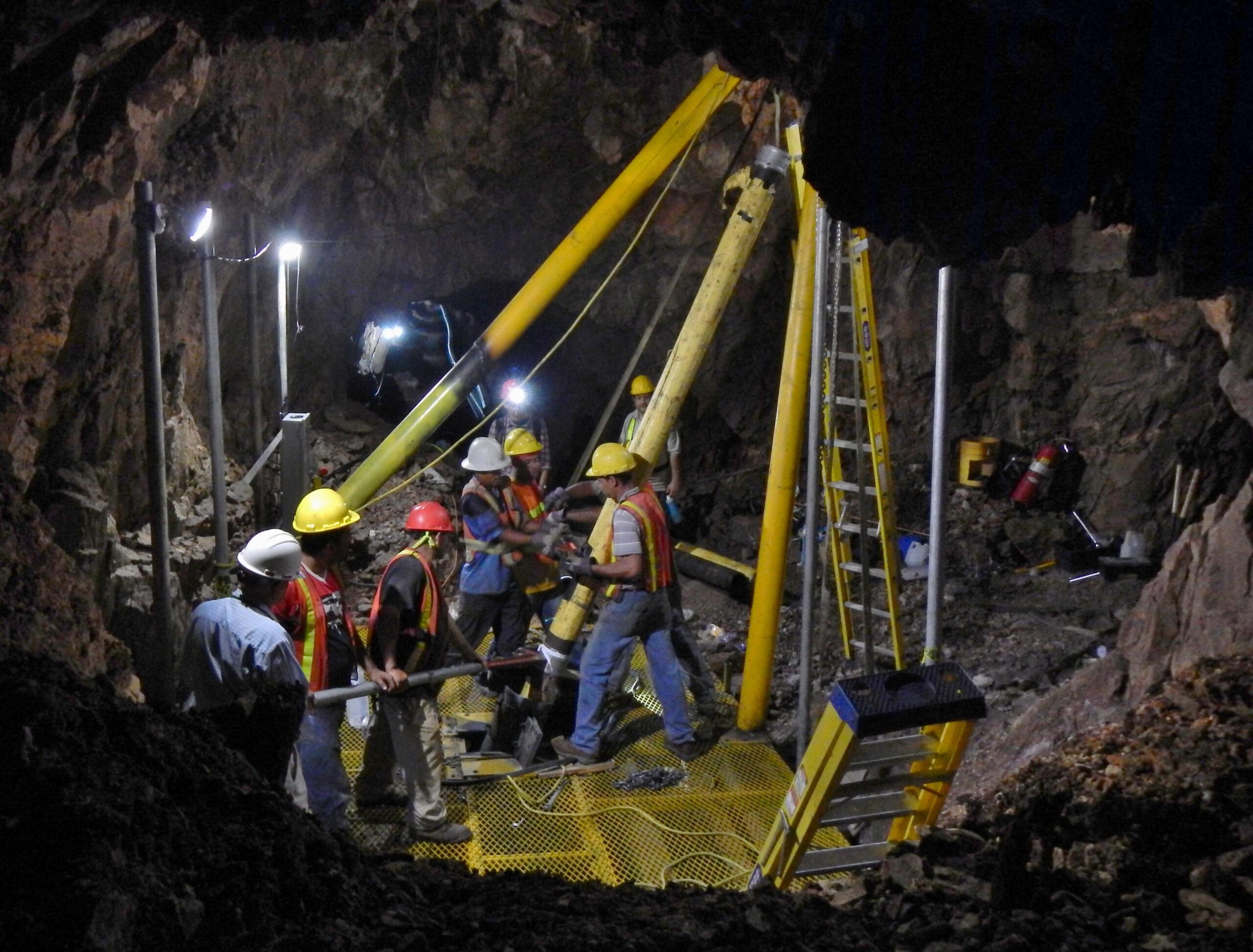
Metals Exploration's La India gold mine in Nicaragua targets first gold in December 2026, funded by Runruno cash flow, with output rising to 150,000 oz a year.
- Runruno is expected to generate US$10-12 million of free cash per month, funding La India's construction without new equity.
- First gold at La India is targeted for December 2026, with a four-to-six-week commissioning period to follow.
- The expanded 1.4 million-tonne-per-year mine plan targets about 100,000 oz in 2027, rising to 140,000-150,000 oz once underground mining begins in 2029-2030.
- Maiden drilling at La Grecia returned 1.30 m at 36.5 g/t gold, including 0.7 m at 67.4 g/t, with further assays due in October 2026.
- An owner-operated build and a cooperative host government reduce execution and permitting risk, although jurisdictional exposure remains.
Gold developers rarely reach first pour without a fresh equity raise or a large project loan, yet Metals Exploration Plc (LSE: MTL) is attempting to do exactly that. The company is using cash flow from its Runruno mine in the Philippines to build the La India gold project in Nicaragua, and first gold remains targeted for December 2026. CEO Darren Bowden set out how the build is being funded, why the mine plan is larger than the one he inherited, and where the next leg of growth could come from.
With gold prices strong and investor interest in producing and near-producing companies rising, the timing matters. Bowden said the company's first appearance at the Colorado conference had produced back-to-back meetings. He attributed that interest partly to La India's Central American location and partly to wider strength across commodities.
Runruno: The Cash Engine Funding the Build
Runruno had a difficult first half of 2026. Bowden explained that mining in the upper levels passed through areas previously worked by small-scale miners, which led to ore contamination. The operation is now below those zones and back into sulphide ore, and he said the plant is running well again. He expects the mine to generate US$10-12 million of free cash per month through the end of the year.
The balance sheet supports that outlook. Following the final drawdown of a US$27 million equipment loan, the company reported cash of £25.8 million, or about US$34.5 million. Bowden said around US$40 million of La India spending remains. He expects the company to still hold about US$30 million once the project reaches start-up. Runruno's FY2026 production guidance stands at 40,000-48,000 oz, following record FY2025 revenue of US$208.4 million and free cash flow of US$115.3 million.
Closure liabilities at Runruno are also smaller than investors might assume. The largest rehabilitation item, the tailings storage facility, is being finished now, with final spillways under construction. Bowden put remaining rehabilitation costs at about US$4 million. The company plans to dismantle the Runruno process plant and ship it to a new operation. No target asset has yet been secured, and Bowden declined to discuss candidates until one is.
La India: Construction and Commissioning
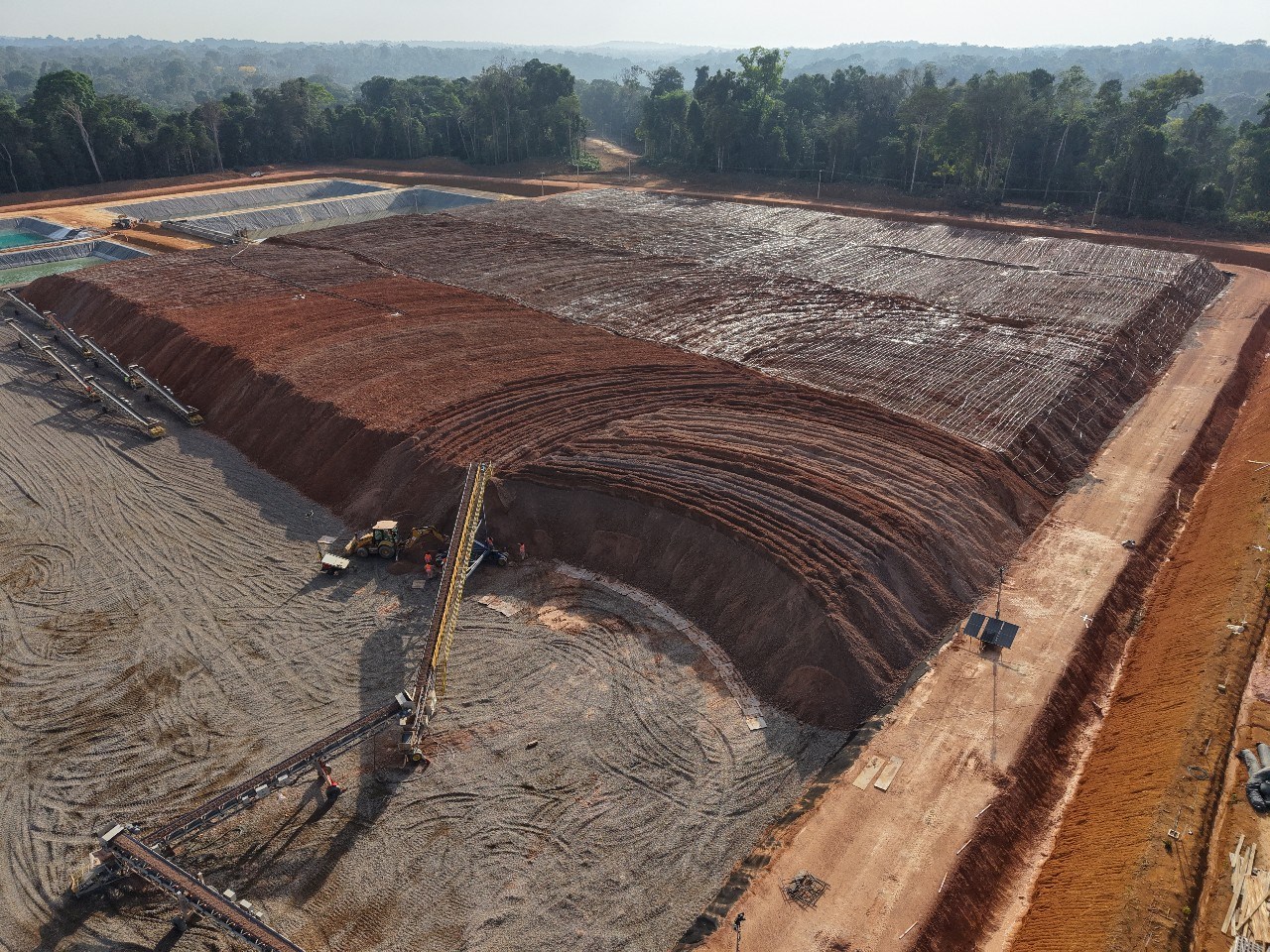
On site in Nicaragua, all key plant components are now installed. Bowden said the CIL (carbon-in-leach) tanks are finished, structural steel is up and both mills are in place, leaving piping and electrical work as the main outstanding items. The conveyor installation is complete, the oxygen plant is installed and lining of the tailings storage facility has begun.
Much of the plant uses refurbished second-hand equipment, fitted with new motors and gearboxes for the mills. Bowden expects a short commissioning period of four to six weeks. It will begin in December and he expects it to be complete by January or February 2027 at the latest. He described the plant as simple, consisting of two mills plus pumps and pipes.
The ramp-up has been de-risked with stockpiled ore. About 244,000 tonnes were on stockpile as of August, and the company is targeting 400,000-500,000 tonnes by year-end. Bowden estimates that represents about five months of plant feed. The company will process low-grade material for the first three to four months. That avoids sending high-grade ore through the circuit before recoveries are fully optimised. Bowden said the company is still targeting about 100,000 oz of gold in 2027, with formal guidance to follow.
Interview with Darren Bowden, CEO of Metals Exploration
A Bigger Mine Plan Than the Feasibility Study
Metals Exploration acquired La India through its takeover of Condor Gold. The 2022 bankable feasibility study (BFS) it inherited assumed an 800,000-tonne-per-year plant and focused on open-pit ore. Metals Exploration's own plan runs at 1.4 million tonnes per year and brings underground mining into the schedule.
Bowden said the difference comes down to how the project is being financed.
"We could bring the underground into it. We could look at a larger picture because we weren't going for bankable... We're using internal money."
Without a lender to satisfy, the company planned the project around where it expects to be in five years rather than what a bank would fund today. Under that plan, production rises from about 100,000 oz in 2027 to around 120,000 oz the following year. Once underground mining begins in 2029-2030, output is expected to reach 140,000-150,000 oz per year. Bowden said the open pits will run at about 2.5 g/t gold, while the underground will contribute higher-grade ore at 4-5 g/t. That underground feed is what lifts output from the bulk open-pit tonnes.
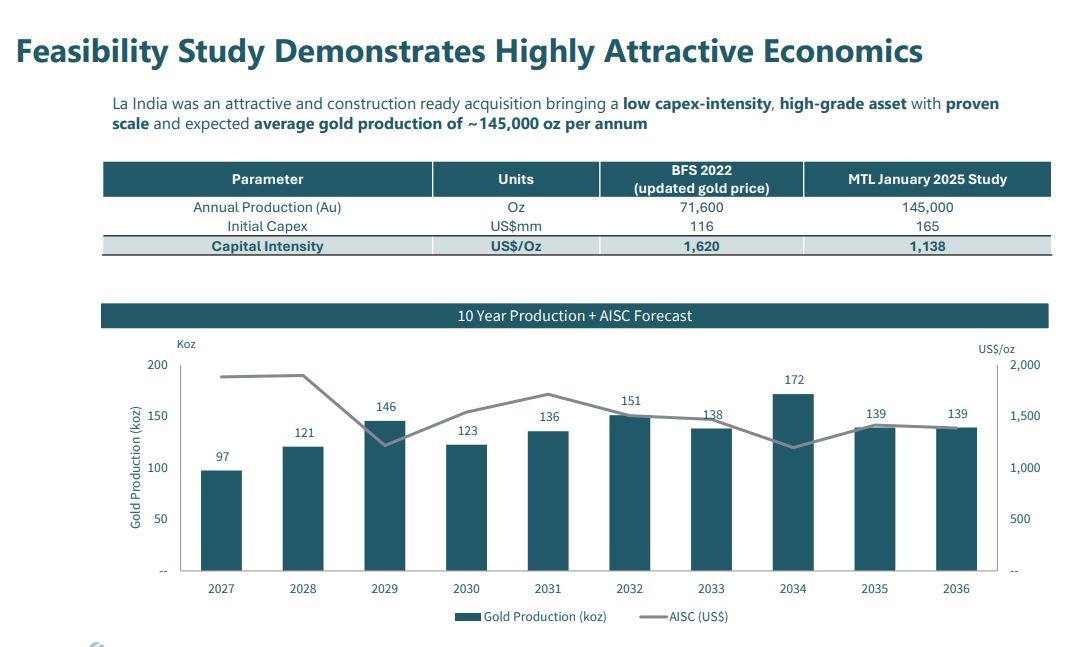
The company's presentation cites an average of about 145,000 oz per year over the mine plan, against 71,600 oz in the 2022 BFS. It also shows a combined Indicated and Inferred resource of 2.28 million oz at 3.9 g/t. The plant was also built with spare capacity. Bowden said this gives the company room to process additional tonnes if early production falls behind plan.
La Grecia & the Philippine Copper Pipeline
Beyond the mine plan, exploration offers further upside. La Grecia, a historical mining district 50 km northwest of La India, was the subject of a maiden 2,450 m drilling programme. Hole LGDD-004 returned 1.30 m at 36.5 g/t gold and 165.78 g/t silver, including 0.7 m at 67.4 g/t gold. The same hole intersected 1.90 m at 6.03 g/t gold and 106.65 g/t silver. Between the two intercepts, the drill hit a 1.2 m void that the company believes is historical mine workings.
Bowden explained that early drilling was oriented in the wrong direction, and only the final hole was drilled from the correct angle. Assays for the rest of the programme are due in October. Follow-up drilling is planned for the first quarter of 2027, and Bowden said La Grecia will become a priority once La India is running. Higher-grade feed from La Grecia could, in his view, push production beyond the 140,000-150,000 oz range.
In the Philippines, the company is building a copper portfolio alongside its Central American gold assets. Bowden said the government is cooperating with the company for Batong Buhay, a copper-gold porphyry that last operated decades ago. He noted that historical drill holes there started and ended in mineralisation. Drilling will begin once community engagement is complete. The historical estimate for Batong Buhay lands at 86.9 million tonnes at 0.60% copper and 0.25 g/t gold.
Owner-Operator Delivery in Nicaragua
Bowden said Metals Exploration is managing the La India build itself rather than handing it to an engineering contractor. Third-party engineers produce drawings, but procurement, engineering and site work are run in-house. The mining fleet is company-owned, financed through the equipment loan, so there are no mining contractors on site.
The team is largely made up of people who have worked with Bowden before. A former vice president of projects at B2Gold brought about 35 members of his team. The general manager, geologists, engineers and process managers were also recruited through existing working relationships. Bowden argued that this removes the risk of contract overruns and speeds up the point at which costs can be modelled with confidence.
Investment Thesis for Metals Exploration
- Runruno's forecast US$10-12 million monthly free cash flow and US$34.5 million cash balance support the La India build without a need for new equity.
- La India targets first gold in December 2026, followed by a four-to-six-week commissioning period using simple, refurbished plant.
- A 400,000-500,000-tonne stockpile at year-end should support a steady ramp-up towards about 100,000 oz in 2027.
- Underground ore from 2029-2030 is expected to lift output to 140,000-150,000 oz per year, with spare plant capacity already in place.
- La Grecia drilling has returned grades of up to 67.4 g/t gold over 0.7 m, with further assays due in October 2026.
- Key risks include commissioning of refurbished equipment, jurisdictional exposure in Nicaragua and the limited life remaining at Runruno.
- Monitor the December 2026 first gold pour, formal 2027 guidance and the Q1 2027 La Grecia follow-up drilling programme.
Macro Thematic Analysis
A strong gold price is changing how the market values producers and near-term developers. When prices rise, operating mines generate surplus cash, and companies that can fund growth from that cash avoid the dilution that typically hits developers approaching a build decision. Metals Exploration is an example of that model. Runruno is effectively financing La India, and the company expects to finish the build with cash still on the balance sheet.
The company's presentation shows how sensitive La India's value is to the gold price. The project's net present value at a 6% discount rate (NPV6) is stated as US$882 million at US$2,500/oz gold and US$1,378 million at US$4,000/oz. That compares with a market capitalisation of £503.1 million at the end of August 2026.
Jurisdiction is the other half of the story. Nicaragua sits within the Central American gold belt but has seen limited development by Western-listed companies. Bowden said Metals Exploration is one of four international companies operating in the country, alongside groups such as Equinox Gold. In his view, success in this environment depends on relationships rather than bureaucracy. He said Nicaragua's government is keen to show that foreign direct investment can succeed there, and the company has benefited from that. He described how the company earned its credibility with officials.
"When we first arrived, the government was like, 'Well, you've been here for 12 years telling us this.' And we said, 'No, we haven't. Just watch this space.' And within 6 months they were changing their mind... They gave [the new tenements] to us because they could see we were delivering on exactly what we said we would."
The company has since received a 25-year renewal of the La India mining concession, effective January 2027, and has expanded its land package to 1,222 km². For investors, the combination of self-funding, a supportive host government and a strong gold price reduces two of the most common risks facing developers: financing and permitting. Execution and sovereign risk remain.
TL;DR
Metals Exploration is building its La India gold mine in Nicaragua with cash from its Runruno operation in the Philippines, targeting first gold in December 2026. CEO Darren Bowden expects Runruno to generate US$10-12 million of free cash per month and the company to reach start-up with about US$30 million in the bank. A four-to-six-week commissioning period, supported by up to 500,000 tonnes of stockpiled ore, is intended to underpin about 100,000 oz of production in 2027. Output is planned to rise to 140,000-150,000 oz once underground mining starts in 2029-2030. High-grade drilling at La Grecia and the Batong Buhay copper project in the Philippines add early-stage exploration upside.
FAQs (AI-Generated)
Analyst's Notes





Subscribe to Our Channel


%20(1)%20(1).jpg)
.jpg)
.jpg)
Stay Informed