




Omai Gold Grows Gold Resources to 8 Million Ounces, PEA Expected by Mid-2026


Omai Gold's 8M oz Guyana project advances to PEA in 2-3 months. Recent drilling upgraded grade to 1.59 g/t, 5 rigs operating, proven 92% recovery, oil-driven infrastructure.
- Omai Gold Mines reported 8 million ounce gold resource across two deposits in Guyana, with recent drilling converting 480,000 ounces from inferred to indicated category while upgrading grade from 1.46 to 1.59 g/t.
- Company is executing a 50,000-meter drill program with five rigs operating continuously, targeting PEA delivery in 2-3 months followed by feasibility study within 9-12 months.
- Project benefits from existing infrastructure including tailings facility, historical metallurgical data showing 92-93% recovery, and recent paving of access road reducing travel time to three hours from Georgetown.
- Guyana's transformation through offshore oil revenues is driving infrastructure investment and creating a pro-mining environment with streamlined permitting.
- Omai Gold Mines' engineering studies will evaluate plant throughput of 15,000-20,000 tonnes per day to optimise economics of the combined 8 million ounce resource across open pit (Wenot) and underground (Gilt Creek) deposits.
Omai Gold Mines is rapidly advancing one of the most significant undeveloped gold projects in South America, with CEO Elaine Ellingham recently providing a comprehensive update on the company's progress toward production. The project's 8 million ounce resource, favourable jurisdiction, and existing infrastructure position it as a potential near-term development opportunity in a region experiencing unprecedented economic growth driven by offshore oil revenues.
Resource Conversion Elevates Project Quality
The company's latest mineral resource estimate represents both a strategic and technical achievement. Following a 2.2 million ounce increase announced in August 2025, Omai has focused on resource conversion and extension from simply expanding tonnage. The recent drilling campaign successfully converted 480,000 ounces from the inferred to indicated category at the Wenot deposit, the project's main open-pit target.
Significantly, this conversion upgraded the quality of the indicated resource, with grades improving from 1.46 grams per tonne (g/t) to 1.59 g/t. Ellingham explained the strategy:
"We had a very large inferred at the Wenot deposit which is the open pittable deposit. We wanted to... start proving that it holds together and that we could convert some of that big inferred into the indicated category."
The technical approach involved addressing a sedimentary zone south of the main mineralised areas that had been classified as waste rock in previous models. Through targeted drilling, the company upgraded this material to at least inferred category, averaging approximately 1 gram per tonne. While this addition lowered the overall inferred grade to approximately 1.36 g/t, it substantially improves project economics by reducing the strip ratio - the amount of waste rock that must be moved relative to ore.
Complementary Deposit Geometry: Dual Mining Strategy
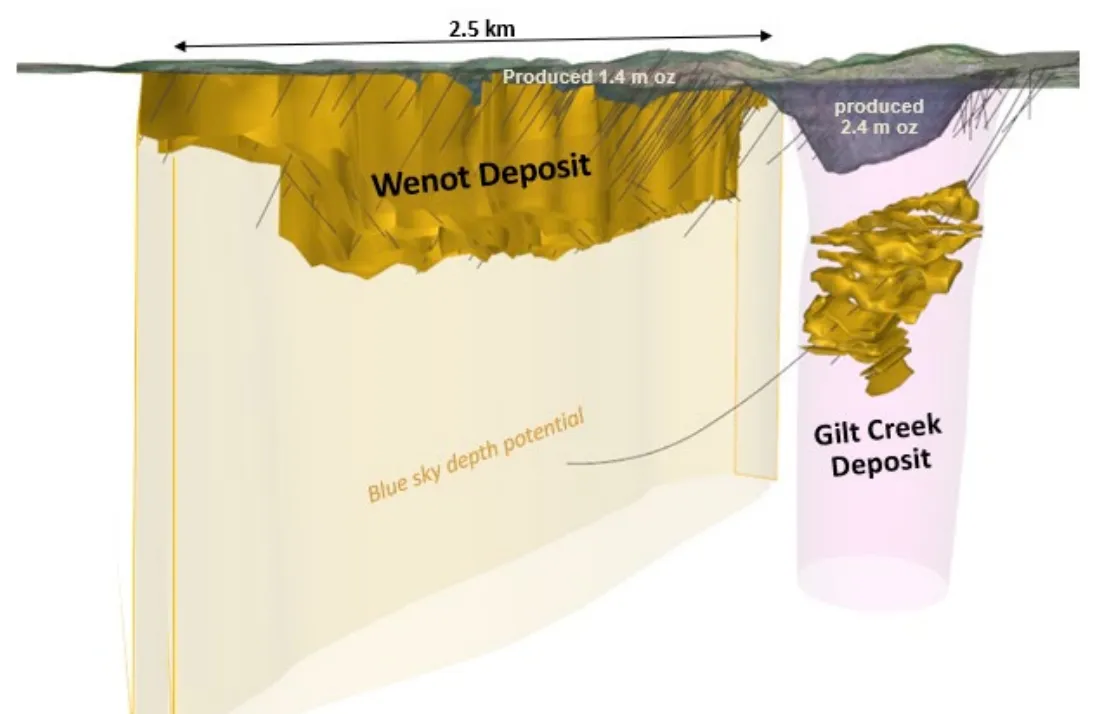
The Omai project comprises two distinct deposits with complementary characteristics. Wenot, the larger open-pit deposit, extends 2.5 kilometers along strike and has been defined to 500 meters depth. It consists of multiple vertical zones that appear likely to form a single large pit based on preliminary constraining pit analysis. The Gilt Creek deposit, located 450 meters from Wenot, is a cylindrical intrusive body containing approximately 2.5 million ounces at a higher average grade of 3.33 g/t across 25 separate zones, making it suitable for underground mining.
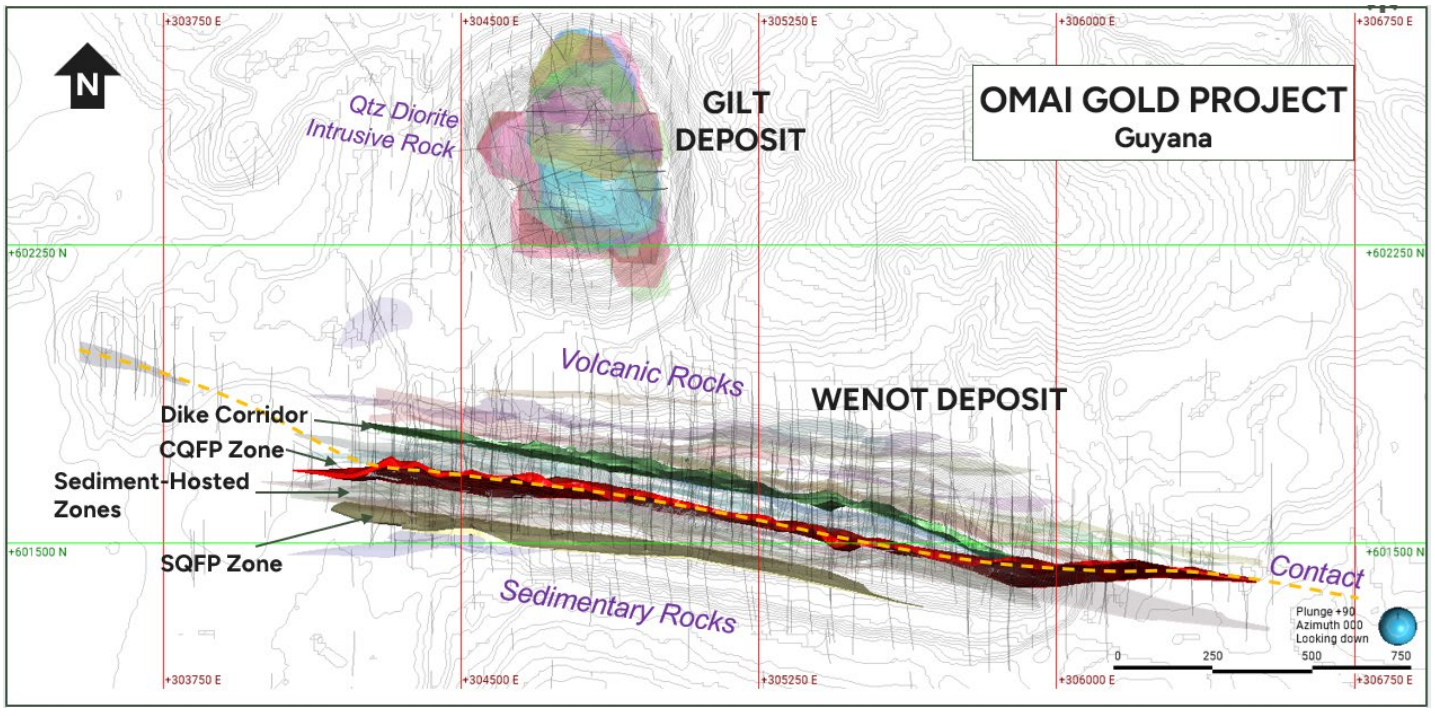
Source: April 14, 2026 OMG News Release
The company maintains a cutoff grade of 0.3 grams per tonne, which Ellingham characterised as conservative given current gold prices. Sensitivity analysis suggests the cutoff could be lowered to 0.22 g/t, though management has opted to maintain consistency for investor comparison purposes. The Wenot deposit demonstrates relatively low sensitivity to cutoff grade adjustments, with doubling the cutoff only reducing ounces by approximately 10% indicating well-defined, concentrated mineralisation rather than broad, lower-grade halos.
Intensive Drill Campaign Advances Feasibility Requirements
Omai is currently operating five drill rigs in an intensive 50,000-meter program designed to both convert resources and expand the known mineralisation. The company drilled 11 of 12 months in the previous year and resumed operations on January, maintaining continuous drilling operations. The program focuses on filling gaps in the drill pattern to achieve 50-meter spacing required for indicated classification, compared to 150-meter spacing for inferred resources.
The company has engaged Objectivity, a specialised firm that uses advanced modelling to optimise drill hole placement. This systematic approach has identified areas within the deposit envelope that remain undrilled, suggesting potential for additional resource growth even as conversion work proceeds. Several northeastern zones have only been defined to 200 meters depth and will be extended deeper during the current program.
Interview with Elaine Ellingham, President & CEO of Omai Gold Mines
Path to Production: PEA and Feasibility Timeline
Management has established clear milestones for advancing the project through economic studies. A Preliminary Economic Assessment (PEA) is expected within two to three months, evaluating both the open-pit and underground operations. The engineering challenge involves optimising two separate mining operations, a complexity that Ellingham acknowledged but framed as "a nice problem to have" given the substantial resource base.
The increased resource size has prompted reassessment of optimal plant throughput. Initial considerations ranged from 9,000 to 15,000 tonnes per day, but with 8 million ounces now defined, the company is evaluating capacities of 15,000 to 20,000 tonnes per day to maximise economic returns. Following the PEA, management anticipates a feasibility study within 9 to 12 months, with much of the current drilling and technical work already oriented toward feasibility-level requirements.
Historical Operations Validate Metallurgical Performance
The project benefits from substantial historical data, having been in production previously. Metallurgical testing of 73 samples is underway at SGS laboratories, with initial results confirming expectations based on historical operations. Ellingham emphasised this advantage:
"We are essentially looking now at extensions of what was mined before and processed before. It used to be 92-93% recovery, 35% of that was gravity circuit, probably going to be the same, all of the indications are we're at those same levels."
The company has also advanced work on the existing tailings facility, confirming capacity for two dam raises and progressing to detailed engineering on construction specifications and material sourcing that would typically occur much later in a greenfield project's development cycle.
Oil-Driven Transformation Creates Mining Infrastructure
Guyana's transformation through offshore oil development has created exceptional conditions for mining development. The country discovered offshore oil in 2015, began production by 2019, and now produces 1.2 million barrels per day through a consortium led by Exxon Mobil. This revenue stream is projected to make Guyana's GDP per capita the highest in the world by next year, driving massive infrastructure investment.
The access road to Omai has been paved to the project junction, reducing travel time from Georgetown to just over three hours,. a dramatic improvement that facilitates personnel movement, supply logistics, and eventual product shipment. The government is developing a deep-water port to service trade routes to northern Brazil, along with hospitals, bridges, and power facilities.
From a permitting perspective, Guyana has demonstrated its pro-mining stance through recent precedent. Another major project in the country proceeded with mine development before receiving its mining license, as the environmental impact assessment (EIA) process runs parallel to engineering and site preparation work. Ellingham noted the Omai site's disturbed nature from previous mining as an advantage.
Market Positioning and Future Catalysts
The company's market capitalisation has appreciated substantially over the past 18 months, reflecting investor recognition of the project's scale and development potential. Management maintains focus on systematic de-risking while positioning for potential partnership or acquisition scenarios. Ellingham stated,
"If we have to build it [mine], if we end up going that route, we bring in obviously the talent that builds mines, we'll be in good shape. Likewise, if somebody decides they want to buy the project and it makes sense to our shareholders, there's a good value proposition for them."
The company has hired engineering staff and begun site preparation activities, indicating confidence in the project's economic viability even before formal study results.
The Investment Thesis for Omai Gold Mines
- Scale and Grade: 8 million ounce resource with indicated grade of 1.59 g/t at Wenot open pit and 3.33 g/t at Gilt Creek underground deposit provides critical mass for major mining operation
- Proven Metallurgy: Historical recovery rates of 92-93% with 35% gravity recovery eliminate metallurgical risk; current 73-sample test program confirming consistency across different rock types and depths
- Existing Infrastructure: Operating tailings facility with capacity for two dam raises, recently paved access road (3-hour drive from Georgetown), and disturbed site requiring no forest clearing significantly reduce capital requirements and permitting timeline
- Rapid Development Timeline: PEA expected in 2-3 months, feasibility study 9-12 months thereafter; management already executing feasibility-level drilling and engineering work in parallel
- Resource Conversion and Growth: Ongoing 50,000-meter drill program with 5 rigs converting inferred to indicated category for feasibility study while identifying undrilled gaps that could expand resource
- Jurisdictional Advantage: Guyana's oil-driven economic boom creating pro-mining environment with streamlined permitting; government investing heavily in infrastructure including deep-water port, power facilities, and road networks
- Strategic Optionality: Project scale and advanced technical work position company for either self-development with construction partner or acquisition by major producer seeking production growth
- Gold Price Leverage: Conservative 0.3 g/t cutoff grade could be reduced to 0.22 g/t at current gold prices, potentially expanding resource; project economics designed to withstand lower gold price environment
- Capital Efficiency: Avoiding typical greenfield challenges (site clearing, baseline environmental studies, infrastructure construction) compresses both timeline and capital intensity relative to comparable-scale projects
Macro Thematic Analysis
Guyana represents a unique convergence of resource sector tailwinds rarely observed in frontier mining jurisdictions. The country's offshore oil discovery in 2015, now producing 1.2 million barrels daily through Exxon Mobil-led operations, has created fiscal capacity for transformative infrastructure investment precisely as gold prices reach multi-year highs. This oil-funded build-out - including road paving, deep-water port construction, and power facility development directly benefits mining projects by eliminating typical greenfield infrastructure costs.
The government's projected achievement of the world's highest GDP per capita next year signals institutional capacity and political stability, while recent mining project approvals demonstrate permitting efficiency. Major gold producers facing reserve depletion and limited organic growth options are increasingly focused on politically stable jurisdictions with infrastructure and scalability which are attributes Guyana now offers.
TL;DR
Omai Gold Mines is advancing an 8 million ounce gold project in Guyana toward economic studies, with a PEA expected in 2-3 months and feasibility study within 12 months thereafter. The company recently converted 480,000 ounces to indicated category while upgrading grade to 1.59 g/t, executes a 50,000-meter drill program with five rigs, and benefits from proven 92-93% metallurgical recovery, existing tailings infrastructure, and Guyana's oil-driven economic transformation that has paved access roads and streamlined permitting. The project's scale, advanced technical status, and favorable jurisdiction position it as a potential near-term development or acquisition target.
FAQ's (AI Generated)
High-grade inferred ounces were converted to indicated, but replaced by newly drilled sedimentary zone material averaging ~1 gram per tonne. This reduces strip ratio and improves economics despite lower overall inferred grade.
Wenot is a 2.5-kilometer-long open-pit deposit with multiple vertical zones averaging 1.59 g/t indicated. Gilt Creek is a compact cylindrical underground deposit 450 meters away with 25 zones averaging 3.33 g/t.
Oil revenues (1.2 million barrels/day) fund infrastructure like paved roads (reducing travel time to 3 hours), deep-water ports, and power facilities - eliminating typical greenfield capital requirements and accelerating development timelines.
PEA expected in 2-3 months, feasibility study 9-12 months after that. Site preparation and engineering work proceeding in parallel. Permitting can advance alongside technical studies based on recent precedent in Guyana.
Operating tailings facility (confirmed for two dam raises), disturbed site requiring no clearing, paved access road, and historical metallurgical data eliminate major capital items and de-risk permitting compared to greenfield projects.
Analyst's Notes





Subscribe to Our Channel






Stay Informed






















