




Atlas Salt: Positioning North America's Next Major De-Icing Salt Producer


Atlas Salt advances 4Mtpa Great Atlantic project in Newfoundland with $920M NPV8, targeting import-reliant North American market amid supply constraints.
- Atlas Salt targets the $2.3B-$2.9B North American de-icing salt market, which imports 8-10 million tonnes annually, with early 2025-26 winter stockpiling by contractors signaling continued supply tightness.
- The Great Atlantic Salt Project features 95.0 million tonnes of probable reserves grading 95.9% NaCl at shallow 180-meter depth, significantly less than the 600-meter industry standard, enabling lower-cost development.
- The 2025 Updated Feasibility Study demonstrates after-tax NPV8 of $920 million, 21.3% IRR, and $188 million average annual post-tax cash flow over a 24.3-year mine life with 4.2-year payback.
- Environmental Assessment approval (April 2024), strategic agreements with Scotwood Industries (offtake), Sandvik (equipment), and Hatch (engineering), plus completion of Updated Feasibility Study position the project for financing and construction.
- All-electric underground operation powered by Newfoundland hydroelectricity generates just 950 tonnes CO2e per million tonnes ore, among the lowest GHG intensity globally, with no tailings or chemical processing.
Introduction: Winter Demand Signals Underscore Supply Gap
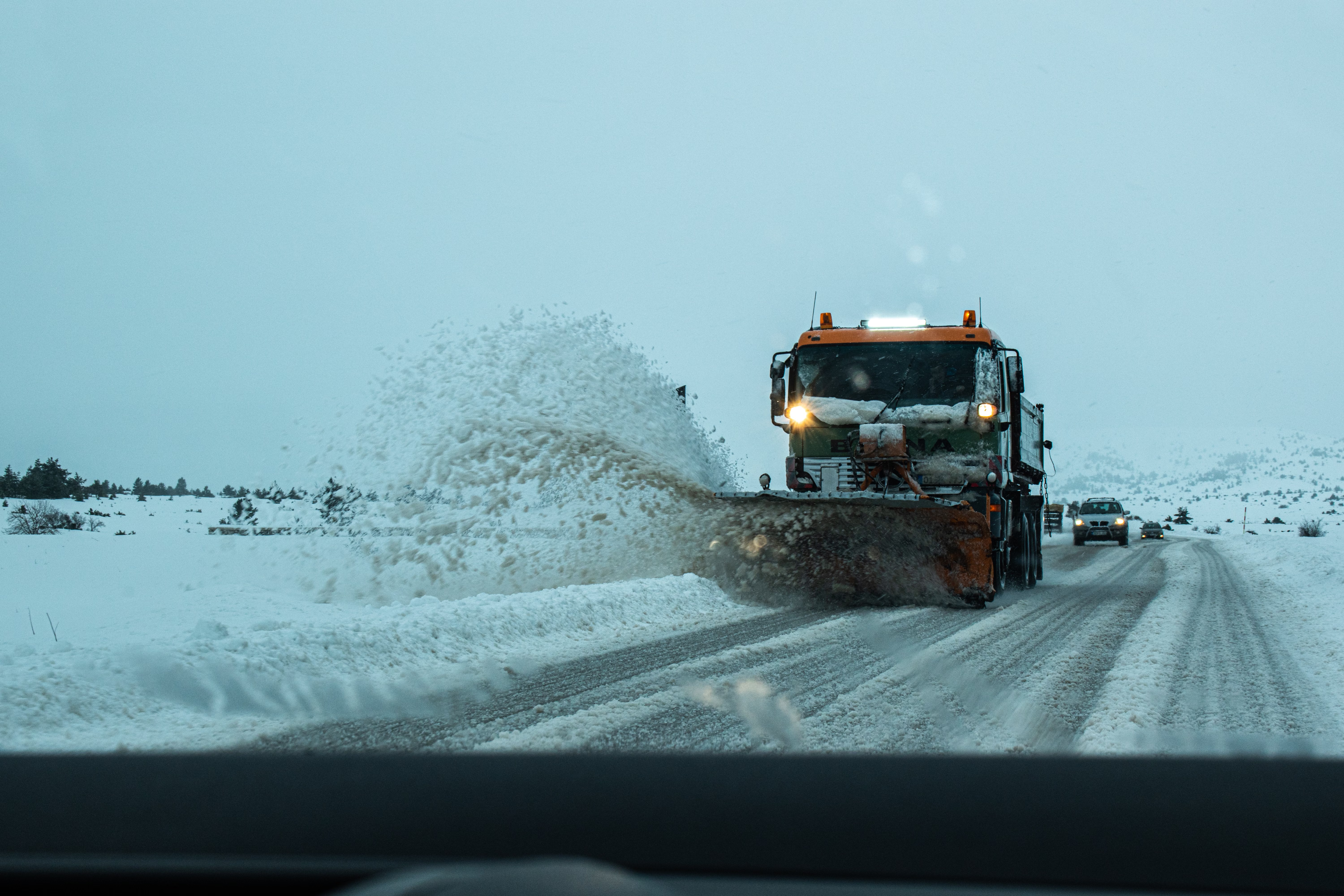
The early arrival of winter conditions across the northeastern United States and eastern Canada in December 2025 has prompted snow removal contractors to pre-stock rock salt inventories at unprecedented levels, according to recent reporting by Spectrum Local News. This behavioral shift, with operators purchasing salt as early as July and maintaining stockpiles exceeding 400 tonnes, reflects lessons learned from the 2024-25 season, when prolonged cold weather stressed North American salt supply chains and left municipalities and commercial operators scrambling for deliveries.
American Rock Salt, the largest U.S. mine, acknowledged shipping more than 2.1 million tonnes by January 2025 compared to typical seasonal volumes around 1.8 million tonnes. The supply pressure occurred despite North America's established mining infrastructure, which includes operations dating to the early 1900s. Legacy mines like Compass Minerals' Goderich facility (operating since 1959) and Cargill's Cayuga operation (producing since 1915) face operational challenges including depths exceeding 600 meters below the surface and, in some cases, underwater extraction beneath the Great Lakes.
Against this backdrop, Atlas Salt Inc. (TSXV: SALT, OTCQB: REMRF) advances the Great Atlantic Salt Project in Newfoundland, positioned to become North America's first new salt mine in nearly three decades when production commences by 2030. The project directly addresses the structural supply deficit that has made North America dependent on imports from Chile, Egypt, Mexico, and the Caribbean, with the United States alone importing 67.5 million tonnes between 2020 and 2023.
Company Overview: Developing a Generational Asset
Atlas Salt controls the Great Atlantic Salt Project on Newfoundland's west coast, approximately two kilometers from the existing Turf Point deep-water marine terminal and connected to the Trans-Canada Highway. The deposit contains probable reserves of 95.0 million tonnes grading 95.9% sodium chloride (NaCl), with an additional 383 million tonnes of indicated resources and 868 million tonnes of inferred resources averaging 95.2% NaCl.
The resource's geology provides significant development advantages. At approximately 180 meters below surface, compared to 600-meter depths typical of North American salt mines, the deposit is accessible via decline ramps rather than costly vertical shaft sinking. The salt horizon averages 200 meters thickness (ranging from 68 to 340 meters) and exhibits high continuity, enabling efficient room-and-pillar mining with minimal development waste.
Newfoundland's Fraser Institute ranking as the ninth-best mining jurisdiction globally in 2025 reflects the province's stable regulatory environment and existing infrastructure. The project site benefits from proximity to established electrical substations (1.4 kilometers), the provincial highway network, and port facilities that have supported gypsum and limestone mining operations since the 1950s. This infrastructure reduces both capital requirements and execution risk compared to greenfield developments in remote locations.
Updated Feasibility Study: Enhanced Economics Through Optimization
Atlas Salt released its 2025 Updated Feasibility Study in September, demonstrating substantial improvements over the 2023 baseline study. By shortening mine life from 34 years to 24.3 years while increasing average annual production from 2.5 million tonnes to 4.0 million tonnes, the company pulled forward cash flow realization and reduced reliance on long-term price forecasts. This optimization increased after-tax net present value (at 8% discount rate) by 66% to $920 million despite applying a 5% lower average selling price over the mine life.
Pre-production capital requirements total $589 million, with life-of-mine sustaining capital of $609 million. Operating costs average $28.20 per tonne shipped (FOB Turf Point), with all-in sustaining costs of $34.90 per tonne when including sustaining capital. Against base-case pricing of $81.67 per tonne, conservative relative to the four-year compound annual growth rate of 4.2% observed in U.S. rock salt prices, the project generates average annual net revenue of $407 million and post-tax cash flow of $188 million.
"We've significantly de-risked the project with the Updated Feasibility Study by pulling forward production and cash flow realization to achieve nameplate production of 4 Mtpa while shortening the mine life to 24.3 years from 34. This increased NPV8 by 66% to $920M while reducing reliance on far-out assumptions."
The Updated Feasibility Study incorporated feedback from the Environmental Assessment process completed in April 2024, refining mine design elements including drift engineering, port and logistics arrangements, and integration of Sandvik battery-electric mining equipment. Engineering firm SLR Consulting prepared the technical report in accordance with National Instrument 43-101 standards, with Andrew Smith, P.Eng., serving as Qualified Person.
Strategic Market Positioning: Serving Import-Dependent Demand
North America consumes between 28.5 and 36 million tonnes of de-icing salt annually, concentrated in the corridor from Atlantic Canada through Quebec and the U.S. East Coast down to the Mid-Atlantic states. This region, encompassing population centers including Montreal, Toronto, Boston, New York, Philadelphia, and Washington, accounts for 11 to 16 million tonnes of annual consumption. Atlas Salt's location positions the project within three days' shipping time to Boston, compared to more than 14 days from traditional import sources in Chile or Egypt.
The North American supply deficit persists despite existing domestic production. Between 2020 and 2023, the United States imported salt from Chile (27%), Canada (29%), Mexico (14%), Egypt (8%), and other sources (22%), according to U.S. Geological Survey data. This import dependence creates supply chain vulnerabilities, as demonstrated by the 2024-25 winter season shortages and the permanent closure of Cargill's Avery Island, Louisiana mine in 2021, which removed 2.5 million tonnes of annual East Coast supply.
Legacy North American mines face operational and regulatory challenges. Cargill's remaining U.S. salt assets in New York and Ohio have remained unsold since 2023 due to environmental concerns. German-based K+S sold its Americas salt business (including Morton and Windsor Salt brands) to Stone Canyon Industries Holdings for $3.2 billion in 2020, representing a 12.5x EBITDA multiple that reflected both the strategic value of salt assets and the challenges of maintaining aging infrastructure.
Environmental Leadership: Low-Carbon Operations
The Great Atlantic Salt Project received release from the Newfoundland Environmental Assessment process in April 2024 after approximately two months of review, a timeline reflecting both the project's low environmental impact profile and the completeness of Atlas Salt's submissions. The all-electric operation, powered by Newfoundland's hydroelectric grid, generates Scope 1 greenhouse gas emissions of just 79 tonnes annually, equivalent to approximately four typical Newfoundland households.
Third-party analysis by consultants places the project's GHG intensity at 950 tonnes CO2-equivalent per million tonnes of ore production, among the lowest in global mining. This compares favorably to gold mining (ranging from 20,000 to 70,000 tonnes CO2e per million tonnes) and base metals operations (typically 60,000 to 160,000 tonnes CO2e per million tonnes). The shallow deposit depth reduces energy requirements for hoisting, while underground processing through crushing and screening eliminates tailings generation and chemical processing common in other mineral operations.
Atlas Salt's August 2024 ESG Report, titled "The Path to a Sustainable Legacy," quantified the project's broader economic contributions. The analysis, based on the 2023 Feasibility Study parameters, projected $2.7 billion in tax revenue (much retained locally), $1.9 billion in household spending across Newfoundland, $90 million to municipalities, and more than 170 long-term direct employment positions.
Strategic Partnerships: De-Risking Development
Atlas Salt executed a Memorandum of Understanding with Scotwood Industries in August 2024 covering targeted offtake volumes of 1.25 to 1.5 million tonnes annually. Scotwood, the largest distributor of packaged retail de-icing salt in the United States, provides market access and customer relationships built over decades of operations. The agreement validates the project's product specifications and commercial viability while securing a foundation customer representing approximately 31% to 38% of planned nameplate production.
Equipment supply and financing arrangements with Sandvik Mining and Rock Solutions, announced in September 2024, total $73 million in value. Sandvik's scope includes provision of battery-electric underground mining equipment and engineering support, backed by the Swedish company's global track record in sustainable mining solutions. The Sandvik equipment package enables the all-electric underground operation while providing potential vendor financing to support project construction.
In November 2025, Atlas Salt formalized a Memorandum of Understanding with Hatch Ltd., establishing the global engineering firm as Lead Engineering Partner and Integrated Project Delivery Partner. Hatch brings experience delivering large-scale soft-rock mines globally and maintains existing operations in Newfoundland, providing local presence and regulatory familiarity.
Current Development Activities: Path to Production
Management's immediate priorities center on securing project financing, with Endeavour Financial engaged to structure and arrange debt and equity components for the $589 million pre-production capital requirement. The financing process benefits from the completed Updated Feasibility Study, approved Environmental Assessment, and strategic partnerships that derisk technical, market, and execution elements. Additional offtake agreements or strategic equity participation from end-users or industry players could provide both capital and further commercial validation.
Remaining permitting requirements include standard construction and operational licenses, with the comprehensive environmental management plans already approved providing the framework for these remaining authorizations. The company continues engaging with Newfoundland provincial authorities on workforce development, local procurement, and implementation of the approved Benefits Plan focused on regional employment and economic participation.
Atlas Salt's development timeline targets production commencement by 2030, with construction duration estimated at approximately 30 months following financial close. The project's shallow depth enables rapid initial development compared to shaft-sinking timelines of 36 to 48 months typical for conventional deep mines.
The Investment Thesis for De-Icing Salt Supply
- Target markets consuming 11-16 million tonnes annually within three days' shipping, with demonstrated contractor stockpiling behavior signaling continued supply tightness.
- Base-case NPV8 of $920 million at conservative $81.67/tonne pricing increases to $1.5 billion at $89.84/tonne (+10%), demonstrating leverage to price realizations.
- Completed Environmental Assessment, Updated Feasibility Study, and strategic partnerships with Scotwood (offtake), Sandvik (equipment), and Hatch (engineering) reduce execution uncertainty.
- All-electric operation with 950 tonnes CO2e per million tonnes ore positions Atlas Salt favorably for institutional investors with sustainability mandates.
- Inferred resources of 868 million tonnes excluded from current mine plan represent potential for production increases or mine life extensions.
- Anticipated production by 2030 positions Atlas Salt to serve markets before further legacy mine closures while avoiding lengthy permitting cycles.
Atlas Salt advances toward construction of North America's first new salt mine in nearly three decades, targeting a market characterized by import dependence, aging infrastructure, and demonstrated supply constraints. The company's November 2025 capital structure includes 108.2 million basic shares outstanding (116.5 million fully diluted), trading at $0.71 per share for enterprise value of approximately $72.3 million, representing 0.08x the $920 million after-tax NPV8 demonstrated in the Updated Feasibility Study.
This valuation disconnect reflects Atlas Salt's pre-construction development stage, with value rerating potential as the company achieves remaining milestones including project financing, final permitting, construction commencement, and ultimately production. For investors seeking exposure to critical infrastructure commodities with strong demand fundamentals, Atlas Salt offers a differentiated opportunity combining world-class resource quality, strategic market positioning, and sustainability leadership. The project's economics demonstrate resilience across pricing scenarios, while the shallow deposit depth and proven mining methodology reduce technical risk relative to more complex extraction technologies.
TL;DR
Atlas Salt advances the Great Atlantic Salt Project in Newfoundland toward production by 2030, targeting North America's import-dependent de-icing salt market with 4 million tonnes annual capacity. The 2025 Updated Feasibility Study demonstrates $920 million after-tax NPV8 and 21.3% IRR, supported by 95 million tonnes of high-grade reserves at shallow 180-meter depth. Strategic agreements with Scotwood Industries (offtake), Sandvik (equipment), and Hatch (engineering) derisk development, while all-electric operations powered by hydroelectricity deliver among the lowest GHG intensity globally.
FAQs (AI-Generated)
Management targets production commencement by 2030, with construction duration estimated at approximately 30 months following financial close.
Pre-production capital of $589 million supports operations generating average annual post-tax cash flow of $188 million, yielding a 4.2-year payback period.
The Scotwood Industries MOU covers targeted volumes of 1.25 to 1.5 million tonnes annually, representing approximately 31% to 38% of nameplate capacity.
At approximately 180 meters below surface, the deposit is significantly shallower than the 600+ meter depths typical of major operations like Goderich.
All-electric operations powered by Newfoundland hydroelectricity generate just 950 tonnes CO2e per million tonnes ore with no tailings or chemical processing.
Analyst's Notes





Subscribe to Our Channel

.jpg)

Stay Informed


