




Can $162M in Recovery Funding Reduce US Antimony Import Reliance?


US antimony reached $25 per pound as 91% import reliance and $162M in federal funding strengthen the case for recovering minerals from tailings.
- The US Department of Energy selected nine projects for $162 million in potential funding on August 18, 2026 to recover scandium, copper, antimony and rare earth elements, expanding supply without waiting for new mines.
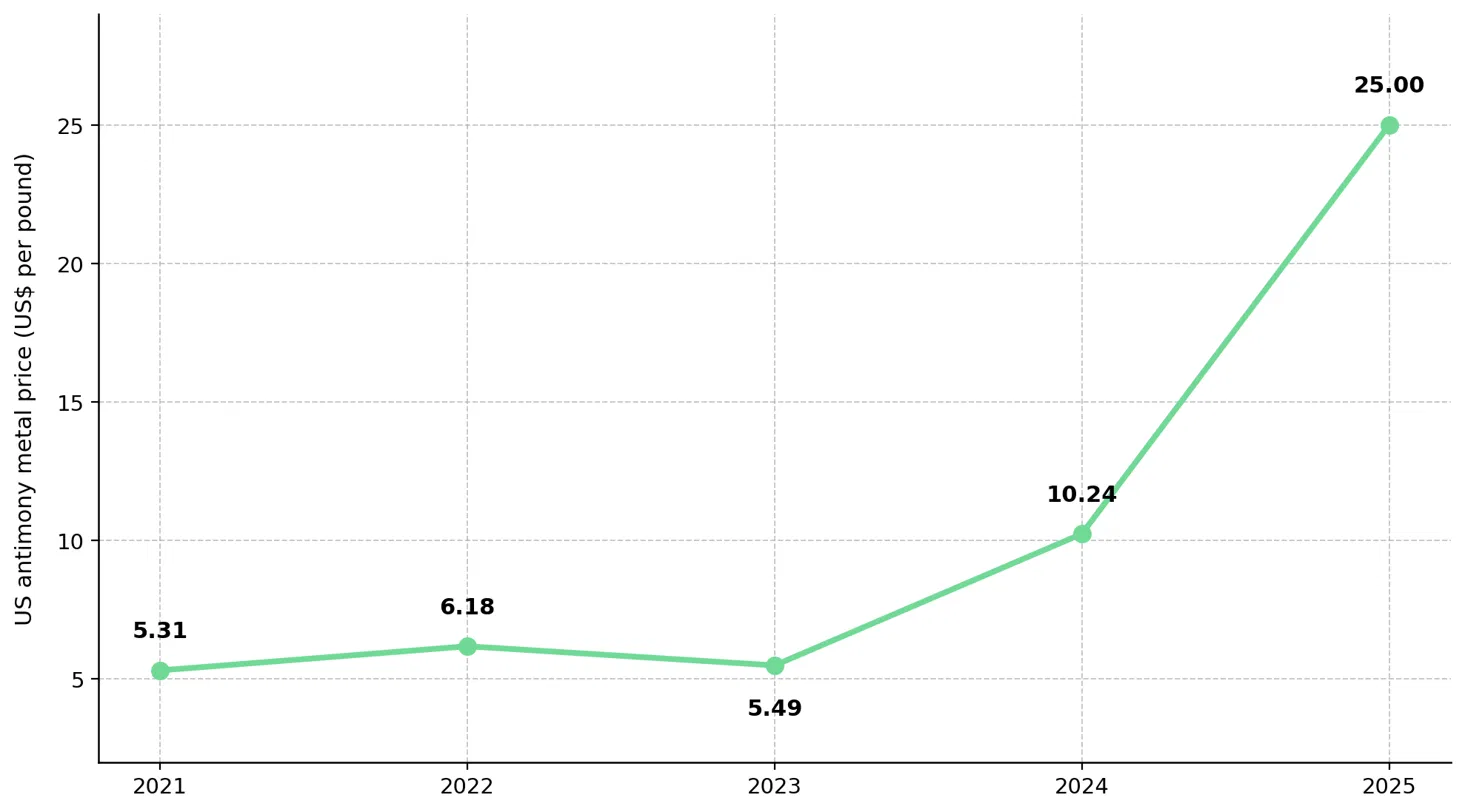
- According to the United States Geological Survey (USGS), the average US antimony metal price reached an estimated $25 per pound in 2025, up from $10.24 in 2024 and $5.31 in 2021, improving the economics of lower-grade recovery.
- US net import reliance for antimony reached 91% of apparent consumption in 2025, up from 86% in 2024, according to USGS, increasing the value of domestic recovery as an alternative supply source.
- US secondary antimony smelter output reached 3,500 tonnes in 2025 versus 700 tonnes of primary output, while recycling supplied 12% of apparent consumption and secondary production was valued at $190 million, up from $49 million in 2023, according to USGS.
- The nine projects were selected for potential funding on August 18, 2026, but the awards are not guaranteed, leaving near-term project financing uncertain.
US $162M Critical Minerals Funding & Tailings Projects Open New Supply Routes
The US Department of Energy's Office of Critical Minerals and Energy Innovation selected nine projects for $162 million in potential funding to recover scandium, copper, antimony, and rare earth elements from existing mines, tailings, industrial facilities, and other feedstocks. The nine selected companies are Anactisis, Still Bright, Nusano, SiTration, Thompson Creek Metals Company, Felix Gold, DISA Technologies, Alcoa Corporation, and Trigg Minerals, directing federal capital toward recovery routes that could add domestic supply without new mine development.
Federal funding is increasingly targeting material already above ground. The nine projects advance four lab-stage technologies to prototype and five prototype technologies to pre-commercial demonstration. They follow $134 million for two rare earth demonstration projects using mine tailings and electronic waste, and $75 million for five coal-based feedstock projects. Three consecutive funding tranches have targeted existing material, supporting new domestic supply routes without relying solely on new mines.
US Supply Constraints & $25 Antimony Improve Low-Grade Waste Recovery Economics
Higher antimony prices improve the economics of recovering lower-grade waste. The average US antimony metal price reached an estimated $25 per pound in 2025, up from $10.24 in 2024 and $5.31 in 2021. At $25 per pound, low-grade waste carries greater potential feedstock value than at $5, supporting recovery from material previously treated as a disposal cost.
US antimony supply became more import-dependent as consumption increased. Net import reliance reached 91% of apparent consumption in 2025, up from 86% in 2024 and 81% in 2023, while consumption rose to 45,000 tonnes from 28,600 tonnes. One company began mining antimony in Montana, while another produced primary metal and oxide from imported feedstock. With domestic primary supply limited, higher consumption increases the value of recovery as an alternative source.
Pilot-Stage Projects Delay New Supply & Extend Antimony Import Dependence Through 2027
Commercialization remains the main constraint, while funding is still conditional. The projects remain at bench and pilot scale, limiting near-term supply even if awards proceed. Audrey Robertson, Head of the US Department of Energy's Office of Critical Minerals and Energy Innovation, said the approach converts previously discarded material into recoverable feedstock, creating potential value from waste already above ground.
Base case: The nine projects progress through bench and pilot stages but add no commercial-scale supply before 2028, keeping US antimony import reliance near 91% through 2027.
Bear case: One or more of the five pre-commercial projects scales successfully, lifting secondary supply above the 12% of apparent consumption supplied by recycling in 2025 and reducing US import reliance.
Limited US Antimony Mining & 5:1 Secondary Output Raise Tailings Value
Secondary recovery already contributes more US antimony output than primary mining. Secondary smelter output reached 3,500 tonnes in 2025 versus 700 tonnes of primary output, while recycling supplied 12% of apparent consumption. Secondary antimony production was valued at $190 million in 2025, up from $49 million in 2023, showing that recovered material is already the larger domestic supply source.
Tailings can carry recoverable value alongside their closure liabilities. Storage requires closure bonds, monitoring, and permitting costs. At $25 per pound antimony, federal support for recovery technology can improve the economics of characterized tailings with documented grades, creating potential revenue against those costs. SiTration is developing technology to recover copper and other critical materials from mining waste at operating sites, providing a direct example of this recovery model.
91% US Import Reliance Keeps Antimony Supply Tight & Supports Prices
US antimony import reliance reached 91% of apparent consumption in 2025, leaving domestic supply heavily dependent on foreign material. With limited US primary production, any disruption to imported supply can tighten availability and reinforce the higher prices that lifted antimony to an estimated $25 per pound in 2025.
Track USGS import-reliance data and antimony prices in 2027. A decline below 85% would signal improving domestic supply and weaker scarcity-driven price support, while reliance near 91% would keep antimony prices sensitive to external supply disruptions.
Analyst's Notes





Subscribe to Our Channel




Stay Informed



