




Marimaca Moves Power at Its Chile Copper Project From Available to Priced


Marimaca Copper secures grid access and renewable power terms near its feasibility study cost, moving MOD power from available to priced.
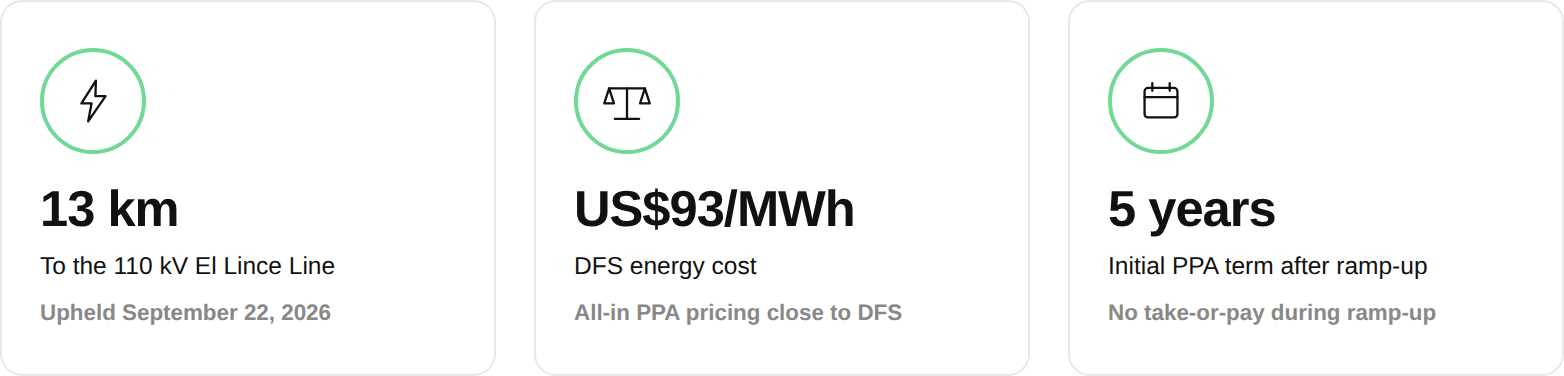
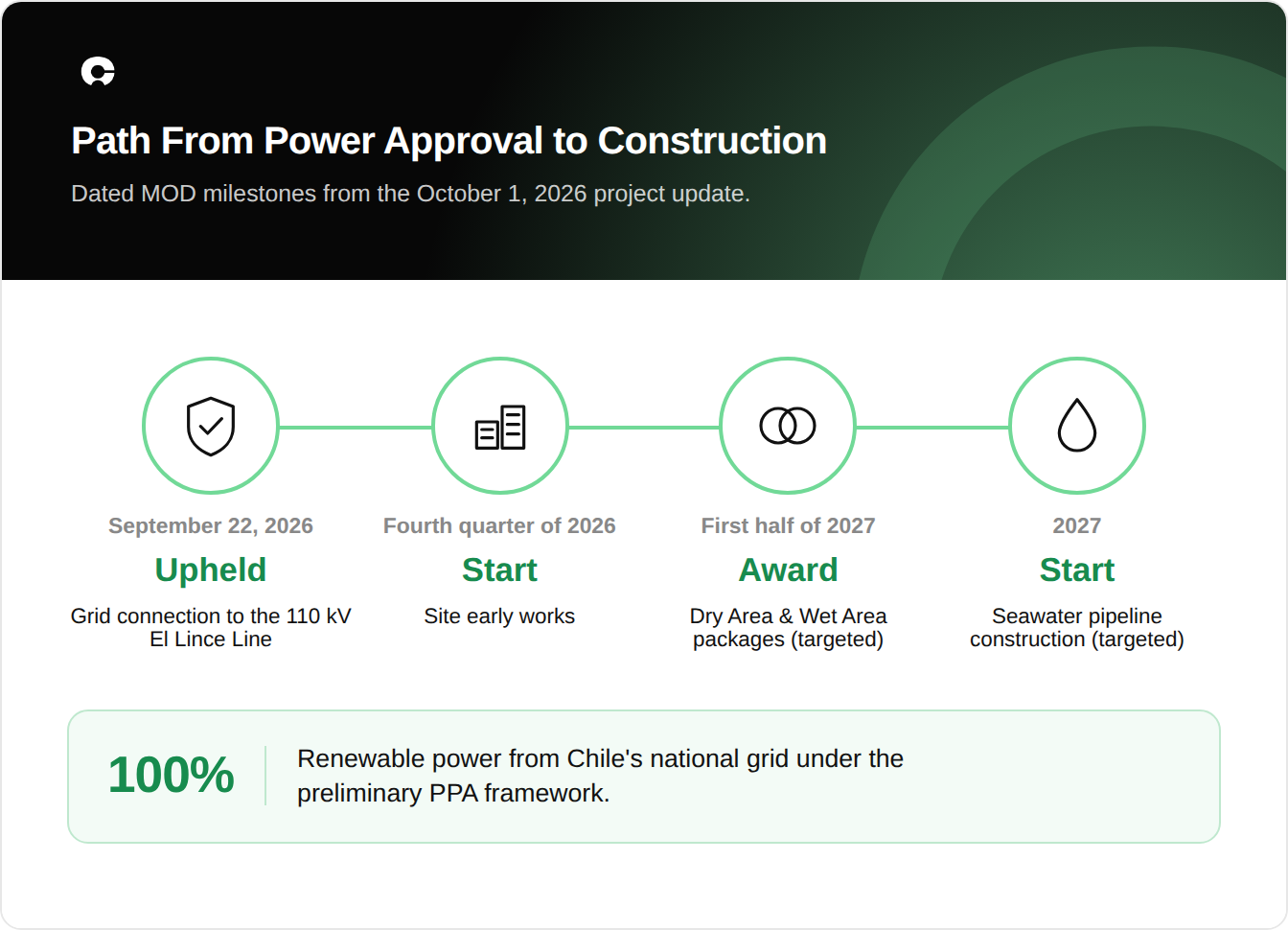
- On September 22, 2026, Chile's Panel of Experts upheld its approval of the Marimaca Oxide Deposit (MOD) to connect to the 110-kilovolt El Lince Line, following a review and challenge period.
- A preliminary power purchase agreement framework provides 100% renewable power from the national grid. The estimated all-in cost is close to US$93 per megawatt-hour, as used in the Definitive Feasibility Study (DFS).
- The framework has no take-or-pay provisions during ramp-up. An initial 5-year term begins after ramp-up.
- Marimaca described power as a certified renewable source of electricity. Water was already covered by a signed recycled seawater option agreement.
- The feasibility study (FS) outlines a cost of US$4.30 per pound of copper. The company held US$140.0 million in cash and had no debt as of June 30, 2026.
Marimaca Copper Corp. (TSX: MARI | ASX: MC2) has turned the power supply for its Marimaca Oxide Deposit (MOD) in northern Chile from an available resource into an authorized grid connection with defined commercial terms. The new pricing is close to the energy cost in the project's 2025 Definitive Feasibility Study (DFS), which underpins the economics Marimaca is taking into project financing.
From Available Supply to Authorized Connection
On September 22, 2026, after a review and challenge period, the Panel of Experts upheld the National Electric Coordinator's approval of Marimaca's application to connect to the 110-kilovolt El Lince Line. The line runs about 13 kilometers from the MOD project area. Marimaca announced the decision on October 1, 2026, together with a preliminary power purchase agreement (PPA) framework with a well-known Chilean energy provider.
Marimaca listed certified renewable electricity supply as one of the project's attributes, alongside water supply that was already secured.
Chief Executive Officer and Director of Marimaca Copper, Hayden Locke, linked the 2 developments:
"The approval of our grid connection is an important de-risking milestone for the Marimaca Oxide Deposit. Together with the preliminary Power Purchase Agreement framework, it provides a clear pathway to securing 100% renewable power at a cost closely aligned with our Definitive Feasibility Study ("DFS") assumptions."
Pricing Close to the DFS Assumption
Under the preliminary PPA framework, the provider will supply the MOD with 100% renewable energy from the national grid. The agreed long-term pricing yields an estimated all-in cost of approximately US$93 per megawatt-hour in the DFS. The framework allows a ramp-up period to commercial production with no take-or-pay provisions, followed by an initial 5-year term once construction and ramp-up are complete.
Locke pointed to the contract structure as well as the price:
"Importantly, the proposed commercial structure provides the flexibility required during commissioning and ramp-up."
The DFS outlines US$587 million of initial capital and a post-tax net present value (NPV8%) of US$709 million. It yields a 31% post-tax internal rate of return (IRR) at a long-term copper price of US$1.84 per pound, and the plan targets 50,000 tonnes per year of copper cathode during steady state in years 2 to 8.
Water & Power Set the Limits on Growth
Water was settled first. Marimaca has signed a water option agreement for recycled seawater from the Bay of Mejillones. The intake is already permitted, and a pipeline of about 32 kilometers with a capacity of 208 liters per second is planned to site. The company says this seawater is secured for life-of-mine (LOM) requirements.
Locke described how management tested the project's final scope against the possibility of a large oxide discovery that would use MOD infrastructure:
"And really it was narrowed down to power consumption and power availability, and water availability. We have once again oversized our pipeline; our water pipeline will be big enough to deliver 100,000 tons of cathode per annum, to give you an idea of how we're thinking."
That test applies most directly to Pampa Medina, about 25 kilometers from the planned MOD infrastructure, where a 30,000 meters drilling program is underway. Locke said oxides found there logically are going to piggyback on the infrastructure regardless of the size that they end up being.
What Remains Open
The power terms are still a preliminary framework and have not yet become a final PPA. Sulfuric acid supply is being handled separately. Under a non-binding memorandum of understanding with a local acid producer, Marimaca has started a conceptual engineering study for the Dos Amigos Acid Plant, which could reduce the project's exposure to acid price volatility.
On the construction schedule, site early works are scheduled to start in the fourth quarter of 2026. Marimaca is targeting award of the crushing, heap leach and solvent extraction-electrowinning packages in the first half of 2027, and the start of seawater pipeline construction in 2027. The company’s mid-2026 financing had narrowed to 3 senior secured lender groups in due diligence.
FAQs (AI-Generated)
Analyst's Notes





Subscribe to Our Channel




Stay Informed


