




Copper Outpaces M2 Growth: El Niño Now Puts 25% of Mine Supply at Risk



Copper’s 44.63% gain versus 5.4% M2 growth points to El Niño supply risks, resilient mines, and a $6.45 to $6.80 price range.
- Copper rose 0.47% to $6.62 per pound on September 1, 2026, extending its monthly gain to 1.69% and its year-over-year gain to 44.63%.
- The Fed’s August 25, 2026 Money Stock Measures report put seasonally adjusted US M2 at $23.218 trillion in July, up from $23.115 trillion in June and $22.026 trillion a year earlier.
- Copper reached a record $6.7270 per pound on Commodity Exchange (COMEX) in late August 2026 before settling at $6.7125, leaving it up roughly 19% for the year.
- Antofagasta cut its production forecast after a July 2026 storm deposited 5 million cubic meters of snow at Los Pelambres, highlighting El Niño-related supply risk that could support copper prices.
- The National Oceanic and Atmospheric Administration (NOAA) confirmed El Niño could become very strong in the second half of 2026, raising disruption risks for copper supply.
Tariff Uncertainty & Rising LME Inventories Create a Lower Copper Entry
Copper rose 0.47% to $6.62 per pound, leaving it 44.63% higher year over year. The rebound followed four straight declines to about $6.55 as hawkish remarks from Fed Chair Kevin Warsh strengthened the dollar. Rising London Metal Exchange (LME) inventories could limit near-term gains, while tariff uncertainty redirects shipments to the US. Any pullback could offer a lower entry point if El Niño disrupts mine supply.
COMEX front-month copper futures reached a record $6.7270 per pound in late August, surpassing the August 12 peak of $6.7140 before settling at $6.7125, leaving copper up roughly 19% in 2026.
Copper’s 44.63% Gain Outpaces 5.4% M2 Growth, Highlighting Mine Constraints
Some commentary argues copper remains cheap relative to US M2, but copper has already risen much faster than the money supply. The Fed’s Money Stock Measures report placed seasonally adjusted M2 at $23.218 trillion in July, up 5.4% from $22.026 trillion a year earlier, compared with copper’s 44.63% gain. Further upside therefore depends more on supply constraints than money growth.
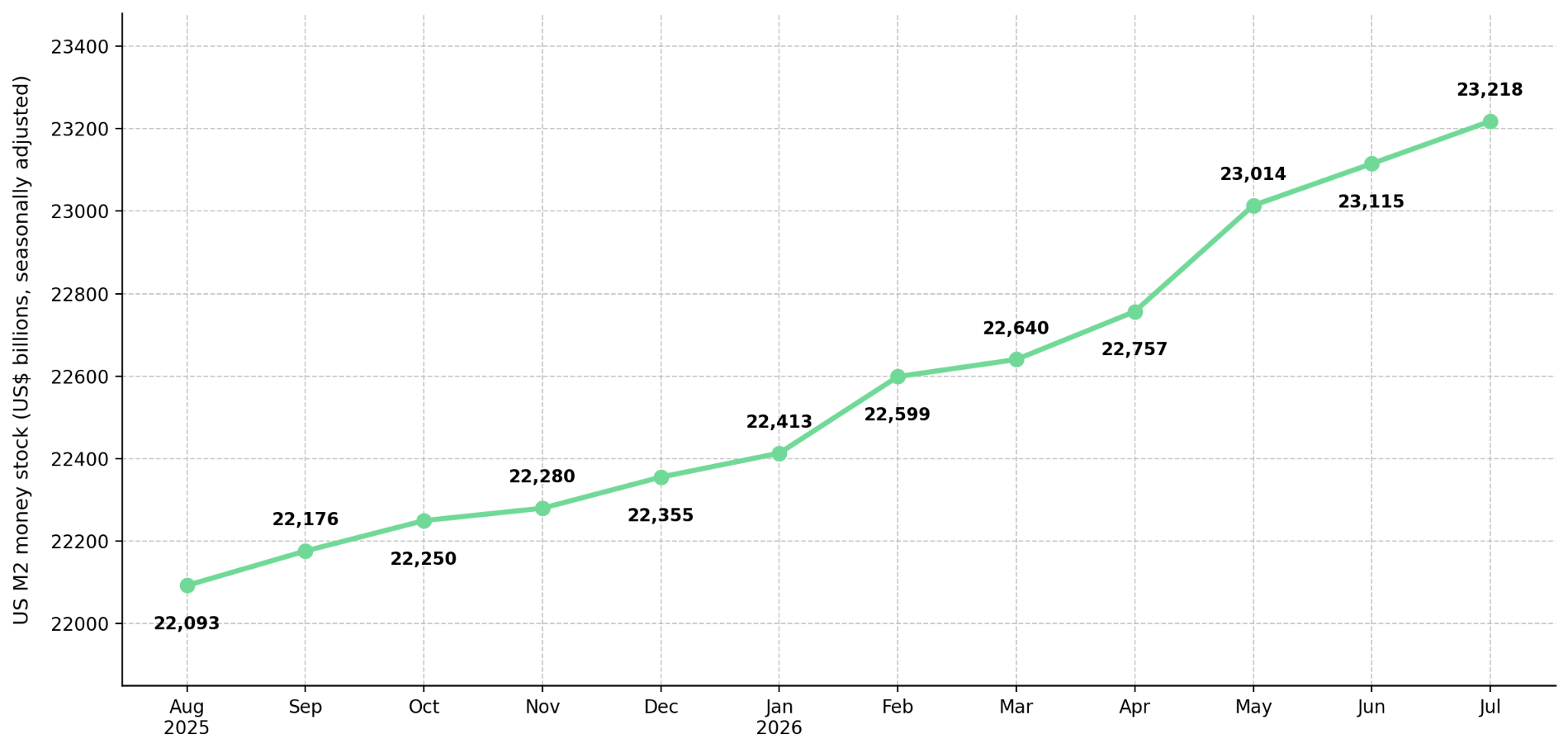
US M2 grew 5.4% year over year while copper gained 44.63%, a 39.2 percentage-point gap that weakens the liquidity case and points to physical supply constraints as the stronger price driver.
Supply Risk Supports $6.80 Copper While Fed Tightening Tests $6.45
Morgan Stanley’s commodities team identified copper as the metal most exposed to El Niño supply disruptions, citing flood, mudslide, and infrastructure risks in Chile and drought-related power shortages in Zambia. Chile produces more than 20% of global copper, while Zambia contributes 4%, so weather-related outages could tighten supply and support prices.
Base case: With El Niño holding at its current intensity and disruptions limited to isolated incidents, copper is targeting $6.45 to $6.80 per pound, with the dollar and US tariff decision setting the range.
Bear case: A September Fed rate increase strengthens the dollar and raises copper costs outside the US, with prices targeting $6.45 per pound.
Chilean Snow and Zambian Drought Hit Copper Supply From Opposite Directions
A storm deposited 5 million cubic meters of snow at Los Pelambres, halting operations and forcing Antofagasta to cut its production forecast. Meteorologists said the atmospheric river that flooded much of Chile was consistent with a strengthening El Niño, raising the risk of further copper supply disruptions.
El Niño threatens about 25% of global copper supply through opposite weather effects. Flooding and mudslides can block transport in Chile and Peru, while drought can reduce hydroelectric power and constrain mining and processing in Zambia and the Democratic Republic of Congo. Mines with secure water, non-hydro power, and multiple haulage routes are better positioned to maintain output.
Geography alone does not identify the most exposed operations. Mines with desalination or independent water, limited reliance on hydroelectric power, and multiple haulage routes face lower production risk during El Niño.
What Signals Decide Copper's Next Move
Physical supply risk better explains current pricing than money growth because US M2 rose 5.4% year over year to $23.218 trillion while copper gained 44.63%.
Copper’s supply premium could reverse if NOAA lowers its El Niño outlook while the Fed raises rates, reducing disruption risk and strengthening the dollar, with prices targeting $6.45 per pound.
Analyst's Notes





Subscribe to Our Channel





.png)

Stay Informed


