




Diesel Scarcity Moves Oil Earnings to Refining Margins Despite IEA Release


.png)
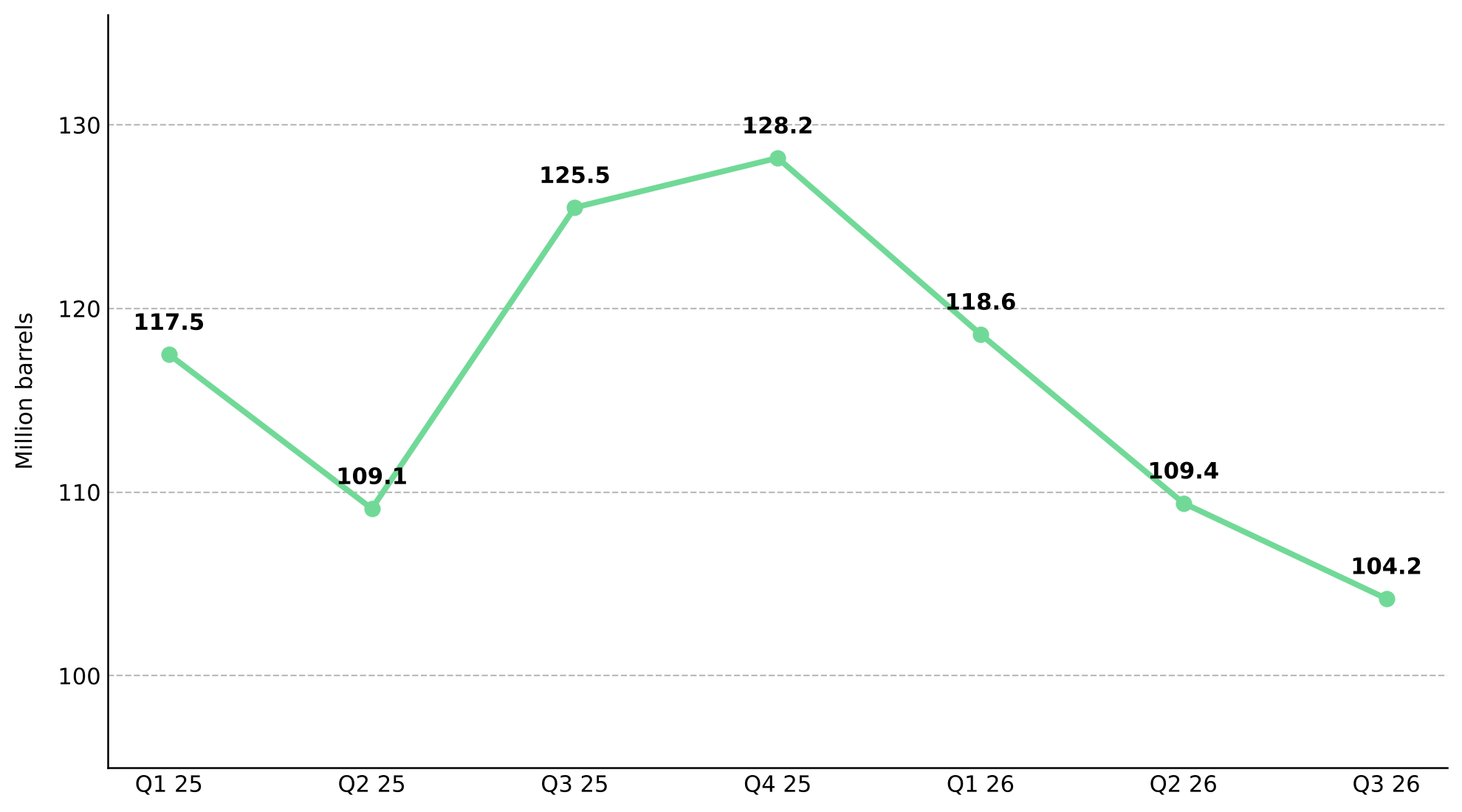
US distillate stocks stood 12% below the five-year average as Gulf Coast refineries ran at 96.3% utilization, supporting elevated fuel spreads.
- Brent fell 0.74% to $105.14 a barrel on October 16 2026 after the International Energy Agency (IEA) pledged to expedite its remaining 100 million barrels of emergency stock.
- The pledge carries over 20 million barrels of diesel, about five days of US distillate consumption at the four-week average of 3.974 million b/d.
- US distillate inventories stood at 102.6 million barrels, 12% below the five-year average, while refineries ran at 93.5% utilization.
- US Energy Information Administration (EIA) links diesel tightness to higher refinery crude demand and forecasts Brent averaging $105 a barrel in the fourth quarter of 2026.
- Distillate stocks above roughly 111 million barrels, within 5% of the five-year average, would remove pressure on refiners to increase crude runs.
IEA Reserve Release Pushes Brent Down $105.14
Brent fell 0.74% to $105.14 a barrel and West Texas Intermediate (WTI) dropped 1% to $96.98, but remained up 0.4% and 5.6% for the week, respectively. The decline followed the IEA’s announcement that member releases would exceed the 400 million barrels agreed in March, with the remaining 100 million barrels expedited, including over 20 million barrels of diesel.
The release pushed European diesel refining margins down nearly 2% to $78.67 a barrel, compared with September's $95 high, while crude fell less than 1%. US distillate inventories stood at 102.6 million barrels, 12% below the five-year average, sustaining diesel supply tightness.
Diesel Scarcity Raises US Refinery Utilization to 93.5%
Tight diesel supplies raised US refinery crude demand to 16.615 million barrels a day, with utilization at 93.5% nationwide and 96.3% on the Gulf Coast. Commercial crude inventories fell 8.6 million barrels to 415.6 million.
Attacks near the Strait of Hormuz intensified as Iran said it was escalating strikes in response to the US blockade of its ports. Kpler analysts reported that intensified Iranian attacks sharply reduced Gulf crude flows. The EIA estimated Middle East production shut-ins at 4.8 million barrels a day in September and forecasts 4.5 million barrels a day in the fourth quarter of 2026.
Five-Day Diesel Reserve Release Leaves Supply Tight
The release's over 20 million barrels of diesel covers only five days of US distillate demand at 3.974 million barrels a day, limiting its ability to relieve the shortage. Norbert Rucker, Head of Economics and Next Generation Research at Julius Baer, argued that oil prices above $100 a barrel were increasingly difficult to justify based on supply and demand conditions.
Wider Crack Spreads Raise Refinery Earnings Potential
US Gulf Coast refinery utilization reached 96.3%, positioning refiners with high distillate yields and export capacity to capture stronger diesel margins. The ultra-low sulfur diesel (ULSD) crack spread over WTI rose from $28.62 a barrel in January to $107.90 in September, highlighting higher earnings potential from refining.
ING attributes elevated crude prices to uncertainty over Hormuz flows, while Julius Baer argues Middle East exports have largely recovered. Refiners with high distillate yields and export access can benefit from diesel margins under either view, while crude-linked funds depend on sustained oil prices.
A US diesel export restriction has no announced timetable, making positions based on it dependent on an uncertain policy decision. Portfolios assuming September's diesel crack spread holds risk a roughly $80-a-barrel decline if it returns to January's level.
Why Could Lower Capacity Lift Refining Margins
The emergency diesel release covers only about five days of US distillate demand, leaving shortages that support refinery crude demand. Elevated diesel margins shift earnings opportunities toward refiners converting crude into fuel.
For US Gulf Coast refiners with high distillate yields and export access, diesel crack spreads drive earnings and should be reflected in valuations.
US operable refining capacity fell from 18.160 million to 18.044 million barrels a day year over year, limiting fuel production capacity regardless of geopolitical risks. Over a multi-year horizon, lower crude prices and reduced refining capacity favor exposure to refiners that can capture higher diesel margins.
Analyst's Notes





Subscribe to Our Channel






Stay Informed


