




Copper to Jump 50% in a Year on US & China Stockpiling, says Deutsche Bank



Deutsche Bank sees copper up 50% by mid-2027 on US and Chinese stockpiling. Miners selling at market prices gain most until stockpiled metal returns.
- Deutsche Bank is targeting copper at $10 per pound ($22,050 per tonne) in Q2 2027, almost 50% above current levels, on US and Chinese stockpiling as reported by Wall Street Journal.
- Head of Metals Research Daniel Ghali estimates the two countries could hold 71% of global copper inventories by year-end, while China's refined output growth slows to 3% to 3.4% in 2026.
- The bank sees users switching to aluminium as the ceiling, but the IEA finds that switch slow despite five years of favourable prices.
- CRU is targeting a fourth-quarter average of $14,500 per tonne. That leaves unhedged copper producers facing a $7,550 spread between the two cases, which no holder can resolve in advance.
- LME stocks rebuilding above 400,000 tonnes, near the April 2026 peak, would show stockpiled metal returning to buyers and remove the Deutsche Bank case.
Bank Targets $10 Copper as LME Warehouse Stocks Fall From April Peak
Deutsche Bank is targeting copper at $10 per pound, or $22,050 per tonne, in the second quarter of 2027, almost 50% above current levels, the Wall Street Journal reported on 28 September. Daniel Ghaliv, Head of Metals Research, attributes the call to stockpiling. China has built its strategic reserve for decades, and the threat of US import tariffs is drawing metal into American warehouses.
Ghali estimates the US and China could hold 71% of global inventories by year-end, and that copper would be unavailable to users elsewhere by the end of 2028 on the current path. The physical draw is already visible: LME stocks fell 38%, from 402,625 tonnes on 15 April to 251,350 tonnes on 28 September.
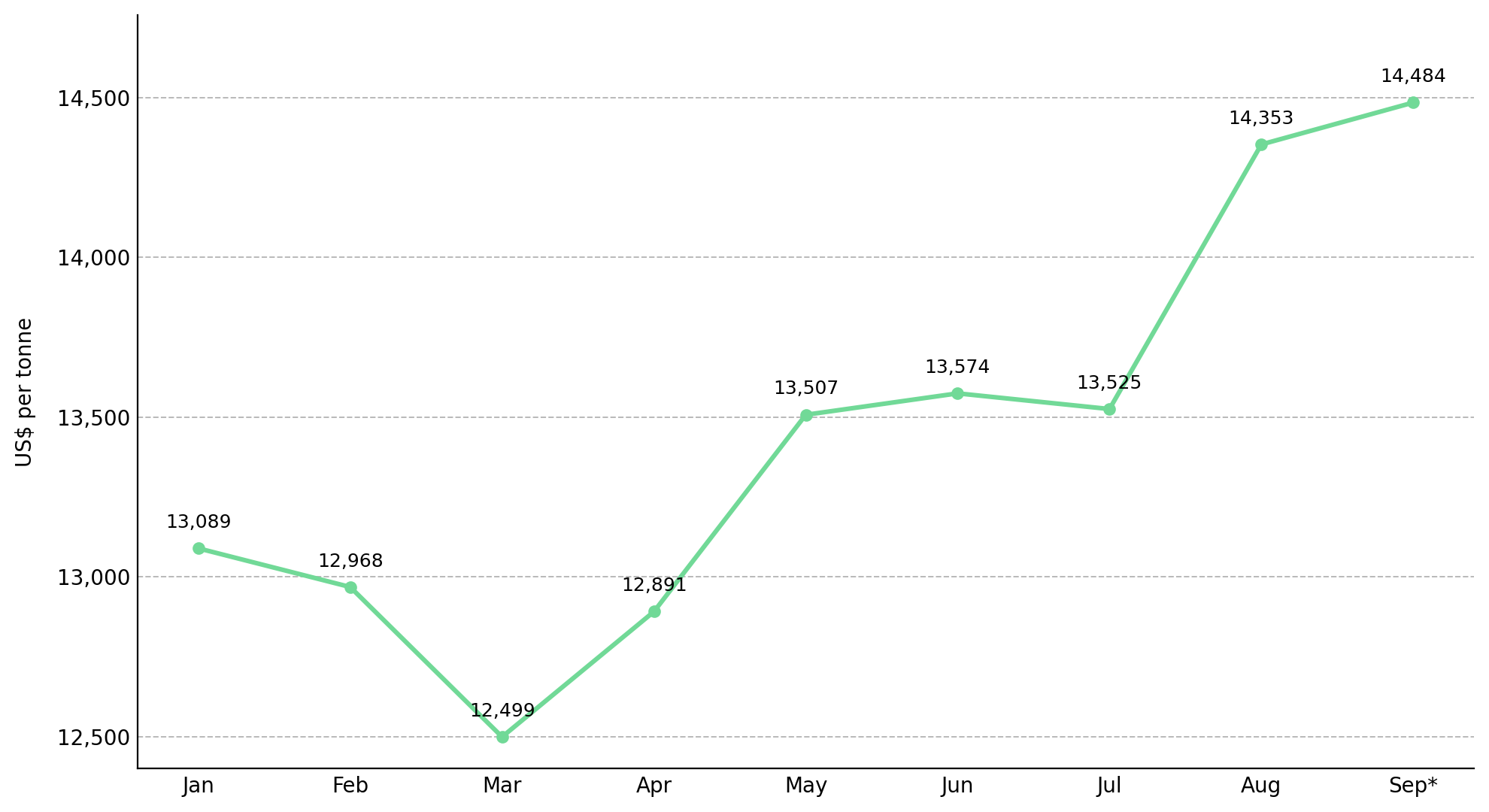
State Stockpiles and Slower Chinese Smelting Pull Refined Copper From Buyers
Stockpiling is removing metal from buyers while refined supply slows. China's refined copper output is on track to grow 3% to 3.4% in 2026, against 10.4% in 2025, the slowest since at least 2000, according to Wood Mackenzie and Zijin Tianfeng Futures via Reuters. Global smelting capacity has outgrown mine supply, and smelters now face three pressures:
- a years-long concentrate shortage
- a fourth-quarter tax crackdown on scrap
- an 11% September fall in sulphuric acid, the by-product that kept them profitable
Seven smelters have scheduled October and November maintenance, removing about 80,000 tonnes of refined supply, as per Reuters.
The US draw holds even without tariffs. US copper futures trade at a premium to the LME, which keeps metal in the country. Because the LME operates US warehouses, a narrowing premium moves metal between American sites rather than to buyers abroad.
Slow Aluminum Substitution Leaves Copper Price Ceiling Untested Through 2027
Deutsche Bank's target assumes prices climb until users switch to aluminium, a cheaper but less efficient conductor. The IEA finds the copper-to-aluminium price ratio has favoured aluminium for most of the past five years without triggering a major switch. About 8% of aluminium supply came from the Persian Gulf last year, where conflict is limiting exports. Smelters cannot fill the gap either. Raghav Jain, Head of Copper Pricing of Argus told Reuters:
"The concern now is that scrap is tightening at the same time as concentrate, reducing smelters' ability to substitute between raw materials."
In the stockpiling case, holdings reach Ghali's 71% of global inventories and prices run to the $22,050 target. In the CRU case, analyst Brian Peng is targeting a fourth-quarter average of $14,500 per tonne on slowing Chinese output (23 September), within this year's $11,700 to $14,875 range.
LME daily stock reports decide between the two. Stocks rebuilding above 400,000 tonnes, near the 15 April peak, would show stockpiled metal returning to buyers, which removes the Deutsche Bank case for unhedged producers.
Sales Terms Decide How Much Stockpiling Lifts Copper Miner Earnings
Wire makers and fabricators outside the US and China absorb the cost first, paying spot prices for metal their governments are not stockpiling. ASX- and TSX-listed copper producers selling unhedged output capture the price in the quarter it prints. Producers with hedges or fixed-price offtakes do not.
Earnings leverage to a $22,050 print depends on two measures: the share of output sold at market prices and the share of each tonne retained after treatment and refining charges.
Where Copper Miner Re-Ratings Hinge on While Stockpiles Hold
Copper pricing through 2027 depends on trade policy in Washington and Beijing more than end-user demand, making sales terms as important to a producer's valuation as grade or cost position. Holders of ASX and TSX-listed copper producers gain most from companies selling at spot with floored treatment charges. Hedge books and offtake contracts are worth checking before adding exposure, since fixed-price volumes give up the upside.
Stockpile releases are not announced in advance. Positions should be sized to survive a return to this year's $11,700 low, because unhedged earnings have no hedge to cushion them. LME daily stock reports are the signal to follow. A rebuild towards 400,000 tonnes would show stockpiled metal returning to buyers and would justify reducing spot-exposed positions.
Over the following decade, prices high enough to squeeze buyers outside the US and China will fund aluminium substitution and scrap collection, which the IEA sees supplying over one-third of copper demand by 2050. Gains that spot-priced producers capture in this cycle are best treated as cyclical, because recyclers and substitute suppliers will take a growing share of copper's value over time.
Analyst's Notes





Subscribe to Our Channel







Stay Informed


