B26's 60-Meter Copper Intercept Tests Abitibi's 30-35 Million Tonne Target


Abitibi Metals' B26 drilling returned 1.25% copper equivalent over 60.2 meters as Western Down-Plunge results support a 30-35 million tonne resource target.
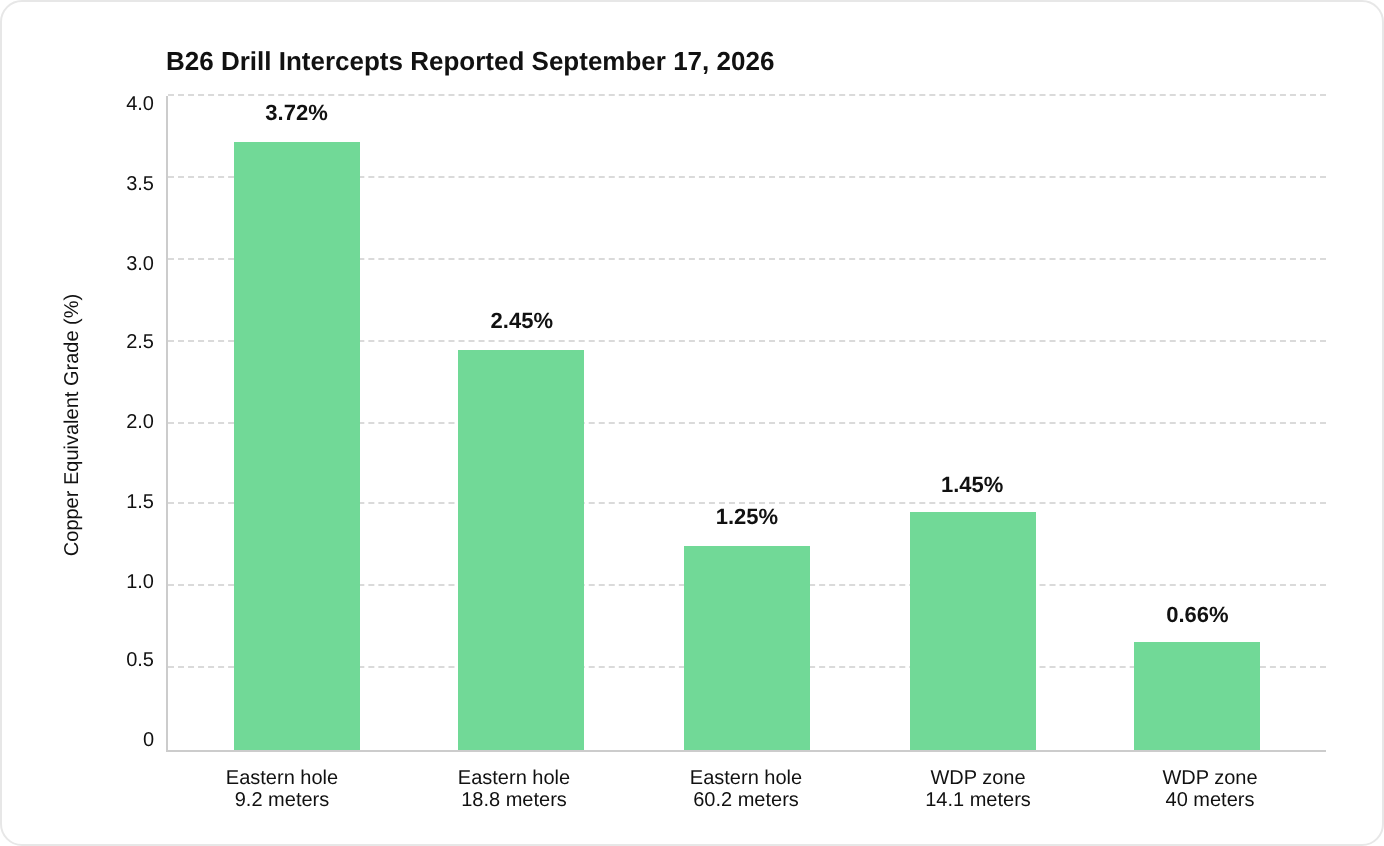
- A hole on the eastern side of B26 returned 1.25% copper equivalent over 60.2 meters, including 3.72% copper equivalent over 9.2 meters, in a deposit with an average width of about 8 meters.
- Drilling in the Western Down-Plunge zone extended mineralization between roughly 966 meters and 985 meters downhole, a similar depth range that returned 17.91% copper equivalent over 6.3 meters in 2025.
- Abitibi Metals is targeting 30 to 35 million tonnes in its next resource update, up from 25.3 million tonnes, and has moved its drilling from resource conversion to growth of Inferred tonnes.
- The current resource contains 12.96 million tonnes Indicated at 2.08% copper equivalent and 12.34 million tonnes Inferred at 2.20% copper equivalent, effective January 1, 2026.
- About C$34 million in cash funds a 40,000-meter Phase 4 program in 2026 within an 80,000-meter two-year plan, ahead of a preliminary economic assessment (PEA) targeted for 2027.
What Has Happened
Abitibi Metals Corp. (CSE: AMQ | OTCQB: AMQFF) reported on September 17, 2026, that a hole drilled on the eastern side of the B26 Polymetallic Deposit in Québec intersected 1.25% copper equivalent over 60.2 meters from 548.8 meters downhole. Inside that interval sit 2.45% copper equivalent over 18.8 meters and a core of 3.72% copper equivalent over 9.2 meters grading 3.42% copper, 0.26 grams per tonne of gold and 9.86 grams per tonne of silver. The company reported that the eastern-side hole returned materially higher grades than it had anticipated.
The same results extended the Western Down-Plunge (WDP) zone, where 2 holes returned 1.45% copper equivalent over 14.1 meters from 985.3 meters, including 2.21% copper equivalent over 5.9 meters, and 0.66% copper equivalent over 40 meters from 966 meters, including 1.65% copper equivalent over 7.6 meters. A deeper hole confirmed down-dip continuity of the system below 1,400 meters downhole.
Abitibi now owns 100% of B26, about 7 kilometers southeast of the former Selbaie Mine, after optioning it from SOQUEM, the Québec government's exploration subsidiary, in November 2023. Management has redirected drilling from upgrading Inferred tonnes toward adding new ones, with a target of 30 to 35 million tonnes in the next resource update, against 25.3 million tonnes today. Each of the September intercepts is a test of that target.
Why a 60-Meter Interval Stands Out at B26
B26 is built from stacked lenses along more than 1.5 kilometers of strike, dipping at about 80 degrees, with an average width of about 8 meters and horizontal thicknesses of 1.5 meters to 40 meters. In a deposit of this shape, tonnage grows in 3 ways: thicker lenses, longer lenses, or lenses that continue deeper. The eastern-side hole bears on the first. Its 60.2-meter interval is a downhole length, and Abitibi states that true width generally corresponds to 60% to 94% of core length. Even with that adjustment, the intercept points to a thicker body of mineralization than the deposit's typical lens.
Geometry also shapes how B26 could eventually be mined. The company describes the near-vertical dip and thickness of the lenses as amenable to conventional underground mining methods, and points to high-grade zones near surface that could support early payback. Thicker zones on the eastern side would add tonnes within the same deposit footprint.
The metal mix in the eastern-side core is copper-dominant, with zinc at 0.02% and copper making up 3.42% of the 3.72% copper equivalent grade. That profile resembles the resource's copper feeder zone, which holds 9.29 million tonnes Indicated at 1.60% copper and 11.82 million tonnes Inferred at 1.67% copper and is the largest of the deposit's 3 zones by tonnage.
Chief Executive Officer Jonathon Deluce linked the results to the deposit's growth profile:
"B26 continues to demonstrate the qualities of a growing, high-grade deposit."
The Western Down-Plunge Zone at Depth
The WDP zone tests the third route to growth: depth. Management describes volcanogenic massive sulfide systems in the Abitibi as deep-seated, and the WDP is where that view is being tested at B26. In 2025, 2 holes in the zone returned 17.91% copper equivalent over 6.3 meters from 989.7 meters downhole, within 6.93% copper equivalent over 19.5 meters, and 4.46% copper equivalent over 21.1 meters from 976.0 meters, within 1.80% copper equivalent over 69.0 meters. The 2 main September 2026 intercepts in the zone, from 966 meters and 985.3 meters, returned lower grades than those 2025 intercepts, although Abitibi notes that the 2 years use different copper equivalent reporting bases.
The company interprets the higher-grade core of the WDP as lying further west and/or at depth, and it states that WDP drilling could add tonnage to future resource estimates. A further intercept returned a silver-zinc interval of 0.62% copper equivalent over 20.6 meters, grading 1.03% zinc and 41.11 grams per tonne of silver, plus a separate gold-copper interval of 0.68% copper equivalent over 5.5 meters. Another cut narrow high-grade veins, including 9.54% copper equivalent over 0.5 meters and 4.32% copper equivalent over 1.8 meters.
West of the zone, a step-out hole intersected B26-style alteration and narrow copper mineralization at about 1,234 meters, which the company interprets as evidence that the system continues west, and the deepest hole confirmed continuity below 1,400 meters downhole. Together, these results point follow-up drilling west and down, toward the higher-grade core Abitibi is targeting.
From Conversion Drilling to Drilling for Scale
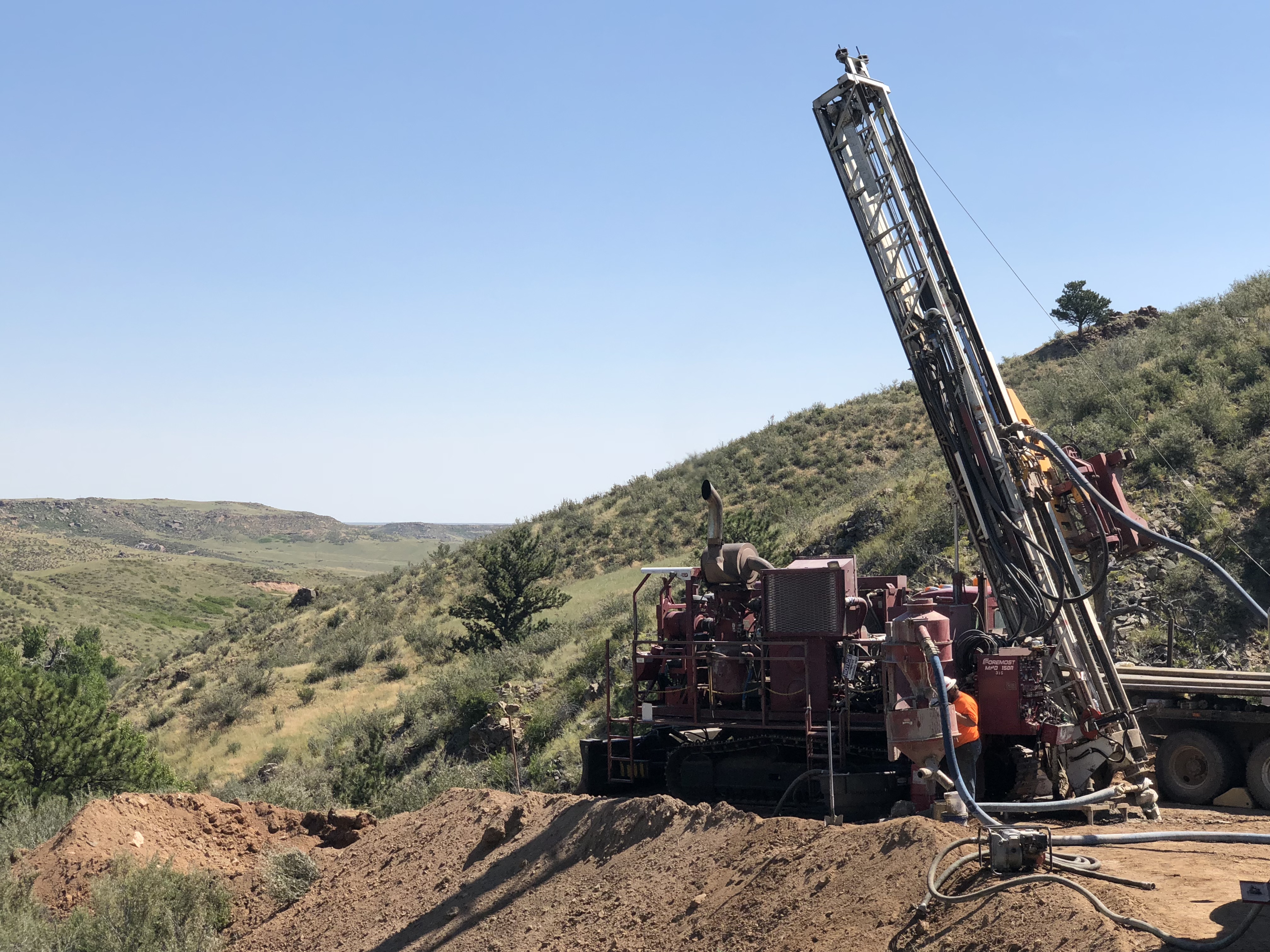
Abitibi had drilled just under 30,000 meters in 2026 by early October, with 3 drills operating through year-end. That work was split between infill of Inferred material, expansion and regional targets. Management has since concluded that its conversion objective has been met internally, so the remaining 2026 drilling is directed at growing Inferred tonnes.
B26 has already grown from 11.3 million tonnes Indicated and 7.2 million tonnes Inferred in the 2024 resource to 12.96 million tonnes Indicated and 12.34 million tonnes Inferred in the 2026 estimate. The company reports that resource tonnage has increased 124% since it optioned the deposit, at a blended discovery cost of C$0.037 per pound of contained copper equivalent added.
Deluce tied the current program to a specific tonnage goal for the next update:
"So I think we're trying to balance all buckets; our resource is 25 million tonnes today, and our goal for our next update is 30 to 35 million tonnes, balancing good progress on the conversion. So we felt that internally we've met our conversion target, so now it's drilling for scale."
The company identifies both the eastern extension and the WDP zone as potential sources of additional tonnage. Neither result is in the current resource, and Inferred resources carry lower confidence than Indicated and cannot be converted directly to reserves. The next update will show how many tonnes the 2 fronts add and at what confidence level.
Funding, Development Work & Broader Context
Abitibi held about C$34 million in cash with no warrants outstanding and is projecting C$28 million to C$29 million at year-end. The company states it is funded through 2027, covering 40,000 meters of Phase 4 drilling in 2026 within an 80,000-meter two-year plan. Discovery Silver holds a 9.9% strategic stake, and the most recent equity offering, in May 2026, was priced at C$0.58 per share.
The preliminary economic assessment (PEA) targeted for 2027 would be the first economic study on B26, and mineral resources that are not reserves have no demonstrated economic viability. The company is running 4 workstreams toward it. Initial metallurgical testwork has returned copper recoveries of 98.2%, against the 98.3% copper recovery assumed in the 2026 resource, with more testwork scheduled through the fourth quarter of 2026. An internal scoping study began in the first quarter of 2026, Indigenous and community engagement is ongoing, and B26 is on a previously permitted and mined brownfield property with road, 120-kilovolt power and rail access.
Management has started time-consuming work such as hydrogeology early, on the view that producers, including Discovery Silver, value how far a deposit has advanced toward production. On the company's own comparison using historical, non-NI 43-101 figures that are not directly comparable to its resource, B26's 25.3 million tonnes would rank second by tonnage among Noranda camp deposits, behind only Horne.
What to Watch Next
The nearest catalyst is the remaining 2026 drilling, with 3 rigs focused on Inferred growth and WDP follow-up, all feeding the next resource update. Management is also planning a deep test of the deposit at about 1.5 kilometers vertical depth, a 500-meter step-out supported by a downhole magnetotelluric survey, aimed at a possible higher-grade source of the stringer mineralization.
In the first quarter of 2027, Abitibi is targeting 1 to 2 drills on regional work, including follow-up of a regional hole about 1.5 kilometers west of B26 that intersected 14.25 meters of 1.13% zinc and 52 grams per tonne of silver in the same host sequence. Extensional and infill drilling at the deposit will continue in parallel.
After the updated resource comes the PEA, which will put the first economic numbers against the tonnes the current program adds. The size of that update relative to the 30 to 35 million tonne goal will be the clearest measure of whether drilling for scale is delivering.
FAQs (AI-Generated)
Analyst's Notes





Subscribe to Our Channel
Stay Informed