




AI Selloff Cut Copper’s US Premium, Favoring LME-Priced Producers


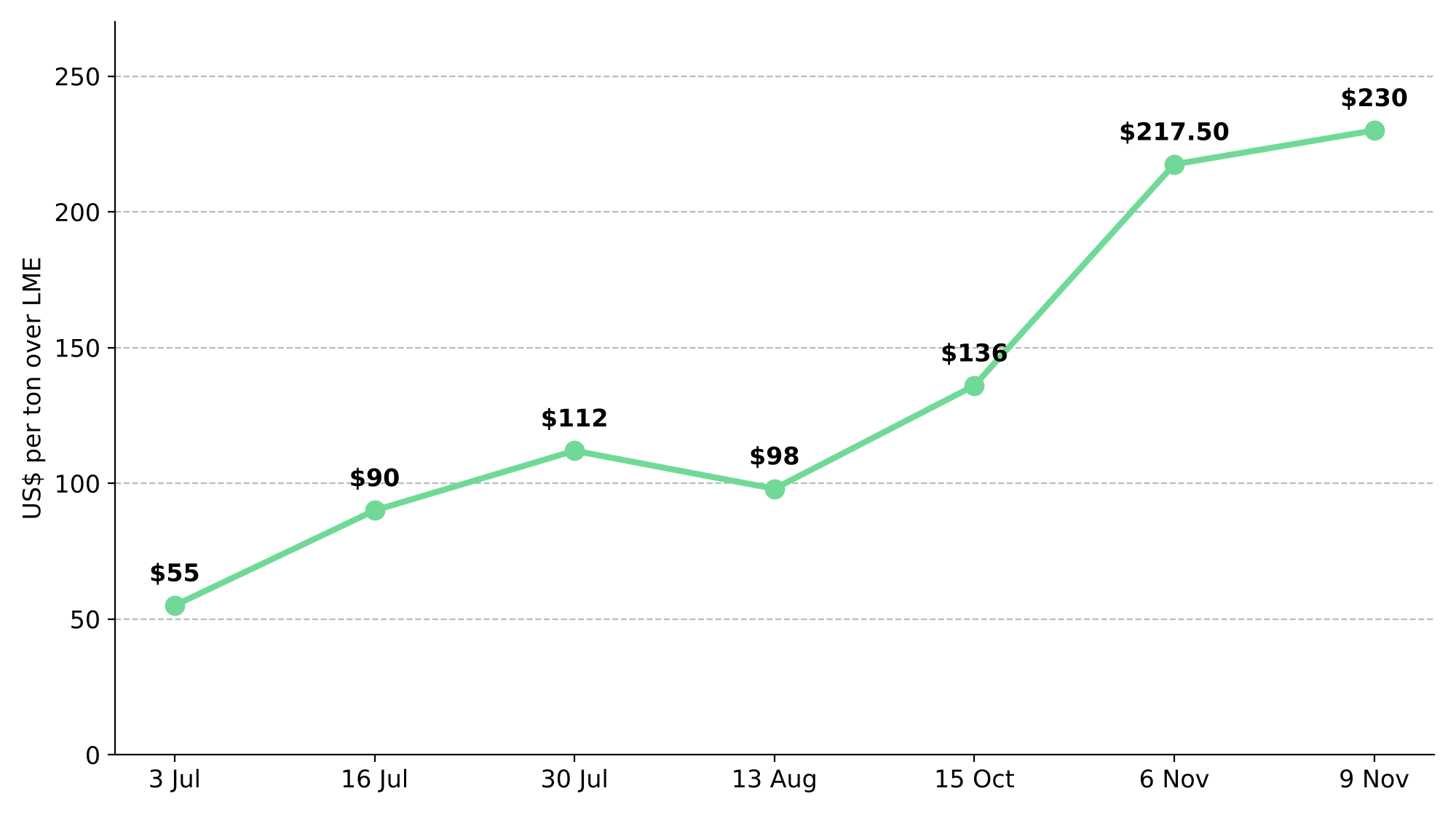
China’s record $230 import premium highlights an advantage for producers able to deliver copper, with 85% of global exchange stocks held in US warehouses.
- Money managers cut their CME copper net long from 82,649 contracts in mid-September to 34,444 after the November 5 AI equity selloff erased $2.5 trillion from the Nasdaq 100.
- US warehouses hold 85% of global exchange copper, while Shanghai Futures Exchange (SHFE) stocks sit at a three-year low of 33,848 tons and China’s Yangshan import premium reached a record $230 a ton on November 9.
- The CME spot premium over the LME shrank from above $700 a ton in August to $80, so new arrivals now enter LME bonded warehouses instead of clearing US customs.
- Morgan Stanley indicates that US copper is unlikely to be re-exported until tariffs are definitively ruled out, leaving overseas supply constrained with no decision date announced.
- A formal US tariff on refined copper would restore the CME premium and reverse the flow into LME warehouses.
AI Equity Selloff Cuts Funds’ Net Copper Bet 58% as Shanghai Stocks Drain
Copper rebounded after a 2.7% weekly decline, its steepest since March, with LME three-month prices rising 1% to $13,908 per metric ton and COMEX futures gaining 1.8% to $6.35 per pound. The decline coincided with an AI equity selloff that erased $2.5 trillion from the Nasdaq 100.
Financial selling reduced money managers’ net long CME copper position from 82,649 contracts in mid-September to 34,444. Meanwhile, SHFE inventories fell more than 24% in one week to 33,848 metric tons, less than one day of Chinese consumption.
US Tariff Stockpiling Holds 85% of Exchange Copper as China Imports Fall
Two years of stockpiling ahead of potential US import tariffs concentrated copper inventories in the US. CME warehouses hold 732,949 metric tons, while US facilities, including LME warehouses, account for 85% of global exchange inventories. China's copper cathode imports fell 16.34% year over year from January through September, while the Yangshan import premium reached a record $230 per metric ton.
The White House has neither imposed nor withdrawn the proposed copper tariff, leaving US stockholders unable to price an exit. Tariff expectations weakened after the Democratic midterm sweep, reducing the CME spot premium over the LME from above $700 per metric ton in August to $80. The LME cash premium of $195 per metric ton over three-month copper now outweighs the incentive to clear US customs, with LME warehouses receiving 107,000 metric tons since October 1 versus 27,000 at CME.
Policy Uncertainty Restrains Re-Exports Despite China's Record Premiums
Shanghai copper premiums already cover shipping costs from the US to China, but a US tariff would make the metal far more valuable within the US. Amy Gower, Metals Strategist at Morgan Stanley, said re-exports would require tariffs to be definitively ruled out.
Shrinking CME Premium Moves Copper Margin Toward LME-Priced Producers
Chinese smelters and fabricators face margin pressure as smelters struggle with concentrate and scrap shortages, while Shanghai spot premiums tripled in two weeks to a record 2,615 yuan per metric ton. Positions dependent on the US premium face losses as the CME-LME gap narrows. Meanwhile, producers selling at LME-linked prices outside the US benefit from higher physical-market prices without relying on tariffs.
Trafigura has sought copper shipments in Asia for November and December and is willing to outbid rivals. Uncommitted Asian cargoes can capture these higher bids, while copper held in US customs cannot. Ewa Manthey, Commodities Strategist at ING, cautioned that Monday's rebound did not necessarily mark the end of the correction.
With no published date for a US tariff decision, copper equity portfolios cannot reliably time the release of US stockpiles. Holdings in LME-priced producers can instead be sized for further price declines, although renewed fund liquidation could still cause losses.
What Copper’s Shrinking US Premium Settles
Tariff expectations concentrated copper in the US without increasing consumption. Despite the shrinking CME premium, US warehouses still hold 85% of global exchange copper, while China's physical supply shortage remains unresolved after the AI equity selloff.
Producers selling at LME-linked prices outside the US benefit from physical market tightness without relying on a future US tariff. A renewed US price premium represents potential upside rather than a guaranteed valuation benefit.
This favors selective exposure to LME-priced producers that can deliver copper into markets paying higher premiums, rather than positions dependent on a renewed US tariff premium.
Analyst's Notes





Subscribe to Our Channel








Stay Informed


