




Copper's Rally Has Further to Run as Demand Outpaces a Shrinking Supply


Copper trades near record highs at $14,215/tonne as demand climbs toward a 25% supply deficit by 2035, with feasibility buffers now at just 18%.
- Copper is consolidating at $6.582 per pound, wedged between support at $6.50 and resistance at $6.65, while the London Metal Exchange (LME) three-month price closed at $14,215.50 per tonne on August 23, 2026, just below January's record of $14,527.50 per tonne.
- The International Energy Agency (IEA) projects a 25% primary supply deficit by 2035, driven by ore grades that have fallen 40% since 1991 and a discovery rate where only 5% of deposits found in the last 35 years were located in the last decade.
- Bank of America is targeting copper above $15,200 per tonne in 2027, while UBS projects the global refined supply shortfall widening from 219,000 tonnes this year to 379,000 tonnes in 2027.
- S&P Global's review of 573 feasibility studies shows the price buffer built into project assumptions has collapsed to an 18% discount in 2026, the tightest cushion since the 2006-2012 supercycle, leaving little room for error.
- A confirmed break below $6.50 per pound targeting $6.28 and then $6.00, or a broader correction toward the $8,500 to $9,000 per tonne range flagged by S&P Global, would test the roughly $10,647 per tonne average base case now underpinning newly approved projects.
Copper Holds Near Record Highs at $14,215 a Tonne
Copper is caught in a tight consolidation on the five-hour chart, trading at $6.582 per pound and wedged between support at $6.50 and resistance at $6.65. Price sits above the 200-period moving average of $6.4191, confirming the longer uptrend, but below the 50-period average of $6.5763, a sign the rally has stalled.
The London Metal Exchange (LME) three-month contract closed at $14,215.50 per tonne on August 23, 2026, up 3.08% for the month and within striking distance of January's record of $14,527.50 per tonne.
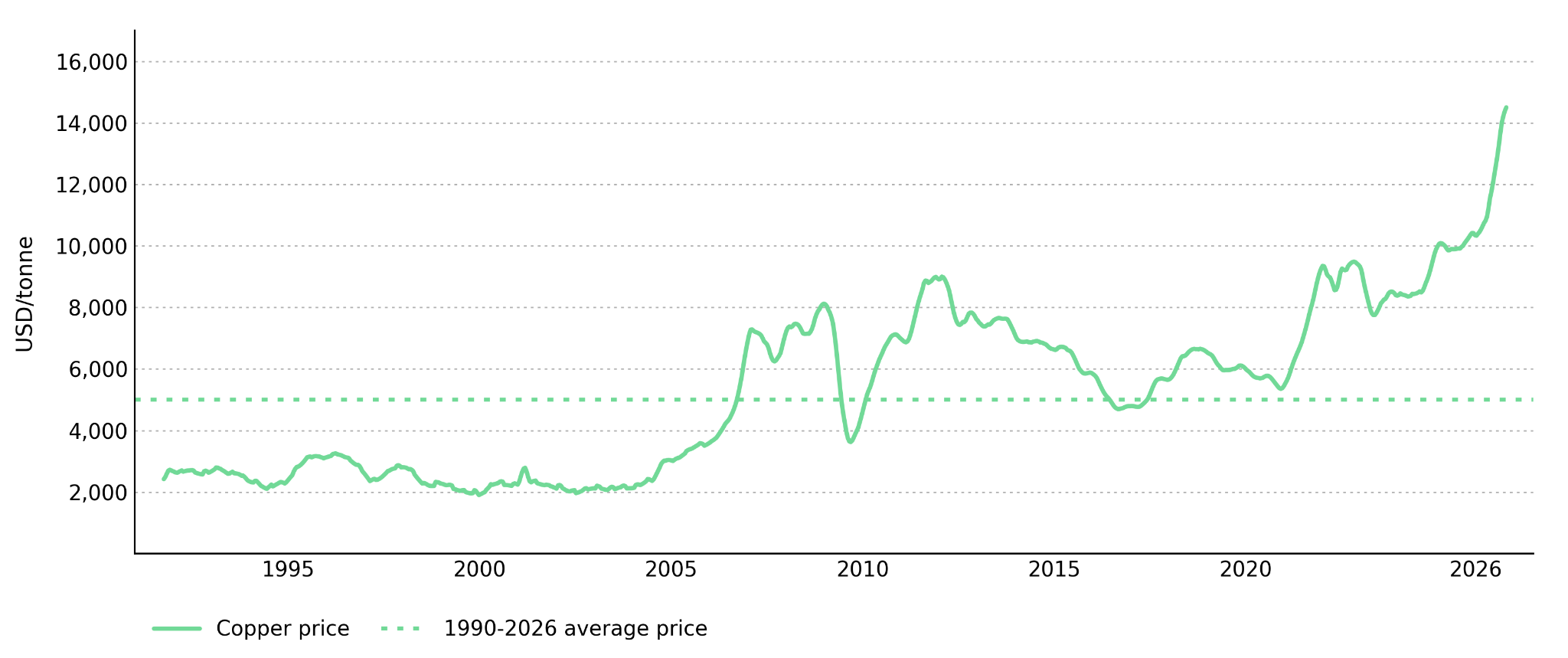
Bank of America is targeting prices above $15,200 per tonne in 2027, with a possible move to $16,000 per tonne in the second half, while UBS projects the global refined shortfall widening from 219,000 tonnes this year to 379,000 tonnes in 2027. The near-term chop and the longer-term deficit case are not contradictory; they describe a market that has already done a lot of the pricing work.
Why the Copper Deficit Has No Quick Fix
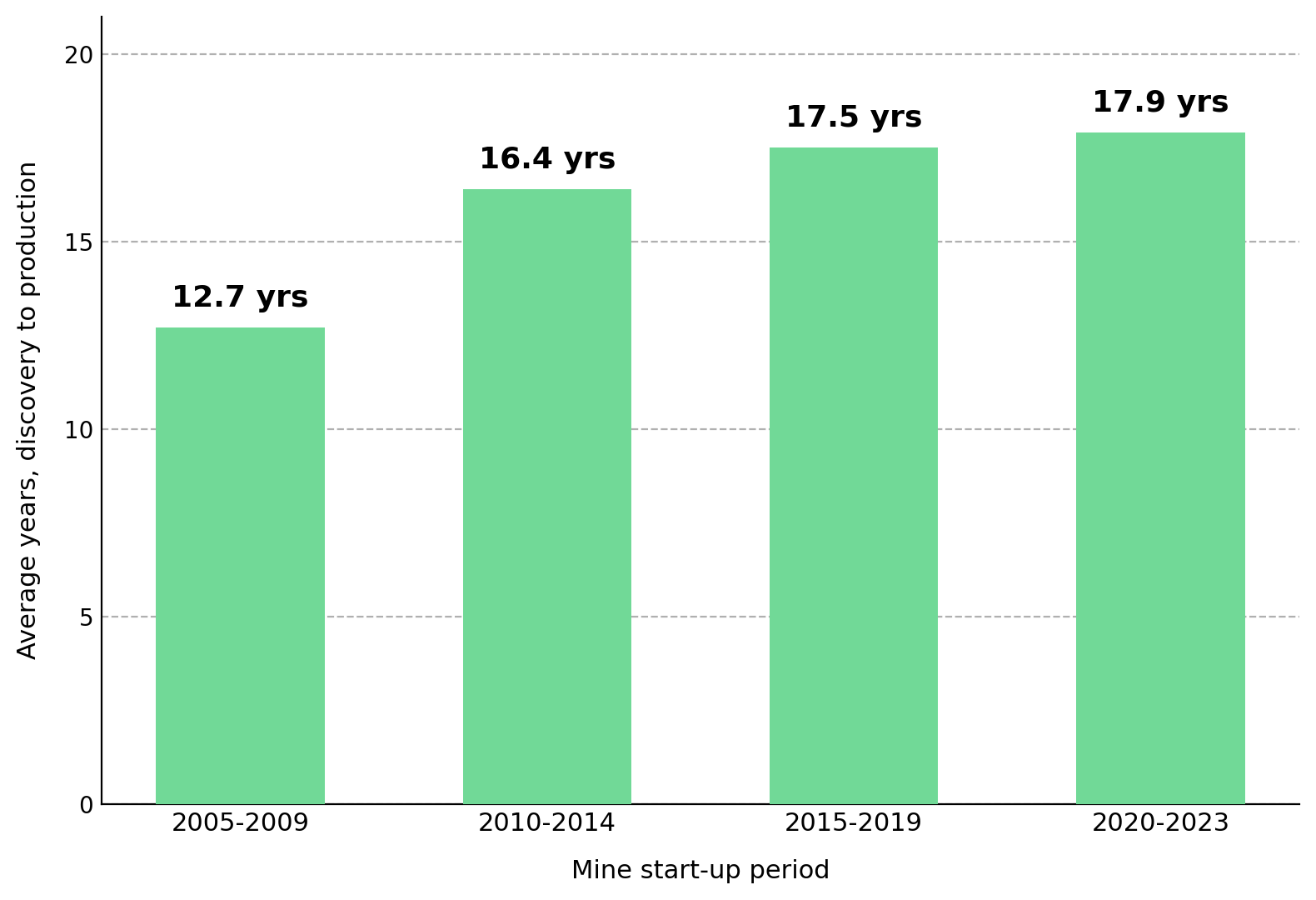
The structural case is not new, but the mechanics behind it are getting harder to dismiss. The IEA targets global refined copper demand rising about 50%, from 28 million tonnes in 2025 to 42 million tonnes by 2040, with grid networks, data centers, transport, and defense competing for the same metal. Meanwhile, average copper ore grades have fallen 40% since 1991, capital intensity for expanding existing mines is up 65% since 2020, and only 5% of deposits discovered in the last 35 years were found in the last decade. Lead times from discovery to production now average around 17.9 years, which is why the IEA projects a 25% primary supply deficit by 2035 under current policy settings.
Mine Disruptions Erased 1.5 Million Tonnes in 2025
The near-term picture has deteriorated further. Disruptions at Grasberg in Indonesia and Kamoa-Kakula in the Democratic Republic of the Congo removed 1.5 million tonnes of supply in 2025, more than 6% of global mined output, with full recovery at Grasberg not targeted until 2028. A second Atacama winter storm has pushed Lundin Mining to lower its 2026 output guidance, while the Strait of Hormuz closure and China's sulphuric acid export ban, running from May through year-end, threaten leaching operations that account for over 15% of primary output. None of this gets solved with a new mine permit.
Feasibility Buffers Have Shrunk to Just 18%
The part of the story that gets less attention is how little downside protection is built into the projects meant to close that deficit. S&P Global Market Intelligence reviewed 573 copper feasibility studies published between 2004 and 2026 and found the price buffer, the discount developers apply to spot prices to stress test project economics, has collapsed. During the 2006 to 2012 supercycle, that discount ran from 17% to 52% even as prices rallied. As of 2026, with the LME averaging roughly $12,970 per tonne year to date, studies are assuming just $10,647 per tonne on average, an 18% discount. Individual projects run thinner still: Lundin Mining and BHP Group's Josemaria project used a $10,141 per tonne base case in its 2026 update, and Blue Moon Metals' Nussir project adopted $10,538 per tonne.
The Last Time Buffers Were This Thin, Copper Corrected
Assumptions tracked close to spot through 2013 and 2014, then proved sticky through the 2015 to 2016 downturn, holding 20% to 31% above a falling spot price rather than adjusting down, a pattern S&P Global calls anchoring. A faster-than-expected recovery at Kamoa-Kakula, an early end to the acid ban, or a tariff resolution that unwinds the current CME inventory build (58% of global exchange stocks at the end of July) could compress the buffer further, exposing projects approved above $10,000 per tonne to the margin pressure that hit the 2011 vintage once prices corrected.
Price Levels That Would Signal a Reversal
The trade is no longer about discovering the deficit; it is priced. The levels worth watching are a confirmed break below $6.50 per pound, which opens $6.28 and then $6.00, and a broader correction toward the $8,500 to $9,000 per tonne range that S&P Global flags as the write-down threshold. Until one of those triggers, or a durable break above $6.65 and $14,527.50 per tonne, the more interesting question is not whether copper is short, but how much of that shortage is left to discover.
Analyst's Notes





Subscribe to Our Channel




Stay Informed


