




Dune Oil's Rebuilt Team Heads Into C-1 With a 17-Year Field Operator



Dune Oil has rebuilt its team around a Chief Operating Officer with more than 17 years in oilfield operations, backed by Türkiye deal and financing experience.
- Management said in August 2026 that 2 new directors and a new Chief Operating Officer were joining Dune Oil.
- Jordan Coleman, the new Chief Operating Officer, leads field operations and the M47 work program with more than 17 years of oilfield operations experience.
- Two executives bring prior Valeura Energy experience in Türkiye.
- The board includes a Chief Financial Officer and an independent director with prior oil and gas financing experience.
- The first operating task is the C-1 re-entry, where management says the pay zone still has to be cemented, perforated, and flowed.
The Work the New Team Faces on Block M47
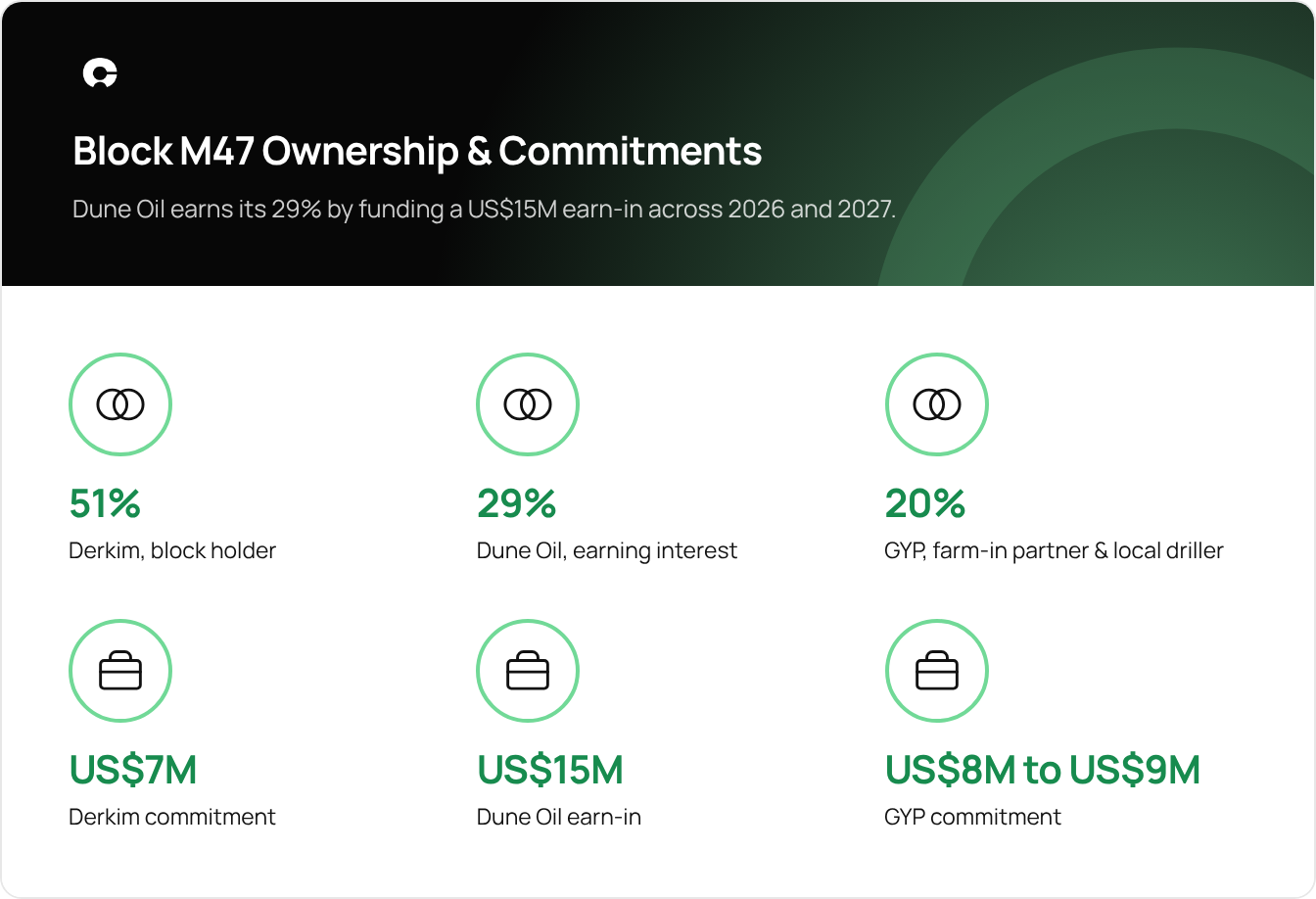
Dune Oil (CSE: DUNE | OTCQB: DUNXF) is earning a 29% working interest in Block M47, the C3 and C4 licenses in the Cudi-Gabar petroleum province of southeastern Türkiye. The company is funding a US$15 million earn-in in 2 tranches across 2026 and 2027, with US$800,000 paid as of October 2026. Derkim, the block holder, has a 51% interest against a US$7 million commitment, and GYP, a farm-in partner and local driller, has 20% against a commitment of US$8 million to US$9 million. Dune Oil's first-tranche share is US$4.3 million, covering 1 to 2 new wells, a re-entry into C-1 and C-2 at the North discovery, an early production facility, and 40 kilometers (km) of staged seismic.
The C-1 well recorded more than 70 meters (m) of gross oil pay and 38 m of net pay, and produced 63 barrels of oil on test. Pay is the oil-bearing rock a well passes through, and net pay is the part of it considered capable of producing oil. Management says the local reservoir has very low pressure, so producing wells in the area use electric submersible pumps to lift oil to the surface. The initial completion target at C-1, in management's account, is an 8 m zone of light oil with 8% porosity, the share of the rock that is open space able to contain oil. For early oil, Dune Oil is targeting 250-barrel tanker-truck haulage to the Tüpraş refinery 130 km away, with no water separation needed initially.
Dune Oil says a flow test at C-1 is the remaining step before part of the North Field's best-estimate contingent resource of 27.6 million barrels net to Dune Oil can be booked as reserves. A contingent resource is oil estimated to be recoverable from a known accumulation that is not yet classed as commercially recoverable. The test work, as Dune Oil describes it, involves cementing and perforating the pay zone and fitting a pump for initial production testing. Perforating means shooting holes through the steel well casing so oil can flow in.
A Rebuilt Field Team Under a New Chief Operating Officer
Chief Operating Officer of Dune Oil, Jordan Coleman, leads the company's field operations and the execution of the M47 work program. He has more than 17 years of oilfield operations experience, beginning at Schlumberger and followed by roles in production, drilling, and operational supervision, much of it based in Latin America. His record covers operations in the United States, Chad, Argentina, and Paraguay, spanning field execution and supervisory management across the drilling and production cycle on multiple fields.
Management said in August 2026 that 2 new directors and a new Chief Operating Officer were joining the company. The in-country geologists and petrophysicists who have worked with Dune Oil for several years remain part of the team, and management says the company is bringing North American technological expertise to the block. President and Chief Executive Officer of Dune Oil, Scott Lower, tied the hiring to the drilling method the company wants to introduce on M47:
"The full team has been retooled. We've looked at bringing in fresh blood focused on the lateral drilling."
Dune Oil says lateral wells, which turn to run horizontally along the oil-bearing layer, have seen little use in Türkiye to date and are only now being introduced there. Dune Oil's plan is to bring C-1 into vertical production first, carry out further seismic work in the well to size a lateral, and then drill laterals of perhaps 300 to 500 m from the same pad. Management says those laterals could produce 4 times the vertical rate, and that the new Chief Operating Officer, who has international experience, is the in-country engineer looking at that lateral work.
Who Runs the Carbonate Section
Dune Oil's 29% is a minority interest on Block M47. Management says the 51% interest holder does not want to operate oil and gas wells and will defer to experienced operators, and Dune Oil has been told it will be able to carry out the operations on the wells it funds. Dune Oil says it has drawn up its own detailed plans for the C-1 re-entry and intends to present them to the partners.
Management says GYP has 20 rigs and supplies the rig cost at about a 40% saving to the program, and that the partners have already held technical committee meetings. Derkim has already put US$7 million into the project, and Dune Oil carries Derkim's share of roughly the next 4 wells, in management's account. Lower described the division of labor Dune Oil wants between the drilling partner and its own team:
"We're hoping to work out a long-term arrangement that accommodates everybody, where potentially the 20% interest holder drills the vertical section. We do everything in the carbonates, which is the pay zone."
Management described the split in August 2026 as an arrangement still to be agreed upon, covering all carbonate work, including lateral drilling. Under standard joint operating terms, Dune Oil says a partner that does not pay for a well loses its participation in that well, so a missed payment does not hold up the program.
Türkiye Commercial & Business Development Experience
Vice President and General Manager, Turkey, at Dune Oil, Burak Tolga Terzi, has more than 18 years of experience in management positions. He holds bachelor's and master's degrees in business administration, and previously worked for Valeura Energy in Türkiye, Weatherford International, and SOCAR AQS, the State Oil Company of the Azerbaijan Republic. Those roles covered both the commercial and technical sides of the oil and gas business.
Business development lead at Dune Oil, Barry Wihak, has 45 years of oil and gas experience, first as a geologist and for the last 25 years in business development. He worked with Vermilion Energy and served as Vice President, Business Development at Valeura Energy, where he helped attract, negotiate, and close a US$100 million farm-out and acquisition deal with Equinor and Transatlantic Petroleum in Türkiye.
Director of Dune Oil, Jay Park, is an energy lawyer focused on upstream oil and gas transactions who has worked on energy projects in more than 50 countries, including Türkiye. He has advised explorers, producers, state oil companies, governments, banks, and multilateral agencies such as the World Bank, and was formerly Chief Executive Officer and then Chairman of ReconAfrica, which was twice named to the TSX Venture 50 during that period.
Financing Experience Against 2 Funding Tranches
Dune Oil's first-tranche capital raise was still in progress as of October 2026. On September 15, 2026, the company announced gross proceeds of CAD$422,500 from further tranches of its non-brokered private placement, issuing 2,816,667 units at CAD$0.15 each, consisting of 1 share and half of 1 warrant exercisable at CAD$0.25 for 1 year. The second tranche, carrying a US$8 million Dune Oil share for at least 3 new wells and potential horizontal wells, follows a capital raise the company is targeting for early 2027.
Chief Financial Officer of Dune Oil, David Thompson, has 30 years of financial experience in the oil and gas industry, including responsibility for production operations in Turkmenistan at the Lhamov and Zhdanoy oil fields, where the company raised more than US$100 million in equity. He has also served as founder, President, and Chief Executive Officer of Sea Dragon Energy and as Financial Director of Forum Energy. Independent Director of Dune Oil, Neil Maedel, has more than 45 years in capital markets and investment banking, and was director of business development at Manas Petroleum, which raised more than US$250 million through equity financings and asset farm-outs. He now works as an investment banker and advisor to upstream oil and gas companies. The Chief Executive Officer is a CPA and has been involved with the company for more than 15 years, with a focus on finance and public markets in his early years. Lower sequenced a wider drilling program behind a producing C-1 and 1 further well:
"Hopefully, by next year, we get this production on for the C-1 well. Get another well under. Then you are really at the point where you can start drilling with confidence on quite a few wells."
On the company's schedule, C-1 production and testing are targeted for fall 2026, ahead of the early-2027 raise for the second tranche.
The Investment Thesis for Dune Oil
- Dune Oil's rebuilt M47 team is led in the field by a Chief Operating Officer with more than 17 years of oilfield operations experience.
- The first operating test is the C-1 re-entry, which management identifies as the remaining step before part of the 27.6 million barrel best-estimate contingent resource can be booked as reserves.
- Management says Dune Oil has been told it will be able to operate the wells it funds, and it hopes to agree on a split in which it handles all work in the carbonate pay zone.
- The commercial team includes 2 executives with prior Valeura Energy experience in Türkiye, 1 of whom helped close a US$100 million farm-out and acquisition deal there.
- Dune Oil's share of the work program is US$4.3 million in 2026 and US$8 million in 2027, with the second-tranche capital raise targeted for early 2027.
Dune Oil's rebuilt team places a field operator with more than 17 years of experience in charge of field operations and the M47 work program, with Türkiye-experienced executives on the commercial side and board members with prior oil and gas financing experience. Management says the arrangement that would give Dune Oil all carbonate work is still to be agreed. C-1 production and testing are targeted for fall 2026.
TL;DR
Dune Oil has rebuilt its operating team around a Chief Operating Officer with more than 17 years of oilfield operations experience, who now leads field operations and the M47 work program in southeastern Türkiye. The first task is the C-1 re-entry, which management identifies as the remaining step before part of the North Field's 27.6 million barrel contingent resource can be booked as reserves. Management says Dune Oil has been told it will be able to run operations on the wells it funds, and that it is seeking an arrangement under which it handles all carbonate work. Dune Oil faces a funding schedule of US$4.3 million in 2026 and US$8 million in 2027.
FAQs (AI-Generated)
Analyst's Notes





Subscribe to Our Channel

Stay Informed


