




Pará's GUIA Route Opens Mines in 6 Months as Permits Wait on Agencies


Pará producers can mine under temporary GUIA licenses. Serabi Gold shows how cash forecasts can keep a license delay from threatening funding.
- Producers in Pará, Brazil's top mining state, can start mining under a temporary GUIA license.
- Management at Serabi Gold says GUIA licenses have been extended because Pará's agencies lack staff to process applications.
- Coringa's GUIA allows 100,000 tonnes (t) of ore a year and expires on January 29, 2027.
- Serabi Gold's cash-flow forecasts indicate adequate resources even if Coringa production is suspended.
- Coringa's permanent license awaits board approvals at the Federal Agency for Indigenous Lands (FUNAI) and the Land Registry (INCRA), targeted for the fourth quarter of 2026.
Introduction
In Brazil's Pará state, a gold mine can begin production before its permanent approvals are in place. The tool is a temporary GUIA license from the Ministry of Mines (ANM), which allows a producer to mine and move ore while federal and state agencies process its permanent permits.
That speed comes with a deadline attached. A temporary license must give way to a permanent one, and the final decision rests with agencies the producer does not control.
Pará's Mining Base & Brazil's Federal Framework
Pará ranks first among Brazilian states for mining, with infrastructure that is improving. The Tapajós province, which covers about 90,000 square kilometers, is roughly the size of Portugal. Management at Serabi Gold says the paving of a federal highway through the region brought power and development to the towns along it, with 5,000 trucks a day now on the road.
The Tapajós is the third-largest alluvial goldfield, with reportedly up to 30 million ounces (Moz) of artisanal production. Only 7 Moz has been defined in 7 hard-rock deposits, and the company counts just 3 commercial hard-rock mines in the region, with a 4th coming on stream.
Management at Serabi Gold calls Brazil's federal regulatory framework for mining simple, well understood, and largely unchanged for years, and says how well it works depends on which state a company is in.
Temporary Licenses as a Route to Production
Under the temporary route, Serabi Gold says it opened 2 mines within 6 months of applying, in a country where management calls the full process of bringing a mine into production cumbersome. The company describes the temporary route as something of a loophole that exists for that reason.
Management calls the temporary license incredibly valuable to the company, because it got Serabi Gold's mines running while permanent approval was still pending. The same management doubts that could be done in other jurisdictions, and describes the arrangement as both good and bad.
Agency Capacity & License Expiry
Management at Serabi Gold points to agency capacity as the constraint on that last step, saying Pará's public-sector bodies have fewer staff than those in southern states and that offices are often too stretched to process applications.
The company says the outcome in practice is often an allowance to keep operating, which management describes as temporary life. For a producer, that allowance keeps output flowing, but the permanent decision and its date stay with the agency.
Management says that the position is hard to explain to investors used to the UK and Canada, where licensing outcomes are clear-cut, because licensing in Brazil carries more gray area. The company's response has been to explain to investors exactly where its licensing stands.
Serabi Gold's Coringa Mine Under a GUIA License
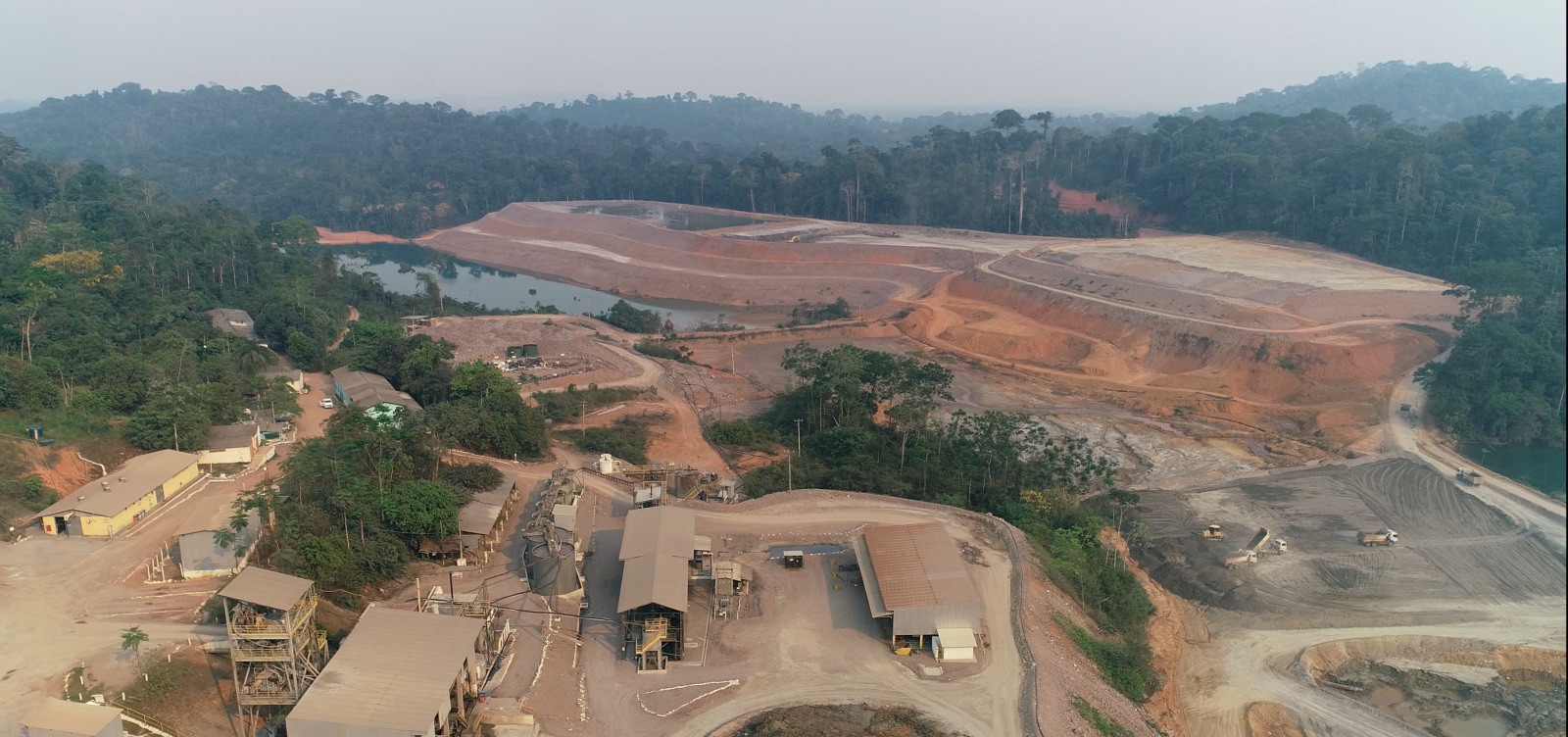
Serabi Gold (AIM: SRB | TSX: SBI | OTCQX: SRBIF) produces gold from the Palito Complex and the Coringa mine in Pará. Coringa has no stand-alone process plant: its ore is crushed and passed through ore sorting, which separates waste rock from ore, then hauled about 200 kilometers by road to Palito. Coringa's GUIA allows 100,000 tonnes (t) of ore a year to be transported to Palito, and it expires on January 29, 2027, or earlier if the annual tonnage limit is exceeded.
Chief Executive Officer of Serabi Gold, Mike Hodgson, traces the company's GUIA extensions to staffing at the agencies:
"You've known for a long time we've operated under temporary licenses called the GUIA license, and these have been extended, and they've had to be extended because the organizations aren't in a position to actually process your application through lack of manpower."
Serabi Gold's 2026 guidance of more than 53,000 ounces (oz) assumes that the ANM raises the GUIA to 200,000 t a year, or that the full mining concession is granted by the fourth quarter of 2026. Either would allow the company to move much more Coringa ore in the fourth quarter and to use Palito's fourth ball mill, which is soon to be commissioned. The board is currently confident the ANM will extend the GUIA term or tonnage limit shortly to avoid any temporary production interruption at Coringa, although there is no certainty yet on timing. Even if neither scenario happens and Coringa production is suspended, Serabi Gold's cash-flow forecasts show adequate resources to continue operating for the foreseeable future. The directors will limit discretionary spending when necessary to manage liquidity.
Looking back on leaner years, Hodgson contrasts them with the company's position under today's gold prices:
"And you're quite right with these heady gold prices there. It's a different world. And I remember the days when we had $1 or $2 million in the bank and hopefully never see them again."
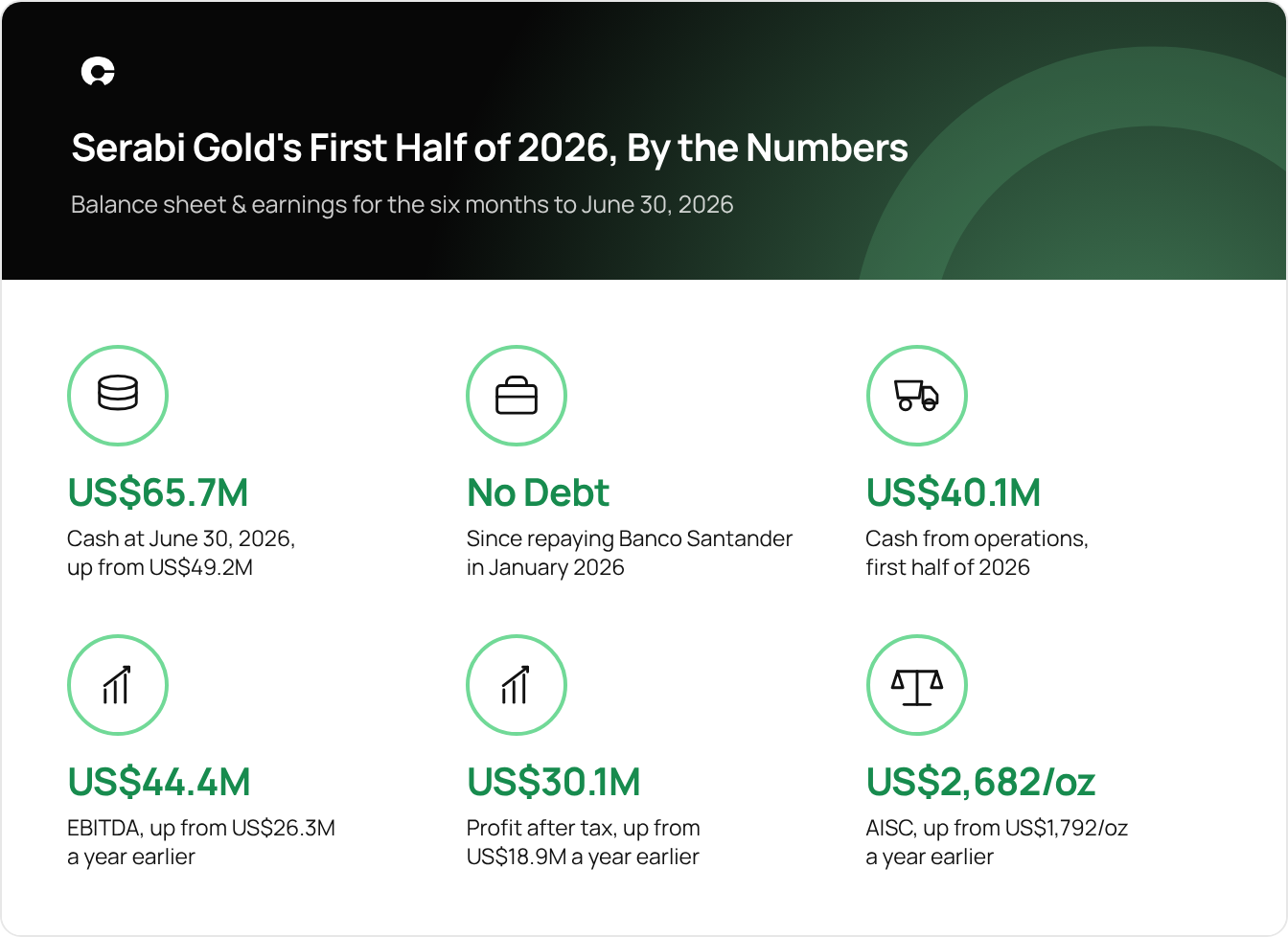
Cash stood at US$65.7 million as of June 30, 2026, up from US$49.2 million as of December 31, 2025, and the company has carried no debt since repaying Banco Santander in January 2026. Operations generated US$40.1 million in cash in the first half of 2026. Earnings before interest, taxes, depreciation, and amortization rose to US$44.4 million from US$26.3 million a year earlier, and profit after tax reached US$30.1 million against US$18.9 million. All-in sustaining cost climbed to US$2,682/oz from US$1,792/oz over the same periods. It was also higher than in the first quarter of 2026, largely because of the continued Coringa ramp-up and one-time general and administrative charges.
Federal & State Approvals in Pará
Coringa's permanent license now waits on 2 board decisions. The legal and technical departments of the Federal Agency for Indigenous Lands (FUNAI) recommend approval of the Indigenous Component Study, and only FUNAI's board remains. The Land Registry (INCRA) has technically and legally approved the change of land use from agriculture to mineral exploitation, pending a vote by its board.
Serabi Gold is targeting the fourth quarter of 2026 for both board approvals, after which SEMAS, Pará's state environmental agency, can issue the Operating License. Hodgson draws on his years in Pará to rank the relationships an operator depends on:
"What I've learned, particularly in Pará, your relationships at the state level are really the key relationships, not at the federal level. You solve your problems at the state level, absolutely."
Management says the state agencies call the shots, and that federal officials largely rubber-stamp their decisions.
Industry Outlook
Major miners are taking ground across the Tapajós in search of large discoveries.
At Coringa, a GUIA update is due in mid-October 2026 with Serabi Gold's third-quarter operational release, the FUNAI and INCRA board decisions are targeted for the fourth quarter of 2026, and the current GUIA expires on January 29, 2027.
Producers entering Pará can use the temporary route for early output, while the permanent license follows the agencies' own timetable.
FAQs (AI-Generated)
Analyst's Notes





Subscribe to Our Channel






Stay Informed






















