




Emperor Metals' Two Quebec Gold Projects, One AI-Built Resource Model


Emperor Metals (CSE:AUOZ) advances two Abitibi gold projects with a 1.46 Moz AI-modelled resource, trading at a steep discount to district peers.
- Duquesne West's maiden 2025 mineral resource estimate of 1.46 million ounces doubled the 2011 historical estimate of 727,000 ounces.
- The project is substantially under-drilled relative to peers, with approximately 140,000 metres completed versus the 600,000-700,000 metres comparable projects needed to reach similar ounce totals.
- Lac Pelletier offers near-term production optionality, with permits valid until 2030 and roughly C$70 million of prior infrastructure spend.
- Emperor Metals trades at a steep discount to Abitibi-region peers on a dollar-per-ounce-of-resource basis.
- The company is backed by strategic investors Rob McEwen, who holds 7%, and Rick Rule, who invested in 2025.
Gold explorers in Quebec's Abitibi Greenstone Belt have had a strong run as bullion prices have climbed, but few names remain as overlooked on a per-ounce basis as Emperor Metals. The company holds two advanced-stage projects along the prolific Porcupine-Destor Fault Zone (PDFZ), a structure that has produced more than 110 million ounces of gold historically, sitting between majors including Agnico Eagle and IAMGOLD. President and CEO John Florek, a geologist with 35 years across BHP, Placer Dome, Barrick, Teck and Detour Lake Gold, sat down to walk through why he believes the market hasn't caught up to what the company has built.
Emperor Overview
Emperor's flagship asset, Duquesne West, received a maiden inferred mineral resource estimate in July 2025 of 26.9 million tonnes at 1.69 grams per tonne gold for 1.46 million ounces, based on a $2,300 USD per ounce gold price. That figure is split between an 18.2 million tonne, 1.11 gram per tonne pit-constrained estimate of 0.646 million ounces, and an 8.7 million tonne, 2.92 gram per tonne out-of-pit estimate of 0.815 million ounces.
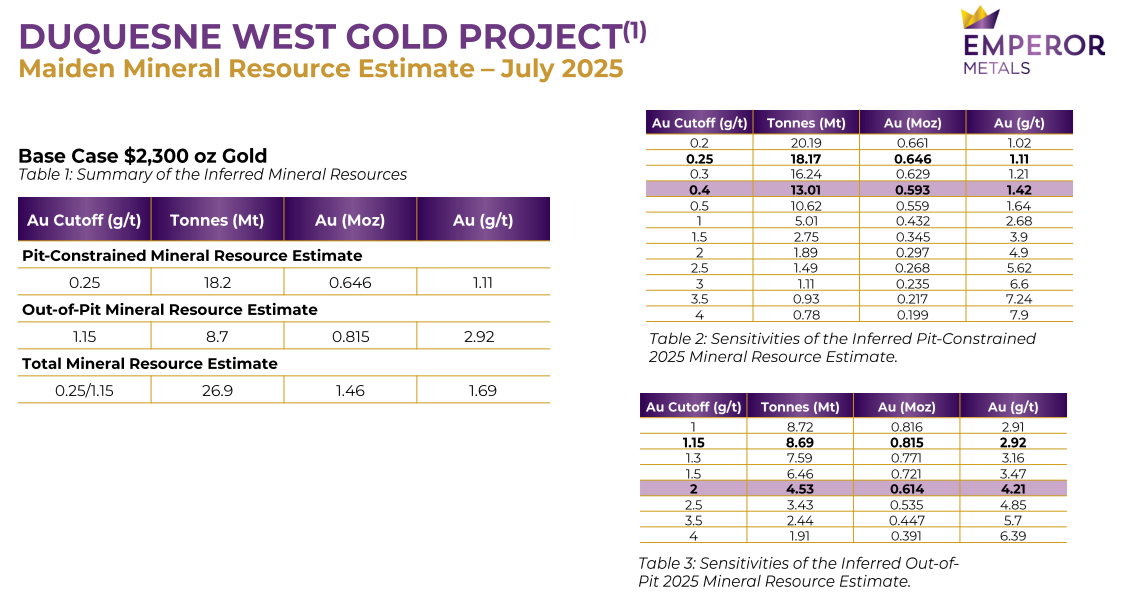
That resource has roughly doubled from a 2011 historical estimate of 727,000 ounces since Emperor took over as operator in 2022, a period during which the company says its all-in drilling cost has run between $200 and $250 per metre, which it describes as among the lowest 10% of costs in the jurisdiction. Florek says the deposit remains substantially under-drilled relative to its resource size.
"We're only at 140,000 metres. That's 15-20% of the amount of drilling that's needed for this project, and we're already at 1.5 million ounces. This just goes to show you the amount of leg room we have here to keep building ounces for this type of deposit."
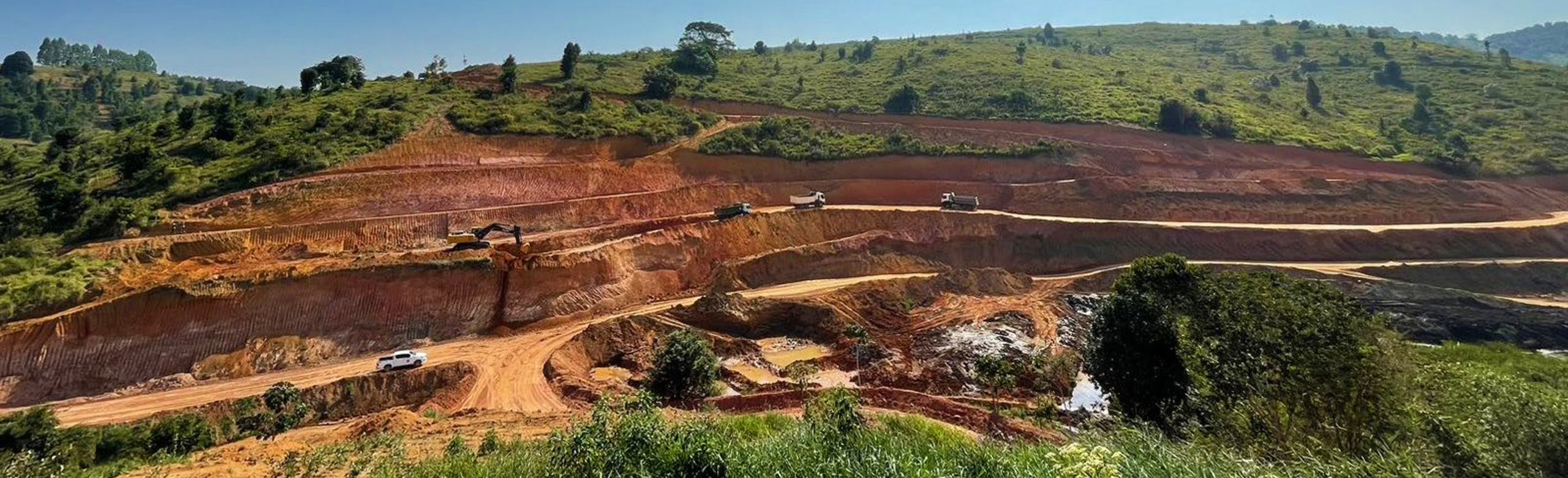
A conceptual open pit currently spans roughly 1.8 kilometres by 800 metres to a depth of 400 metres, with management targeting an eventual strike length of up to 3 kilometres. Bulk cyanide leach testwork on the deposit's replacement-style and porphyry-hosted mineralisation returned recoveries in the 90-94% range, with no deleterious elements identified to date. A 15,000 metre drill program is under way, alongside an 8,000 metre historical core re-sampling effort aimed at converting inferred ounces to indicated through duplicate drilling of decades-old holes.
Secondary asset: Lac Pelletier
Roughly 30 kilometres south, Lac Pelletier gives Emperor a distinct near-term production angle. The project carries a historical resource of 227,000 ounces at 3.9 grams per tonne gold, split between 89,400 ounces measured and indicated at 4.08 grams per tonne and 137,600 ounces inferred at 3.89 grams per tonne. Roughly C$70 million has been spent on the site historically, including more than 3.3 kilometres of underground development, a portal and a vent raise. Two bulk samples taken in 2009 and 2010 averaged 96.3% gold recovery. The project is permitted for production until 2030, and Emperor's next steps are to update the historical feasibility study and evaluate a production decision.
Interview with John Florek, President & CEO of Emperor Metals
AI-Assisted Geological Model
Emperor Metals has built its exploration strategy around AI-assisted geological modelling, an approach CEO John Florek says he developed while serving as chief geologist at Detour Lake Gold, where his team built sophisticated multi-element geochemical models to correct grade-control practices that had been sending ore to the waste dumps. He applied the same method before acquiring the Duquesne West claims, using AI to fully evaluate the deposit's potential prior to purchase. The payoff, according to Florek, was a "Eureka moment": Duquesne West had never had a 3D geological model built for it despite decades of historical drilling, and once Emperor's AI-driven modelling was applied, it revealed that the deposit's higher-grade underground lenses were surrounded by a much larger, lower-grade bulk-tonnage gold envelope suitable for open-pit mining - a scale of mineralisation earlier operators had missed.
"When I saw that it illuminated the opportunity for exploration potential and build, I picked them up. There was no 3D model. It just had a history. Old people came, they drilled and they left. But when we built the 3D models ... and saw the host rock also contained gold, we had something like 25 metres of 1.69 grams per tonne - that was our Eureka moment. These high-grade lenses are also encompassed by low-grade bulk tonnage gold."
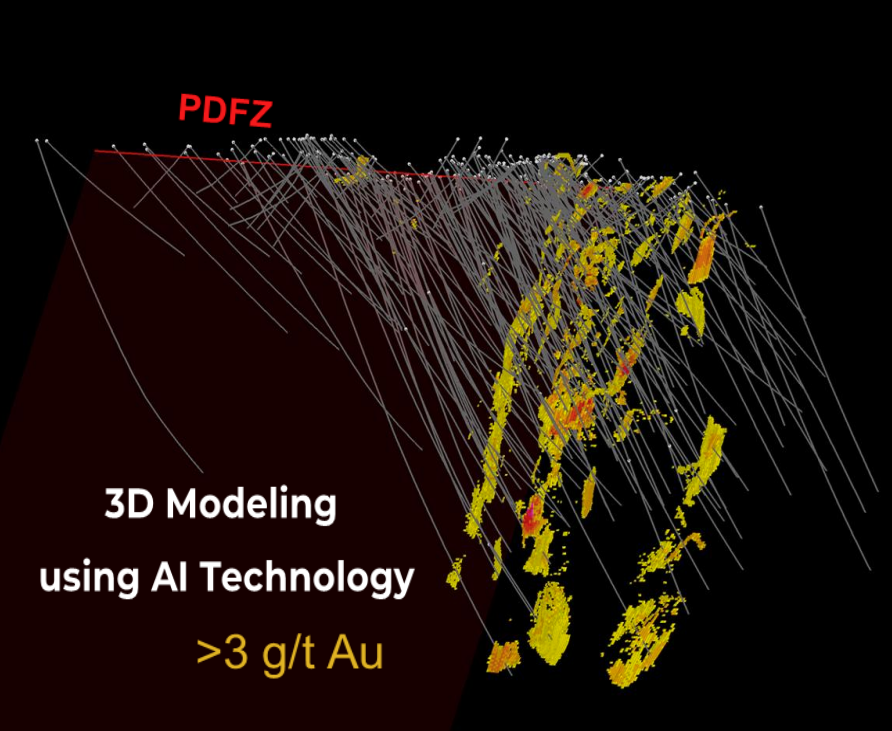
The company says it continues to use AI to build and refine its 3D models with each new round of drilling, feeding results back into targeting for the next campaign, and that this iterative process is central to how it identifies drill targets, defines minable stope shapes (using Inverse Distance Cubed grade estimation within AI-modelled grade shells), and prioritises where to expand the resource next.
Competitive positioning
Emperor sits within a cluster of Abitibi-focused developers and majors, bordering Agnico Eagle's Wasamac deposit and the past-producing Holloway mine near Duquesne West, and neighbouring Falco Resources' Horne 5 project and the historical Stadacona mine near Lac Pelletier. Management argues that proximity to under-utilised mills in the district could reduce the capital Emperor needs to spend building its own processing infrastructure, should either project advance toward production.
As of June 2026, Emperor Metals had 194,850,005 shares outstanding, 242,289,794 on a fully diluted basis, and an estimated C$5.4 million in working capital. Strategic investor Rob McEwen holds 7% of the company, and Rick Rule added a position in 2025. Public float and high-net-worth investors make up the bulk of the remaining register, with management holding 5.8%. Emperor Metals traded at a market capitalisation of C$39 million, roughly C$25.28 per ounce of gold in its resource.
Catalysts
Near-term catalysts include outstanding assay results from the current drill program, a further 30,000 to 50,000 metre drill campaign the company expects to launch around October 2026 pending financing, continued historical core re-sampling, and progress toward the roughly 2 million ounce threshold management says it wants to reach at Duquesne West before commissioning a preliminary economic assessment. At Lac Pelletier, an updated feasibility study is the next disclosed milestone.
The Investment Thesis for Emperor Metals
- Emperor trades at a steep discount to district peers on a $-per-ounce-in-resource basis, at roughly C$25 per ounce against C$225-$640 per ounce for comparable Abitibi explorers.
- The 1.46 million ounce inferred resource at Duquesne West has been defined from only about 140,000 metres of drilling, well below the 600,000-700,000 metres peers needed to reach similar ounce counts.
- A funded 15,000 metre drill program and 8,000 metre historical core re-sampling campaign are under way, with a further step-out program targeted for October 2026.
- Lac Pelletier adds near-term production optionality: permitted until 2030, backed by roughly C$70 million of prior infrastructure spend and two historical bulk samples averaging 96.3% recovery.
- Strategic backing from Rob McEwen and Rick Rule signals a level of external due diligence beyond management's own assessment.
- Watch for assay results from the current drill program, any conversion of inferred to indicated ounces via twin drilling, and an updated feasibility study at Lac Pelletier.
- Both resource estimates remain inferred or historical, and neither project has a production decision; this remains an exploration and de-risking story, not a producer.
Macro Thematic Analysis
Emperor's pitch leans heavily on artificial intelligence as a differentiator in exploration, an increasingly common claim in junior mining but one the company backs with a specific track record: the same AI-assisted modelling approach Florek built at Detour Lake Gold, described above, carried directly into his evaluation of Duquesne West before Emperor acquired it. That read - identifying a large-scale, lower-grade open-pit envelope surrounding higher-grade underground lenses that prior operators had missed since the 1940s - is the foundation of Emperor's growth story. Whether machine-learning-driven targeting translates into a faster, cheaper path to reserve-grade ounces than conventional methods is not yet proven at scale in the junior gold space, but it is a theme investors are likely to see more juniors lean on as computing costs fall and exploration budgets stay tight. For Emperor specifically, the approach sits alongside a more traditional tailwind: gold's rise from roughly $1,800 to above $4,300 per ounce since the company began assembling its land package, which management argues has not yet been reflected in its own valuation.
TL;DR
Emperor Metals holds two Abitibi Greenstone Belt gold projects: flagship Duquesne West, with a 1.46 million ounce inferred resource defined using AI-assisted geological modelling, and Lac Pelletier, a permitted near-term production candidate with C$70 million of historical infrastructure spend. Trading at roughly C$25 per ounce versus C$225-$640 for district peers, the company argues its resource is under-appreciated given it's been defined from a fraction of the drilling comparable projects required. Backed by Rob McEwen and Rick Rule, catalysts include ongoing drill results and a Lac Pelletier feasibility update.
FAQs (AI Generated)
Analyst's Notes





Subscribe to Our Channel

Stay Informed






















