




EV Sales Grow Just 4%, Yet Mine Supply Splits Critical Minerals



Copper holds near a five-year high on Chilean output cuts while nickel trades flat in surplus, as US-China talks on critical minerals set the near-term range.
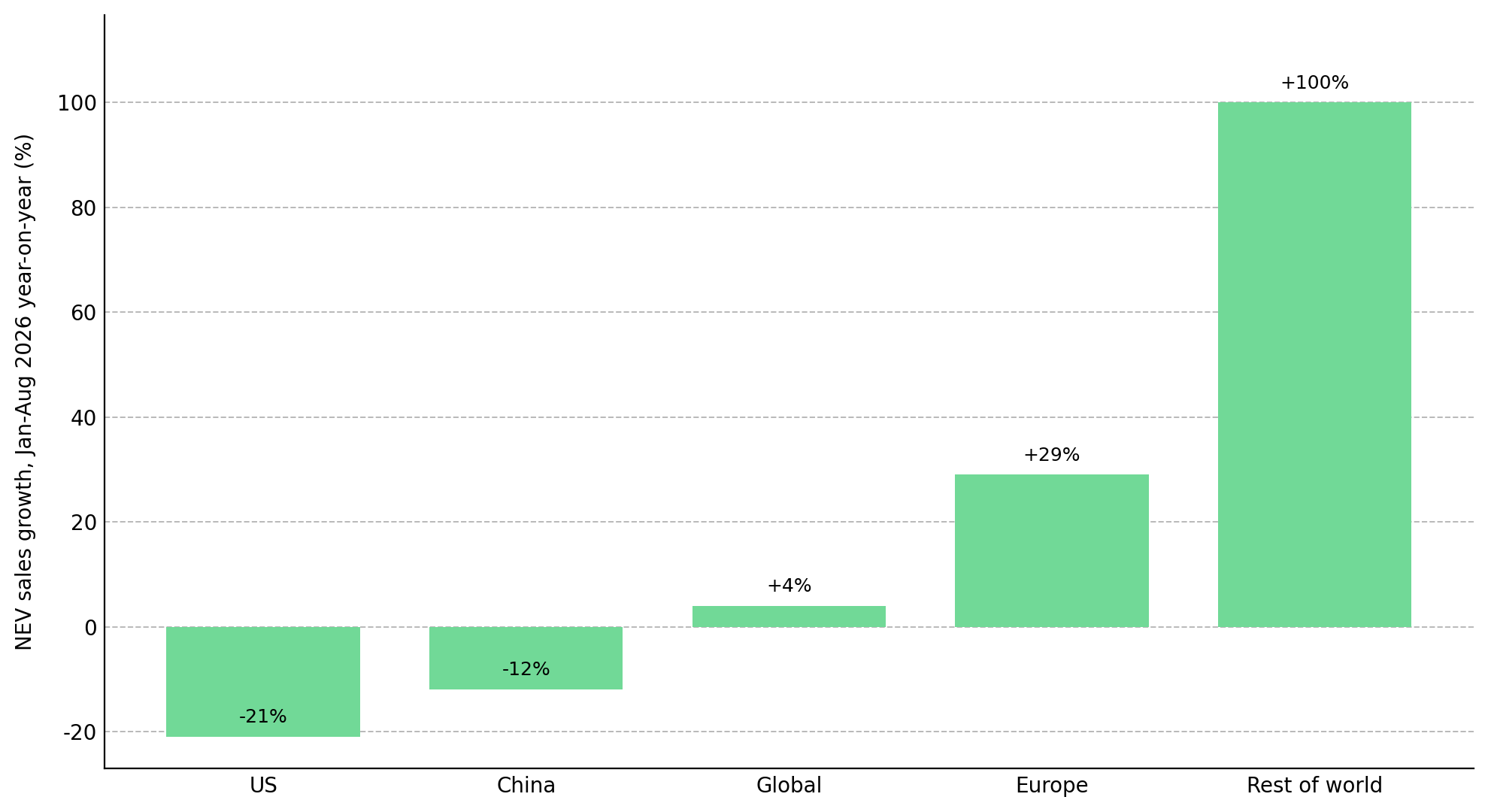
- Global NEV sales rose 4% year on year in January to August 2026, per Benchmark Mineral Intelligence via Reuters. Over the same period, US sales fell 21%, and China's fell 12%.
- Copper held at $14,529 per tonne, 2% below its five-year high. Chilean miners are targeting 2026 output 5% to 7% below guidance, and China refines 44% of global copper.
- Wood Mackenzie's oil-driven EV scenario adds only 2% to copper demand but it still lifts required new mine capacity from 850,000 to 960,000 tonnes per year.
- The 24 September Trump-Xi meeting on tariffs and critical minerals is binary. A truce weakens the US stockpiling bid, escalation widens the premium on non-Chinese supply, and neither outcome is knowable in advance.
Oil Shock Accelerates EV Sales Outside the US as Copper Holds Near Its Range High
Global new energy vehicle (NEV) sales (battery-electric and plug-in hybrid) rose 4% year-on-year in January to August 2026, per Reuters. US sales fell 21% after federal subsidies ended and China's fell 12%, while Europe grew 29% and the rest of the world doubled. Copper held at $14,529 per tonne against a five-year high of $14,850, per J.P. Morgan Asset Management, while Shanghai nickel traded flat at 123,920 yuan per tonne, per Shanghai Metals Market (SMM).
The 4% headline hides the supply consequence. Wood Mackenzie's "electric shock" scenario, driven by high oil prices, puts copper demand just 2% above a base case of 4% annual EV growth. Even so, it lifts required new mine capacity from a long-term average of 850,000 tonnes per year to 960,000 tonnes over 2025 to 2040.
Chilean Flood Cuts and China's Refining Share Keep Copper Supply Tight
The physical break sits in Chile, which supplies roughly 24% of mined copper and, with Peru, about 40%. After El Niño-related flooding, major Chilean miners are targeting 2026 output 5% to 7% below prior guidance, per Bloomberg Intelligence data. Replacement tonnes cannot arrive inside that window: ore grades are declining, and aluminum, the nearest substitute, carries about 61% of copper's conductivity.
China refines 44% of copper, 72% of lithium and 43% of nickel, per IEA. The US is responding with Project Vault, a $12 billion strategic critical mineral reserve. It is also weighing copper tariff escalation, which pulls US stockpiling forward as Chinese buyers compete for cargoes. Critical minerals sit on the agenda of US-China consultations in New York from 19 to 23 September, ahead of the Trump-Xi meeting.
US-China Critical Minerals Talks Set the Near-Term Range
A tariff truce would not add tonnes, because mine development sets the lag.
If talks yield a critical minerals truce, the US stockpiling bid weakens, and pricing rests on the Chilean supply gap alone, leaving copper as the only one of seven transition metals in projected 2030 deficit, per BloombergNEF. If tariffs escalate, pre-emptive US buying and Chinese competition for concentrate widen the premium on non-Chinese supply, and producing copper miners outside Chile's flood-affected regions capture price without adding volume.
The monthly signal is Chilean copper output from the National Statistics Institute (INE), published at month-end, tracking the guidance cut.
Battery Chemistry Shift Leaves Nickel in Surplus as Copper Producers Capture Pricing Power
Margin compression lands on wire, cable and transformer fabricators buying spot copper at $14,529 per tonne against earlier-priced sales contracts. Nickel producers sit outside the trade. Lithium iron phosphate (LFP), a cobalt- and nickel-free battery chemistry, holds the majority of battery deployment, and BloombergNEF places nickel in a 2030 surplus. LME nickel at $16,127 per tonne is 67% below its five-year peak, per J.P. Morgan Asset Management.
The Trump-Xi outcome is binary and unknowable in advance, which makes position size, not entry timing, the variable a retail holder of producing copper miners controls. Copper within 2% of its five-year high carries drawdown risk toward the $7,000 five-year low if the deficit case breaks.
Mine Capacity Limits Decide Which Critical Minerals Reprice
A demand shock prices through the metal whose supply cannot respond, not the one with the loudest demand story. EV sales barely grew in aggregate, yet copper held because mine capacity binds. Nickel absorbed the same oil shock without moving because surplus capacity and a chemistry shift sat between demand and price.
Producers hold the near-term advantage, selling operating tonnes into current prices, with China's refining share a pricing input in their valuations. Permitted copper developers scheduled to produce before 2030 sit closest to supplying the additional mine capacity required above the long-term build rate.
Analyst's Notes





Subscribe to Our Channel






Stay Informed


